Image source: wikiart.org
Introduction
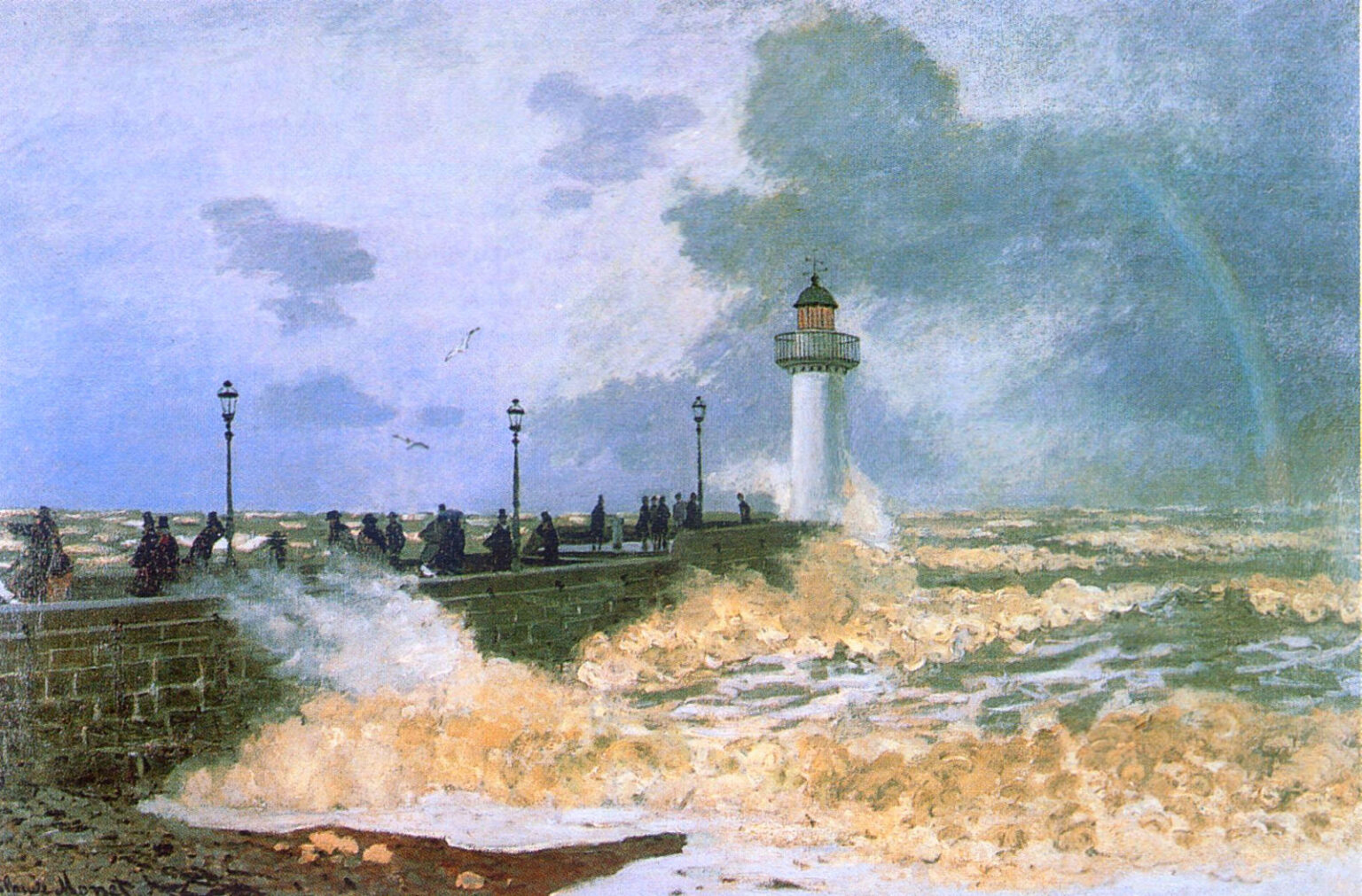
Claude Monet’s The Jetty at Le Havre from 1868 is a striking early marine painting that captures the unstable meeting point between land, sea, weather, and modern life. At first glance, the painting seems to offer a direct view of a stormy coast, with waves surging against a jetty and a lighthouse standing firm against a vast sky. Yet the more one looks, the more complex the image becomes. This is not simply a landscape or a harbor scene. It is a painting about force, atmosphere, perception, and human fragility in the face of nature.
The painting belongs to a formative period in Monet’s career, before Impressionism had fully defined itself as a movement, but already rich with the qualities that would later make him so important. The scene is rooted in observation, but it is not rendered with cold precision. Instead, it is built through fleeting effects of light, shifting color, and energetic brushwork. Monet is less interested in mapping every physical detail of Le Havre than in conveying the sensation of being there, feeling the wind, hearing the surf, and witnessing the drama of a storm at the coast.
Le Havre held deep significance for Monet. It was his birthplace and an essential visual source throughout his early life. The port, the sea, and the changing weather of the Normandy coast provided him with recurring motifs that helped shape his artistic language. In this painting, he transforms that familiar setting into a scene of turbulence and grandeur. The jetty becomes both a real structure and a symbolic threshold, a narrow strip of human order extending into the uncontrollable power of the sea.
The Overall Composition
One of the most compelling aspects of The Jetty at Le Havre is its carefully organized composition. The painting is structured around strong directional contrasts. The jetty juts outward into the sea, creating a diagonal line that leads the eye toward the lighthouse, which rises vertically near the center right of the canvas. This vertical form anchors the painting and serves as a visual counterweight to the restless waves and sweeping sky.
The arrangement of space is essential to the emotional effect of the work. Monet does not place the viewer at a comfortable distance. Instead, the churning water in the foreground pushes forward aggressively, as though it might spill beyond the edge of the picture. The shoreline and stonework at the lower left reinforce this feeling of immediacy. From there, the eye moves along the jetty, populated by small dark figures, toward the lighthouse and the crash of surf around it. Above all of this looms the vast sky, which occupies a large portion of the image and intensifies the sense of exposure.
This composition creates a vivid tension between control and instability. The jetty is geometric, man made, and firm in structure, but it appears vulnerable against the moving sea and sky. The figures on the pier are tiny and nearly silhouetted, reinforcing the scale of the natural forces around them. Monet balances these elements so that the painting feels dynamic without becoming chaotic. Every part contributes to a sense of drama held together by visual intelligence.
The Sea as Motion and Energy
The sea in this painting is not a passive setting. It is the active force that gives the picture its energy. Monet paints the water as a mass of movement, not as a flat surface. The waves rise, break, foam, and spread in layers of white, yellow, green, and gray. The result is not merely descriptive. It is expressive. The viewer feels the sea as a living, shifting body.
What is especially notable is Monet’s refusal to idealize the ocean. This is not a calm, picturesque harbor. The water is rough and disorderly. It surges against the jetty with visible power, producing spray and foam that seem to dissolve into the air. By treating the sea this way, Monet emphasizes nature’s unpredictability. The painting becomes less about maritime beauty in a traditional sense and more about the physical experience of weather and motion.
At the same time, the sea is painted with remarkable sensitivity to light. The foam is not simply white. It is touched with cream, pale gold, and muted lavender tones. These touches prevent the water from becoming monotonous and give it visual richness. The waves reflect the sky and the atmosphere, so the sea becomes part of a larger system of light and air. Monet sees water not as an isolated object but as a responsive surface constantly altered by its environment.
This treatment of the sea anticipates the later Impressionist fascination with transient effects. Monet is already exploring how to paint what cannot be fixed, how to suggest constant change through pigment and brushstroke. The sea in The Jetty at Le Havre is therefore central not only to the subject of the painting, but also to its artistic ambition.
The Sky and the Drama of Weather
The sky dominates the upper half of the painting and plays a decisive role in its mood. Rather than providing a neutral backdrop, it acts almost like a second sea above the horizon. Clouds swell and spread across the canvas in broad, atmospheric formations. They appear heavy, damp, and unstable, suggesting that the weather is in the midst of change. The sky does not merely hang over the scene. It presses upon it.
Monet’s handling of the clouds is particularly evocative. Instead of outlining them with academic precision, he shapes them through tonal variation and soft transitions. Gray, blue, pale violet, and greenish hues mingle across the sky, creating depth and movement. Some areas seem thick and storm laden, while others open into lighter passages that suggest shifting illumination. This makes the atmosphere feel alive and unsettled.
One of the most intriguing features of the painting is the faint rainbow arc visible on the right side of the sky. This detail introduces a note of surprise and subtle wonder. It suggests that the storm is not simply dark or destructive, but optically complex. The rainbow softens the violence of the scene without diminishing it. It reminds the viewer that harsh weather can also produce fleeting beauty, and that Monet is attentive to those passing visual events that traditional history painting often ignored.
The sky also helps dissolve clear boundaries between air and sea. Spray from the waves rises upward, and the low clouds seem almost to descend toward the horizon. The result is an atmosphere in which elements mix and overlap. Monet conveys not a stable world of separate objects, but an environment in which light, moisture, and motion blur distinctions. This is one of the painting’s most modern qualities.
The Lighthouse as a Visual and Symbolic Center
The lighthouse is the clearest vertical form in the composition and serves as a natural focal point. Its white cylindrical tower rises from the end of the jetty and stands against the darker mass of the sky. Because it is simple and bright, it immediately attracts the eye. It organizes the surrounding forms and gives the viewer a stable reference point amid the movement of water and cloud.
On a symbolic level, the lighthouse carries obvious associations with guidance, vigilance, and endurance. In a storm scene such as this, it becomes a marker of human effort to impose order on dangerous conditions. It is functional, but it is also almost heroic in the way Monet presents it. The waves break near it, the sky swirls around it, yet it remains upright and clear.
Still, Monet does not romanticize the lighthouse in an overly theatrical way. It is not isolated on a dramatic cliff, nor enlarged into a monumental emblem. Instead, it belongs to the ordinary working environment of a port city. This grounded treatment is important. The painting gains its power from the tension between the everyday and the sublime. The lighthouse is both a practical structure and a symbolic presence, both part of daily life and a sign of resistance against natural force.
Its whiteness also matters chromatically. The tower stands out against the cooler and darker colors around it, but it is not painted in a hard, flat manner. Monet modulates the white with soft shadows and warm notes, allowing it to participate in the atmospheric unity of the scene. Even this seemingly solid object is affected by light and weather.
Human Figures and the Experience of Scale
The figures scattered along the jetty are small, dark, and loosely defined, yet they are crucial to the painting. Without them, the scene would still be dramatic, but it would lose an important psychological dimension. Their presence gives the viewer a measure of scale and turns the image into a human encounter with the elements.
These figures are not individualized portraits. They appear almost as silhouettes, bundled forms gathered along the pier, walking, pausing, or watching the storm. Because Monet does not describe them in detail, they function collectively rather than personally. They represent human spectatorship, vulnerability, and resilience. They are ordinary people occupying a public place, and their dark forms stand out against the brighter surf and sky.
Their smallness is particularly significant. Monet uses scale to dramatize the scene without exaggerating it artificially. The waves seem larger because the people are there. The jetty seems longer and more exposed because it is occupied. The lighthouse seems sturdier because fragile bodies move beneath it. This relationship between human presence and natural scale deepens the emotional impact of the work.
There is also something quietly modern about these figures. They are not mythological sailors or heroic protagonists. They are urban or coastal residents inhabiting a contemporary environment. Their appearance reflects Monet’s broader interest in modern life, even in landscapes. The painting is not detached from society. It shows people engaging with a modern maritime world shaped by infrastructure, weather, and observation.
Color and Tonal Harmony
The color palette of The Jetty at Le Havre is restrained but extremely sophisticated. Monet does not rely on intense contrasts of pure color. Instead, he builds the image from related tonal families, cool blues, sea greens, grays, creams, and muted golds. This limited palette strengthens the atmospheric unity of the scene and prevents any one area from feeling separate from the rest.
The most striking color relationship is between the cool storm tones and the warmer foam of the waves. The sea and sky lean toward blue, gray, and green, while the breaking surf is infused with beige, yellow, and off white highlights. This warmth in the foam gives the water luminosity and makes it appear thick and active. It also keeps the painting from becoming visually cold or monochromatic.
Monet’s use of color is responsive rather than formulaic. He paints according to what light does to surfaces. The waves pick up golden tones where they catch illumination. The clouds shift from bluish violet to greenish gray as the atmosphere changes. The stone jetty is dark but not dead, carrying subtle variations that tie it into the larger palette. Nothing is merely local color. Everything is seen through weather.
This approach reveals Monet’s growing commitment to direct visual perception. He is moving away from the studio conventions of fixed color and toward a more empirical, immediate understanding of nature. Yet the painting remains highly composed. The color feels natural, but it is also orchestrated with care. The harmony of the palette allows the whole work to breathe as a unified atmospheric field.
Brushwork and the Early Language of Impressionism
Although this painting predates the first Impressionist exhibition, it already demonstrates many of the painterly qualities associated with Monet’s mature style. The brushwork is varied, responsive, and visible. It does not disappear into a polished illusion. Instead, it remains active on the surface, reminding the viewer that the painting is a record of looking and making.
In the sky, Monet uses broad, soft applications of paint to suggest the spread of clouds and moisture. In the sea, the brushwork becomes more animated, broken, and directional, following the movement of waves and foam. Along the jetty and in the figures, darker, firmer touches provide structure and contrast. This variation of handling helps organize the image while preserving its vitality.
What makes this especially important is that the brushwork serves sensation rather than finish. Monet is not trying to conceal the act of painting. He is using paint to suggest instability, atmosphere, and fleeting visual effects. The viewer can sense the speed and confidence with which certain areas were laid in, particularly in the spray, cloud, and surf. This gives the work immediacy.
At the same time, the painting is not as radically fragmented as some of Monet’s later canvases. There is still a strong sense of form and a degree of solidity in the lighthouse, jetty, and horizon line. This makes The Jetty at Le Havre especially interesting historically. It occupies a transitional space, balancing realism and atmospheric freedom, structure and sensation. It shows Monet discovering how far painting could move away from strict finish while still remaining legible and powerful.
Le Havre, Modernity, and Maritime Life
Le Havre was not only Monet’s hometown, but also an important modern port. That context matters for understanding the painting. This is a coastal scene, but it is also a scene of infrastructure and urban connection. The jetty, lighthouse, and promenade lamps indicate a built environment shaped by commerce, navigation, and public life. Monet is painting nature, but he is painting nature as encountered in a modern port city.
This distinguishes the work from more traditional seascapes that focus solely on ships, fishermen, or romantic shorelines. Here, the emphasis is on the meeting point of natural spectacle and civic structure. The jetty is a public place. The figures appear to be onlookers as much as workers. The lighthouse is part of an organized maritime system. This setting gives the image a contemporary character rooted in lived experience.
Monet’s interest in such subjects reflects a broader shift in nineteenth century painting. Artists increasingly turned toward modern environments, not just historical or idealized ones. Even when painting nature, they did so within the context of current life. In The Jetty at Le Havre, modernity is not presented through factories or trains, but through coastal engineering, public space, and the rhythms of a port.
Yet Monet does not make the painting feel industrial or mechanical. The human structures are present, but they do not dominate the visual experience. Instead, they become part of a larger dialogue with weather and light. This balance is one of the painting’s strengths. It acknowledges modern life without sacrificing the emotional and sensory richness of the natural world.
Emotion, Atmosphere, and the Sublime
One reason this painting remains so compelling is that it carries a strong emotional charge without resorting to melodrama. The mood is intense, but it is not overdone. Monet achieves this through atmosphere rather than narrative. There is no obvious story unfolding, no shipwreck, no rescue, no heroic action. Instead, the drama comes from perception itself, from the feeling of standing before a sea in upheaval.
This gives the work a subtle relationship to the idea of the sublime, the experience of awe mixed with instability or fear in the presence of overwhelming natural power. The huge sky, the crashing surf, and the smallness of the figures all contribute to that effect. Yet Monet modernizes the sublime by locating it in an everyday public setting. The viewer does not need a mountain precipice or ancient ruin to feel awe. A jetty in a working harbor can produce the same sensation when seen under the right conditions.
The emotional atmosphere is also enriched by ambiguity. The scene is turbulent, but not hopeless. The rainbow suggests passing light. The lighthouse stands firm. The figures remain present. There is danger, but also continuity. This balance prevents the painting from becoming merely bleak. It recognizes nature’s violence while also finding beauty and structure within it.
That emotional complexity is one of Monet’s gifts as an artist. He is not simply recording appearances. He is translating them into mood. The painting invites the viewer to feel wind, dampness, motion, and exposure, but also wonder, attention, and visual pleasure. Its atmosphere is immersive, and that is why it lingers in memory.
Conclusion
The Jetty at Le Havre is one of Claude Monet’s most impressive early marine paintings because it unites observation, atmosphere, and painterly freedom in a remarkably assured way. It captures a specific place, yet it reaches beyond topography. It shows a stormy coastal scene, yet it is equally a meditation on modern life, natural force, and the act of seeing.
The composition is strong and deliberate, organized around the diagonal of the jetty and the upright presence of the lighthouse. The sea is painted as motion itself, energetic and unstable. The sky expands the drama through shifting clouds and subtle light. The figures, though small, provide human scale and emotional resonance. The color palette is restrained but luminous, and the brushwork reveals Monet’s growing confidence in painting transient effects directly.
What makes the painting especially important is its position within Monet’s development. It still retains a degree of structural clarity associated with earlier realism, yet it already points toward the Impressionist concern with atmosphere, immediacy, and sensation. It stands at a threshold, much like the jetty it depicts, extending from established tradition into a new vision of painting.
Above all, The Jetty at Le Havre demonstrates Monet’s ability to turn an ordinary location into a scene of profound visual and emotional richness. He finds grandeur in a public pier, poetry in storm light, and beauty in instability. The painting reminds us that modern life and natural drama are not opposites. In Monet’s hands, they meet in a single charged image, filled with motion, weather, and light.
