Image source: wikiart.org
Introduction
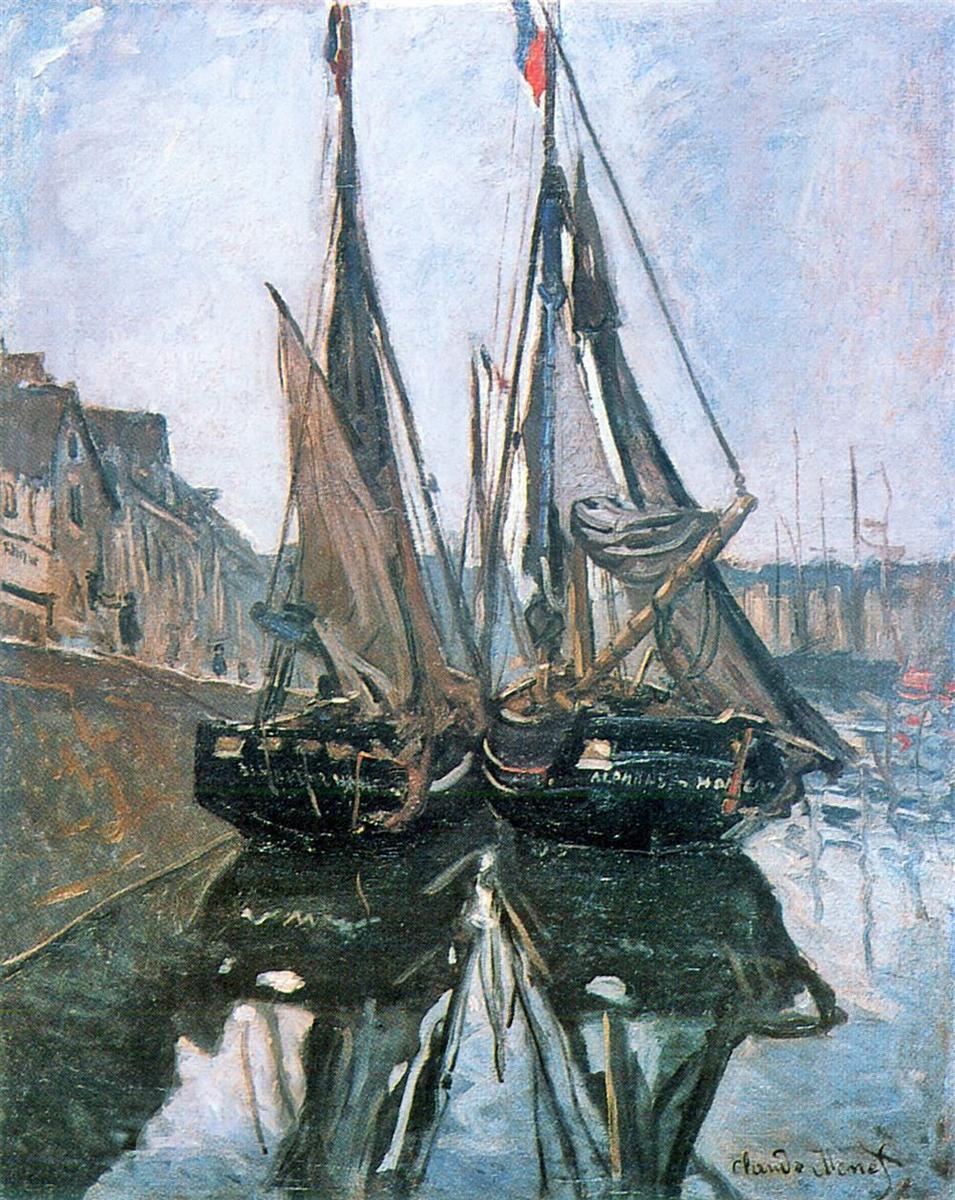
Claude Monet’s Fishing Boats at Honfleur from 1868 is a quiet but deeply revealing work from the early phase of his career. At first glance, the painting seems modest in subject. Two boats rest in still water near the harbor edge, their masts rising sharply into a pale sky while the town and distant vessels fade into a cool haze. Nothing dramatic appears to happen. There is no storm, no theatrical sunset, no grand narrative. Yet this apparent simplicity is exactly what gives the painting its strength. Monet turns an ordinary harbor scene into a study of light, atmosphere, reflection, and visual sensation.
This painting belongs to a crucial moment in Monet’s artistic development, when he was moving away from conventional finish and toward a more immediate response to the visible world. Honfleur, a port town in Normandy, offered him an ideal subject. Its waterfront, changing weather, and busy but often quiet maritime life gave him endless opportunities to study how water, sky, and man made structures interact. In Fishing Boats at Honfleur, Monet does not simply record boats in a harbor. He explores how forms dissolve into air, how reflections stretch and tremble on water, and how a familiar place can become poetic through close observation.
The painting also shows how early Monet already possessed many of the qualities that would later define Impressionism. The interest in transient light, the broken treatment of surfaces, the reduced emphasis on polished drawing, and the sense that the scene was captured from lived experience are all present here. At the same time, the work retains a certain solidity and structure that connect it to the realism of the 1860s. This tension between observation and atmosphere makes the painting especially compelling.
The Harbor as Subject
Harbors had long attracted painters because they combine natural and human elements in rich and varied ways. Boats, masts, ropes, stone embankments, water, buildings, smoke, sky, and cloud all create a layered visual field. For Monet, the harbor at Honfleur was more than a picturesque setting. It was a place where the visible world was in constant transformation. Water reflected everything but never with exact permanence. Weather shifted rapidly. Sails could appear heavy and opaque in one moment, then luminous in another. Masts cut vertical lines against the sky, while reflections created downward echoes of those same forms.
In this painting, Monet selects a scene that is intimate rather than panoramic. Instead of offering a wide view of the port, he brings the viewer close to two moored fishing boats. Their presence dominates the composition, making them the central actors in the scene. Yet these are not heroic ships. They are working vessels, ordinary and practical. By choosing them, Monet gives dignity to everyday maritime life. He does not romanticize labor through anecdote or staged action. Instead, he lets the boats themselves carry the visual interest through their shapes, surfaces, and relation to the water.
The town appears to the left as a muted row of buildings along the quay. It does not overwhelm the painting. Rather, it provides a contextual anchor, reminding us that the harbor is a lived space where commerce, labor, and daily life unfold. In the distance, more boats and masts become increasingly faint, almost ghostlike. This gradual loss of detail draws attention to the moist atmosphere of the port and deepens the sense of spatial recession.
Composition and Structure
One of the most striking aspects of Fishing Boats at Honfleur is its compositional organization. The two central boats occupy the foreground and middle ground with remarkable force. Their dark hulls sit low on the water, creating a horizontal base, while their masts thrust upward in strong vertical lines. This combination of horizontal and vertical movement gives the painting its stability. The boats feel anchored, but the masts carry the eye upward and outward, opening the composition toward the pale sky.
The placement of the boats is slightly asymmetrical, which keeps the image from feeling rigid. They are close enough to be read as a pair, yet distinct enough to maintain individuality. The boat on the right is especially prominent, its hull showing visible lettering that adds specificity and material reality. The sails and rigging create diagonal accents, softening the strict verticality of the masts and introducing a sense of visual complexity. These diagonals also guide the eye through the composition, linking the upper part of the painting to the reflections below.
The left side of the painting is anchored by the harbor wall and row of buildings. This section introduces a receding diagonal that leads the eye inward toward the distant boats and the open harbor space. Without this architectural edge, the composition might feel too centered on the boats alone. Instead, the quay gives the scene structure and perspective. It also balances the openness of the water on the right side.
Perhaps the most beautiful compositional device is the reflection. The mirrored image of the boats extends downward into the lower half of the painting, effectively doubling the visual rhythm of the masts and sails. These reflections are not exact copies. They are elongated, softened, and broken by the movement of the water. As a result, the lower half of the painting feels both stable and fluid. Monet uses reflection not only as a natural phenomenon but also as a formal tool, enriching the design and deepening the viewer’s engagement.
Light, Atmosphere, and Mood
This painting is less about bright sunlight than about atmospheric diffusion. The light is gentle, cool, and veiled. The sky does not blaze with dramatic color. Instead, it is filled with pale blue gray tones that suggest either early morning, late afternoon, or an overcast maritime day. This subdued illumination creates a contemplative mood. It is not a scene of energetic bustle but one of pause and quiet presence.
Monet’s real subject may be the air itself. The harbor appears wrapped in moisture, and distant objects lose clarity as they recede. This softening effect is especially visible in the background, where masts and boats emerge through haze rather than precise drawing. The atmosphere unifies the scene, binding boats, buildings, sky, and water together into a single visual envelope.
The mood of the painting is one of stillness, but not emptiness. The harbor feels inhabited even when few figures are visible. One senses the routines of maritime life just beyond the moment depicted. The boats are moored, their sails partly gathered, their work perhaps paused. This calm interval gives the scene a reflective quality. It feels like a moment between actions, when the visible world can be observed without distraction.
Monet avoids melodrama. There is no effort to turn the harbor into a sentimental image of rustic life or a grand symbol of modern industry. Instead, he allows quiet visual facts to produce emotion. The mood comes from the hush of the water, the muted palette, the softened forms, and the sense of temporary stillness. This restraint is one of the painting’s greatest achievements.
Color and Tonal Harmony
The color scheme of Fishing Boats at Honfleur is restrained but highly effective. Monet relies on cool blues, grays, muted browns, deep blacks, and touches of subdued earth tones. This limited range creates tonal harmony and supports the atmospheric mood of the work. Rather than using vivid color contrasts, he builds the painting through subtle relationships of light and dark.
The sky is composed of pale, cool hues that set the emotional key of the painting. These tones are echoed in the water, where blue gray passages mix with darker reflections and milky highlights. The water is especially rich because it contains both the color of the sky and the dark mass of the boats. This interplay between cool openness and dense shadow gives the lower half of the canvas a remarkable visual depth.
The boats themselves provide the strongest dark accents. Their hulls are painted in deep, almost black tones, but these blacks are not empty or flat. They contain nuances of green, brown, and blue that keep them alive. Against the pale water and sky, these dark forms become powerful anchors. The sails are quieter in color, with muted browns, creams, and grays that blend naturally into the surrounding atmosphere.
Small touches of warmer color in the quay and buildings prevent the painting from becoming too cold. These earthy notes suggest stone, wood, and weathered architecture. They also help distinguish the built environment from the watery openness of the harbor. Even the tiny flag near the top of one mast adds a brief accent that catches the eye and animates the upper part of the composition.
What makes the color so successful is Monet’s refusal to isolate objects with arbitrary local color. He treats every surface as affected by light, air, and surrounding tones. The result is a unified chromatic field in which each element belongs to the same atmospheric reality.
Brushwork and Surface
Although Fishing Boats at Honfleur predates the fully developed Impressionist style of the 1870s, Monet’s brushwork already reveals a strong commitment to immediacy. He does not labor over minute detail in the academic manner. Instead, he uses visible strokes to suggest forms, textures, and changing light. The surface of the painting feels alive because it records the artist’s response rather than hiding it.
In the water, the brushwork becomes especially expressive. Reflections are rendered with downward strokes and broken passages that capture their instability. Monet does not attempt a polished mirror effect. He understands that reflections on harbor water are stretched, interrupted, and constantly shifting. By allowing the paint handling to remain somewhat loose, he conveys that instability more convincingly than a highly finished approach would.
The sails and rigging show an interesting balance between structure and freedom. The masts are clearly established, but the sails are treated with softer, more suggestive strokes. This contrast reinforces the difference between firm constructed forms and flexible fabric responding to air and gravity. The buildings on the left are also painted with economy. They do not need precise architectural detail to be legible. Their mass and recession are enough.
This approach to brushwork is central to Monet’s modernity. He paints not just what things are, but how they appear in a given moment. The surface of the painting becomes a record of perception. Viewers are invited to participate in the act of seeing, piecing together forms from strokes, tones, and relationships rather than consuming a fully closed illusion.
Honfleur and Monet’s Early Development
Honfleur was an important place for Monet in his youth and early maturity. Located on the Normandy coast, it was associated with marine painting and with artists interested in direct observation of nature. The region had already attracted painters such as Eugène Boudin, whose influence on Monet was profound. Boudin encouraged him to work outdoors and to look closely at sky and atmosphere. That lesson echoes throughout Fishing Boats at Honfleur.
In 1868, Monet was still establishing himself. He had not yet become the central figure of Impressionism that art history now recognizes. His work from this period often reveals a dialogue between realism, landscape painting, and a new search for fleeting visual truth. In Fishing Boats at Honfleur, one can sense both discipline and experimentation. The composition is well organized, the forms are intelligible, and the subject is grounded in ordinary reality. Yet the handling of atmosphere, reflection, and light points clearly toward a more radical artistic future.
This makes the painting historically significant within Monet’s career. It shows an artist learning how to make sensation the foundation of pictorial structure. Instead of using atmosphere merely as a background effect, he lets it shape the entire scene. The harbor becomes less a collection of separate objects and more a unified field of light, water, and air.
The painting also reflects Monet’s growing interest in repeated modern subjects. Harbors, rivers, bridges, stations, and coastlines would become central to his art because they allowed him to study variation. A fishing boat is never just a fishing boat in Monet. It becomes a surface for light, a silhouette against sky, a source of reflection, a marker of human presence within nature.
The Poetry of Reflection
Reflection is one of the defining motifs in this painting, and it deserves special attention. Water in art often functions as a mirror, but Monet treats reflection as something more subtle and unstable. The mirrored masts and hulls below the boats are elongated and distorted, breaking apart as they descend into darker water. This creates a poetic doubling of the visible world. The harbor exists both above and below, in solid form and liquid echo.
These reflections increase the contemplative power of the painting. They slow the viewer down. Instead of reading the composition only from top to bottom or left to right, the eye lingers on the correspondence between object and image, between material reality and fleeting appearance. Reflection becomes a metaphor for perception itself. What we see is never fixed. It trembles, shifts, and depends on conditions.
Monet also uses reflection to deepen the emotional tone of the scene. The mirrored boats feel slightly melancholy, not in a tragic sense but in a quiet, introspective one. Their downward forms seem to dissolve into darkness and cool light, suggesting the fragile nature of visual experience. The harbor is present, yet already vanishing into atmosphere and water.
This attention to reflection would remain central throughout Monet’s career, later reaching extraordinary heights in his river scenes, his views of the Seine, and eventually the water lily paintings. In Fishing Boats at Honfleur, we see an early but already sophisticated understanding that water can transform the world into something both more beautiful and less certain.
Realism and Impressionist Sensibility
One reason this painting is so appealing is that it stands between two artistic worlds. On one side is realism, with its commitment to everyday subject matter, direct observation, and unsentimental truth. On the other is the emerging Impressionist sensibility, with its concern for transient light, atmospheric unity, and the fragmentary nature of perception.
The boats are real boats in a real harbor. The town is recognizably constructed space. The scene is grounded in ordinary life rather than mythology or literary narrative. This is the realist dimension of the painting. Yet the way Monet sees this world is already different from strict realism. He does not isolate each object with sharp contour and descriptive precision. He lets edges soften, forms blur in distance, and reflections distort the supposed solidity of things.
This balance is what gives the painting its richness. It is not yet the sparkling broken color of full Impressionism, but neither is it a conventionally finished harbor scene. It is transitional in the best sense. It shows an artist discovering that truth in painting can come from the impression of a moment rather than from exhaustive detail.
For modern viewers, this quality makes the work feel intimate and fresh. It allows us to witness Monet’s artistic thinking in motion. We see him trusting the eye more than inherited formulas, trusting atmosphere more than hard outline, and trusting the poetry of ordinary life.
Lasting Appeal of the Painting
Fishing Boats at Honfleur endures because it transforms a humble scene into an image of remarkable quiet beauty. Its appeal lies not in spectacle but in sensitivity. Monet shows how much visual richness exists in a small harbor moment, in still water, muted weather, and working boats at rest. He asks us to look patiently, and the longer we look, the more the painting reveals.
The work also remains compelling because it captures a tension that many viewers instinctively feel: the desire for stability in a world of flux. The boats are moored, but their reflections move. The town stands firm, but the atmosphere softens it. The composition is structured, but the brushwork is alive and open. Everything in the painting exists between permanence and change. That is part of what makes it feel so true to lived experience.
Within Monet’s career, the painting offers a valuable glimpse of the artist before the most famous achievements of Impressionism, yet already unmistakably himself. His fascination with light, weather, water, and perception is fully present. The seeds of later masterpieces are here, but the painting has its own independent charm. It is quieter, more restrained, and perhaps more intimate than many of his later works.
Ultimately, Fishing Boats at Honfleur is a painting about seeing. It invites us to notice subtle tonal shifts, the geometry of masts, the softness of haze, and the fragile beauty of reflections. Monet turns a working harbor into a meditation on atmosphere and perception, proving that modern painting could find profundity in the most ordinary places.
