Image source: wikiart.org
Introduction
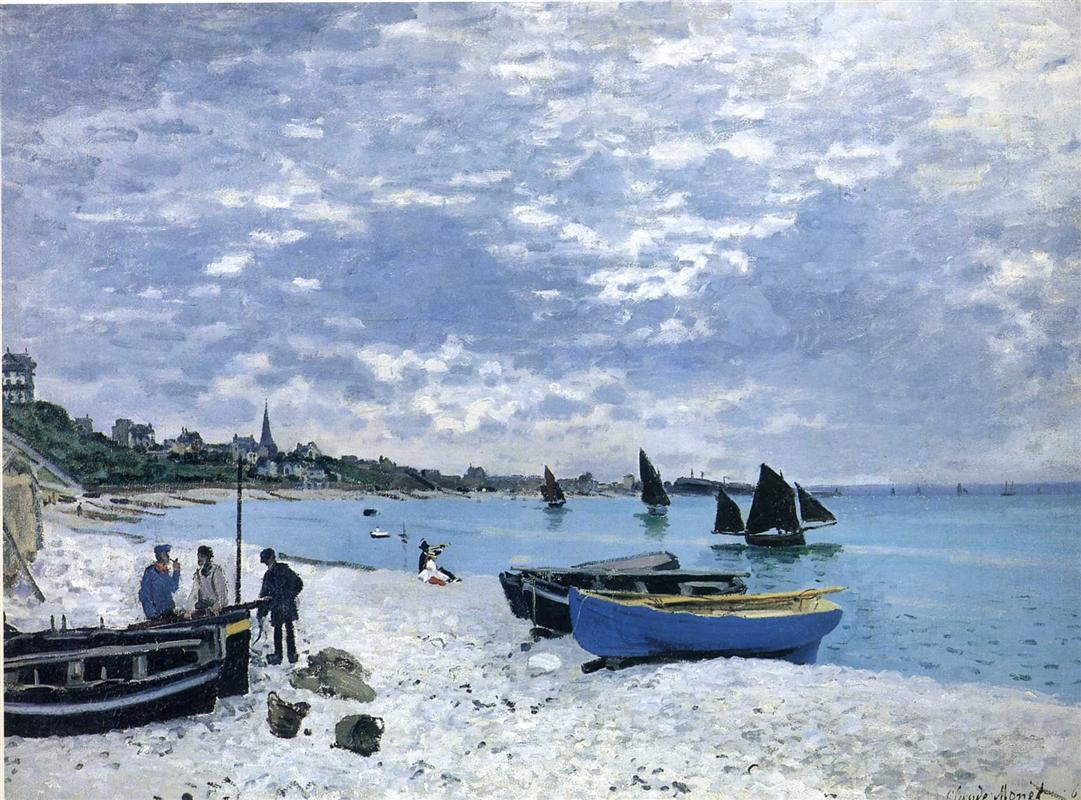
Claude Monet’s The Beach at Sainte-Adresse from 1867 is one of those paintings that seems quiet at first glance but becomes richer the longer you study it. On the surface, it presents a calm shoreline, a wide expanse of sky, a few boats, and a handful of figures gathered near the water. Nothing dramatic appears to happen. Yet this apparent simplicity is exactly what gives the painting its power. Monet transforms an ordinary coastal view into something luminous, spacious, and deeply modern. He is not telling a story in the traditional academic sense. Instead, he is capturing an experience of place: the brightness of the beach, the shifting air above the water, the measured rhythm of boats near shore, and the stillness that can exist even within a living landscape.
Painted in Sainte-Adresse, near Le Havre in Normandy, this work belongs to an important moment in Monet’s early development. He was still a young painter in the 1860s, but he was already moving away from highly finished studio painting toward a direct and immediate response to the visible world. In this canvas, the beach is not idealized into a timeless classical setting, nor is it turned into a moral lesson or historical drama. It is simply observed, but observed with exceptional sensitivity. Monet makes light, atmosphere, and color the real subjects of the work.
What makes The Beach at Sainte-Adresse so compelling is the balance it strikes between structure and spontaneity. The composition is carefully organized, but it never feels rigid. The colors are restrained, yet they vibrate through subtle variation. The brushwork remains lively, but the whole image feels coherent and calm. This combination helps explain why Monet became such a central figure in modern art. Even before Impressionism was fully named and defined, paintings like this one show him discovering a new way of seeing.
Historical Context and Monet in 1867
By 1867, Monet was in his mid twenties and already committed to painting contemporary life and natural light. This period was difficult for him personally and financially, but artistically it was formative. He had studied the effects of outdoor painting, learned from artists such as Eugène Boudin and Johan Barthold Jongkind, and absorbed the lessons of Realism while pushing beyond them. He was not interested in reproducing nature with polished exactitude. He wanted to paint what it felt like to stand before a scene at a given moment.
Sainte-Adresse was especially meaningful for Monet because it was associated with family connections and with the Normandy coast he knew well. The region offered him changing skies, reflective water, and a mix of leisure, labor, and marine activity. It was an ideal place for a painter interested in fleeting visual effects. In this setting, Monet could observe not only the sea and sky but also modern coastal life, with its boats, promenades, beaches, and seasonal visitors.
This painting comes before the first Impressionist exhibition of 1874, yet it already contains many qualities that would later define the movement. There is an emphasis on natural light, a refusal of heavy historical subject matter, and a preference for visible brushwork over academic finish. At the same time, The Beach at Sainte-Adresse still shows a certain clarity of arrangement that ties it to earlier traditions. It is not a chaotic or radically fragmented image. Rather, it reveals a painter who is finding a new visual language while still maintaining strong compositional discipline.
That tension makes the work especially interesting. It is not simply an early Impressionist picture in a rough, transitional sense. It is a confident painting in its own right, one that demonstrates Monet’s ability to turn a modest seaside view into a fully realized work of art.
The Setting of Sainte-Adresse
The beach at Sainte-Adresse is not presented as a wild, untouched shore. It is a lived and inhabited place, where people gather, work, rest, and observe the sea. Monet includes signs of settlement in the distance, with buildings and a church spire rising along the shoreline. This detail matters because it reminds us that the painting is not about nature in isolation. It is about the meeting of land, sea, sky, and human presence.
The setting also carries a distinctive social mood. Unlike stormy marine paintings that emphasize danger or heroic struggle, this beach feels open, familiar, and accessible. The boats are close to shore, the sea is relatively calm, and the figures seem at ease. Even though the scene is contemporary, Monet avoids turning it into anecdotal genre painting. He does not ask the viewer to focus on a specific narrative involving the people on the beach. Instead, they are part of the total atmosphere of the place.
This attention to the character of Sainte-Adresse helps ground the painting in the modern world. Monet is not inventing an imaginary coast. He is painting a recognizable location, and that specificity gives the work authenticity. Yet the painting also transcends local description. The broad sky, cool palette, and quiet spatial depth make it feel universal. Many viewers can recognize in it the emotional texture of a seaside morning or afternoon: the brightness, the breeze, the sense of looking outward toward open water.
In that sense, Sainte-Adresse becomes both a real place and a poetic one. Monet does not separate observation from feeling. The painting is descriptive, but it is also meditative.
Composition and Spatial Design
One of the strongest features of The Beach at Sainte-Adresse is its compositional clarity. Monet divides the canvas into distinct but interconnected zones: the broad sky above, the calm band of sea across the middle, and the pale beach in the foreground. This structure creates an immediate sense of stability. The viewer can read the image easily, but within that simplicity Monet introduces enough variation to keep the composition alive.
The horizon line sits relatively high, allowing the sky to dominate much of the painting while still giving substantial presence to the beach. This is an important choice. It creates a feeling of openness, yet the foreground remains tangible and immediate. The eye moves from the textured stones and boats nearby into the still water and then outward toward the distant coastline and sails. The result is depth without theatrical exaggeration.
The placement of the boats is especially effective. Large dark and blue boats in the foreground anchor the lower portion of the composition. Farther out, the sailboats punctuate the sea with triangular dark shapes that rhythmically lead the eye across the water. These sails act almost like visual notes in a musical phrase. They prevent the sea from becoming empty while also reinforcing the spaciousness of the scene.
The figures on the left side contribute to the balance of the painting. Their clustered forms create a counterweight to the boats and to the open expanse on the right. Monet avoids perfect symmetry, which would have made the work static, but he ensures that the painting feels ordered. The distant townscape and church spire add vertical accents that subtly echo the upright elements near the shore.
This compositional control shows that Monet’s apparent naturalness is carefully constructed. The painting feels effortless, but its harmony depends on deliberate decisions about spacing, weight, and movement.
Light and Atmosphere
If composition gives the painting structure, light gives it life. Monet’s true subject here is not simply the beach itself but the way light settles over sand, water, boats, and sky. The atmosphere feels cool and clear, but not harsh. The scene is bright without being blazing. Instead of dramatic sunlight or high contrast, Monet creates a diffused luminosity that seems to spread gently across the entire canvas.
The sky is central to this effect. It is filled with layered clouds, broken passages of brightness, and delicate tonal shifts. Rather than painting the sky as a smooth blue backdrop, Monet gives it motion and density. The clouds seem to drift and thin in places, allowing light to emerge unevenly. This makes the atmosphere feel real and changing. It also creates a correspondence between sky and sea, since the water reflects the sky’s cool tones and subtle variations.
The beach itself is treated with remarkable sensitivity. Its pale surface is not a flat white mass. Monet modulates it with gray, blue, and soft earthy touches so that it registers as sunlit ground under a cool sky. This is one of his great gifts as a painter: he understands that bright surfaces are full of color. White is never just white. It absorbs surrounding light and atmosphere.
The painting’s mood depends heavily on this atmospheric unity. Nothing feels isolated. The boats, figures, beach, and sea all seem to belong to the same air. That sense of visual coherence would become a defining achievement of Impressionism. Instead of separating objects sharply from their environment, Monet allows light to bind them together.
This is why the painting feels so immediate. The viewer does not merely look at objects arranged in space. The viewer seems to breathe the same air that fills the canvas.
Color and Tonal Harmony
The color palette of The Beach at Sainte-Adresse is restrained, but it is never dull. Monet builds the painting from cool blues, soft grays, pale whites, muted greens, and darker accents of black and brown. These tones work together to create an atmosphere of calm and freshness. The overall effect is harmonious, but within that harmony there is considerable complexity.
Blue is the dominant note, though it appears in many forms. In the sky, it is pale and airy. In the water, it becomes smoother and more reflective. In the boat at the right, it grows richer and more saturated, giving the foreground a striking visual accent. This variation allows Monet to repeat the same general color family across different parts of the canvas while keeping each area distinct.
The dark sails are crucial to the tonal structure. Without them, the middle distance might dissolve into excessive softness. Their sharply defined silhouettes add contrast and rhythm, making the sea feel more expansive by comparison. Likewise, the darker boats in the foreground help stabilize the lower edge of the composition.
Monet’s use of white and gray is especially sophisticated. The beach is full of cool whites that respond to the sky rather than standing apart from it. These tones suggest brightness, but they also preserve the painting’s quiet mood. There is no aggressive contrast, no theatrical clash of warm and cool. Instead, the color relationships remain subtle and balanced.
Even the small touches of warmer color, such as the clothing on some of the figures, are carefully controlled. They enliven the scene without overpowering it. Monet knows exactly how much color intensity the painting can sustain before its atmosphere is broken.
This tonal harmony is one reason the painting remains so satisfying to look at. It is visually rich, yet it never becomes noisy. Monet creates beauty through measured relationships rather than excess.
Brushwork and Technique
Monet’s technique in this painting shows him moving decisively toward modern painting. The brushwork is visible throughout, but it does not feel careless. Each area is handled according to its visual function. The sky is built from broken, active strokes that suggest shifting cloud formations. The beach is rendered with textured touches that give it a granular, uneven surface. The water is smoother, though still animated by light marks and gentle tonal changes.
This variation in handling is essential. Monet does not treat every part of the canvas in the same way because he is not interested in uniform finish. He wants the method of paint application to correspond to the character of what is being seen. Clouds require one kind of touch, stones another, water another still. In this sense, technique becomes descriptive.
At the same time, the painting does not aim for precise detail in the academic sense. The figures are small and loosely defined. Boats are recognizable but not obsessively finished. Distant buildings are simplified into shapes and tonal accents. This economy of means allows Monet to preserve the freshness of the scene. He gives enough information for the eye to complete the image, but he does not overstate it.
The surface of the painting therefore carries a double appeal. From a distance, it reads as a coherent coastal scene. Up close, it reveals an arrangement of strokes, patches, and color relationships. This ability to function on both levels is one of Monet’s most important achievements. He respects the material reality of paint while using it to evoke the experience of seeing.
In 1867, this approach was still relatively bold. Many viewers expected paintings to conceal their making and present an illusion of polished finish. Monet does the opposite. He allows painting to remain visibly painted. That choice was central to the development of modern art.
Human Presence and the Quiet Drama of Everyday Life
Although the landscape dominates the canvas, the human figures matter. They give scale, social context, and emotional warmth to the scene. Yet Monet treats them without sentimentality or theatrical emphasis. They are part of the beach, not stars of a story.
The small group near the left foreground appears engaged in conversation or shared activity. Another figure sits closer to the water. These presences suggest leisure, observation, and ordinary coastal life. The beach is a place where people gather, but Monet does not force us to decode their relationships. Their anonymity is part of the painting’s modernity. They are not allegorical figures, saints, heroes, or literary characters. They are simply people inhabiting a moment.
This quiet handling of human presence reflects a broader shift in nineteenth century art. Modern painters increasingly turned toward contemporary life not as a source of moral lessons but as a worthy subject in itself. Monet’s interest lies in how people exist within atmosphere and space, not in the drama of individual action.
That does not mean the figures are unimportant. On the contrary, they help establish the emotional tone of the painting. Their stillness reinforces the calm of the sea and the breadth of the sky. Their small scale compared with the surrounding space also emphasizes the openness of the environment. Human life here is modest, temporary, and integrated into a larger world of weather, tide, and light.
There is a quiet poetry in that relationship. The painting suggests that everyday experience can be as worthy of serious art as any grand event. A beach, a few boats, a cloudy sky, and a handful of figures become enough. Monet finds meaning not through narrative complexity but through attention.
The Painting’s Mood and Emotional Resonance
The emotional force of The Beach at Sainte-Adresse lies in its serenity. This is not a passive or empty calm, but a deeply observed stillness. The painting feels contemplative. It invites the viewer to slow down and notice gradations of light, distances across water, and the subtle presence of people near shore.
Part of that mood comes from the absence of obvious drama. The sea is not rough. The clouds are active but not threatening. The figures are present but not agitated. Nothing urgent demands attention. Because of this, the viewer becomes more sensitive to quiet relationships: between sky and water, dark sail and pale beach, foreground weight and distant openness.
There is also a sense of temporary suspension. The boats seem at rest, or nearly so. The figures pause in their activities. The clouds drift slowly above. Monet captures a moment that feels both specific and enduring. It belongs to a particular day, yet it also conveys something lasting about the experience of standing at the edge of the sea.
This emotional restraint is one of the painting’s greatest strengths. Many works attempt to move the viewer through overt drama, symbolism, or narrative tension. Monet achieves depth through balance, atmosphere, and attentiveness. The painting is moving because it feels true to perception and to memory.
For many viewers, this truth has a restorative quality. The canvas offers space, light, and order without stiffness. It feels intimate and expansive at once. That combination helps explain why Monet’s coastal scenes continue to resonate so strongly. They do not merely depict places. They recreate states of perception.
Why The Beach at Sainte-Adresse Still Matters
Today, The Beach at Sainte-Adresse remains important because it captures a crucial moment in the history of painting. It shows Monet refining the elements that would help transform modern art: direct observation, luminous color, visible brushwork, and an emphasis on transient visual experience. Yet it also stands as more than a historical stepping stone. It is a fully accomplished painting with its own enduring beauty.
The work matters because it redefines what a significant painting can be. Instead of relying on grand historical subject matter, Monet finds profundity in an ordinary beach scene. Instead of building meaning through narrative, he builds it through perception. Light, air, color, and space become worthy of sustained attention. That shift opened the door for much of modern painting.
It also matters because of its extraordinary control. The canvas feels fresh and immediate, but it is not careless. Monet brings together spontaneity and order, atmosphere and structure, intimacy and breadth. Few artists manage that balance as convincingly.
Above all, the painting still matters because it remains visually alive. The sky still shimmers. The water still opens outward. The boats still anchor the shore with quiet solidity. The figures still inhabit the beach with natural ease. Nothing in the painting feels dead or over explained. It leaves room for the viewer’s own perception, which is one reason it continues to reward repeated looking.
In The Beach at Sainte-Adresse, Monet shows that a modern painting can be both specific and timeless. He gives us a place, a moment, and an atmosphere, but he also gives us a way of seeing. That is the lasting achievement of the work, and it is why this seemingly simple seaside view remains one of the most memorable examples of Monet’s early genius.
