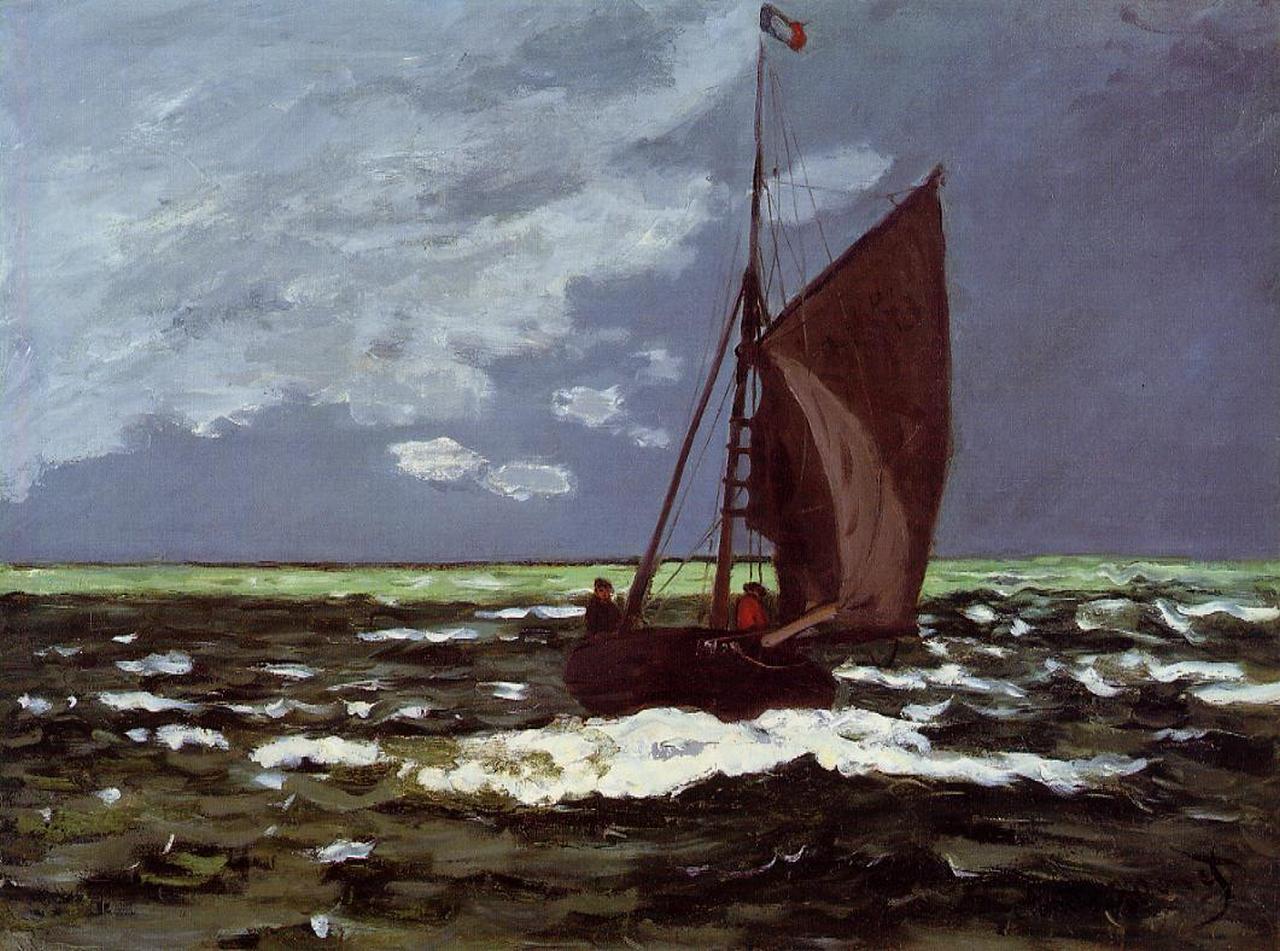
Image source: wikiart.org
Introduction
Claude Monet’s Stormy Seascape from 1867 is a painting that immediately announces itself through atmosphere, tension, and motion. At first glance, the scene appears simple: a small sailboat rides rough water beneath a vast and troubled sky. Yet the longer one looks, the more complex the painting becomes. This is not just an image of a boat at sea. It is a study of instability, weather, light, and human vulnerability in the natural world. Monet transforms a familiar marine subject into something deeply experiential. The viewer does not merely observe the stormy coast from a safe distance. Instead, the painting creates the sensation of being placed directly in front of wind, spray, darkness, and shifting water.
This work belongs to a crucial stage in Monet’s career, when he was still developing the pictorial language that would later define Impressionism. In 1867, Monet had not yet become the artist most people associate with shimmering gardens, haystacks, and water lilies. He was still experimenting, still pushing against academic tradition, and still searching for the most convincing way to capture fleeting visual experience. In Stormy Seascape, that search is already powerfully visible. The painting combines close observation with bold simplification. It respects the physical truth of the sea while also presenting nature as emotional force.
What makes this work so compelling is its balance between directness and subtlety. The composition is stark, but not empty. The color palette is limited, but not dull. The subject is dramatic, but not theatrical in an artificial way. Monet does not overload the image with narrative detail. He gives the viewer just enough to feel the event and the environment. The result is a marine painting that feels immediate, raw, and modern.
Historical Context and Monet’s Early Development
To understand Stormy Seascape, it helps to place it within Monet’s early artistic development. During the 1860s, Monet was moving away from established academic expectations and toward a more personal way of seeing. He had studied landscape and marine painting, and he was deeply committed to painting from life rather than relying on studio formulas. Coastal scenes were especially important in this process. The sea offered constant change, unstable weather, and effects of light that could never be fully fixed. For an artist interested in sensation, atmosphere, and natural truth, the shoreline was an ideal subject.
The year 1867 sits at an interesting point in Monet’s career. He was already ambitious and technically skilled, but his most famous mature series still lay in the future. In works from this period, one can often feel both discipline and experimentation at once. He had not abandoned structure, but he was loosening it. He had not rejected representation, but he was making it more immediate and sensory. Stormy Seascape shows this beautifully. The forms remain legible, yet they are conveyed through energetic touches, tonal contrasts, and atmospheric unity rather than through polished finish.
Marine subjects also linked Monet to broader traditions in French painting. Seascapes had long been respected subjects, especially in the work of artists who explored weather, coastlines, and the power of nature. But Monet approached the genre with unusual freshness. Rather than composing an idealized maritime spectacle, he focuses on a brief and unstable moment. His interest is less in grandeur for its own sake and more in how the eye experiences a storm at sea. The painting is not about an imagined heroic event. It is about the visible reality of wind, water, cloud, and fragile human effort.
Composition and the Power of Simplicity
One of the greatest strengths of Stormy Seascape is its composition. Monet organizes the entire image around a few major elements: the broad expanse of water, the heavy sky, and the dark sailboat. This simplicity gives the painting extraordinary power. Nothing feels unnecessary. Every part of the image contributes to the central sensation of exposure and movement.
The horizon line stretches firmly across the scene, creating a strong division between sea and sky. Yet this division does not make the composition static. On the contrary, the horizontal structure intensifies the instability of everything within it. The waves are broken and restless. The clouds mass and shift. The boat leans and strains. The whole scene seems suspended between horizontal breadth and diagonal force.
The boat occupies the right half of the composition, which is a crucial choice. If it were centered, the image might feel more stable and balanced. By placing it off center, Monet increases the sense of uncertainty. The vessel appears caught within forces larger than itself. The eye is drawn to the mast and sail, which rise sharply into the sky and create a vertical accent against the long sweep of sea and horizon. This upright structure is essential because it becomes the visual sign of resistance. The boat does not disappear into the storm. It stands against it, even as it looks vulnerable.
There is also a striking openness to the composition. Large areas of water and sky are left relatively uncluttered by detail. This openness is not emptiness. It allows the weather to dominate. It gives the viewer room to feel the scale of the environment. The small human presence becomes more meaningful because it is surrounded by such immense and unstable space.
The Sea as Motion and Surface
The sea is the true protagonist of the painting. Monet does not treat it as a flat blue field or a decorative backdrop. He presents it as a living, changing surface made of weight, texture, and force. The waves are broken into irregular patches of dark water and white foam. This creates a sense of continual disruption. The surface never settles. It heaves, flashes, and fractures before the eye.
What is especially impressive is how Monet suggests movement without resorting to rigid contour or overworked detail. The sea is built through painterly contrasts. Dark greenish and brownish tones establish depth and heaviness, while sharp highlights of white suggest spray, foam, and the reflection of turbulent light. These white accents are scattered across the surface in a way that feels spontaneous, yet they are carefully arranged to guide the eye. They animate the water and make the storm legible.
The texture of the brushwork contributes strongly to this effect. Rather than smoothing the surface, Monet allows his strokes to remain active and visible. This visibility matters because it parallels the instability of the subject itself. The paint seems to move as the water moves. The viewer becomes aware not only of what is depicted, but of the act of depiction. The sea is not simply represented. It is re-created through marks that carry energy.
There is also a convincing sense of physical resistance in the water. This is not a decorative marine scene with elegant ripples. The waves feel thick and forceful. The boat seems to push through them rather than glide over them. That sense of resistance is central to the mood of the painting. Nature here is not passive or picturesque. It is active, indifferent, and powerful.
Sky, Weather, and Atmospheric Drama
If the sea provides motion, the sky provides emotional pressure. Much of the painting’s drama comes from the huge, cloud-filled expanse above the horizon. Monet treats the sky as a dynamic and changing structure, not as a blank background. It looms over the scene with shifting gray, blue, and violet tones, creating a visual atmosphere that feels heavy, unstable, and charged.
The cloud forms are broad and somewhat diffuse, which prevents the sky from becoming overly literal. Instead of sharply describing every cloud edge, Monet gives the impression of masses gathering and moving. This is exactly what makes the weather feel real. Storms are experienced as changing atmospheres rather than as neatly bounded objects. The sky in this painting feels in motion because it has been observed as a condition rather than diagrammed as a collection of shapes.
Monet is especially attentive to light within darkness. The sky is not uniformly gloomy. Patches of brightness break through, especially near the horizon and through lighter cloud forms. These openings are essential because they create visual tension. The storm is not absolute blackness. It is a shifting field of obscurity and illumination. That complexity gives the painting emotional depth. The scene is threatening, but not hopeless. The light remains present, even if only intermittently.
The relationship between sky and sea is also crucial. The greenish light along the horizon echoes into the water, creating unity across the painting. This band of luminous color is one of the most memorable elements in the image. It acts almost like a temporary opening in the storm, a strange and beautiful interval between dark water below and dark cloud above. That thin zone of brightness intensifies everything around it. It makes the sea seem darker, the sail more dramatic, and the sky more oppressive.
Color and Tonal Harmony
The palette of Stormy Seascape is restrained, but it is far from monotonous. Monet uses a narrow range of grays, greens, browns, blacks, and muted violets to create a cohesive and emotionally charged image. This limited palette is one of the reasons the painting feels so convincing. It matches the weather and strengthens the unity of the scene.
The dominant tones are dark and cool, which supports the mood of danger and exposure. Yet Monet avoids simple uniformity by introducing subtle shifts within those dark passages. The sea contains olive, brown, and slate tones. The sky moves between pale gray, blue-gray, and violet shadow. These variations keep the surface alive and prevent the painting from becoming heavy in a dull way.
The luminous green band near the horizon deserves special attention because it acts as a chromatic hinge for the composition. It is not the bright, cheerful green of spring landscape painting. Instead, it is a strange marine light, cold and somewhat eerie. That makes it perfect for a storm scene. It suggests a moment when the atmosphere is transformed by weather, when ordinary colors are altered by cloud, mist, and reflected light. Monet was especially gifted at noticing such moments, and this painting shows that sensitivity very clearly.
The dark sail and hull are also important from a color standpoint. Their brown and black tones create a dense focal point within the composition. Against the lighter sky and foaming water, the boat becomes visually concentrated and solid. This contrast helps anchor the painting. Without it, the image might dissolve into atmospheric effects. With it, Monet creates a strong dialogue between stable form and unstable environment.
The Boat and the Human Element
Although the painting is dominated by natural forces, the small boat gives the scene its emotional focus. A storm at sea becomes more than meteorological spectacle when human presence enters the frame. The boat, with its dark hull, taut lines, and angled sail, embodies effort, risk, and survival. It is the human answer to the sea’s power, fragile but determined.
The figures on the boat are tiny, yet they matter enormously. Monet does not individualize them in a portrait-like way. Instead, he presents them as small presences within the larger setting. This is a wise decision. Too much emphasis on narrative detail would have shifted the painting toward anecdote. By keeping the figures small and understated, he preserves the primacy of atmosphere while still giving the viewer something to identify with.
The boat is also visually expressive in itself. Its leaning mast, dark sail, and low position in the water all suggest strain. It appears caught in a difficult moment, but not in a melodramatic or catastrophic one. The scene is tense, yet controlled. The boat continues forward. That sense of persistence is one reason the painting feels so compelling. It is about danger, but also about endurance.
There is a deeper symbolic dimension here as well. Small vessels in rough seas have long served as images of human vulnerability in art and literature. Monet does not push the symbolism overtly, but the association is hard to avoid. The boat becomes a sign of human life confronted by instability, uncertainty, and forces beyond control. This gives the painting a resonance that reaches beyond its immediate subject.
Brushwork and the Move Toward Modern Painting
One of the most exciting aspects of Stormy Seascape is its handling of paint. Monet’s brushwork is active, visible, and responsive to the subject. He does not attempt to hide the means of construction behind a glossy academic finish. Instead, the painting declares itself as painted. This is one of the features that makes it feel modern.
In the water, the brushstrokes are broken and varied, suggesting wave movement and foam without overdefining them. In the sky, the strokes are broader and softer, allowing cloud masses to form through tonal transitions rather than hard outlines. The boat itself is more compactly handled, which helps it stand out. This variation in touch is subtle but effective. Monet adjusts his method according to what each part of the painting needs.
The visibility of the brushwork also enhances the immediacy of the scene. One senses that Monet was trying to capture a fleeting effect rather than build an elaborate studio fiction. The painting feels observed in real time, even if it may have involved later refinement. That sense of direct engagement with nature is central to Monet’s achievement and to the larger development of modern landscape painting.
This handling anticipates the more fully developed Impressionist method that Monet would later refine. The concern with light, atmosphere, and momentary sensation is already here. So is the willingness to let paint remain alive on the surface. In that sense, Stormy Seascape is both an accomplished work in its own right and an important sign of where Monet was headed.
Emotion, Mood, and the Experience of the Sublime
The emotional force of Stormy Seascape comes from its refusal to separate observation from feeling. Monet does not sentimentalize the storm, but neither does he neutralize it. The painting invites an emotional response precisely because it is so faithful to the visual experience of unstable weather. The viewer feels the weight of the clouds, the churning of the sea, and the precariousness of the boat.
There is a strong element of the sublime in this image. The sublime, in artistic terms, often refers to experiences of nature that overwhelm, unsettle, or exceed ordinary human scale. This painting operates in that territory. The sea and sky are not simply beautiful. They are imposing. The viewer is made aware of nature’s scale and force in contrast to the smallness of human presence.
Yet the painting is not terrifying in a theatrical sense. Its power is quieter and more truthful than that. It conveys tension through atmosphere rather than spectacle. This restraint is one of its greatest strengths. Monet does not need shipwreck, lightning, or dramatic gestures to create intensity. He trusts the basic elements of weather, color, movement, and scale.
At the same time, the painting is undeniably beautiful. The green light at the horizon, the rhythm of white foam, and the balance of dark sail against cloudy sky all create visual pleasure. This combination of beauty and unease is what gives the work lasting richness. It does not offer a single, simple mood. It offers a layered experience in which danger, beauty, isolation, and persistence coexist.
Why Stormy Seascape Still Matters
Stormy Seascape remains compelling because it captures something timeless about the relationship between people and the natural world. Even today, the image feels immediate. The sea still appears unpredictable. The boat still seems vulnerable. The sky still presses down with emotional force. Nothing about the painting feels stale or distant.
It also matters because it reveals Monet in a mode that is sometimes overshadowed by his later fame. Many viewers know Monet primarily through luminous gardens and tranquil water scenes. This painting reminds us that he was equally capable of intensity, darkness, and dramatic weather. It broadens our understanding of him as an artist. He was not only a painter of serenity and light. He was also a painter of instability, exposure, and atmospheric tension.
The work further matters because it demonstrates a major shift in nineteenth century painting. Instead of presenting a polished, idealized marine subject, Monet gives us a lived visual experience. He values sensation over formula, atmosphere over convention, and painterly immediacy over finished smoothness. These priorities would become central to modern art, and Stormy Seascape shows them emerging with clarity.
Conclusion
Claude Monet’s Stormy Seascape is a remarkable example of how much can be achieved with a relatively simple subject. A small boat, rough waves, a heavy sky, and a narrow band of strange light are enough for Monet to create a painting of enormous presence. The work is visually direct, emotionally resonant, and historically important. It shows an artist deeply committed to observing nature honestly while also understanding how paint itself can convey motion, atmosphere, and feeling.
The painting’s success lies in its unity. Composition, color, brushwork, and subject all work together to create a single concentrated experience. The sea moves, the sky threatens, the boat resists, and the viewer is drawn into that unstable world. There is no excess, no decorative distraction, and no false drama. Everything serves the atmosphere.
Seen today, Stormy Seascape still feels modern because it trusts perception. Monet does not explain the storm. He lets us see it, feel it, and inhabit it. That is why the painting endures. It is not only an image of a weather event from 1867. It is a deeply convincing meditation on fragility, movement, and the power of the visible world.