Image source: wikiart.org
Claude Monet and an Unusual Domestic Subject
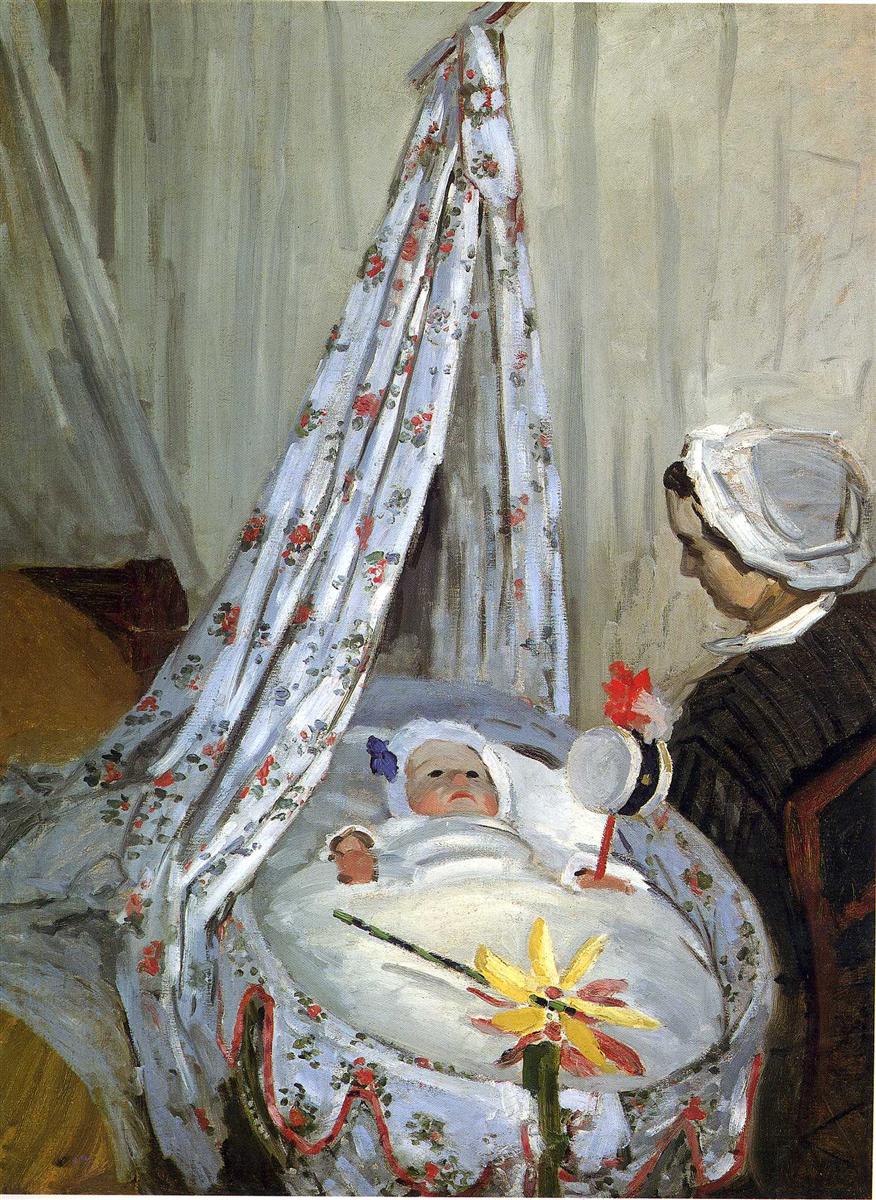
Claude Monet is most often associated with open air painting, shimmering water, gardens, regattas, haystacks, and the changing effects of light across landscape. Because of that, Jean Monet in the Cradle feels especially intimate. Painted in 1867, it turns away from public spectacle and toward private life. Instead of a bustling modern boulevard or a bright riverside scene, Monet gives us a quiet interior centered on a child in a cradle, watched over by a seated woman. The result is tender, restrained, and deeply revealing.
This painting matters not only because it shows Monet’s son, Jean, in infancy, but also because it captures a side of the artist that is sometimes overshadowed by his later fame. Here Monet is not yet the painter of the vast late water lily panels. He is a young artist still shaping his direction, responding to contemporary life in a more immediate and personal way. The painting shows that modern life, for Monet, could include the domestic sphere just as much as the boulevard, the garden, or the seaside.
At first glance, the scene appears simple. A baby lies nestled in a floral cradle beneath a draped canopy. A woman sits nearby, turned toward the child, holding what appears to be a toy or rattle. A bright flower rises in the foreground. The room itself is quiet and subdued, with soft gray walls and a calm, enclosed atmosphere. Yet the more one looks, the more carefully structured and emotionally resonant the painting becomes. Monet builds the image through delicate contrasts of texture, color, and shape, transforming a modest interior into a poetic statement about care, fragility, and presence.
The Historical Moment Behind the Painting
Painted in 1867, this work belongs to an important period in Monet’s development. He was still young, still establishing himself, and still navigating financial and personal uncertainty. These years were crucial in the formation of the style that would later be called Impressionism. Monet was experimenting with how to paint modern life with freshness and immediacy, often using lively brushwork and close attention to changing light.
What makes Jean Monet in the Cradle so compelling is that it channels those same instincts into a domestic subject. Instead of a broad public setting, Monet chooses an interior scene that feels private and almost protective. The painting has none of the grand historical ambition that still dominated much official art in the nineteenth century. It does not tell a dramatic story from mythology or literature. It does not elevate its subject through theatrical gesture or elaborate symbolism. Instead, it focuses on a real moment in ordinary life.
That choice aligns Monet with a broader shift in modern painting. Artists of his generation increasingly found seriousness in everyday scenes. The home, the family, the nursery, the quiet rituals of daily existence all became worthy of artistic attention. In Monet’s hands, this intimate subject becomes something more than anecdotal. It becomes a study of atmosphere, surface, tenderness, and human closeness.
The date is also important because it places the painting before the fully mature Impressionist style of the 1870s. One can already see Monet’s interest in looseness, color vibration, and the material presence of paint, but the work still retains a degree of structure and solidity that connects it to earlier traditions. This balance gives the painting a special tension. It feels both rooted and fresh, careful and immediate.
Composition and the Architecture of Tenderness
The composition is one of the painting’s greatest strengths. Monet organizes the scene around the cradle, which occupies the center and lower half of the canvas. The cradle is large, rounded, and visually enveloping. Its curved form creates a sense of shelter around the infant. The draped canopy rises upward and then falls in soft diagonal folds, giving the image a vertical lift while also reinforcing the idea of protection.
The canopy is especially important because it does more than describe furniture. It creates a visual enclosure, almost like a tent or a curtain of care. Its floral pattern softens the scene and turns the cradle into a world within a world. The child lies in the middle of this small sheltered universe, visually framed by fabric, white bedding, and curved contours. Monet has arranged the scene so that everything seems to lean inward toward the infant.
The seated woman on the right provides balance. Without her, the composition might feel too symmetrical or too passive. Her dark clothing anchors the right side of the painting and contrasts with the pale whites and grays surrounding the cradle. She is turned toward the child, and her body directs our attention inward. Her gesture adds narrative, but only lightly. She is present not as a dramatic actor but as a quiet witness and caretaker.
The flower in the foreground may seem like a small detail, but it plays a major compositional role. Its bright yellow and red petals introduce a vivid note near the lower center of the canvas. This touch of color enlivens the painting and prevents the cool whites and grays from becoming monotonous. It also echoes the floral decorations of the cradle canopy, tying foreground and center together. Monet often used such visual echoes to unify a composition without making the structure obvious.
Space in the painting is compressed rather than expansive. The room does not open deeply into the distance. Instead, Monet keeps the setting close and intimate. The walls rise behind the cradle without much detail, creating a quiet backdrop that allows the figures and fabrics to dominate. This compression makes the scene feel enclosed, almost hushed, as if sound itself has been softened.
Color, Light, and the Poetry of White
One of the most impressive aspects of Jean Monet in the Cradle is Monet’s handling of white. The painting contains a great deal of pale fabric, bedding, lace, and light-toned surfaces, yet the whites never feel flat. Monet modulates them with gray, blue, cream, lilac, and soft pink. The result is a luminous harmony in which white becomes a rich field of variation rather than a single tone.
This sensitivity to white is one of the clearest signs of Monet’s brilliance. He understood that light transforms every surface. A white cloth is never simply white. It absorbs shadows, reflects nearby colors, and shifts according to surrounding tones. In this painting, the bedding around the baby glows gently, while the canopy catches cooler and warmer notes in different areas. The woman’s bonnet is likewise built from subtle tonal changes, not harsh outlines.
The dominant atmosphere is muted and calm. Gray-beige walls, pale textiles, and dark clothing create a subdued palette, but Monet inserts accents of stronger color at key points. The red flowers scattered across the canopy, the red ribbon or toy held by the woman, the blush in the baby’s face, the blue bow near the child’s head, and the yellow-red flower in the foreground all act as small pulses of life. They animate the composition without disturbing its serenity.
Light in the painting is soft rather than dramatic. There is no single spotlight effect, no theatrical beam. Instead, illumination seems diffused through the room, settling gently on surfaces. This softness suits the subject. A nursery scene demands quiet. Monet’s light does not reveal the room with clinical precision. It wraps forms in atmosphere. The child appears nestled in radiance, yet that radiance is modest and domestic.
Color here serves emotion as much as description. The cool grays and whites create calm, while the touches of red and yellow suggest warmth and affection. The dark dress of the seated woman gives the composition gravity, preventing the scene from becoming sentimental. Monet is careful. He wants tenderness, but not sweetness in excess. That discipline is one reason the painting feels genuine.
Brushwork and the Living Surface of Paint
Although the subject is gentle, the brushwork is alive. Monet paints with a freedom that keeps the surface active and immediate. The walls are built from visible strokes that move vertically and diagonally, giving the background a soft vibration. The fabrics are described with quick, responsive marks rather than rigid contours. The cradle skirt, the drapery, and the bedding all seem to breathe through the movement of paint.
This is important because it prevents the scene from becoming static. Domestic subjects in nineteenth century art could easily become stiff or overly polished. Monet avoids that trap. He lets the viewer feel the painting as a painted object. Brushstrokes remain present. Edges dissolve and reform. Details are suggested rather than exhaustively described. This approach gives the scene freshness, as if it has been captured in a living instant.
The floral pattern on the cradle canopy is especially revealing. Monet does not render each flower with miniature precision. Instead, he suggests blossoms through quick notes of red and green distributed across the white ground. The eye reads them as decoration, but the hand of the artist remains visible. The same is true of the flower in the foreground, which is briskly painted yet strikingly effective.
Even the faces are handled with economy. The baby’s features are not painstakingly modeled in the academic manner. They are simplified, soft, and direct. The seated woman’s profile is likewise spare. Monet gives enough information to establish presence and expression, but he does not linger over finish for its own sake. This restraint helps preserve the intimacy of the scene. The painting feels observed, not staged.
Brushwork also contributes to mood. The loose handling of the walls and fabrics creates softness and quiet. Nothing is hard-edged or aggressively defined. The entire room seems held together by touch. In a painting about infancy and care, that quality matters. The surface itself becomes an extension of tenderness.
The Child, the Woman, and the Emotional Core of the Scene
At the center of the painting lies the infant Jean, swaddled and secure. Monet presents the child not as a symbol of idealized innocence but as a specific, vulnerable human presence. The baby’s face emerges from the white bedding with small touches of pink and shadow. One tiny hand is visible, adding immediacy and charm. The child’s expression is calm but not simplified into a smile. This seriousness gives the scene dignity.
The seated woman is equally important, even though she occupies less space. She does not dominate the painting. Instead, she embodies the act of attending. Her posture is turned toward the cradle, and her gesture suggests interaction, perhaps soothing or entertaining the child. The intimacy of the scene depends on this relation. Without her, the cradle might become a still life. With her, the painting becomes a lived moment of care.
Monet is careful not to overstate emotion. There is no melodrama, no exaggerated tenderness, no sentimental theatrics. The feeling arises from proximity, posture, and atmosphere. The woman watches. The child lies quietly. The room is still. This restraint makes the emotion more persuasive. We do not feel pushed toward a response. We are invited to observe and absorb.
There is also something deeply modern in the way Monet treats this domestic subject. He does not idealize the interior into a grand moral allegory. He paints it as a contemporary reality, modest and immediate. The nursery becomes a site of real life, worthy of serious attention. In that sense, the painting enlarges the category of what modern art can be about.
The relationship between the figures is also mediated through objects. The cradle, the canopy, the toy or rattle, the bonnet, the flower in the foreground all contribute to the emotional world of the painting. These are not random accessories. They create an environment of nurture. The child is surrounded not only by people but by things arranged for comfort, beauty, and care.
Interior Space as a Modern Theme
When people think of Monet, they often think first of outdoor light. Yet Jean Monet in the Cradle shows that interiors could also serve his artistic aims. This room is not filled with elaborate furniture or dramatic decoration. It is quiet, modest, and somewhat sparse. That simplicity allows Monet to concentrate on atmosphere and surfaces.
The interior feels inhabited rather than displayed. It is not a showpiece room. It is a lived space, shaped by daily routine. The cradle dominates because in such a room the needs of the child dominate. Everything else recedes. This sense of practical intimacy gives the painting emotional truth.
The walls themselves are notable. Monet does not describe them with decorative detail. Instead, he lets them remain broad, softly worked planes that hold the scene together. Their muted tone provides calm and creates contrast with the lighter fabrics. In effect, the background functions almost like silence in music. It is a necessary quiet around the more delicate notes.
This domestic modernity was an important direction for painting in the later nineteenth century. Artists increasingly turned toward scenes of everyday life, not because they lacked ambition, but because they recognized that ordinary experience could carry deep visual and emotional meaning. Monet’s nursery scene belongs to that broader shift. It affirms that private life is artistically significant.
There is also a subtle psychological dimension to the enclosed interior. The space feels safe, but also fragile. A cradle is a symbol of beginning, dependency, and care. The painting’s hush suggests how much attention surrounds such a beginning. Even the drapery seems to participate in that atmosphere of shelter.
Early Monet and the Road Toward Impressionism
This painting is especially interesting because it lets viewers see Monet before the full flowering of his later style. Many of the qualities that would define him are already present. He is alert to fleeting visual effects. He breaks down white into varied tonal and chromatic notes. He uses brushwork to suggest sensation rather than merely record objects. He values immediacy. He finds beauty in ordinary life.
At the same time, Jean Monet in the Cradle is not a late Impressionist canvas. It retains more solidity and compositional containment than many of his later outdoor works. The forms are more centralized. The scene is more enclosed. The emotion is more concentrated. This makes the painting an important bridge between tradition and innovation.
One can imagine how easily a conventional academic painter might have approached the same subject with greater polish, sharper outlines, and more sentimental emphasis. Monet chooses another path. He lets the paint remain alive. He lets atmosphere soften edges. He trusts tonal relationships more than linear precision. In doing so, he points toward a new kind of realism, one based on perception rather than finish.
The painting also reveals that Impressionism was never only about landscapes. At its core, it involved a new way of seeing. It meant paying attention to the instability of light, the richness of ordinary moments, and the material vitality of paint. All of those qualities are present here, even in a quiet nursery interior.
Because the subject is so intimate, the painting can sometimes be overlooked beside Monet’s more famous public and outdoor scenes. Yet that intimacy is exactly what makes it valuable. It shows that the modern world, for Monet, included emotional and domestic realities as well as visual spectacle.
Why the Painting Still Feels Moving Today
One reason Jean Monet in the Cradle continues to resonate is that it speaks across time without requiring elaborate explanation. Anyone can understand the vulnerability of an infant, the attentiveness of a caregiver, and the quiet concentration of a room organized around care. The painting is rooted in a specific nineteenth century setting, but its emotional structure remains legible.
It also feels contemporary because of its honesty. Monet does not idealize the scene into perfection. The room is not glamorous. The figures are not heavily dramatized. The painting’s beauty comes from looking carefully at what is there. That kind of attention still feels modern.
The work also rewards slow viewing. At a glance, it seems simple. Over time, its richness emerges. The variety within the whites, the movement of the brushwork, the compositional role of the canopy, the quiet exchange between woman and child, the restrained but effective color accents all become more apparent. It is a painting that deepens through patience.
There is also something especially touching about seeing a major artist turn his eye toward such a small and personal subject. Great painters are often remembered for monumental works, but some of their most human achievements lie in moments like this one. Here Monet records not grandeur, but nearness. Not public display, but domestic attention. Not spectacle, but care.
Conclusion
Jean Monet in the Cradle is one of Claude Monet’s most intimate and quietly powerful early paintings. It transforms a nursery scene into a refined meditation on tenderness, atmosphere, and the visual poetry of ordinary life. Through the curved shelter of the cradle, the falling floral canopy, the calm presence of the seated woman, and the luminous orchestration of whites and grays, Monet creates a world defined by softness and protection.
The painting is important not only as a family image, but as a work that expands our understanding of Monet. It reminds us that his genius was not limited to gardens, rivers, or skies. He could also find profound beauty in a quiet room, a swaddled child, a patterned curtain, and the gentle watchfulness of care. Even at this early date, he shows an extraordinary sensitivity to color, light, and atmosphere.
What makes the painting memorable is its restraint. It does not force emotion. It allows feeling to arise through form, tone, and presence. That discipline gives the scene its lasting power. More than a charming domestic image, it is a serious and beautifully observed work that reveals how modern painting could honor the smallest moments of life.
