Image source: wikiart.org
Claude Monet and the Coastal World of 1867
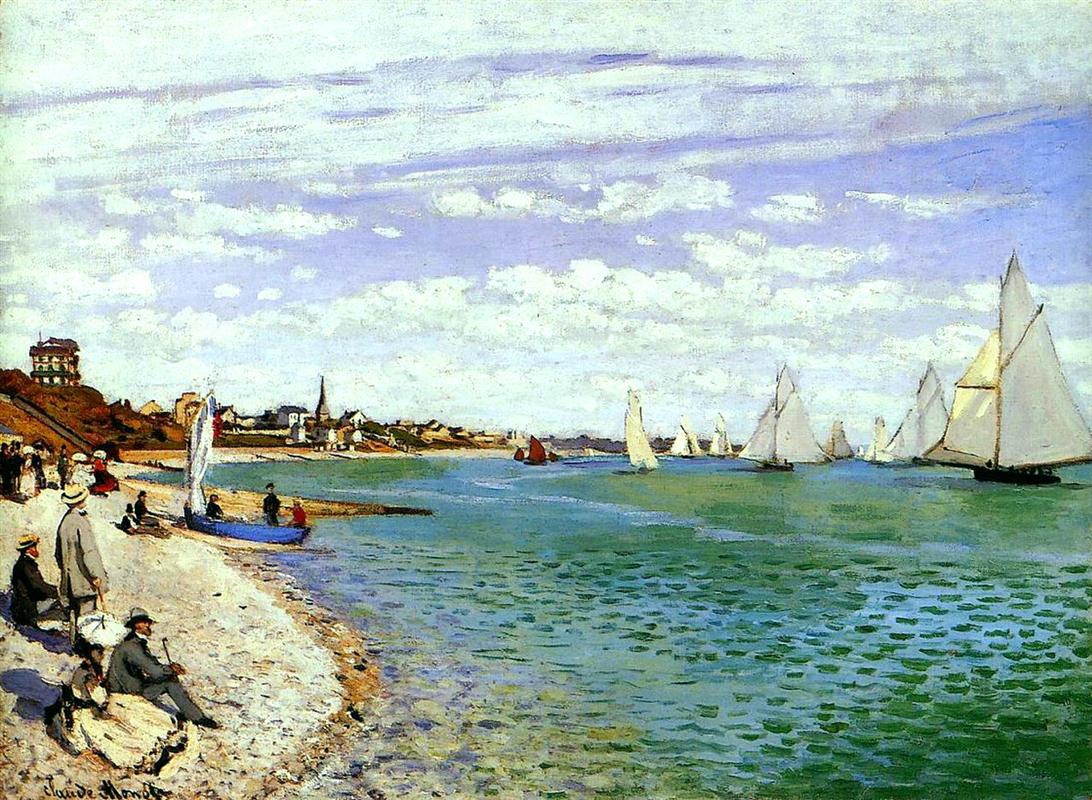
Claude Monet’s Regatta at Sainte-Adresse is a vivid and deeply atmospheric painting that captures much more than a simple day by the sea. Painted in 1867, the work belongs to an important moment in Monet’s early development, when he was refining the visual language that would later define Impressionism. Even at this stage, he was already drawn to modern leisure, changing weather, open air light, and scenes that allowed him to study the shifting relationships between color, water, sky, and movement. In this painting, those interests come together with remarkable clarity.
Sainte-Adresse, located near Le Havre on the Normandy coast, gave Monet the ideal setting for this kind of observation. It was a place where sea traffic, local life, tourism, and natural light converged. The coast was not only beautiful. It was alive with signs of modernity, pleasure, and public life. Regattas brought together boats, spectators, changing wind conditions, and fleeting visual impressions, all of which suited Monet’s temperament as a painter. Rather than presenting the coast as a timeless or heroic landscape, he treated it as a living environment shaped by everyday experience.
What makes Regatta at Sainte-Adresse so compelling is the way it balances immediacy and structure. At first glance, it feels spontaneous, bright, and breezy. Yet the composition is carefully organized. The shoreline angles inward, the sailboats are distributed across the water in a rhythm of white forms, and the distant buildings help anchor the scene in place. Monet gives the viewer a vivid sensation of standing at the water’s edge while also guiding the eye through a coherent visual design. This mixture of freshness and control is one of the painting’s greatest strengths.
First Impressions of the Scene
The immediate effect of the painting is one of openness. The viewer encounters a broad sweep of sea and sky, interrupted by the elegant silhouettes of sailboats and the gentle curve of the beach. The scene feels airy and expansive, with a strong sense of coastal light. Monet does not crowd the image with anecdotal detail. Instead, he lets the relationships between land, water, figures, and vessels create the experience.
The beach occupies the left foreground, where a number of people sit, stand, or gather close to the shore. Their presence establishes the painting as a social scene as much as a marine view. These are not mythological figures or anonymous peasants performing labor. They are observers, visitors, participants in a moment of public recreation. Their dark clothing and distinct outlines contrast with the pale beach and the luminous water, making them visually legible without turning them into the main subject. Monet includes them not to tell individual stories, but to create a living atmosphere.
Out on the water, the regatta unfolds. The sailboats are distributed across the bay, their white sails catching the light and standing out against the blue and green tones of the sea. Some are close enough to feel imposing, while others recede toward the horizon. This arrangement gives the painting depth and activity. The boats do not simply decorate the water. They define its scale, suggest motion, and transform the seascape into an event.
The distant shore, with its clustered buildings and rising land, provides a calm counterweight to the open water. It reminds us that this is a specific place, not a generalized coastal fantasy. The town is present, but Monet does not dwell on architectural detail. He reduces it to essential shapes and tonal contrasts, enough to evoke a recognizable settlement while preserving the unity of the whole.
Composition and the Movement of the Eye
Monet’s composition is one of the most effective aspects of the work. The beach begins in the lower left corner and sweeps diagonally toward the middle distance, pulling the eye naturally into the scene. This diagonal shoreline acts as a visual pathway, connecting the foreground figures to the distant town and creating a sense of continuity between human presence and landscape. It is a simple but elegant device that prevents the image from feeling static.
The water occupies the center and right portions of the composition, opening into a wide field where the sailboats can move and breathe. Their placement is crucial. The largest boats appear toward the right, where their sails rise dramatically against the sky. Smaller vessels are scattered deeper into space, creating variation in scale and giving the impression of a regatta extending across the bay. Monet avoids rigid symmetry. Instead, he builds balance through asymmetry and spacing.
The horizon line sits relatively high, which allows the surface of the sea to become a major expressive zone. This is important because Monet is not simply painting boats on water. He is painting light on water, color on water, movement on water. By giving the sea a large role in the composition, he turns it into an active participant in the scene rather than a passive background.
The sky, though broad, does not overwhelm the painting. Its horizontal cloud bands echo the calm breadth of the bay, while its pale tones help intensify the brightness of the sails. The whole composition depends on a series of relationships: the diagonal beach against the horizontal horizon, the vertical masts against the open sky, the dark figures against the pale shore, the crisp sails against the broken surface of the sea. Each contrast sharpens the painting’s vitality.
The Sea as a Field of Color and Sensation
The sea in Regatta at Sainte-Adresse is not rendered as a flat blue expanse. Monet treats it as a constantly shifting field of reflections, ripples, and tonal changes. Greens, blues, turquoise notes, and muted grays mingle across the surface. The water appears to move not through dramatic waves, but through a lively texture of brushstrokes that suggest gentle motion and changing light.
This approach is central to Monet’s art. He was less interested in defining every object with hard contours than in recording the way light breaks forms into sensations of color. In the water, this method becomes especially effective. The strokes are visible, but they do not feel arbitrary. They follow the logic of surface movement. They make the sea shimmer.
The color transitions are subtle but important. Closer to the shore, the water reflects the pale tones of the beach and shallows. Farther out, it deepens into cooler blues and greens. Around the boats, the water seems to shift again, catching light differently depending on angle and distance. This constant variation gives the sea a living quality. It is never a single thing. It is always changing before the eye.
At the same time, Monet avoids overdramatizing the weather. The scene is bright, but not stormy or theatrical. This moderation is one reason the painting feels so convincing. The sea is beautiful because it is attentively observed, not because it is exaggerated into spectacle.
Sky, Atmosphere, and the Coastal Light
The sky plays a quieter but equally essential role. It is filled with soft cloud formations spread across a pale blue atmosphere. These clouds are not densely modeled in an academic way. Instead, they appear light, broken, and mobile, as if shaped by sea air and shifting wind. Their scattered forms create rhythm across the upper half of the canvas and contribute to the painting’s open feeling.
Monet understood that coastal light has its own character. It is diffused, reflective, and often unstable. In this painting, the light does not descend from a single dramatic source. It seems to circulate through the entire scene, touching sails, water, beach, and sky alike. This gives the image a unified atmosphere. Nothing looks isolated from the surrounding air.
The brightness of the sails depends heavily on the sky behind them. Their pale surfaces catch the light and stand out because the sky remains luminous but not overpowering. Monet is careful to preserve enough tonal difference for the sails to remain clear, yet he also integrates them into the atmosphere so that they do not appear pasted onto the scene. This sensitivity to value and air is one of the work’s defining achievements.
There is also a sense of weather without any strong narrative of weather. The clouds suggest movement, the sails imply wind, and the water carries the signs of a breezy day. But Monet does not turn the painting into a meteorological drama. The atmosphere remains stable enough to support leisure and observation. The result is a mood of freshness and alert calm.
Figures on the Beach and the Modern Leisure Scene
Although the regatta provides the title and the visual excitement, the people on the beach are crucial to the painting’s meaning. They establish the scene as an image of modern recreation. These are spectators enjoying a public event, occupying the shore as part of a new social relationship to landscape. The seaside is not presented as wild nature alone. It is a place to visit, watch, and inhabit.
Monet includes the figures with economy. They are simplified, but not careless. Their hats, dark garments, and varied postures make them readable from a distance. Some sit close to the foreground, grounding the viewer in the immediate space of the beach. Others stand or gather farther along the shoreline, creating a gentle procession into the distance. This sequence of human forms helps animate the edge of the land and prevents the composition from dissolving into pure landscape.
What is especially interesting is the way the figures interact with the setting. They do not dominate it. They participate in it. Their scale emphasizes the breadth of the bay, while their stillness contrasts with the movement of the boats and water. In this sense, they function almost like visual pauses, moments of quiet observation within a more dynamic field.
This balance between social life and natural atmosphere is typical of Monet’s modern vision. He was interested in leisure not as portraiture or social satire, but as a sign of contemporary experience. The beachgoers here embody that shift. They are ordinary people in a real place, enjoying a real moment under changing light.
Boats, Sails, and the Rhythm of Motion
The sailboats are the painting’s most striking formal elements. Their white sails rise sharply against the sea and sky, introducing vertical accents into a composition largely built from horizontal and diagonal lines. Each boat has a slightly different position and scale, which keeps the regatta from feeling repetitive. Together, they create a rhythm that moves across the water from middle ground to distance.
Monet does not treat the boats with exact nautical precision. He paints enough detail to establish their structure and direction, but his main interest lies in their visual effect. The sails become luminous shapes, almost abstract in their simplicity. They capture the light and punctuate the scene with moments of brightness. This is where the painting begins to move toward the logic of Impressionism. Objects are important, but their appearance within a specific atmosphere matters even more.
The boats also help express motion without requiring overt drama. Nothing in the scene feels frantic. The regatta unfolds with grace. The angled sails, varied distances, and slight shifts in orientation suggest that the vessels are responding to wind and current. Their movement is implied rather than narrated. This restraint gives the painting elegance.
The largest boat at the right edge is especially important. It anchors the composition and gives the regatta a strong visual climax. Its size adds weight to the right side of the canvas, balancing the populated beach on the left. Without it, the scene might disperse too easily. With it, the composition holds together beautifully.
Brushwork and the Transition Toward Impressionism
Regatta at Sainte-Adresse belongs to a formative period in Monet’s career, and the painting reveals an artist moving decisively away from polished academic finish. The brushwork is visible throughout. On the water, it flickers and breaks. In the sky, it softens and spreads. On the beach and figures, it becomes more compact and descriptive. This variation shows Monet’s growing confidence in letting the method of painting remain present on the surface.
Yet the work is not fully loose in the later Impressionist sense. There is still a degree of structure and control that ties it to earlier landscape traditions. Forms remain understandable, and the composition is carefully built. This is one reason the painting feels so satisfying. It stands at a threshold. It carries the freshness of direct observation while retaining enough solidity to make the scene feel stable.
Monet’s handling of edges is particularly telling. Some contours are clear, especially where he wants figures or boats to register sharply. Others dissolve into surrounding color. This selective clarity reflects the way vision actually works in changing light. Not everything is seen with equal certainty. Monet turns that perceptual truth into a pictorial principle.
The result is a painting that feels immediate but not unfinished, lively but not chaotic. It marks an important step in the emergence of a new way of seeing, one based less on idealized finish and more on the experience of perception itself.
Sainte-Adresse as a Place of Elegance and Observation
The setting matters enormously. Sainte-Adresse was not simply a convenient coastal location. It represented a modern seaside environment where nature, bourgeois leisure, and maritime activity intersected. That gives the painting a distinctly nineteenth century character. This is not a romantic ruin, a fishing village of hardship, or a heroic naval scene. It is a place where people come to watch, stroll, and enjoy the spectacle of the coast.
Monet captures that atmosphere without moralizing or sentimentalizing it. He neither celebrates luxury in an overt way nor critiques it. Instead, he observes how modern life unfolds in relation to the sea. The regatta becomes part of a broader visual culture of leisure, public space, and seasonal experience.
At the same time, the location remains deeply tied to the artist’s ongoing fascination with Normandy. The region’s coastlines, skies, and marine conditions gave Monet countless opportunities to explore transient effects. In Regatta at Sainte-Adresse, the place is both specific and universal. It is clearly a particular shoreline, yet it also becomes an image of coastal brightness and sociability that reaches beyond local description.
This ability to transform a real place into a broader poetic experience is one of Monet’s gifts. He does not invent grandeur. He discovers it in ordinary light, ordinary weather, and ordinary moments of looking.
The Mood of the Painting
One of the most appealing aspects of Regatta at Sainte-Adresse is its mood. The painting feels bright, fresh, and quietly festive. It captures public enjoyment without noise or excess. There is activity, but there is also calm. The boats move, the figures gather, the clouds drift, yet the whole scene remains poised.
This mood arises from Monet’s control of color and space. The palette is luminous without being harsh. The blues and greens of the water feel cool and refreshing. The whites of the sails and beach shimmer in the light. The darker figures provide grounding accents rather than heaviness. Even the distant architecture feels softened by air.
There is also a sense of invitation in the painting. The viewer seems placed just close enough to the spectators to feel part of the gathering, but also far enough back to take in the breadth of the event. Monet creates not a detached view, but a lived vantage point. We are made to feel what it is like to stand there, looking out.
The emotional register is subtle. This is not a painting of psychological intensity or narrative tension. Its pleasure comes from attentiveness, from the sensation of presence. Monet suggests that such moments matter. A day at the shore, a regatta under a bright sky, the meeting of sea breeze and public life can become worthy subjects for serious painting.
Why the Painting Still Resonates
Regatta at Sainte-Adresse continues to resonate because it captures a familiar but fragile kind of experience: the pleasure of being outdoors, among others, under changing light, with no grand event except the act of seeing. Its subject remains accessible. Most viewers can recognize the appeal of shoreline space, boats in motion, and a sky alive with atmosphere. Yet the painting elevates that ordinary appeal through extraordinary visual intelligence.
It also remains important because it reveals Monet in transition. We can see the roots of later Impressionism here in the broken brushwork, the sensitivity to light, and the emphasis on immediate sensation. At the same time, the work retains a compositional strength that gives it lasting clarity. It is both experimental and assured.
For modern viewers, the painting can also feel restorative. It offers an image of social life that is open, relaxed, and attentive to the natural world. Even though it belongs to 1867, it does not feel remote. Its air, light, and spaciousness remain vivid. The scene still breathes.
In the end, Regatta at Sainte-Adresse is memorable not because it dramatizes the coast, but because it observes it so well. Monet finds brilliance in the ordinary meeting of water, sky, people, and sail. He turns a seaside regatta into a study of perception, atmosphere, and modern pleasure. That is why the painting continues to hold the eye. It is not just a record of what was there. It is a record of how it felt to be there.
