Image source: wikiart.org
Introduction
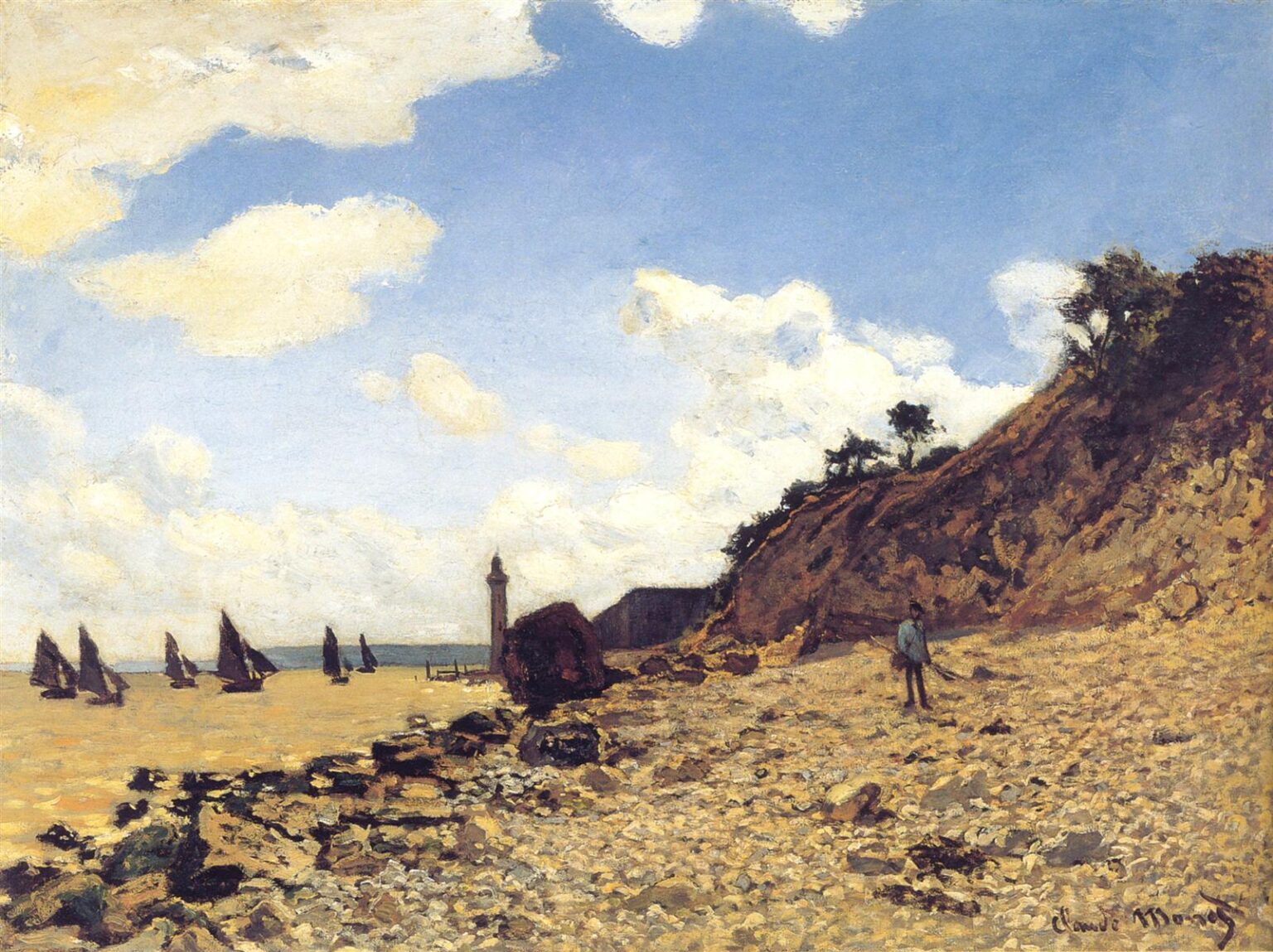
Claude Monet’s The Beach at Honfleur is a painting that feels both immediate and searching. Made in 1866, it belongs to a moment when Monet was looking hard at the visible world and testing how far paint could go in capturing atmosphere, light, and lived experience. The scene appears simple at first glance: a pebbled shore, a bright open sky, dark boats on the water, a steep cliff to the right, and a solitary figure standing near the base of the slope. Yet the more closely the painting is studied, the more complex it becomes. It is not just a coastal view. It is a study in balance, scale, weather, and perception. It shows Monet thinking through how a landscape can be built not only from forms, but from sensations.
What makes this painting compelling is the way it stands between traditions. It still carries traces of mid nineteenth century landscape realism, especially in its close attention to place and the physical character of the beach. At the same time, it already points toward the concerns that would define Monet’s later career. The sky is not treated as a static backdrop. The beach is not merely a ground plane. Light moves across everything, changing the relationship between sea, stone, cliff, and cloud. The scene is organized less like a formal academic landscape and more like an experience caught in passing, a moment in which the artist has responded quickly to what he sees.
Honfleur was an important location for Monet and for several painters of his generation. The Normandy coast offered shifting weather, busy marine activity, and broad luminous skies that encouraged painters to work directly from nature. In The Beach at Honfleur, Monet does not turn the site into a grand theatrical spectacle. Instead, he presents it as observed reality, animated by light and atmosphere. The result is a painting that feels grounded and alive, modest in subject but ambitious in artistic intention.
Monet in 1866 and the Importance of Honfleur
By 1866, Monet was still a young artist, but he had already begun to define the direction his work would take. He was moving away from polished studio conventions and toward a more direct engagement with nature. This was a period of experimentation, when he was absorbing lessons from earlier landscape painters while pushing toward a fresher, more immediate visual language. He had not yet reached the fully dissolved brushwork and serial methods of his late career, but the seeds of that approach are visible here.
Honfleur mattered because it offered exactly the kind of environment Monet needed. The town and its coastline had drawn artists for years, especially those interested in marine painting and changing weather conditions. The meeting of land and sea produced constant variation. Skies opened and closed. Water reflected color differently from hour to hour. Boats moved in and out of view. Sunlight could turn pebbles, cliffs, and sails into entirely different subjects within a short time. For an artist sensitive to light and atmosphere, this was a rich field of study.
In this context, The Beach at Honfleur can be understood as both a record of place and an artistic exercise in seeing. Monet is not only describing a stretch of shoreline. He is working out how the painting surface can hold fleeting visual impressions without losing structural coherence. That tension between immediacy and construction gives the painting much of its energy.
The First Visual Impression
The first thing many viewers notice is the enormous sky. It dominates the composition, occupying much of the upper half of the painting and setting the tone for everything below. The clouds are broad and irregular, drifting across a clear blue expanse that feels airy and spacious. This openness is countered by the dense, earth colored cliff on the right, which anchors the scene and gives it weight. Between these two large elements, sky and cliff, the beach stretches diagonally into the distance.
That diagonal movement is crucial. Rather than presenting the shoreline frontally, Monet leads the eye along the coast. The viewer seems to stand on the stones, looking out across the water while also following the curve of the beach toward the distant structures and boats. The composition feels natural rather than staged. It gives the impression of someone who has chosen a spot, paused, and painted what was there.
The boats in the water appear as dark, almost calligraphic shapes against the luminous sea. Their repeated triangular sails create rhythm across the horizon zone. Near the center left, a vertical tower or beacon rises at the edge of the shore, adding another note of structure. Closer to the viewer, the stones and scattered rocks are painted with broken, varied touches that make the beach feel uneven and tactile. The solitary human figure on the right is small, but important. Without that figure, the beach might feel empty and purely scenic. With it, the landscape becomes inhabited and measurable.
Composition and Spatial Design
Monet organizes the painting through contrasts of mass, direction, and tone. The cliff on the right is large and dark, while the sky on the left and above is open and bright. The sea lies low and horizontal, calm and glowing, while the beach runs diagonally, introducing motion and depth. These different directional forces keep the composition from feeling static.
The diagonal shoreline is especially effective because it pulls the viewer into the image. It begins in the foreground with a field of pale pebbles and moves gradually toward the middle distance, where the beach narrows near the tower and the rocky outcroppings. This recession gives the scene spatial credibility, but Monet does not achieve depth through precise linear perspective alone. He also uses color and tonal shifts. The foreground stones are more varied and textured, while distant forms become simpler and flatter.
The figure standing near the cliff acts as a visual hinge. Positioned off center, this person prevents the right side of the composition from becoming a mere mass of earth. The figure introduces verticality, human presence, and scale. At the same time, it does not dominate the scene. This is not a portrait placed in a landscape. It is a landscape in which a person briefly appears.
The composition also depends on asymmetry. Nothing is perfectly balanced in an academic sense, yet the painting feels stable. The sky has more visual area, but the cliff has more visual density. The boats are small, but their repeated dark silhouettes give the water a strong graphic presence. Monet’s design is subtle, but carefully judged.
Sky, Clouds, and Atmosphere
The sky is central to the painting’s emotional and visual effect. Monet treats it not as empty space, but as active atmosphere. The blue is clear yet soft, and the white clouds are touched with cream, gray, and pale yellow, suggesting sunlight filtering through changing air. The cloud forms are loose and irregular, which keeps them from feeling decorative. They seem to move and dissolve as one looks.
This attention to atmosphere is one of the most revealing aspects of the painting. Monet is already deeply interested in how weather affects perception. The sky does not simply sit behind the landscape. It controls the light on the sea, the illumination of the beach, and the tonal relationships across the whole canvas. Because the sky is so expansive, it gives the painting a feeling of openness and breath. Even the heavier elements, like the cliff and rocks, are softened by the surrounding light.
There is also a fascinating tension between solidity and transience. The cliff appears enduring, carved by time and weather, while the clouds seem temporary and unstable. The boats may move away. The figure may leave. The light will certainly change. The painting, then, captures a moment in which permanent and passing things coexist. This idea would become central to Monet’s mature art, but it is already eloquently present here.
Light and Color
The color structure of The Beach at Honfleur is restrained but sensitive. Monet does not rely on a wide, decorative palette. Instead, he builds the painting from a few dominant zones: the cool blues and whites of the sky, the golden and pale tones of the beach, the darker browns and violets of the cliff, and the muted shining surface of the sea. These colors are carefully related, so that no area feels isolated from the whole.
The beach is especially interesting in chromatic terms. At a glance it may seem simply beige or sandy, but closer attention reveals a network of warm creams, dusty yellows, browns, grays, and touches of violet. These variations make the stones feel alive under sunlight. Monet is not painting each pebble individually. He is translating the flicker of reflected light across an uneven surface.
The sea is also handled with delicacy. It is not a dramatic blue field. Instead, it reflects the light of the sky and the warmth of the day, appearing subdued, luminous, and slightly metallic near the horizon. The dark boats become more striking because of this relative softness. Their silhouettes read almost like punctuation marks across the brightness.
What matters most is that light unifies the scene. The same daylight touches clouds, cliff, person, and stones, binding them into one visual event. Monet is not simply depicting objects under light. He is depicting the world as light reveals it.
The Beach and the Material Presence of Nature
One of the painting’s great strengths lies in its treatment of the beach itself. This is not a smooth or idyllic shore. It is rough, stony, and irregular. Rocks lie scattered in the foreground. Darker patches break up the lighter field of pebbles. The ground feels unstable underfoot, which gives the location a physical reality often missing from more polished coastal scenes.
Monet’s handling of this terrain suggests close observation. He seems interested in how the beach changes from point to point, how light catches one cluster of stones and leaves another in shadow, how the shore becomes both surface and texture. This attention gives the lower half of the painting a tactile richness that balances the airy sky above.
The cliff rising on the right intensifies that material presence. It is painted with earthy browns, ochres, and deep shadowed notes, creating a rugged face that contrasts with the openness of the sea. Trees and shrubs along its upper edge are suggested with dark, loose forms. The cliff is not minutely described, but it feels geologically convincing. Monet captures its slope, its roughness, and its mass without overworking it.
Together, beach and cliff make the painting more than a pleasant marine view. They root it in a specific coastal environment shaped by erosion, tide, and weather. Nature here is beautiful, but not softened into sentimentality.
Boats, Shore Activity, and the Working Coast
The boats scattered across the water are small, yet they contribute enormously to the character of the scene. Their dark sails and hulls introduce rhythm, contrast, and a sense of local life. These are not ornamental vessels inserted for picturesque effect. They suggest labor, movement, and the practical reality of a coastal town. Honfleur was a working place, and Monet allows traces of that identity to remain visible.
Because the boats are distributed at intervals, they help articulate the breadth of the seascape. They also reinforce the horizontality of the water, especially when set against the vertical tower near the shoreline. This interplay of horizontals and verticals gives the middle distance visual clarity.
The possible beacon or lighthouse structure near the center left adds a note of human infrastructure to the composition. It reminds the viewer that the coast is navigated, used, and inhabited. Yet these man made elements do not dominate. They exist within the larger presence of sky, sea, and land. Monet does not dramatize industry or maritime commerce. He simply allows them to be part of the observed world.
This quiet integration of human activity into nature is one reason the painting feels modern. It does not set up a rigid opposition between landscape and daily life. Instead, it shows a world in which both are intertwined.
The Solitary Figure and the Sense of Scale
The single figure on the right is easy to overlook, but it plays a crucial role in how the painting is read. Standing at some distance, facing the open beach, the person gives scale to the cliff and breadth to the shore. The figure also introduces a human viewpoint within the landscape, almost echoing the viewer’s own act of looking.
There is a certain ambiguity in the figure’s presence. The person does not perform a clearly dramatic action. There is no narrative event. This lack of anecdotal emphasis is important. Monet includes the figure not to tell a story, but to deepen the reality of the place. A beach like this is not only seen, it is walked, crossed, occupied. The figure confirms that bodily relation to the land.
Emotionally, the figure contributes to the painting’s contemplative tone. The person seems isolated, but not lonely in a tragic sense. Rather, the figure appears small within the larger order of sky, cliff, and sea. This proportion between human life and the natural world gives the painting quiet dignity. It is one of the ways Monet turns an ordinary coastal view into something more reflective.
Brushwork and the Transition Toward Impressionism
Although this is an early work, Monet’s brushwork already reveals a decisive shift away from tightly finished academic surfaces. The paint handling varies across the canvas according to the needs of each element. The sky is broad and soft. The stones are broken into quick, lively touches. The cliff is built from rougher, denser passages. The boats are reduced to dark, economical marks.
This variation is significant because it shows Monet painting not according to a fixed formula, but according to visual sensation. He wants the sky to feel expansive, the stones to feel scattered, the cliff to feel weighty. Brushwork becomes expressive of perception. It is not merely a technical means to an end.
At the same time, the painting has not yet reached the full optical fragmentation associated with later Impressionism. Forms remain legible. The scene is still held together by relatively solid masses and a coherent tonal structure. That makes the work especially interesting. It occupies a transitional space, where realism and emerging Impressionist sensibility meet.
In this sense, The Beach at Honfleur is valuable not only as an attractive coastal landscape, but as evidence of artistic development. It shows Monet learning how to let paint remain visible, how to preserve freshness, and how to trust direct observation.
Mood, Silence, and the Poetry of the Ordinary
The emotional register of the painting is calm, but not empty. It conveys stillness without becoming static. The bright sky and open shoreline create a sense of freedom, while the dark boats and rocky beach keep the scene grounded. There is no storm, no dramatic sunset, no theatrical human action. The mood arises from attention rather than spectacle.
That quality is one of Monet’s great gifts. He can make an ordinary place feel memorable simply by seeing it intensely. The beach at Honfleur is not idealized into fantasy. It remains a real location with rough stones, working boats, and an uneven coast. Yet through the orchestration of light, space, and atmosphere, it becomes poetic.
The painting also suggests a kind of visual silence. Even though one can imagine wind, surf, or distant activity, the image itself feels hushed. The figure stands apart. The boats are scattered. The clouds drift. This silence invites sustained looking. It encourages the viewer to dwell on subtle relationships rather than obvious drama.
For that reason, the work rewards repeated viewing. What first appears simple gradually reveals greater complexity. The color is more nuanced than expected. The space is more carefully designed than it first seems. The mood is more layered, combining brightness with solitude, openness with material roughness.
Why the Painting Still Matters
The Beach at Honfleur remains important because it captures Monet at a formative stage while also standing as a compelling work in its own right. It shows how deeply he was already committed to painting from direct experience. It reveals his sensitivity to atmosphere, his interest in transient light, and his refusal to separate beauty from ordinary reality.
The painting also helps explain why Monet became such a transformative figure in modern art. His revolution did not begin all at once. It emerged through works like this, where traditional structure is still present but increasingly animated by immediacy and perception. In this beach scene, one can feel the old language of landscape painting opening into something newer and freer.
For contemporary viewers, the painting offers another kind of value as well. It reminds us that close attention can turn a modest subject into a profound image. There is no need here for grand mythology or historical drama. A shoreline, a cliff, a handful of boats, and moving clouds are enough. Through Monet’s eye, the ordinary world becomes worthy of sustained contemplation.
Conclusion
Claude Monet’s The Beach at Honfleur is a remarkable early landscape that combines observational truth with growing artistic boldness. Its broad sky, luminous shore, dark boats, and rugged cliff create a composition that feels both natural and deeply considered. The painting is rooted in a real place, yet it also reaches beyond topographical description to explore atmosphere, light, and visual sensation.
What makes the work enduring is its balance. It is structured without stiffness, fresh without formlessness, quiet without emptiness. Monet records a beach, but he also records the experience of seeing it under changing daylight. In doing so, he gives the scene a kind of living presence. The viewer does not simply look at Honfleur. The viewer feels the openness of its sky, the roughness of its stones, and the calm breadth of its shore.
As an image from 1866, the painting stands near the threshold of major change in modern art. It preserves something of earlier landscape traditions while already moving toward the freer, more atmospheric language that would define Impressionism. That alone would make it significant. But beyond its historical importance, it remains a beautiful and thoughtful painting, one that proves how much can be found in a single coastal moment when an artist truly knows how to look.
