Image source: wikiart.org
Introduction
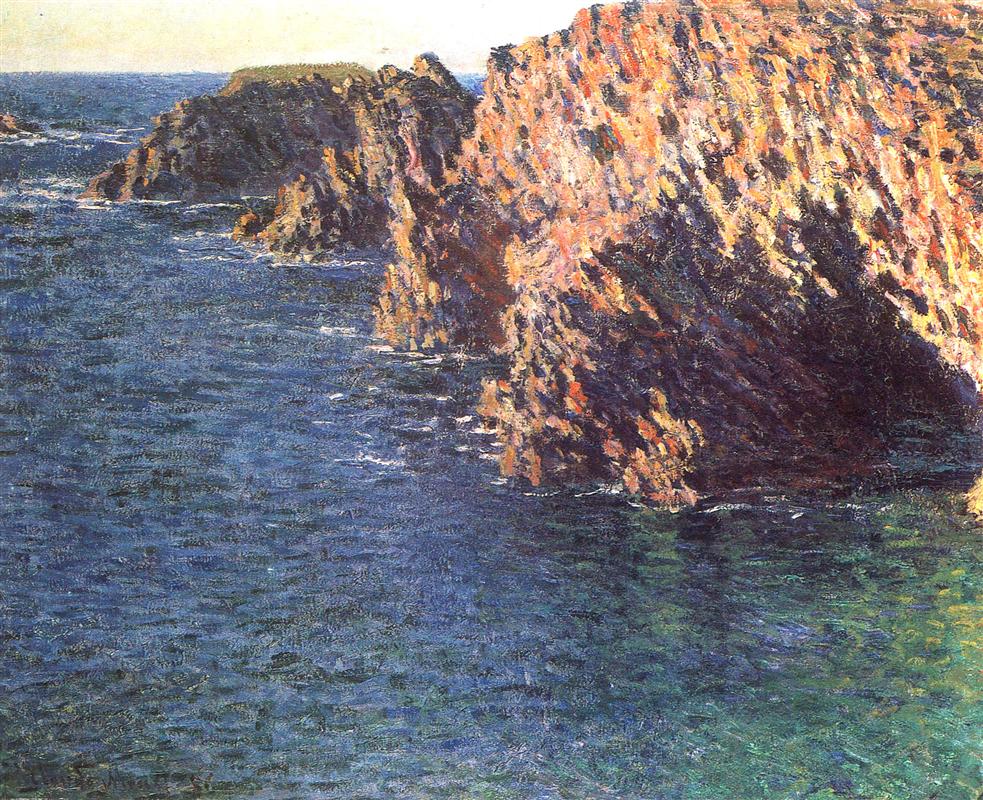
Claude Monet’s “The Grotto of Port-Domois” is one of those seascapes that feels immediate and ancient at the same time. At first glance, the painting seems to present a simple encounter between sea and cliff. A closer look reveals something far more complex. Monet transforms a rugged coastal formation into an experience of light, movement, density, and atmosphere. The scene is rooted in a specific place, yet it resists becoming a straightforward topographical record. Instead, it becomes a study of how vision itself works when confronted with a coastline that is always changing under the effects of wind, water, and sun.
This painting is generally associated with Monet’s stay at Belle-Île in 1886, a period in which he became deeply absorbed by the drama of Atlantic coastal scenery. That setting matters because the work does not depict a calm, decorative shore meant simply to please the eye. It presents nature as resistant, irregular, and alive. The cliffs do not offer a gentle entrance into space. They rise abruptly, catch and fracture the light, and force the viewer to confront their mass. The water below them is not a flat strip of color but a field of shifting tones and broken reflections. Everything in the painting seems to exist in motion, even the rock, which appears stable but is visually animated by Monet’s brushwork.
What makes “The Grotto of Port-Domois” so compelling is the balance it achieves between structure and sensation. The painting is carefully organized, yet it never feels rigid. It is full of strong forms, but those forms dissolve into flickering touches of paint. Monet is not only painting a cliff face and the sea below it. He is painting the act of seeing them in changing light. That ambition places the work firmly within his mature development as an Impressionist, while also showing how far he could push landscape painting beyond mere description.
Historical Context and Monet’s Coastal Vision
By the time Monet painted works related to Belle-Île, he had already spent decades studying the natural world through direct observation. He had painted rivers, gardens, villages, snow scenes, railway stations, and beaches. Yet the coast offered him something unique. It brought together several elements that fascinated him throughout his career: unstable light, reflective surfaces, shifting weather, and the challenge of rendering nature without forcing it into academic clarity.
The coastline at Port-Domois gave Monet a subject that was both solid and elusive. Cliffs appear permanent, but their appearance changes from hour to hour. Their surfaces absorb and reflect color differently depending on the sun’s angle, the condition of the sky, and the movement of the sea below. In this sense, the painting belongs to Monet’s broader artistic project. He was never satisfied with the old idea that painting should present a stable, idealized image of the world. He wanted to show how reality appears in lived time, under particular conditions, from a particular point of view.
This approach separates Monet from earlier landscape traditions that often treated nature as a setting for narrative or moral meaning. In “The Grotto of Port-Domois,” there are no figures, no anecdotal details, and no literary cues guiding interpretation. The drama comes entirely from the natural forms themselves and from the painter’s response to them. That absence of human presence makes the scene feel even more powerful. The coast exists on its own terms. Monet meets it as an observer, but he does not try to tame it.
At the same time, the painting shows how Impressionism evolved beyond sunny leisure scenes and urban modernity. Monet is often associated with shimmering gardens, water lilies, and pleasant outdoor light, but this seascape reminds us that his art could also be severe, forceful, and physically intense. The cliffs are not softened into picturesque charm. Their scale and texture dominate the composition. The beauty of the painting comes from its truth to the visual experience of an unforgiving landscape.
Composition and the Power of Cropping
One of the most striking features of “The Grotto of Port-Domois” is its composition. Monet does not place the viewer at a comfortable distance from the subject. Instead, he brings the nearest cliff so close to the front of the image that it feels cropped by the edge of the canvas. This creates a powerful sense of immediacy. The rock face occupies much of the right side and upper portion of the picture, pushing itself into the viewer’s space and making the scene feel almost physically present.
This compositional decision gives the painting tension. Rather than offering a broad panoramic view, Monet chooses a partial, angled view that emphasizes the interruption of vision. We do not see the entire coastal formation in a balanced, centered way. We see it from a position that feels contingent and real, as though Monet stopped at a particular spot and painted what the eye could grasp from there. That sense of partiality is essential to the work’s modernity. The image does not pretend to be complete in an absolute sense. It records an encounter.
The receding line of cliffs toward the left background helps create depth, but Monet avoids using strict linear perspective in a traditional academic manner. Space is built through overlapping forms, tonal variation, and the changing density of paint. The nearer cliff appears larger, brighter, and more texturally active. The farther landmass is darker and flatter, though still alive with broken brushwork. Between them, the water acts as both separator and connector, a shifting band that ties the composition together.
The large open area of sea in the foreground also plays a crucial role. Without it, the painting would feel cramped. With it, Monet creates breathing room and allows the eye to move before confronting the heavy rock masses. The water becomes a visual threshold. It is not empty space but active space, full of color modulation and surface vibration. Because of this, the composition achieves a dynamic balance between openness and obstruction, fluidity and solidity.
The Cliffs as Monument and Surface
The cliffs are the emotional and visual center of the painting. Monet treats them not as inert geological facts but as vibrant surfaces that catch the light in countless variations. Their vertical and diagonal planes give the composition weight and structure, but their apparent solidity is constantly challenged by the broken, flickering manner in which they are painted.
What is remarkable is how the cliffs seem to oscillate between monumentality and instability. On one hand, they tower over the scene and dominate the frame. They feel ancient and immovable. On the other hand, Monet’s brushstrokes refuse to let them become fixed blocks of matter. Their surfaces shimmer with pinks, ochres, violets, creams, rust tones, and deep blue shadows. Light does not simply fall on the cliffs from the outside. It seems to penetrate them, splinter across them, and reveal their irregular textures.
This treatment turns geology into sensation. Monet is not diagramming rock strata. He is conveying how the eye reads a complex surface under changing illumination. The cliffs become a field of visual incidents. Sharp edges, crevices, projecting faces, and shadowed recesses all emerge through touches of color rather than through hard contour lines. Because of this, the rock formations feel alive. They do not literally move, but they vibrate in the viewer’s perception.
There is also a subtle psychological effect in the way Monet paints these cliffs. Their steepness and scale suggest danger, or at least indifference to human comfort. The viewer is not invited into a welcoming landscape. Instead, one confronts a natural force shaped over time by erosion and weather. Yet Monet makes that force visually intoxicating. The very roughness of the cliff becomes a source of beauty. He discovers richness in fracture, irregularity, and resistance.
Water, Reflection, and the Language of Movement
If the cliffs provide mass, the water provides motion. The sea in “The Grotto of Port-Domois” is not rendered as a smooth reflective mirror. It is dense, layered, and restless. Monet uses short, varied strokes to suggest the surface agitation of the water, and these strokes create a subtle rhythm across the foreground. The result is a surface that seems continuously in flux.
The color of the water is especially important. Rather than relying on a single descriptive blue, Monet builds the sea out of multiple tones. Deep blues dominate, but within them are greenish passages, cooler gray notes, and scattered touches of lighter paint that suggest the reflection of sky and cliff. Near the base of the rocks, the water takes on greener hues, as if light filtered through depth and reflected mineral tones from the stone above. This is one of Monet’s great strengths as a painter: he refuses the obvious local color in favor of observed variation.
The small flickers of pale paint across the surface hint at the movement of water against rock. They are not carefully outlined waves, yet they convincingly suggest contact, churn, and foam. Monet does not need to render every ripple in detail. His method depends on suggestion. The eye assembles the scene from the energy of the brushstrokes.
Water also serves a symbolic purpose in the painting, though Monet is not allegorical in any heavy-handed sense. It represents change in contrast to the apparent permanence of stone. Yet because the cliffs are also visually animated, the difference is not absolute. The painting implies that both sea and rock are part of the same dynamic world. Water erodes stone over time, and light transforms both from moment to moment. Monet’s art captures that shared instability.
Color and the Construction of Light
Light in this painting is inseparable from color. Monet does not apply light as a neutral brightness laid over objects. Instead, light appears through chromatic relationships. The sunlit parts of the cliff glow with warm pinks, pale golds, apricots, and creamy whites. The shadowed parts shift into violets, blues, and dense purples. This contrast between warm illumination and cool shadow gives the image its vibration and depth.
The choice of colors is daring because it moves far beyond literal description. A less adventurous painter might have treated the cliffs as simply brown or gray. Monet sees them as repositories of reflected and refracted color. The rock face becomes a prism of atmospheric effects. Warm and cool tones are interwoven so densely that the cliff appears almost to pulse. This is not decorative excess. It is a way of making visible the complexity of outdoor light.
The water echoes and balances the cliffs chromatically. The deep blues of the sea anchor the painting and prevent the warm rock face from overwhelming the composition. At the same time, those blues are not flat or dead. They contain internal modulation, with turquoise and green passages that pick up some of the brightness of the illuminated cliff. This creates visual unity. Rock and water belong to the same world of light, even though they behave differently.
The sky, though relatively limited in the visible portion of the painting, plays a subtle role. It is pale and understated, which allows the stronger colors of the cliffs and sea to dominate. Monet does not turn the sky into a theatrical spectacle. Instead, he uses it as a quiet counterpoint. Its restraint helps emphasize the intensity of the lower forms. This is a sophisticated decision because it keeps the composition from becoming overloaded.
Brushwork and the Material Presence of Paint
Monet’s brushwork is central to the success of “The Grotto of Port-Domois.” The painting would lose much of its force if the same scene were rendered with polished, smooth academic technique. Here, the visible stroke is not a byproduct but a primary expressive tool. Paint is laid down in distinct touches that remain legible on the surface. These touches vary in direction, thickness, and density according to the needs of the motif.
On the cliffs, the strokes often follow the jagged structure of the rock. They descend diagonally or vertically, creating the sensation of rough, broken planes. On the water, the strokes become more horizontal and fluid, though never mechanically regular. This difference in handling helps the viewer feel the difference between stone and sea without relying on rigid outline.
What is especially impressive is how Monet uses the materiality of paint to parallel the materiality of the landscape. Thick, energetic applications of pigment suggest the tactile roughness of the cliffs. More layered and flickering marks suggest the shifting skin of the water. The brushstroke becomes a kind of equivalent for the physical world, not by copying it directly but by finding a visual language that feels appropriate to it.
This also means the painting operates on two levels at once. From a distance, the image coheres into a believable seascape. Up close, it breaks into autonomous marks and patches of color. That double experience is one of the pleasures of Monet’s art. The viewer is made aware both of nature and of painting as a constructed object. “The Grotto of Port-Domois” is therefore not only about a coastal scene. It is also about the act of transforming vision into paint.
Space, Scale, and the Viewer’s Position
Monet creates a powerful sense of scale without relying on human figures or architectural markers. The cliffs feel large because of how they are positioned in relation to the open water and to the edges of the canvas. Their abrupt rise and sharp descent into the sea suggest a landscape that exceeds the limits of the picture. The viewer senses that the visible forms are only fragments of a larger coastal system.
This is where Monet’s handling of space becomes especially modern. Traditional landscape painting often guides the viewer smoothly into depth through clear recession and balanced framing. Here, the nearest cliff interrupts that movement. It blocks as much as it reveals. The eye is drawn outward toward the distant headland, then back again to the luminous rock in the foreground. Space is therefore not passively received. It is actively negotiated.
The implied grotto or recess within the rocky formation adds another layer of interest. Even if the opening is not theatrically emphasized, the title directs attention to the idea of hidden space within the cliff. This suggests inwardness as well as outward extension. The coast is not only a facade. It contains depths, cavities, and unseen interiors. Monet hints at this without turning it into narrative mystery. The result is a subtle sense of enigma.
The viewer’s position feels precarious in the best possible way. We are close enough to feel the imposing nature of the cliffs, yet far enough to see their interaction with the sea. This unstable balance intensifies the work’s atmosphere. It is not the viewpoint of leisurely detachment. It is the viewpoint of someone present at the edge of a powerful environment.
Mood and Emotional Resonance
Although Monet is often celebrated for his observational precision, paintings like this show how strongly mood emerges from his landscapes. “The Grotto of Port-Domois” does not rely on narrative drama, yet it has a distinct emotional character. The mood is serious, concentrated, and slightly austere. There is beauty here, but it is not soft or sentimental. It is the beauty of force, exposure, and elemental contrast.
Part of this mood comes from the absence of anecdotal distractions. No boats, bathers, or strolling figures soften the scene. Nature appears self-contained. Another part comes from the stark relationship between the dark blue water and the blazing cliff face. The contrast feels almost musical, with deep lower tones set against luminous higher ones. The painting seems to alternate between calm and intensity.
There is also a sense of solitude in the work. Even though the surface is alive with brushstrokes, the overall emotional effect is not bustling but inward. The viewer is left alone with rock, sea, and light. That solitude can feel meditative, but it can also feel slightly overwhelming. Monet allows both responses to coexist.
This emotional ambiguity is part of the painting’s strength. It does not tell the viewer exactly how to feel. Instead, it offers a visual experience rich enough to support multiple reactions. One might see the cliffs as radiant and uplifting, or as severe and daunting. One might read the sea as serene in its broad expanse, or as restless in its ceaseless motion. The painting remains open, and that openness gives it lasting power.
The Painting’s Place in Monet’s Development
“The Grotto of Port-Domois” reveals Monet at a moment when his landscape painting had become both more daring and more concentrated. He was no longer simply demonstrating the principles of early Impressionism. He was deepening them, using them to confront subjects of greater structural complexity and emotional weight.
The Belle-Île works show a Monet who could handle difficult motifs without losing freshness. Coastal rock formations are visually demanding because they combine irregular geometry, shifting light, and constantly changing surroundings. In this painting, Monet meets that challenge by trusting color, touch, and direct sensation. He does not simplify the cliffs into easy shapes, but neither does he overdefine them. The balance he achieves is the result of long experience.
This painting also anticipates later developments in his career. The emphasis on repeated observation, the interest in a motif transformed by conditions, and the increasing autonomy of brushstroke and color all point forward. Even though “The Grotto of Port-Domois” remains firmly tied to a specific site, it already shows Monet moving toward a vision in which the boundary between object and atmosphere becomes increasingly fluid.
For viewers today, the painting remains impressive not only as an example of Impressionism but as a statement about landscape itself. Monet shows that nature is not a static backdrop waiting to be recorded. It is an event of perception. The coast becomes meaningful through light, color, and the painter’s sustained attention. That is why the image still feels vivid. It is not merely about what Port-Domois looked like. It is about what it felt like to stand before it and truly see.
Conclusion
“The Grotto of Port-Domois” is a masterful example of Claude Monet’s ability to transform a coastal scene into a living field of sensation. Through its daring composition, luminous color contrasts, energetic brushwork, and intense attention to the relation between sea and rock, the painting becomes far more than a descriptive landscape. It is an exploration of presence, atmosphere, and the instability of visual experience.
The cliffs dominate the image, yet they never become inert. The sea opens the composition, yet it never becomes empty. Every area of the canvas participates in Monet’s larger goal of making perception visible. He paints not only the appearance of the coast but the pulse of light across it, the resistance of stone, and the shifting movement of water below.
That is why the painting endures. It captures something essential about Monet’s art at its strongest. He looks at nature with extraordinary patience, but he also allows it to remain wild, fractured, and unresolved. In “The Grotto of Port-Domois,” the viewer encounters a landscape that feels immediate, physical, and deeply alive. The result is a seascape of remarkable intensity, one that stands as both a powerful work of Impressionism and a profound meditation on how the natural world reveals itself through light.
