Image source: wikiart.org
Introduction
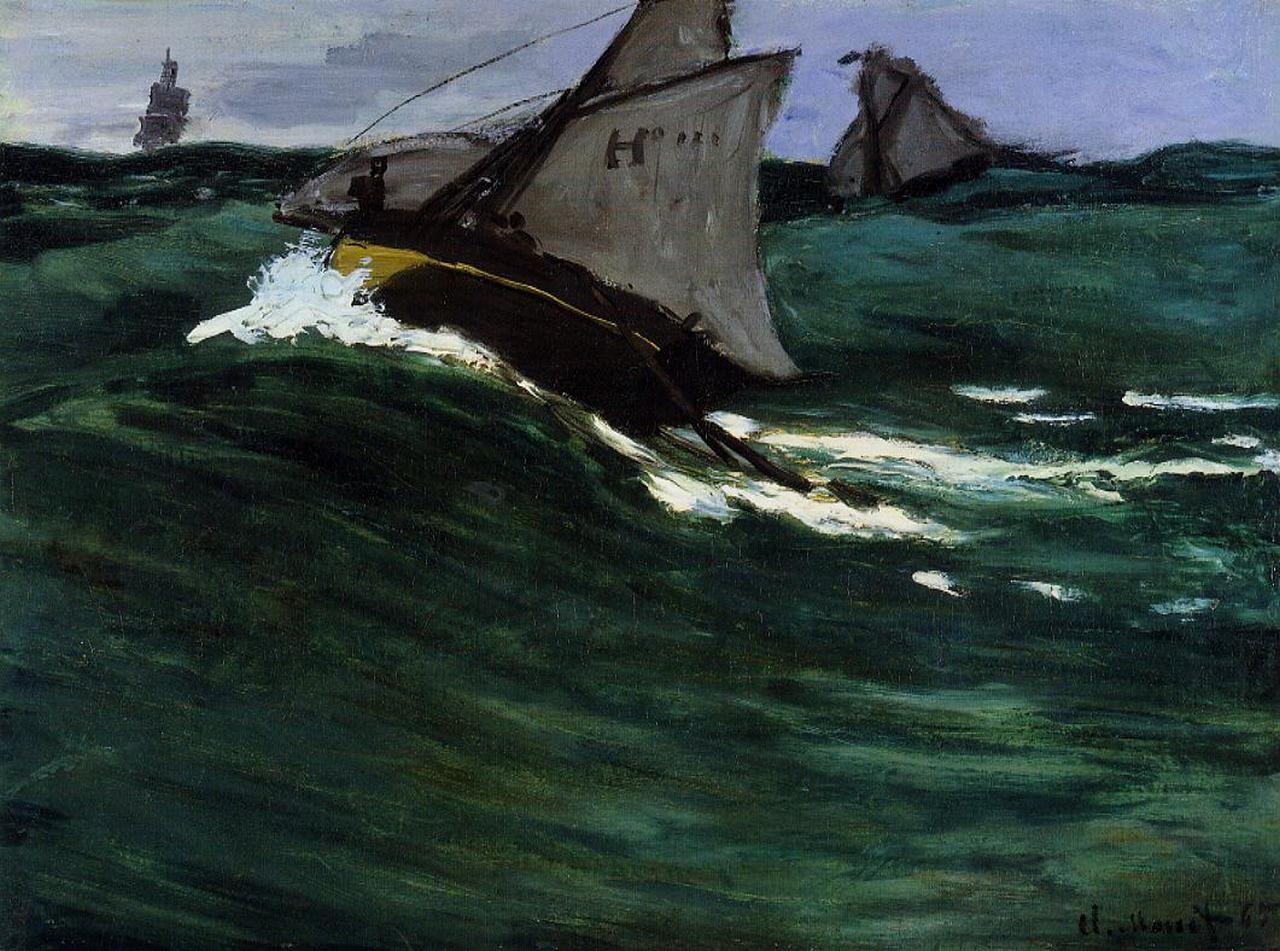
Claude Monet’s The Green Wave from 1866 is a striking early seascape that reveals just how ambitious he already was before Impressionism had fully taken shape as a movement. At first glance, the painting seems simple. A few boats rise and fall in rough water under a pale sky. Yet the longer one looks, the more powerful the work becomes. The painting is not really about boats alone, or even about the sea in a literal sense. It is about movement, instability, atmosphere, and the overwhelming force of nature. Monet turns a marine scene into something immediate and physical, as if the viewer is not standing safely on shore but confronting the swell head on.
This is one of the qualities that makes The Green Wave so memorable. It does not feel distant or decorative. It feels close, unsettled, and alive. The sea occupies most of the composition, and that decision matters. Monet gives the green water a monumental presence, making it the true subject of the painting. The boats are there, but they are secondary to the wave itself. The painting’s title already directs attention to that fact. The wave is not just part of the setting. It is the central event.
Seen within the larger arc of Monet’s career, this work is especially fascinating because it shows an artist still early in his development but already pushing toward the qualities that would later define him. Here, one can sense his fascination with fleeting visual experience, his refusal to smooth nature into something calm and polished, and his desire to capture a moment rather than a timeless ideal. The Green Wave belongs to the world of nineteenth century marine painting, but it also points beyond it. It suggests a new way of seeing, one based on sensation, atmosphere, and the unstable surface of things.
Historical Context
By 1866, Monet was a young painter working in a period of artistic transition. Academic painting still dominated official taste in France, and polished history painting remained the most prestigious genre. At the same time, a growing number of artists were turning toward modern life, landscape, and direct observation of the natural world. Monet stood at the center of that shift. He had already been shaped by outdoor painting, by contact with fellow artists who valued immediacy and truth to visual experience, and by an intense interest in light and weather.
Marine subjects had a long history before Monet. The sea had been painted by Dutch masters, by Romantic artists, and by French painters who were drawn to harbors, storms, and coastal life. But many earlier marine paintings emphasized either narrative drama or carefully structured grandeur. Monet’s approach feels different. In The Green Wave, he is less interested in telling a story than in capturing the sensation of looking at water in motion. The scene contains drama, but it is not theatrical in the old sense. It is observational, visceral, and immediate.
This period was also important in Monet’s personal artistic evolution. He had not yet become the painter of haystacks, cathedrals, and water lilies for which he is best known today. Yet many of the seeds of that later achievement are already visible here. He is studying how light touches surfaces, how forms dissolve in atmosphere, and how brushwork can suggest instability and flux. The sea gave him an ideal subject for those concerns because water never stays still. It changes shape from moment to moment, and its color depends entirely on light, sky, and depth. In painting the sea, Monet was already practicing the art of perception that would define his mature work.
First Visual Impression
One of the most powerful things about The Green Wave is the force of its first impression. The viewer is confronted by a dark, rising mass of water that occupies the foreground and pushes upward into the picture. It is not a calm sea viewed from a distance. It is a body of water that seems to surge directly toward us. That immediacy creates tension. Even before the eye settles on the boats, the painting communicates motion and instability.
The main boat appears near the center, cutting into the swell with its sail catching the light. Another vessel lies farther back, partially obscured by the waves, and a more distant ship rises faintly on the horizon. This recession into depth gives the image structure, but Monet never allows the background to become more important than the foreground surge. The painting feels anchored in the present moment, in the physical encounter between boat and water.
There is also a strong emotional effect produced by the contrast between the pale sails and the dark sea. The sails appear fragile, almost ghostlike, against the heavy green water. The boats seem small in relation to the surrounding force of nature. Yet they are not swallowed entirely. They persist, holding their course. That balance between vulnerability and endurance gives the painting much of its energy.
The sky, subdued and cool, contributes to the mood without distracting from the main event. It offers enough light to define the forms, but it remains restrained. The sea is where the action is. Monet keeps the viewer’s attention fixed on its shifting tones, its foam, and its mass.
Composition and Spatial Design
Monet’s composition is bold because it gives so much dominance to the foreground wave. Many marine painters would have distributed interest more evenly across the scene, giving the horizon and ships a larger role. Here, the immense diagonal swell creates a visual structure that almost overwhelms the conventional balance of the image. It rises from the lower left and sweeps upward, guiding the eye toward the central boat and then out toward the distant vessels.
This composition has a cinematic quality before cinema existed. It feels cropped, immediate, and close to the action. The viewer is not placed in an elevated position above the sea. Instead, the perspective suggests proximity to the waterline. That low vantage point makes the boats appear more precarious and the wave more imposing. The result is a composition built not on calm order but on dynamic pressure.
The placement of the central boat is especially effective. It does not sit serenely in open water. It meets resistance. The bow strikes into the swell, and the foam around it shows the force of impact. This is not just a boat resting on water. It is a boat negotiating with it. That encounter becomes the structural core of the image.
The distant elements are important precisely because they are understated. The second boat and the ship on the horizon deepen the space and suggest a larger maritime world beyond the immediate scene. Yet they remain subordinate. Monet uses them as quiet echoes of the main motif rather than as competing centers of attention. The painting therefore feels both expansive and concentrated, open in depth but focused in effect.
Color and the Meaning of Green
The title The Green Wave draws attention to one of the painting’s most memorable features, its unusual and expressive color. Monet does not present the sea as simply blue. Instead, he fills it with dense green tones mixed with dark blues, blacks, and flashes of white. This choice matters because it gives the water an earthy, almost bodily presence. The sea here is not a transparent surface reflecting a bright sky. It is thick, weighty, and alive.
Green in this painting is never flat or uniform. It shifts from deep shadowed passages to lighter, more translucent areas where the water seems to catch the light. These variations create both realism and emotion. Realistically, they suggest the complexity of seawater under changing weather conditions. Emotionally, they give the painting a mood that is more intense and unsettled than a clearer blue sea might have conveyed. The green becomes a color of force, depth, and instability.
The white foam is crucial in activating those green passages. It breaks across the dark water in irregular flashes, making the wave seem to move before the viewer’s eyes. Monet does not outline the foam neatly. He lets it appear as an energetic interruption, a temporary brightness formed by impact and turbulence. This contrast between dark green mass and white foam creates the painting’s visual rhythm.
The sails introduce another important color contrast. Their pale surfaces, touched with grays and muted creams, stand apart from the surrounding water. They catch the available light, offering a temporary calm against the darker sea. Yet they are not radiant in a triumphant way. Their whiteness feels weathered and exposed. That restraint keeps the mood serious and avoids any sense of picturesque prettiness.
Brushwork and Surface Energy
The painting’s brushwork is one of the clearest signs of Monet’s growing originality. Rather than smoothing the surface into a polished academic finish, he allows the paint to remain active and visible. This choice gives the image much of its vitality. The sea is not merely represented. It is built through strokes that echo its movement.
The wave in the foreground is composed of long, sweeping passages that follow the direction of the swell. These strokes create a sense of rolling momentum. At the same time, smaller, sharper accents in the foam and around the boat suggest disruption, collision, and spray. The viewer can feel the difference between the heavier body of the water and the breaking surface where it turns to white.
This handling of paint also affects how the forms are perceived. The boats are defined, but not in a rigid or overdrawn manner. Their contours remain somewhat softened by atmosphere and motion. Monet is less interested in exact description than in visual truth as experienced in a fleeting moment. That is a major step toward Impressionism. The painting still has more solidity and tonal depth than many of his later works, but the basic principle is already there. Vision is active, unstable, and dependent on conditions.
There is a physical intelligence in the way Monet uses the brush. He does not apply the same touch to every part of the canvas. The sea, foam, sails, and sky all receive different kinds of handling. This variation prevents the painting from becoming monotonous. More importantly, it allows the material of paint to participate in meaning. The surface itself becomes expressive.
The Sea as the True Subject
Although boats appear prominently in The Green Wave, the painting is really about the sea. Monet presents the ocean not as a backdrop for human activity but as a living force with its own presence and authority. The wave is the protagonist. It carries the emotional weight of the scene and gives the work its identity.
This is a significant artistic decision. In many traditional marine paintings, ships are the heroes. They may symbolize commerce, exploration, warfare, or human courage. Here, those themes recede. The boats matter because they reveal the scale and force of the water. Without them, the viewer might not fully register the magnitude of the swell. Yet their role remains secondary. They are measures of the sea, not masters of it.
The foreground wave has a near abstract power because it occupies such a large portion of the image. Its dark body dominates the lower half of the canvas, reducing narrative detail and focusing attention on pure sensation. The eye follows its movement rather than searching for anecdote. This is one reason the painting feels so modern. It privileges perception over storytelling.
At the same time, the sea in this work is not chaotic beyond comprehension. Monet gives it structure and rhythm. The wave rises, the foam breaks, the boats tilt, and the horizon remains faintly stable in the distance. The painting therefore holds together as an ordered visual experience even while depicting instability. That balance between structure and flux is one of Monet’s greatest strengths.
Human Presence and Fragility
Even though the sea dominates, the human presence in The Green Wave is essential. The boats bring scale, tension, and emotional focus. They remind us that this is not just an image of nature in isolation. It is an image of human beings confronting forces larger than themselves.
Monet does not sentimentalize that encounter. The figures, if present, are barely visible. There is no dramatic gesture, no heroic posture, no overt narrative of survival. Instead, the human element is implied through the vessels and their movement. This restraint makes the painting more powerful. The fragility of human effort is felt rather than explained.
The central boat, with its pale sail and dark hull, seems both determined and vulnerable. It presses into the wave, but it does not conquer it. The second boat in the distance reinforces that sense of precariousness. Partly obscured by the swell, it appears even more exposed. Meanwhile, the faint ship on the horizon suggests how small all maritime life is against the broad expanse of sea and sky.
This tension between human persistence and natural force gives the painting a subtle philosophical dimension. It speaks to endurance, uncertainty, and the limits of control. Yet Monet keeps these ideas grounded in the visible world. He does not turn the scene into allegory. The meaning emerges naturally from what is seen.
Mood and Emotional Atmosphere
The emotional atmosphere of The Green Wave is one of seriousness, concentration, and latent drama. It is not a storm scene in the most violent sense, but neither is it peaceful. The mood comes from the sense of pressure in the water, the muted light, and the way the boats appear dwarfed by the surrounding elements.
Part of the painting’s emotional power lies in its refusal to exaggerate. Monet does not fill the sky with lightning or dark theatrical clouds. He does not depict shipwreck or panic. Instead, he presents a single charged moment in which everything feels uncertain. That restraint allows the tension to remain believable and immediate. The viewer senses danger, but it is held in suspension.
There is also a deep melancholy in the color and light. The gray sky and dark sea create an atmosphere that feels cool and solitary. The painting does not celebrate the sea in a grand Romantic manner. It contemplates it. The result is quieter, but in some ways more intense. The viewer is invited not to admire spectacle from a distance but to enter an unstable mood.
This emotional quality helps explain why the painting remains compelling. It captures a recognizable human feeling, the experience of facing something larger, shifting, and not fully controllable. That feeling is conveyed through formal means rather than overt symbolism. The mood is built from color, brushwork, scale, and composition.
Monet’s Early Development and the Path Toward Impressionism
The Green Wave is especially important because it shows Monet in transition. He is still connected to the traditions of marine painting and to a relatively dark tonal palette. Yet he is already moving toward the concerns that would define his mature art. He is less interested in stable form than in shifting appearance. He is painting not just objects but conditions.
One can see this in the way the boats are integrated into atmosphere rather than isolated sharply from it. One can also see it in the treatment of the sea as a changing field of color rather than a fixed surface. The painting does not yet have the bright broken palette of Monet’s later Impressionist work, but it already privileges immediacy over finish and sensation over academic clarity.
This early date is significant because it reminds us that Impressionism did not appear suddenly. It developed through experiments like this one, through years of observing how weather, water, light, and movement could be translated into paint. The Green Wave belongs to that experimental path. It may not look identical to Monet’s later masterpieces, but it contains the same restless intelligence.
What is particularly striking is how modern the composition feels. The close cropping, the emphasis on a transient moment, and the dominance of a single visual sensation all anticipate later developments in art. Monet is not merely recording a marine scene. He is transforming it into a study of perception itself.
Why The Green Wave Still Matters
Today, The Green Wave remains important because it captures something timeless in a fresh and forceful way. It is a painting about nature, but not in a generic sense. It gives us a very specific encounter with water, movement, and vulnerability. It reminds us that the sea can be beautiful without being gentle, and that visual beauty can emerge from instability and tension.
The painting also matters because it broadens our understanding of Monet. Many people know him primarily through his luminous late landscapes, especially the water lilies. This early seascape shows another side of his art, more dramatic, darker in tone, and more physically forceful. It reveals that his interest in water began long before Giverny and that his fascination with surface, reflection, and instability was rooted in earlier experiences.
For modern viewers, the work still feels vivid because its central experience is so direct. One does not need specialist knowledge to feel the push of the wave or the precariousness of the boats. At the same time, the more closely one studies it, the richer it becomes. Its structure, color relationships, and painterly handling reward sustained attention.
In that sense, The Green Wave stands as both an accomplished marine painting and a key document in Monet’s artistic growth. It bridges tradition and innovation. It speaks to the eye immediately, but it also opens onto larger questions about nature, perception, and the evolving language of modern painting.
Conclusion
Claude Monet’s The Green Wave is far more than a simple depiction of boats at sea. It is an early masterwork of movement, atmosphere, and visual tension. By giving the wave itself the dominant role, Monet transforms a maritime subject into a study of force and sensation. The sea becomes not just a setting but a living presence, immense and unstable, against which human effort appears fragile but persistent.
The painting’s power comes from the union of composition, color, and brushwork. The great green swell, the pale sails, the flashes of foam, and the subdued sky all work together to produce an image that feels immediate and alive. Monet captures not a static scene but a fleeting encounter between vessel and water, between human intention and natural motion.
As an early work, it is especially revealing. It shows Monet already thinking in ways that would shape Impressionism, even while he remained connected to earlier traditions of marine painting. He is studying appearances as they shift in time and weather, trusting the expressive potential of paint itself, and seeking truth in direct visual experience.
That is why The Green Wave continues to resonate. It offers both sensory drama and artistic insight. It shows a young Monet discovering how to make nature feel immediate on canvas, and in doing so, it points toward the revolution in seeing that his later work would help bring about.
