Image source: wikiart.org
Introduction
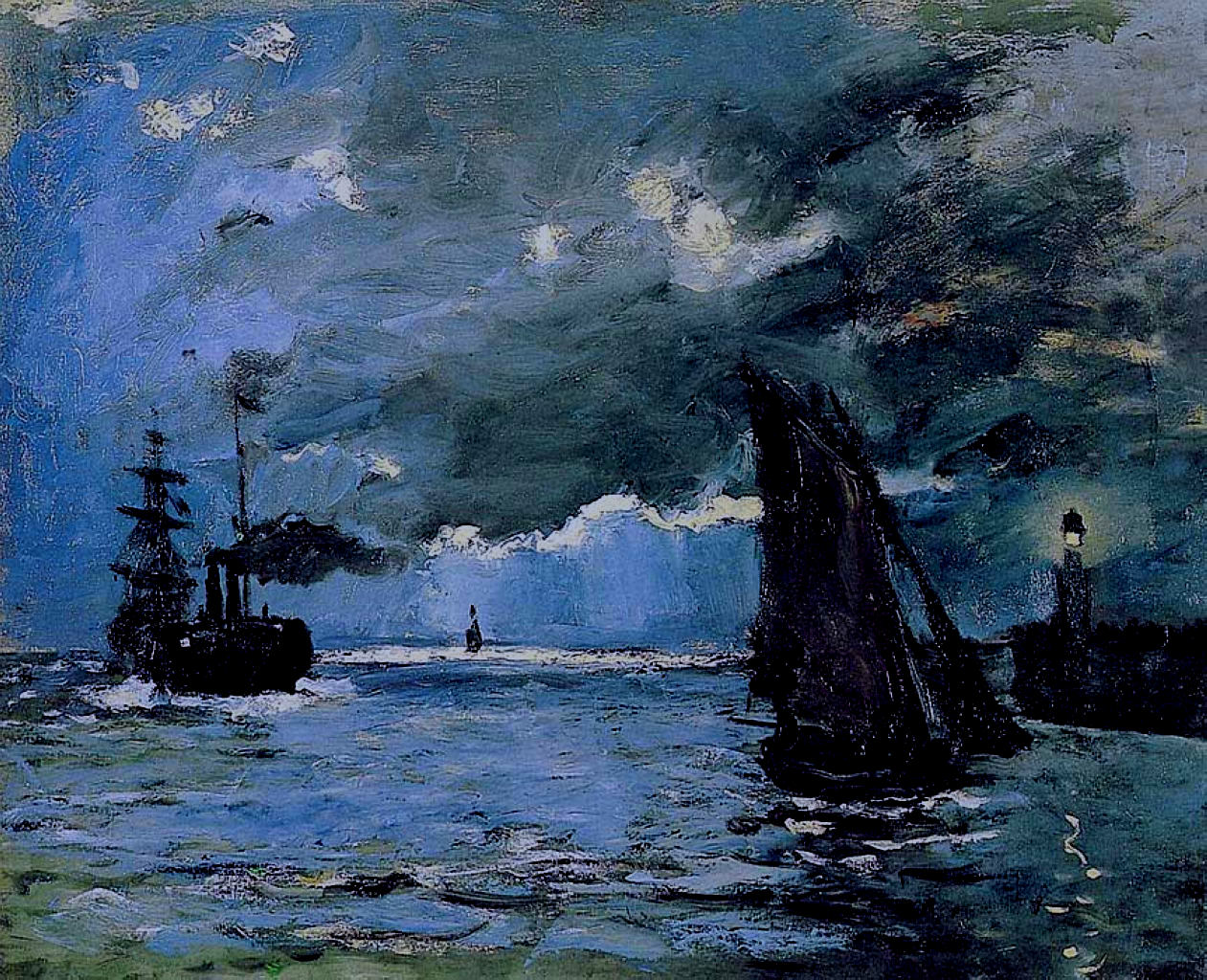
Claude Monet’s Seascape, Night Effect from 1866 is a remarkable early work that already reveals many of the qualities that would later define him as one of the most important painters of modern art. At first glance, the painting feels almost simple. A few boats move across dark water under a vast sky. A distant light flickers at the edge of the horizon. Heavy clouds roll across the scene, while the sea reflects scattered glimmers from above. Yet the longer one looks, the richer and more complex the picture becomes. This is not merely a view of ships at sea. It is an exploration of atmosphere, uncertainty, movement, and light under difficult conditions.
What makes the painting especially compelling is its tension between visibility and obscurity. Monet does not present the sea in a clear, descriptive way. Instead, he gives the viewer fragments of perception. Shapes emerge from darkness, dissolve back into it, and reappear through contrast. The boats are not rendered with precise nautical detail. The sky is not calmly mapped out. The waves are not measured or orderly. Everything feels alive, unstable, and fleeting. The result is a painting that captures not only a seascape at night, but also the actual experience of trying to see in low light while weather, water, and darkness shift constantly.
This early date is important. In 1866, Monet was still building the artistic language that would later make him famous. Even so, this painting shows how early he was pushing away from academic finish and toward a more immediate, sensory kind of painting. Instead of turning the night sea into a polished historical image, he treats it as a living environment. He is interested in what light does to form, how atmosphere changes perception, and how paint itself can suggest instability. In that sense, Seascape, Night Effect stands as an important sign of the artist Monet was becoming.
Historical Context and Monet’s Early Development
By the mid 1860s, Monet was a young painter deeply engaged with modern life and natural observation. He had already begun to reject the rigid conventions of academic art, especially the idea that a painting had to present a carefully finished, idealized version of reality. He was increasingly drawn to direct encounters with the natural world, especially changing weather, shifting light, and transient effects that could not be frozen into fixed formulas.
Marine subjects were a natural part of this development. The coast offered constantly changing conditions, open space, and dramatic interactions between sky and water. The sea also gave Monet an ideal setting for experimentation because it was never static. Waves, clouds, reflections, and boats in motion all challenged traditional methods of representation. A seascape could not be treated like a still interior or a posed figure. It demanded responsiveness. The painter had to work with speed, sensitivity, and a willingness to accept instability.
In Seascape, Night Effect, Monet turns that challenge into the central subject of the painting. Rather than using the sea merely as a backdrop, he lets it become a field of visual transformation. The work belongs to a moment when he was increasingly focused on sensation rather than strict finish. This is why the painting feels so modern. Monet is not trying to provide exhaustive information. He is trying to convey the feeling of being there, standing before a sea at night, where darkness obscures detail and the eye must rely on flashes, silhouettes, and tonal contrasts.
This approach places the painting at an important point in nineteenth century art. Many artists had painted seascapes before Monet, and the genre had a long history. But Monet’s contribution lies in the way he dissolves traditional clarity. He is not interested in giving the viewer a neatly organized maritime narrative. Instead, he offers an environment in flux. This marks a clear movement toward the kind of vision that would later be associated with Impressionism, even though the painting precedes the formal emergence of that movement.
Composition and the Drama of Space
The composition of Seascape, Night Effect is one of its strongest features. Monet arranges the scene so that the viewer feels both grounded and unsettled at the same time. The water occupies the lower portion of the canvas, but it does not feel calm or flat. It serves as an unstable surface that leads the eye into the distance. The horizon line sits relatively low, which allows the sky to dominate the composition. This gives the painting a sense of scale and tension. The sea is significant, but the sky feels overwhelming.
The boats are placed strategically to create balance without symmetry. A dark vessel at the left anchors the image, while a larger, more imposing sail shape rises on the right. Between them lies an opening toward the distant horizon, where a smaller boat appears and light glows faintly in the distance. This arrangement creates a kind of visual corridor. The eye moves from foreground darkness toward remote light, then back again into the surrounding gloom. The painting therefore works through opposition. Near and far, light and dark, solidity and vapor all interact across the surface.
One of the most striking aspects of the composition is the way Monet uses silhouette. The vessels are not described in minute detail. Instead, they stand as dark masses against lighter areas of sky and water. This makes them feel both real and ghostly. They have presence, but they also seem vulnerable to disappearance. In daylight, such ships might be clear and specific. At night, however, they become shapes carved out of darkness. Monet understands this perfectly and builds the whole composition around that visual fact.
The right side of the painting is especially dramatic. The tall dark sail rises almost like a vertical force against the broad sweep of the sky. It interrupts the horizontal movement of sea and horizon, creating tension and monumentality. Although the painting is not large in subject matter, this shape gives it an almost theatrical presence. It feels like a sudden apparition, part ship and part shadow. That ambiguity adds greatly to the mood of the work.
Color and the Language of Night
Color plays a central role in the power of this painting. Monet does not treat night as simple blackness. Instead, he reveals that darkness is full of color. Blues, greenish tones, gray, white, and deep black interact across the surface. These colors are muted, but they are far from dull. Their subtle relationships create the atmosphere of the painting.
The dominant impression is one of coolness. Blue saturates much of the image, especially in the sky and water. But this blue is not uniform. It shifts from pale, luminous passages to denser, darker areas. In some places it approaches silver. In others it seems almost green. These variations allow the painting to breathe. Night is shown not as an absence of color, but as a condition in which color becomes more delicate, uncertain, and suggestive.
The whites are also crucial. Small highlights in the clouds and on the water act like sparks. They do not flood the scene with illumination, but instead appear as broken fragments of light. This is one of the painting’s great strengths. Monet understands that nocturnal light is partial. It reveals only bits and pieces. The viewer must connect those fragments mentally, which makes the act of looking more active and immersive.
Dark tones are used with equal intelligence. The ships, sail, and portions of the sky are rendered in deep blacks and blue blacks that create dramatic contrast. These passages give the painting structure. Without them, the luminous effects would lose their force. Monet therefore uses darkness not just as atmosphere, but as architecture. It shapes the picture and directs attention.
The relationship between color and mood is very strong here. The cool palette conveys quiet, distance, and unease, but it never becomes lifeless. There is energy in the brushwork and subtle vibrancy in the tonal transitions. The night feels active, not dead. The sky churns, the sea moves, and light pulses through the darkness. This dynamic use of color is one reason the painting feels so modern and emotionally convincing.
Brushwork and the Material Presence of Paint
Another remarkable feature of Seascape, Night Effect is its brushwork. Monet handles paint in a way that makes the image feel immediate and alive. Rather than smoothing everything into polished finish, he allows brushstrokes to remain visible. This gives the painting a tactile surface and reinforces the sensation of movement.
The sky is especially expressive. Broad, energetic strokes suggest drifting clouds, turbulent weather, and unstable light. The paint appears layered and varied, with some passages thin and atmospheric, others thicker and more assertive. This uneven handling is not accidental. It mirrors the unpredictability of the scene itself. The sky is not a fixed backdrop. It is in motion, and Monet’s brush makes that motion visible.
The sea is treated differently but with equal sensitivity. Horizontal strokes create the sense of water stretching across space, while broken marks and lighter accents suggest reflection and wave movement. These strokes do not describe each wave individually. Instead, they capture the general rhythm of the water. This is a crucial distinction. Monet is not cataloging forms. He is translating sensation into paint.
The dark ships are painted more solidly, but even here the brushwork remains loose enough to preserve atmosphere. Their outlines are not hard and final. They emerge from the surrounding tones rather than being sharply cut out from them. This keeps the entire image unified. Nothing feels pasted onto the surface. Everything seems to belong to the same humid, unstable world.
Visible brushwork in a painting like this also has a deeper meaning. It reminds the viewer that the image is a made object, a record of perception translated by hand. Monet’s strokes carry the urgency of observation. They suggest a painter responding quickly to changing conditions, trying to catch something before it vanishes. That urgency is part of the emotional force of the picture.
Atmosphere, Weather, and the Experience of Uncertainty
Perhaps the most memorable quality of Seascape, Night Effect is its atmosphere. Monet does not simply depict boats on water. He creates an enveloping environment in which weather, darkness, and distance all influence what can be seen. The painting feels humid, windy, and unstable. It seems to belong to a moment when the elements are shifting and no form is entirely secure.
This atmosphere depends partly on the blurring of boundaries. Sea and sky are distinct, but not rigidly separated. Clouds drift into darkness, darkness falls onto water, and light glimmers between both. This creates a sense of continuity across the canvas. The world is not divided into clearly measurable parts. Instead, it appears as a fluid whole in which everything affects everything else.
The theme of uncertainty is central. Night reduces visibility, and Monet embraces that reduction. He does not try to overcome it with excessive description. On the contrary, he builds the painting around partial vision. The viewer sees enough to recognize ships, water, and sky, but not enough to feel complete mastery over the scene. This uncertainty gives the work its emotional depth. It evokes solitude, caution, and wonder.
At the same time, the painting is not frightening in an extreme way. Its darkness is balanced by beauty. The small bursts of light, the elegance of the sail forms, and the expansive rhythm of sea and sky all create a sense of poetry. The unknown here is not simply threatening. It is also alluring. Monet invites the viewer to dwell in ambiguity rather than escape it.
This is one of the reasons the painting continues to resonate. It captures a universal human experience, the feeling of looking into darkness and finding that the world has become both less clear and more mysterious. Instead of resisting that mystery, Monet turns it into the subject of art.
The Maritime Subject and Its Emotional Meaning
Seascapes have long carried emotional and symbolic associations, and Monet’s painting participates in that tradition while remaining grounded in direct observation. Ships at sea often suggest travel, risk, labor, and the vulnerability of human life before nature. In Seascape, Night Effect, these ideas are present, but they are handled with restraint. There is no overt narrative, no shipwreck, and no dramatic human action in the foreground. Yet the emotional weight of the maritime setting is undeniable.
The boats appear small in relation to the sky and sea. Even the larger sail on the right, imposing as it is, feels exposed within the vastness of the scene. This creates a subtle sense of human fragility. The vessels are signs of human presence, but they do not dominate nature. Instead, they move within it carefully, almost tentatively.
The distant light also contributes to the emotional structure of the painting. It may suggest guidance, harbor, or safety, but it remains remote. Monet does not bring reassurance too close. The light is visible, yet far away, and that distance matters. It gives the painting a feeling of longing and continuation. The scene has not ended. The boats are still moving through uncertainty toward whatever lies beyond the visible horizon.
The maritime setting also allows Monet to investigate a world of surfaces and depths. Water reflects light, but only incompletely. It mirrors and distorts at the same time. This makes the sea a perfect subject for a painter interested in unstable appearances. In this work, the sea is both a physical space and a metaphor for visual uncertainty itself.
Why This Painting Matters in Monet’s Career
Although Seascape, Night Effect belongs to Monet’s early career, it already contains many of the concerns that would define his mature work. First, there is the emphasis on fleeting effects. Monet is not interested in a timeless, static image. He focuses on a specific condition of light and weather. This commitment to momentary perception would become central to his later art.
Second, the painting shows his growing interest in atmosphere as subject matter. The sea, boats, and sky are important, but what truly unifies the image is the surrounding air, the dampness, darkness, and luminous instability that tie everything together. Later in his career, Monet would repeatedly return to this idea, whether painting rivers, haystacks, cathedrals, or water lilies. He was always concerned with how environment alters appearance.
Third, the work demonstrates his willingness to let paint remain open and expressive. The image is convincing not because it is highly finished in an academic sense, but because its brushwork feels responsive to the scene. This painterly freedom would become a defining feature of Impressionism and of Monet’s own style.
Finally, the painting matters because it reveals that Monet’s originality was present early on. Even before the height of Impressionism, he was already questioning how much detail a painting needed, how darkness could be colored, and how visual uncertainty could become aesthetically powerful. Seascape, Night Effect is therefore not just an interesting early work. It is a key example of his developing modern vision.
Enduring Appeal and Final Thoughts
The lasting appeal of Seascape, Night Effect lies in its ability to feel both immediate and elusive. It presents a recognizable scene, yet it never gives itself away all at once. The viewer must spend time with it, adjusting to its darkness, following its broken lights, and allowing its forms to emerge gradually. That slow process of looking is part of the painting’s beauty.
Monet transforms a relatively simple maritime view into something deeply atmospheric and emotionally resonant. He shows that night is not emptiness but complexity. He shows that darkness can be rich with color. He shows that uncertainty can be beautiful. Most importantly, he shows that painting can capture not just objects in the world, but the unstable act of perceiving them.
This is why the work remains so compelling. It is not merely an illustration of boats on the sea in 1866. It is a meditation on vision itself. The painting asks what we truly see when light fades, when weather thickens, and when the world becomes harder to define. Monet’s answer is not intellectual or literal. It is painterly. Through tone, brushwork, and atmosphere, he gives form to the fragile border between seen and unseen.
In the end, Seascape, Night Effect stands as a powerful example of Monet’s early genius. It reveals an artist already capable of turning transient sensation into enduring art. The sea is dark, the clouds are heavy, and the boats move through a world of uncertainty, yet the painting glows with life. That paradox is its greatness. It captures a night scene, but it also illuminates the direction of modern painting.
