Image source: wikiart.org
Claude Monet and the World of Honfleur
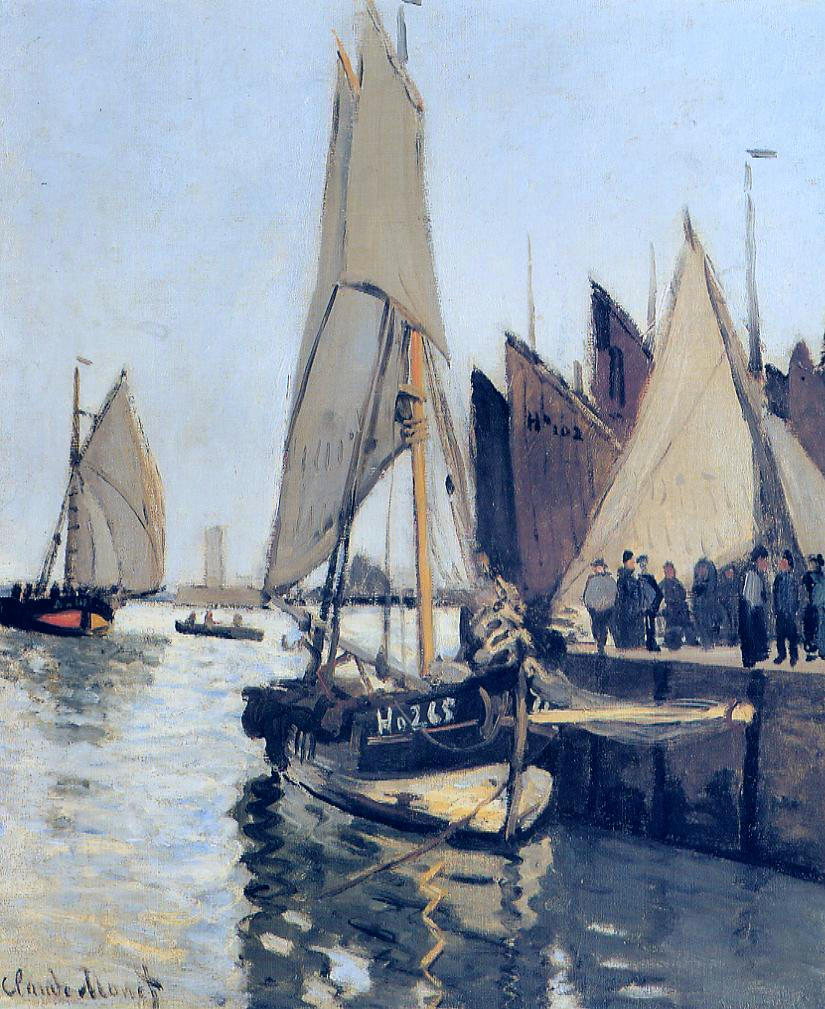
Claude Monet’s Sailing Boats at Honfleur from 1866 belongs to a crucial moment in the artist’s early development. It shows a harbor scene that might seem modest at first glance, yet it reveals many of the qualities that would later define Monet’s mature art. The painting is not built around dramatic storytelling, grand historical subject matter, or idealized figures. Instead, it turns to an ordinary coastal setting and discovers within it a rich visual experience shaped by light, atmosphere, water, and the changing life of the port.
Honfleur was an important place for Monet in the 1860s. The Norman coast gave him direct contact with maritime scenery, open sky, shifting weather, and the visual effects of reflection on water. In a work like this, he does not simply record boats at rest. He transforms a harbor into a living field of perception. The sails rise like pale vertical accents, the water breaks into unstable reflections, and the dock becomes a stage where stillness and movement exist together. This is what makes the painting compelling. It is both specific and fleeting, both observed and interpreted.
The scene also reflects Monet’s growing independence from academic traditions. Instead of composing a perfectly finished marine view in the conventional sense, he paints what the eye actually encounters in a moment of looking. Shapes are simplified, outlines are sometimes loose, and surfaces remain open enough to preserve a sense of immediacy. The result is a picture that feels alive rather than polished into stiffness. Even in this early date, Monet is already showing that painting can be less about ideal finish and more about sensation, atmosphere, and truth to experience.
The Harbor as Subject
The subject of this painting is deceptively simple. We see a cluster of sailing boats at Honfleur, some moored at the dock and others further out on the water. A small group of people stands on the right, gathered near the edge of the harbor. Masts and sails break the sky into vertical rhythms. The water below mirrors fragments of hulls, sails, and dock structures in a surface that is never entirely still. The port appears active, but not chaotic. There is motion implied everywhere, yet the whole scene remains calm.
This choice of subject mattered enormously in the nineteenth century. Harbors, rivers, and coastal towns provided artists with a modern alternative to the grand themes of history painting. They allowed painters to engage with everyday life, commerce, weather, and local identity. For Monet, a harbor was especially attractive because it united solid forms and unstable visual effects. Boats have clear structures, but water dissolves those structures into shimmering reflections. Docks create strong geometry, but the atmosphere softens edges and distances. A place like Honfleur offered both order and instability, making it ideal for a painter interested in how vision actually works.
In this picture, the harbor is not just a backdrop. It is the real protagonist. The boats, the dock, the figures, and the water all contribute to a single visual environment. Monet is less interested in individual identities than in relationships between forms. He wants us to see how a pale sail stands against a cool sky, how dark hulls anchor the lower half of the composition, and how human activity becomes part of the larger rhythm of the port. That ability to turn a simple harbor view into a unified visual event is one of the painting’s greatest strengths.
Composition and Visual Balance
One of the most striking aspects of Sailing Boats at Honfleur is its composition. Monet arranges the scene so that the viewer’s eye moves naturally from foreground to distance while remaining aware of strong vertical and diagonal structures. The large boat in the foreground occupies a central position, its tall sail rising upward and immediately claiming attention. This boat acts as an anchor for the entire composition. Around it, Monet places additional sails and vessels that create repetition without monotony.
The dock on the right gives the scene weight and stability. Its dark mass contrasts with the luminous water and the pale sails. The group of figures standing there adds a human note and reinforces the sense that this is an observed moment from daily life. At the same time, the figures are not individualized portraits. They function as part of the design, establishing scale and helping the viewer feel the physical presence of the harbor.
The left side of the composition opens out toward water and distance. A smaller boat appears there, and beyond it the harbor extends into a hazy horizon. This openness prevents the image from becoming too crowded. It also creates a subtle tension between enclosure and release. The right side is busy and structured, while the left side feels airy and expansive. Monet uses this contrast skillfully, giving the painting both solidity and breath.
The verticality of the sails is especially important. These tall forms divide the picture plane and create upward movement, but they also remain soft and pliable rather than rigid. Because sails catch light differently across their surfaces, they become large planes of tone rather than simply outlines. This allows Monet to balance linear structure with painterly freedom. The composition is carefully organized, yet it never looks mechanical.
Light, Atmosphere, and Reflection
Light is the true unifying force in this painting. Although the scene contains boats, dockside figures, and architectural suggestions in the far distance, everything is held together by a delicate atmosphere. Monet is already deeply attentive to the way light alters objects and binds them into a single environment. Rather than presenting each form with equal clarity, he allows light to soften, dissolve, and connect.
The sky is pale and cool, almost silvery. It does not dominate through dramatic clouds or vivid sunset color. Instead, it acts as a quiet field against which the sails can appear. This restraint is essential to the painting’s mood. Monet is not trying to overwhelm the viewer with spectacle. He is exploring subtler effects, the kind of muted brightness that often defines maritime weather. The harbor feels damp, luminous, and slightly veiled, as if the air itself were filtering every form.
The water is especially important because it receives and transforms the world above it. Reflections of the boats and dock appear not as precise mirror images but as broken, wavering passages of paint. This is where Monet’s observational brilliance becomes especially clear. He understands that water does not simply duplicate what stands above it. It fragments, stretches, and flickers. By painting these reflections in a fluid and abbreviated way, he creates a surface that feels alive.
This sensitivity to atmosphere distinguishes Monet from more rigid marine painters. He is not just cataloging vessels in a harbor. He is painting the visual conditions in which those vessels are seen. The air, the moisture, and the reflective instability of water all become central parts of the subject. In this sense, Sailing Boats at Honfleur points directly toward the later Impressionist project, where light and perception matter more than fixed contour.
Color and Tonal Harmony
The color palette of this painting is restrained, and that restraint gives it elegance. Monet does not rely on bright, saturated contrasts. Instead, he builds the image through harmonies of pale blue, gray, cream, muted brown, and dark navy. These colors evoke a cool maritime environment and support the painting’s quiet intensity.
The sails are among the lightest elements in the picture. Their creamy tones stand out against the cooler sky and the darker boats. Yet even these light areas are not flat white. Monet varies them with touches of warm beige, soft gray, and delicate shadow. This gives the sails substance and makes them responsive to the surrounding air.
The darker areas, especially the hulls and parts of the dock, provide the painting with depth and structure. They keep the composition from dissolving into softness. But these dark passages are also nuanced. They include blues, browns, and near black tones that shift according to light and context. Monet is already thinking in relational terms. No color exists by itself. Every tone depends on what surrounds it.
The water serves as a bridge between the light and dark zones of the painting. Its surface catches pale sky tones as well as deeper shadows from the boats and dock. Because of this, it becomes the most complex chromatic area in the image. It is both reflective and material, both luminous and dense. The subtlety of these tonal relationships gives the work a strong sense of coherence. Even without brilliant color, the painting feels rich and complete.
Brushwork and the Sense of Immediacy
Monet’s brushwork in this painting reveals an artist who is already moving away from academic finish toward a more direct and responsive method. The paint surface does not aim for hard polish. Instead, it preserves evidence of touch, adjustment, and quick perception. This makes the picture feel immediate, as though it were built from looking rather than from formula.
In the sails, brushstrokes are broad enough to suggest plane and movement without overdefining detail. In the water, strokes become more broken and fluid, capturing the unstable rhythms of reflection. Along the dock and hulls, darker strokes provide firmness and contrast, but even these areas retain a certain openness. Monet is not interested in smoothing everything into a single glossy surface. He wants the painting to breathe.
This openness in handling is part of what gives the work its freshness. The eye senses the artist’s decisions as they happen. Some contours remain tentative. Some passages seem almost abbreviated. Yet this is not weakness. It is exactly what allows the painting to retain the feeling of a lived visual moment. Monet trusts the viewer to complete what is only suggested. He knows that a few well placed strokes can evoke far more than laborious finish.
The figures on the dock illustrate this particularly well. They are not carefully described individuals. They are compact, dark accents, enough to indicate posture, grouping, and presence. Their lack of detail does not diminish them. On the contrary, it integrates them more fully into the overall atmosphere. They belong to the harbor scene rather than standing apart from it.
Space, Distance, and the Modern Eye
The spatial structure of Sailing Boats at Honfleur is remarkably effective because it combines clarity with atmospheric softness. The foreground boat is close and substantial. The dock at the right defines a near edge. Beyond that, smaller boats and distant forms recede into light haze. This creates depth without relying on rigid academic perspective.
Monet organizes space through overlap, scale, and tonal recession rather than through sharply drawn architecture. The large foreground sail partly obscures what lies behind it. Boats diminish in size as they move into the distance. Far forms lose definition and merge with the pale horizon. These are natural visual effects, and Monet uses them with great intelligence. The result is a space that feels seen rather than constructed.
This way of organizing depth reflects a modern visual mentality. Instead of presenting space as a stable geometric box, Monet presents it as an experience conditioned by light, weather, and viewpoint. The harbor extends outward, but it also seems to dissolve into atmosphere. Distance is not merely measured. It is felt. This gives the painting a subtle emotional quality. The farther the eye travels, the more the world seems to become quiet, diffused, and uncertain.
Such treatment of space would become central to Impressionism. Monet is already learning that depth can be suggested through tonal vibration and atmospheric change as much as through line. In this early harbor scene, that discovery is already well underway.
Human Presence and Daily Life
Although boats dominate the painting, the human presence remains important. The cluster of figures on the dock reminds us that this is not an empty landscape or a purely formal arrangement of sails and water. It is a working harbor, a place of gathering, waiting, labor, and observation. The figures are small, but they give the scene social life.
Monet handles them with economy. He does not pause to describe faces, clothing, or individual narratives in detail. Instead, he treats them as part of the rhythm of the dock. Their dark silhouettes balance the bright sail nearby and create a compact zone of activity. This is enough to suggest the life of the port without turning the painting into genre anecdote.
That restraint is one of Monet’s strengths. He acknowledges human life without making it overly literary. The figures do not interrupt the atmosphere of the harbor. They belong to it. They are absorbed into the same light, the same tonal harmony, and the same visual field as the boats and water. This unity between human activity and environment is central to the painting’s appeal.
The scene therefore feels modern in a quiet way. It shows ordinary life without sentimentality. It does not idealize labor or dramatize commerce. It simply presents a harbor as it appears in passing, with people occupying it naturally and temporarily. That modesty is part of what makes the work feel so truthful.
Honfleur and Monet’s Early Development
The date of 1866 places this painting at a formative stage in Monet’s career. He was still a young artist, but he had already begun to move toward the observational freedom that would later define his work. Coastal scenes such as this allowed him to explore problems that would remain central throughout his life: the rendering of transient light, the relationship between solid form and atmosphere, and the challenge of painting reflections on water.
Honfleur itself had special significance. The port town and its surroundings had attracted painters who were attentive to natural light and modern landscape experience. In this environment, Monet could study changing skies, harbor activity, and the meeting of land, water, and air. These subjects pushed him away from studio convention and toward direct contact with the visible world.
In Sailing Boats at Honfleur, one can sense both discipline and experimentation. Monet still respects structure. The boats are legible, the composition is balanced, and the scene remains coherent. Yet he is also experimenting with looseness, abbreviation, and visual immediacy. He is learning how much can be gained by allowing paint to suggest rather than fully define. This balance between control and freedom is one of the most exciting things about the picture. It captures an artist on the edge of transformation.
Why the Painting Still Resonates
This painting continues to resonate because it offers more than a simple marine scene. It invites the viewer into a particular way of seeing. Rather than forcing a narrative or spectacle, it asks us to slow down and attend to relationships between light, tone, reflection, and atmosphere. It rewards patient looking.
There is also something deeply appealing about its calmness. Many harbor scenes emphasize noise, industry, or dramatic weather. Monet chooses another path. His Honfleur is active but restrained, luminous but quiet. The painting feels like a suspended moment between movement and rest. Boats are moored, yet they imply travel. People gather, yet the scene remains contemplative. Water shifts, yet the composition holds steady. This balance gives the work lasting emotional depth.
It also resonates because it allows us to witness Monet before the full flowering of Impressionism. We can see the seeds of his later achievements already present in this early work. The interest in fleeting light, the sensitivity to atmosphere, the broken handling of reflection, and the preference for modern everyday subject matter are all here. The painting is historically important, but more than that, it is visually beautiful in its own right.
Conclusion
Sailing Boats at Honfleur is a remarkable example of Claude Monet’s early talent and evolving vision. What appears at first to be a straightforward harbor view reveals itself as a complex study of atmosphere, light, structure, and modern perception. The boats are not just nautical motifs. They become vertical accents in a carefully balanced composition. The water is not just background. It becomes a shifting field of reflection and visual instability. The figures are not narrative actors. They serve as part of the living rhythm of the port.
What makes the painting especially powerful is its combination of freshness and control. Monet observes directly, paints with openness, and allows the scene to retain the feel of immediate experience. At the same time, he organizes the image with real intelligence, balancing light and dark, closeness and distance, stillness and motion. The result is a harbor scene that feels both spontaneous and deeply considered.
In this work, Monet shows that the everyday world can be a source of profound visual richness. A few boats, a dock, a pale sky, and moving water are enough to create an image full of depth, harmony, and life. Sailing Boats at Honfleur stands as an early statement of the qualities that would later make Monet one of the most influential painters in the history of art. It captures not only a place, but a way of seeing that would change painting forever.
