Image source: wikiart.org
Introduction
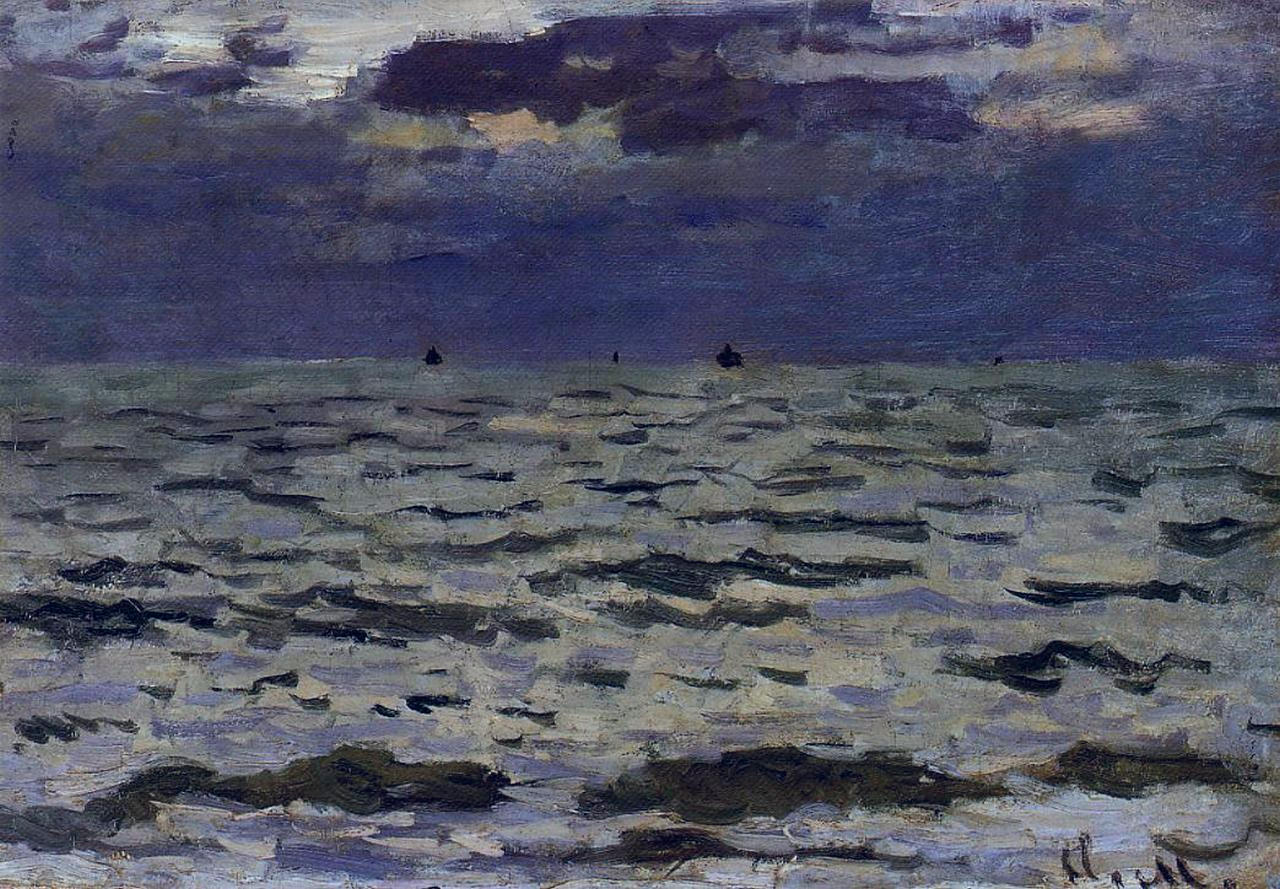
Claude Monet’s Seascape from 1866 is a painting that reveals how much can happen within apparent simplicity. At first glance, the composition seems almost bare. There is no crowded harbor, no elaborate narrative, no dramatic human activity in the foreground. Instead, Monet gives the viewer an expanse of water under a dense sky, interrupted only by a few small dark shapes of boats near the horizon. Yet the painting quickly proves that it is far from empty. It is filled with movement, atmosphere, tension, and a remarkable sensitivity to light.
This work belongs to an important moment in Monet’s development. In the mid 1860s, he was still a young painter, but he was already pushing against academic conventions and turning toward direct observation of nature. In Seascape, that ambition is visible everywhere. The subject is not simply the sea itself. The real subject is the shifting relation between sky, water, distance, and perception. Monet does not treat the ocean as a backdrop for a story. He treats it as a living surface that changes from second to second.
What makes this painting so compelling is the way it stands between traditions. It still carries something of earlier marine painting, especially in its attention to atmosphere and open space, but it also points toward the new language Monet would help define. The brushwork is freer than academic finish. The forms are reduced to essentials. The color is restrained but deeply expressive. Rather than describing every object with polished precision, Monet lets sensation lead the image. The result is a seascape that feels immediate, honest, and modern.
The Power of a Minimal Composition
One of the most striking aspects of Seascape is its compositional economy. Monet builds the image with very few elements. The sky occupies a large portion of the upper canvas, the sea spreads across the lower portion, and the horizon creates a subtle division between the two. There are only a few boats, rendered as tiny dark accents, and these are so small that they seem almost secondary to the larger encounter between water and weather.
This reduction gives the painting great force. Because there are so few distractions, the viewer becomes intensely aware of tone, rhythm, and atmosphere. The eye moves slowly across the surface, noticing the restless texture of the water and the heavy clouds overhead. Instead of following a narrative path, the viewer enters a state of observation. The painting encourages attention to subtle differences rather than dramatic incident.
The horizon line is especially important. It is placed low enough to grant the sky a powerful presence, but high enough to allow the sea to remain equally significant. Neither element fully dominates. Instead, the picture depends on their relationship. The sky presses downward with weight and shadow, while the sea answers with broken reflections and constant motion. This balance creates a feeling of tension, as though the entire scene is suspended between calm and disturbance.
The few boats near the horizon provide scale, but they also deepen the emotional effect. Their smallness emphasizes the vastness of nature. They are not detailed enough to become portraits of vessels. They function more like visual anchors, tiny signs of human presence within a much larger world of weather and water. Because they are so reduced, they seem fragile and distant, almost swallowed by the surrounding atmosphere.
Sky as Emotional Architecture
The sky in this painting is not passive background. It is the emotional architecture of the scene. Monet builds it in broad, layered masses of violet, blue, gray, and pale light, creating a heavy atmosphere that feels unstable and charged. The clouds do not float lightly. They gather and spread like a weight across the upper half of the picture, suggesting moisture, wind, and changing conditions.
What is remarkable is how Monet avoids overdefining the clouds. He does not outline them in a rigid way or turn them into a theatrical spectacle. Instead, he allows them to emerge through tonal shifts and painterly patches. This gives the sky a sense of movement. It feels alive because it is not fixed. The viewer senses that the weather could transform within moments.
The darker central band of cloud is especially effective. It stretches across the composition with a broad, somber authority, creating a zone of tension between the lighter upper sky and the flickering water below. This dark horizontal mass reinforces the flat breadth of the seascape while also heightening the emotional mood. It suggests a coming storm, or perhaps the aftereffect of one. The atmosphere feels unsettled, but not violent. Monet is interested in the threshold between conditions, that uncertain moment when light and weather seem to negotiate with each other.
The lighter passages near the top of the canvas are equally important. They prevent the sky from becoming monotonous and introduce a fragile luminosity. These pale areas suggest that light is still present behind the cloud cover. The result is complexity rather than simple gloom. The sky is dark, but not dead. It holds both opacity and light, density and openness.
The Sea as a Surface of Perception
If the sky gives the scene its emotional framework, the sea gives it its living energy. Monet paints the water as a constantly changing field of reflections, ripples, and broken light. He does not attempt to render each wave in a descriptive, literal manner. Instead, he captures the sea as an optical event, something seen in fragments and flashes.
The surface is built from horizontal strokes, short patches of paint, and irregular tonal shifts that suggest the restless rhythm of waves under shifting light. The water appears silvery, but that silver is never uniform. It is infused with lavender, gray, blue, and muted green, creating a rich and unstable color structure. This complexity makes the sea feel real because real water is never one color. It absorbs the sky, the air, and the light around it.
What stands out is the way Monet understands reflection. He does not mirror the sky in a smooth, polished way. Instead, the light breaks apart across the moving surface. Each brushstroke seems to record a separate shimmer or ripple. The sea becomes a mosaic of changing impressions. This approach is central to Monet’s vision. He is not painting the sea as an object with fixed properties. He is painting the act of seeing it.
The foreground is particularly strong in this respect. The darker wave forms near the bottom edge of the canvas are more pronounced, giving the viewer a sense of proximity and physical presence. These darker accents ground the composition and keep it from dissolving entirely into atmospheric softness. They remind us that the sea has mass and motion. At the same time, they are painted with enough freedom to preserve the painting’s overall sense of immediacy.
Color and Tonal Harmony
The palette of Seascape is restrained, but it is far from dull. Monet creates emotional depth through tonal relationships rather than bright color contrasts. Blues, violets, grays, and silvery whites dominate the surface, with subtle shifts that reward close looking. This limited palette contributes to the painting’s unity. Everything belongs to the same atmospheric world.
The coolness of the color scheme is essential to the work’s mood. These are not sunlit Mediterranean blues or decorative marine tones. They are colors of damp air, filtered light, and unsettled weather. Yet Monet finds extraordinary richness within that cool range. Violet inflections in the clouds and water soften the grays and prevent the painting from becoming flat. Blue depths in the sky create weight and distance. Pale highlights on the water introduce flicker and life.
This is a painting in which tone does much of the expressive work. Light and dark are carefully balanced, but never mechanically arranged. The darker sky and the broken middle tones of the sea create a broad harmony, while the lighter patches of reflected light animate the whole. Monet shows how a limited tonal range can still create dramatic effect when handled with sensitivity.
The small dark silhouettes of the boats become more powerful because of this tonal structure. Against the luminous but subdued environment, they read almost like punctuation marks. Their darkness sharpens the spatial field and gives the eye moments of focus within the otherwise fluid expanse.
Brushwork and the Material Life of Paint
Monet’s handling of paint in Seascape is one of the clearest signs of his modernity. The brushwork is visible throughout. He does not conceal the means of making the image. Instead, the painting openly records the gesture of the hand and the movement of looking.
In the water, the strokes are varied and responsive. Some are short and broken, others longer and more horizontal. Together they create the sensation of a shifting surface. In the sky, the paint is broader and more blended in places, yet still alive with directional movement. This difference in handling helps distinguish air from water while preserving the unity of the whole.
What matters most is that the paint does not merely cover the canvas. It performs. It carries the visual experience. Each mark holds information about light, texture, and atmosphere. When we look at the painting, we are not only seeing sea and sky. We are seeing Monet’s attempt to translate fleeting conditions into painterly form.
This is where the painting gains much of its freshness. Academic marine painting often sought finish and polish, smoothing the surface so that the image would appear complete and controlled. Monet moves in another direction. He allows incompleteness, or at least the appearance of it, to become expressive. The viewer is invited to participate, to let the eye complete what the brush has only suggested. That openness is part of what gives the painting its vitality.
Mood, Silence, and Emotional Ambiguity
Although Seascape contains no dramatic human action, it has a powerful emotional presence. The mood is contemplative, but it is not peaceful in a sentimental sense. There is tension in the darkened sky, uncertainty in the shifting water, and loneliness in the distant boats. The painting feels quiet, yet it is a charged quietness.
This emotional ambiguity is one of its greatest strengths. The scene could be read as melancholy, but it could also be understood as meditative or even quietly exalting. Monet does not force a single interpretation. He leaves the mood open, allowing the viewer’s own sensitivity to respond to the weather and light.
The absence of a detailed foreground contributes to this effect. There is no shoreline, no figures, no anecdotal detail to stabilize the image. The viewer faces the sea directly, without mediation. This creates a certain intimacy with the natural world, but also a sense of exposure. We are placed before something larger than ourselves, something beautiful but also indifferent.
The distant boats intensify this feeling. Their presence implies human activity, yet their scale makes that activity seem fragile and remote. They are not narrative protagonists. They are small witnesses to the same atmosphere that surrounds everything else. This gives the painting a sense of human modesty in relation to nature, a theme that runs quietly through many great seascapes.
Monet in 1866
In 1866, Monet was still in an early but decisive phase of his career. He had not yet become the fully established figure later associated with series paintings, water lilies, and the mature Impressionist movement. Yet many essential qualities of his art were already visible. He was deeply committed to observing natural effects, especially the behavior of light on surfaces. He was also increasingly willing to break with conventional finish in order to preserve immediacy.
Seascape shows this young Monet thinking through problems that would remain central to his work for decades. How can painting capture a transient effect? How can color and brushstroke convey atmosphere rather than merely describe objects? How can a composition remain powerful even when stripped of anecdotal content? These questions are already active here.
The painting also demonstrates Monet’s affinity for coastal subjects. The sea offered him an ideal field for experimentation because it is never still. Water reflects, distorts, darkens, flashes, and changes in constant relation to the sky. For an artist increasingly interested in fleeting visual phenomena, the seascape was not just a subject but a laboratory.
At the same time, this work still retains a certain gravity that distinguishes it from some later, brighter Impressionist scenes. The palette is sober, the mood introspective, and the composition severe in its simplicity. That gives the painting a special place within Monet’s development. It is youthful and exploratory, but also serious and emotionally resonant.
Space, Distance, and the Horizon
Monet handles space in this painting with remarkable subtlety. There is no conventional recession marked by architectural forms or elaborate perspective lines. Instead, depth is created through tone, scale, and the behavior of the horizon. The distant boats help establish scale, but the real sense of space comes from the layered relationship between foreground water, middle distance reflections, and the vast sky above.
The horizon line acts almost like a boundary between states of matter. Below it, everything flickers and breaks apart. Above it, everything gathers and hangs. This opposition creates a spaciousness that feels both visual and psychological. We sense the breadth of the sea, but we also sense the emotional distance of the scene.
Because the horizon is relatively understated, it does not cut the picture into rigid halves. Instead, it softly joins sea and sky while preserving their distinction. This is crucial to the work’s atmospheric power. The painting never feels diagrammatic. It feels breathed into being.
Distance in Seascape is not simply measured. It is felt. The tiny boats seem far away not only because of their size, but because they are partially absorbed into the tonal field. The farther reaches of the water also lose some of the stronger contrasts visible in the foreground. This softening creates the sensation of receding space without relying on hard perspective.
The Modernity of Looking
What ultimately makes Seascape such an important painting is its modern understanding of vision. Monet does not present the world as a stable arrangement of clearly bounded forms. He presents it as something perceived under changing conditions. The sea is not a fixed surface. The sky is not a solid ceiling. Both are mutable, and the painting honors that mutability.
This approach marks a major shift in nineteenth century painting. Instead of organizing nature according to inherited formulas, Monet responds to what the eye actually encounters: interrupted reflections, blurred edges, tonal uncertainty, and constant movement. The world is not simplified into symbols. It is experienced as living sensation.
That is why the painting still feels fresh. Even now, it resists stiffness and cliché. It asks the viewer to slow down and see how much complexity exists within an apparently limited motif. There is no need for spectacle, because the spectacle is perception itself. Light on water, shadow in cloud, the small interruption of boats at the horizon: these are enough.
Monet’s genius lies in understanding that enough can be more than enough. A sea under a dark sky can hold the drama of weather, the poetry of distance, the humility of human scale, and the excitement of new ways of painting. Seascape is not loud, but it is profound.
Conclusion
Claude Monet’s Seascape from 1866 is a remarkable demonstration of how much expressive power can emerge from restraint. Through a limited composition, a cool and nuanced palette, and a surface alive with responsive brushwork, Monet transforms an ordinary view of sea and sky into a deeply affecting work of art. The painting captures more than a place or a moment. It captures the instability of nature as it is truly seen.
Its enduring strength comes from the way it joins observation and emotion. The sea glimmers and darkens. The sky gathers in broad shadow. Tiny boats remind us of human presence without shifting attention away from the atmosphere itself. Every element contributes to a mood that is reflective, uncertain, and quietly grand.
Seen within Monet’s early career, the painting reveals a young artist already moving toward a radical vision of painting, one based on immediacy, sensation, and the truth of changing light. Seen on its own terms, it remains a beautiful and compelling seascape, one that invites the viewer into a world of silence, movement, and infinite tonal subtlety.
