Image source: wikiart.org
Introduction
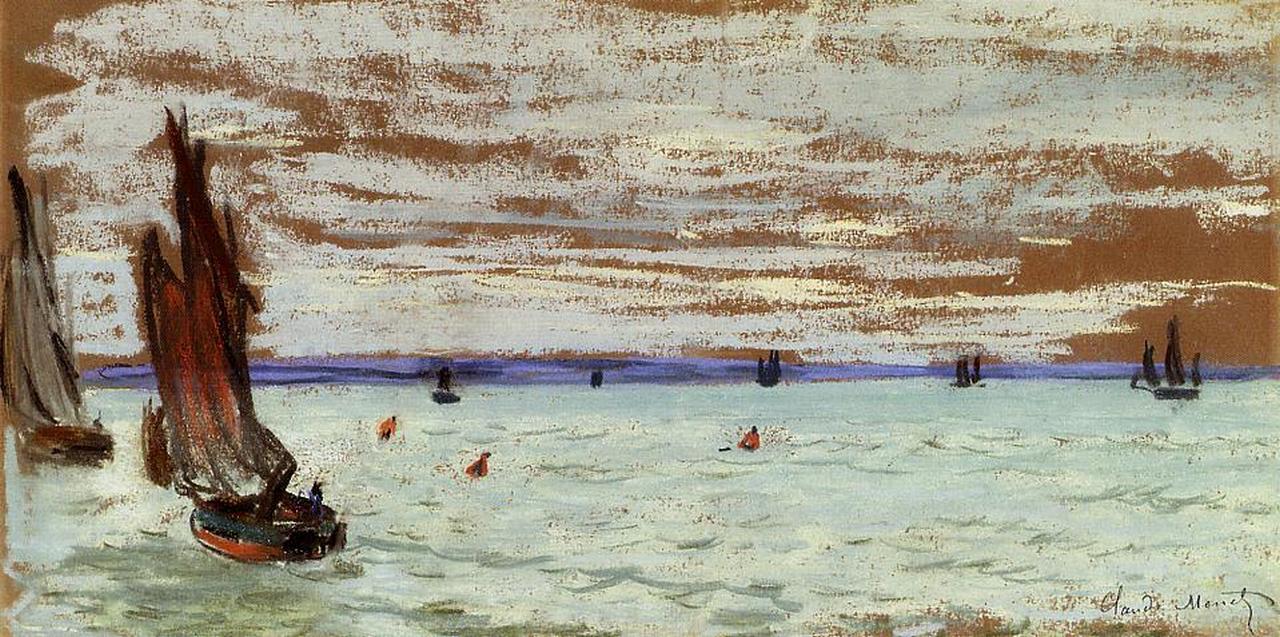
Claude Monet’s Open Sea from 1866 is a remarkable example of how much atmosphere, movement, and emotional resonance can be carried by a seemingly simple marine scene. At first glance, the painting appears spare. A few boats occupy a wide stretch of water, the sky spreads heavily across the upper half of the composition, and the horizon line remains low and distant. Yet the more one looks, the more the painting reveals its sophistication. Monet transforms a coastal view into a study of light, weather, spatial openness, and human fragility within nature.
What makes Open Sea so compelling is that it does not rely on grand narrative or elaborate detail. There is no dramatic shipwreck, no mythological subject, and no theatrical action. Instead, Monet focuses on the interaction between sea, sky, boats, and color. This approach gives the painting a modern quality. Rather than presenting the sea as a backdrop for heroic storytelling, he treats it as a living environment whose changing conditions become the true subject.
The painting also shows Monet’s gift for reducing a scene to its essential visual relationships. He does not overload the surface with precise description. He selects what matters most: the sweep of the water, the heaviness of the sky, the dark accents of the sails, and the small points of warm color scattered across the sea. Through these elements, he creates a work that feels immediate and deeply observed. The result is a marine painting that captures both the vastness of the coast and the fleeting sensation of a particular moment.
The First Visual Impression
The first impression of Open Sea is one of breadth and air. The composition opens outward rather than pulling the viewer into a tightly enclosed scene. The low horizon allows the sky to dominate much of the image, while the sea stretches broadly across the surface. This gives the painting a sense of expansion, as though the viewer is standing before an immense natural space that continues far beyond the frame.
At the same time, Monet avoids emptiness by carefully positioning the boats and figures. The large sailboat at the left foreground acts as a visual anchor. Its dark reddish sail rises sharply against the muted sky, immediately drawing attention. Smaller boats appear farther away along the horizon, creating rhythm and distance. Tiny touches of red in the water suggest swimmers, workers, or bathers, adding human scale and life to the scene.
The painting therefore balances openness with structure. The space feels wide, but never shapeless. Monet organizes the composition so that the viewer’s eye moves naturally from the bold foreground boat to the distant horizon and then back across the water. This circulation of vision is one reason the painting feels so alive. It is not static. It breathes.
Another striking aspect of the first impression is the painting’s tonal restraint. The colors are relatively muted, yet they are not dull. Soft greens, pale blue whites, earthy browns, violet accents, and warm reds interact subtly. Monet proves that a painting does not need intense color to be vivid. Instead, he builds vitality through relationships of temperature, contrast, and texture.
Composition and Spatial Design
The composition of Open Sea is deceptively simple. Monet divides the image into three main bands: the broad sky, the narrow horizon, and the restless sea. Within this basic structure, he introduces several vertical and diagonal elements to keep the scene dynamic. The sails are particularly important in this respect. They punctuate the horizontal spread of sea and sky, giving the composition lift and movement.
The left foreground boat is the strongest compositional statement in the painting. Its dark sail rises almost like a silhouette, creating immediate contrast against the lighter atmosphere. Because it is placed near the edge rather than at the center, the composition feels more spontaneous and modern. Monet avoids academic symmetry. Instead, he embraces an off balance arrangement that feels observed in real time.
This boat also acts as a gateway into the scene. Its position at the front edge of the painting allows the viewer to enter the marine world from a close vantage point. From there, the eye travels outward across the water toward the smaller vessels in the distance. The reduction in scale creates convincing depth without relying on rigid linear perspective. Monet uses spacing, size variation, and atmospheric thinning to suggest distance.
The horizon itself is treated with great economy. It is not sharply defined in an architectural way. Instead, it appears as a delicate boundary between sea and sky, softened by light and atmosphere. This treatment reinforces the painting’s theme of transition. Water and air seem to merge rather than separate cleanly. That ambiguity gives the work a lyrical quality.
The small red figures in the water are also crucial to the composition. Without them, the sea might feel too vacant between the foreground boat and the distant horizon. These small notes create a stepping stone effect across the middle ground. They also echo the warm accents in the foreground boat, helping to unify the painting chromatically.
Color and Atmosphere
Color in Open Sea is less about description than sensation. Monet does not attempt to present the sea as a fixed local color. Instead, he treats it as a surface that reflects light, weather, and movement. The water appears pale, cool, and luminous, yet it carries greenish and bluish shifts that keep it visually active. It is a sea defined by atmosphere rather than formula.
The sky is equally important in setting the painting’s mood. Rather than a bright clear blue, Monet gives it a textured expanse of warm brownish tones mixed with pale areas of light. This unusual coloration suggests changing weather, filtered sunlight, or the heavy illumination of a coastal day under layered cloud cover. The sky feels thick and mobile, not empty or decorative.
One of the most sophisticated aspects of the painting is the contrast between cool and warm zones. The sea tends toward pale coolness, while the sky introduces warmer earthy notes. Against both, the dark sails and touches of red stand out with force. This temperature contrast creates visual energy. It also heightens the realism of the scene, since coastal light often produces precisely these subtle shifts between warm cloud cover and cool water.
Monet’s limited palette allows small accents to carry great power. The reddish sail of the foreground boat becomes a dramatic focal point because the surrounding tones are quieter. Likewise, the tiny warm marks in the water instantly catch the eye. These touches prevent the composition from dissolving into monotony. They create flashes of life within the broader calm of the marine setting.
The atmosphere of the painting is therefore built not through minute detail but through tonal nuance. Monet understands that the feeling of being near the sea comes as much from the quality of light and air as from exact forms. In Open Sea, color becomes the medium through which air itself seems visible.
Brushwork and Surface
The brushwork in Open Sea plays a major role in its emotional and visual effect. Monet does not render the scene with polished smoothness. Instead, the paint surface remains active and tactile. The sky, especially, appears to be built from broad, broken strokes that leave the sensation of movement across the canvas. This textured application suggests drifting cloud cover and unstable weather.
The water is handled with lighter, quicker marks. Rather than describing every wave individually, Monet suggests the sea through repeated touches and directional strokes. These create the impression of shimmering movement. The water seems to flicker and shift, even though the forms remain simple. This ability to imply motion through paint is one of Monet’s great strengths.
The sails are painted more decisively. Their darker contours and stronger masses give them weight and clarity against the more open handling of sea and sky. This contrast in brushwork helps distinguish solid objects from atmospheric space. Boats feel tangible, while the environment around them feels fluid and changing.
What is especially striking is the economy of means. Monet says a great deal with very little. A few strokes can indicate a boat far away. A tiny patch of color can suggest a figure in water. The painting shows a trust in visual suggestion rather than exhaustive finish. This gives the work freshness. It feels like a painting made in response to immediate perception, not one overworked into stiffness.
The visible brushwork also contributes to the modern character of the painting. The viewer is always aware not only of the scene depicted, but of the act of painting itself. Surface and subject remain intertwined. We see the sea, but we also see paint functioning as paint. This dual awareness is one of the qualities that makes Monet’s art so enduringly compelling.
Sea, Sky, and the Experience of Nature
In Open Sea, nature is not idealized into a perfectly serene vision, nor dramatized into violent spectacle. Instead, Monet presents it as vast, shifting, and quietly powerful. The sea occupies a middle state between calm and agitation. It is not stormy, but neither is it glasslike. The viewer senses motion, depth, and unpredictability beneath its pale surface.
The sky amplifies this feeling. Its broad textured mass presses down over the sea, creating a mood that is contemplative rather than cheerful. Yet the painting is not gloomy. There is light throughout the composition, and the water remains luminous. Monet captures a mood of suspension, as if the scene exists in a temporary balance between weather conditions, between stillness and change.
This sensitivity to natural transition is central to the painting’s power. Monet is interested not in a symbolic sea, but in the sea as actually seen and felt. The environment is unstable in small ways. The light shifts. The horizon softens. Boats drift. Human figures appear tiny and vulnerable within the larger field of nature. The painting invites the viewer to experience that instability as beauty.
At the same time, there is no fear in the scene. The boats and figures do not seem overwhelmed. Instead, they belong to the marine world, even if they are dwarfed by it. This relationship between humanity and nature is important. Monet does not stage a conflict. He stages coexistence. People move through the sea, work upon it, or enjoy it, while the larger atmospheric setting continues around them.
The painting therefore becomes a meditation on scale. Human presence is visible, but small. Nature is expansive, but not hostile. This balance gives Open Sea a reflective quality. It reminds the viewer of both human activity and human limitation without turning either into melodrama.
Monet in the Mid 1860s
Seen in the context of Monet’s early development, Open Sea is especially interesting because it reveals many of the concerns that would remain important throughout his career. Even at this stage, he is deeply attentive to transient light, shifting weather, and the visual instability of natural surfaces. He is less interested in precise academic finish than in the direct sensation of a moment.
The marine subject was particularly suited to these interests. The sea is never still. Its color changes constantly. Its surface breaks light into fragments. The horizon can be clear or hazy from one instant to the next. All of these qualities made coastal scenes fertile ground for an artist committed to observation and immediacy. In Open Sea, Monet seems drawn to exactly these changing conditions.
The painting also reflects a broader move away from traditional hierarchy in subject matter. Instead of treating history painting or literary narrative as the highest artistic goal, Monet gives full seriousness to an ordinary coastal view. Boats, swimmers, sky, and water are enough. This was a modern position. It suggested that painting could find meaning in contemporary experience and direct perception rather than inherited stories.
Another notable aspect of the work is its confidence in incompleteness. Certain passages remain sketchlike, but this does not make the painting feel unfinished in a negative sense. Rather, its openness feels deliberate. Monet allows the eye to complete what the brush only suggests. This confidence would become a hallmark of modern painting, where suggestion often carries more life than strict finish.
In this sense, Open Sea stands as an early statement of Monet’s pictorial values. It may not be among his most widely discussed paintings, but it clearly demonstrates the qualities that would later define his achievement: sensitivity to atmosphere, freedom of handling, devotion to natural light, and a willingness to let perception guide form.
Human Presence in a Vast Setting
One of the most poetic features of Open Sea is the way human presence is handled. The people in the painting are extremely small. They do not dominate the composition, and in some cases they are little more than touches of warm color. Yet they matter greatly. They turn a seascape into a lived environment.
These figures make the scale of the sea more palpable. Without them, the viewer would still register openness, but not necessarily the full sense of human smallness within that openness. The tiny red marks scattered across the water create a poignant contrast with the broad expanse around them. They remind us that the sea is both a place of work and a place of exposure.
The boats perform a similar function. They are human made structures navigating a natural world that exceeds them. The foreground vessel feels sturdy, but still relatively slight against the immensity of sea and sky. The distant boats become even more fragile, reduced almost to signs on the horizon. This diminishing scale intensifies the feeling of space.
Yet the painting does not treat human life as tragic. The figures and vessels seem active, integrated, and at ease in their environment. Their smallness is not humiliation. It is simply part of the truth of coastal existence. Monet’s vision here is neither sentimental nor heroic. It is observational, and because of that it feels deeply convincing.
This approach gives the painting a quiet humanity. Even though the people are not individualized, they are essential to the emotional logic of the scene. They bring warmth to the cool water, movement to the middle distance, and a sense of lived reality to the broad marine setting.
The Mood of Open Sea
The mood of Open Sea is difficult to reduce to a single word, and that is part of its richness. It is calm, but not placid. It is spacious, but not empty. It is luminous, but not radiant. The painting occupies a subtle emotional register that feels highly true to nature. Monet captures the psychological complexity of standing before the sea on a day that is neither stormy nor bright, neither festive nor bleak.
There is a contemplative stillness in the scene, especially in the way the horizon stretches quietly across the distance. But this stillness is animated by the shifting texture of water and sky. The painting suggests that calm is never absolute. Nature remains in motion even in its quieter states. That tension gives the work depth.
The limited palette also contributes to the mood. These are not celebratory colors, but restrained and meditative ones. The browns, pale greens, cool whites, and violet notes create an atmosphere of seriousness and introspection. The warm red accents punctuate the scene without breaking its overall reserve. They feel like brief flashes of vitality in a hushed environment.
For many viewers, the painting’s emotional appeal may lie precisely in this refusal to overstate itself. Open Sea does not demand awe through spectacle. Instead, it invites slow looking. Its beauty emerges gradually, through tonal harmony, compositional balance, and sensitive observation. It rewards attention rather than overwhelming the viewer at once.
That quality makes the painting enduring. It reflects an experience many people recognize but rarely see expressed so well: the feeling of encountering an open natural space that quiets the mind while also making one aware of constant change.
Why Open Sea Still Matters
Open Sea remains significant because it demonstrates how a painting can achieve depth through restraint. Monet does not rely on complexity of subject. He relies on the intelligence of seeing. Through a few boats, a broad sky, and a luminous stretch of water, he creates a work that speaks about atmosphere, scale, and the fleeting nature of perception.
The painting also matters because it shows an artist discovering the modern possibilities of landscape and seascape. Instead of presenting nature as a theatrical stage, Monet treats it as an ever changing field of light and sensation. This shift was crucial to the future of painting. It opened the door to a more immediate and experiential kind of art.
For contemporary viewers, Open Sea can still feel fresh because its concerns remain so recognizable. Many people respond instinctively to open coastal scenes, to changing weather, and to the emotional mix of calm and uncertainty that the sea can produce. Monet captures those sensations with extraordinary economy.
The work also reminds us that painting can be powerful without being loud. Its drama is quiet. Its emotion is subtle. Its composition is simple but carefully controlled. The more time one spends with it, the more one sees how every element contributes to a unified visual experience.
In the end, Open Sea is a painting about perception itself. It shows how the world appears in a passing instant when light, color, movement, and atmosphere briefly align. Monet preserves that instant without freezing it. The scene still feels alive, still in motion, still open. That is why the painting continues to resonate. It gives form to something fleeting and makes that fleetingness the heart of its beauty.
Conclusion
Claude Monet’s Open Sea is a subtle but powerful marine painting that reveals the artist’s extraordinary sensitivity to atmosphere, light, and spatial openness. Through restrained color, confident brushwork, and an elegantly balanced composition, Monet transforms a simple view of boats on water into a profound meditation on nature and perception. The painting feels immediate, modern, and deeply observed.
Its strength lies in its refusal to overexplain. Monet allows sea, sky, sails, and scattered human presence to speak through visual relationships rather than narrative detail. The result is a work of quiet intensity, one that invites prolonged attention and rewards it with increasing richness.
Open Sea shows that even an apparently modest coastal scene can hold vast emotional and artistic depth. In Monet’s hands, the open water becomes more than scenery. It becomes a space of movement, atmosphere, and contemplation, where human life appears briefly within the larger rhythms of the natural world.
