Image source: wikiart.org
Introduction
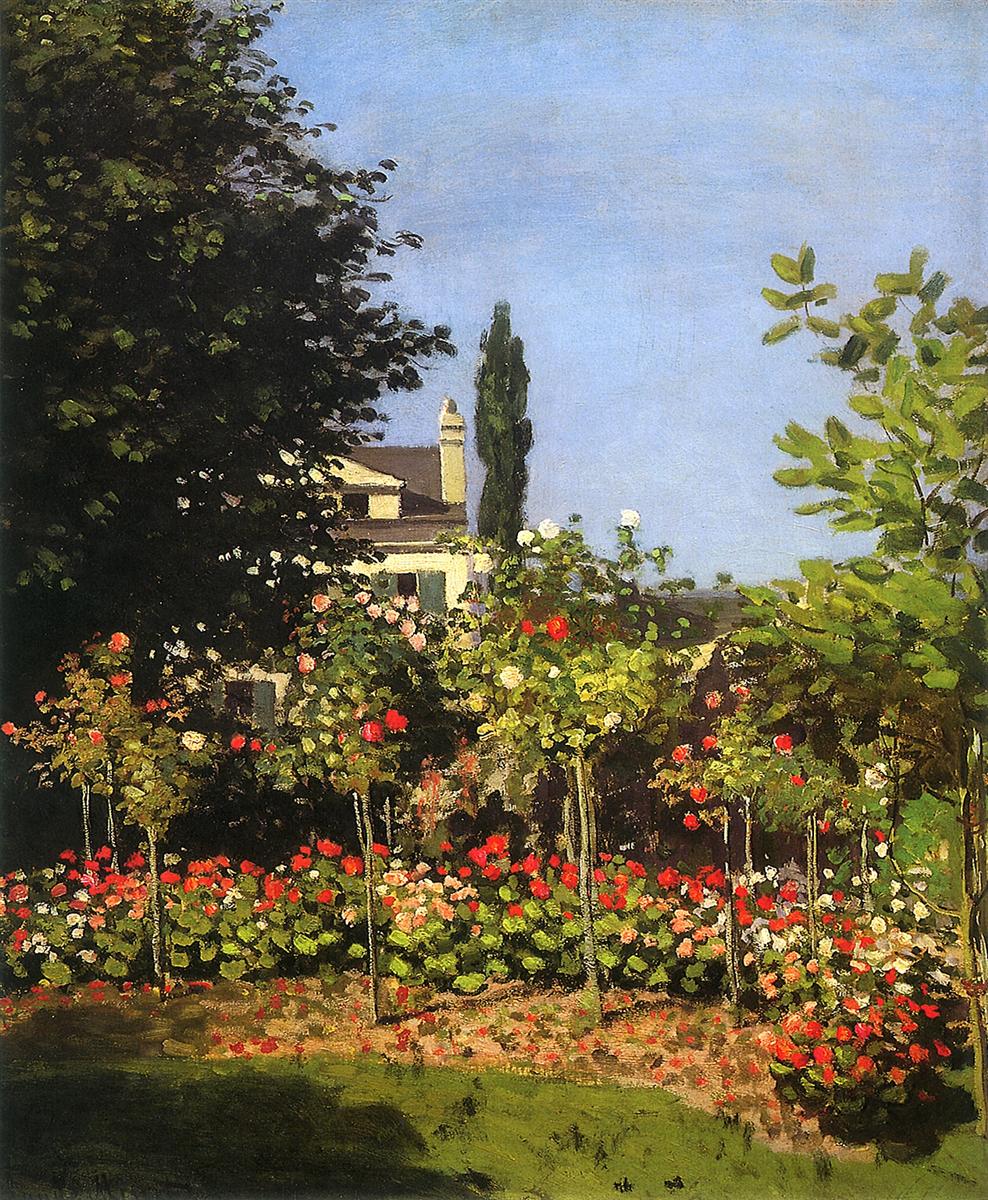
Claude Monet’s Garden in Bloom at Sainte-Adresse from 1866 is a painting that immediately communicates pleasure, freshness, and visual abundance. At first glance, it seems simple: a cultivated garden, bright flowers, a house partly hidden behind trees, and a wide expanse of blue sky above. Yet the more closely the viewer looks, the richer and more complex the image becomes. This is not just a pleasant garden scene. It is a carefully structured work that reveals Monet’s early mastery of light, color, atmosphere, and modern outdoor painting.
This painting belongs to an important moment in Monet’s development. In the mid 1860s, he was still a young artist, but he had already begun to move decisively away from academic conventions and toward the direct study of nature that would later define Impressionism. Garden in Bloom at Sainte-Adresse shows him exploring the visual experience of a sunlit place rather than constructing a polished historical or literary subject. Instead of narrative drama, Monet offers sensation. Instead of symbolic allegory, he offers light on leaves, flowers in heat, shadows on grass, and the dense, living texture of a domestic garden.
The result is a painting that feels both intimate and expansive. It is intimate because it depicts a cultivated, enclosed space, full of care and domestic order. It is expansive because the open sky and loose handling of paint give the scene air, movement, and freedom. Monet turns a familiar garden into an event of vision. The subject is not just the flowers or the house, but the act of seeing a summer garden in a particular instant.
The Setting at Sainte-Adresse
Sainte-Adresse, near Le Havre on the Normandy coast, was closely connected to Monet’s early life. The region offered him sea views, gardens, changing weather, and bright outdoor conditions that sharpened his interest in direct observation. In this painting, however, the coastal identity of Sainte-Adresse is not announced through cliffs or open water. Instead, Monet presents a cultivated retreat, a quiet garden space shaped by human care yet still fully animated by nature.
That balance between cultivation and spontaneity is central to the painting’s charm. The garden is clearly planned. Flowers are arranged in beds, small trees are supported by stakes, and the architecture of the house anchors the setting. But the overall effect is not rigid or formal. The garden seems alive, growing, and overflowing with color. The flowers do not read as flat decorative patches. They seem to pulse in sunlight and shift in the breeze. Monet captures a place that is maintained, yet never static.
The painting also reflects the increasing modernity of landscape painting in the nineteenth century. A domestic garden could now be treated as a serious subject for art. Earlier traditions often reserved high prestige for religious, mythological, or historical scenes. Monet, by contrast, invests a private garden with painterly importance. The everyday becomes worthy of sustained aesthetic attention. In doing so, he helps redefine what painting can be about.
First Impressions and Overall Mood
The mood of Garden in Bloom at Sainte-Adresse is one of brightness, repose, and sensory fullness. The scene feels warm, calm, and intensely present. There is no visible human figure, but human presence is implied everywhere through cultivation, architecture, and arrangement. This absence of figures is significant because it allows the garden itself to become the protagonist. The flowers, trees, lawn, and sky take on the emotional weight that a figure might otherwise carry.
Monet creates a feeling of afternoon stillness, but not silence. One can almost imagine birds, insects, the rustle of leaves, and the dry warmth of sunlight on soil. The garden is at once orderly and lush, composed and overflowing. This combination gives the painting its emotional subtlety. It is not wild nature, but nature brought close to the rhythms of home life. The painting evokes comfort without becoming dull, and beauty without becoming sentimental.
The freshness of the scene comes partly from Monet’s refusal to overfinish the image. Some areas are carefully structured, while others remain loose and suggestive. This variation creates immediacy. The viewer feels the painting was made in direct engagement with the living world. Rather than smoothing everything into uniform detail, Monet lets different areas breathe according to how they are seen. Dense shadows, flashes of blossoms, and the open sky all receive different kinds of treatment.
Composition and Spatial Design
One of the great strengths of this painting is its compositional intelligence. Monet organizes the scene through a layered structure that guides the eye from foreground to middle ground to background while preserving a natural, unforced impression. The dark lawn and shadowed foreground form a visual threshold. Beyond that, the flower beds stretch horizontally across the painting, building a lively band of color. Behind them rise the taller shrubs, roses, and staked saplings, which create vertical accents and deepen the space. Finally, the house and trees stand against the blue sky, establishing a calm upper zone.
This arrangement gives the painting both stability and movement. The lower portion is busy with blossoms and textured planting, while the upper sky provides openness and relief. The vertical forms of tree trunks, stakes, and the tall slender tree near the center help structure the composition and prevent it from becoming too diffuse. They act almost like visual markers, creating rhythm across the scene.
The house is placed partly behind foliage, which is an especially revealing choice. Monet does not present it as a dominant architectural object. Instead, it emerges through the garden, subordinated to the broader experience of light and vegetation. This helps preserve the painting’s immersive naturalism. We do not stand outside the scene, analytically surveying it. We feel placed within or just before the garden, seeing house and flowers together as part of one sensory field.
The asymmetry of the composition is also important. The dark mass of foliage on the left is balanced by the lighter, more open greenery on the right. The central zone opens toward the house and sky, creating a subtle inward pull. This asymmetrical balance keeps the image lively. A more rigid arrangement would have reduced the spontaneity that makes the scene feel convincing.
Color and the Celebration of Bloom
Color is one of the most memorable features of Garden in Bloom at Sainte-Adresse. Monet uses color not merely to describe objects, but to create the painting’s emotional and atmospheric reality. The reds, pinks, whites, and warm coral tones of the flowers are set against a broad range of greens, from deep shadowy olive to brighter yellow green. Above them, the pale blue sky opens like a cool counterweight to the warm density of the garden.
This interplay between warm and cool tones is handled with remarkable control. The blossoms attract immediate attention because of their intensity, but they do not overwhelm the painting. Monet distributes them across the canvas so that they flicker rhythmically rather than forming one single mass. The reds are especially effective because they animate the garden with sparks of visual energy. White and pale pink flowers soften the effect and create tonal variety, preventing the floral display from appearing too heavy.
Green, meanwhile, is never monotonous. Monet understands that foliage in sunlight contains endless variation. Some leaves appear nearly black in shadow, while others catch the light with yellowish brilliance. This range of green gives the painting depth and vibrancy. It also demonstrates Monet’s sensitivity to natural color relationships. He does not treat leaves and grass as generic areas of green. He paints them as shifting, light-filled surfaces.
The sky is a crucial color field in the composition. Its relatively clear, open blue provides rest for the eye after the concentrated activity of the garden. Yet even here Monet avoids flatness. The sky has soft tonal transitions that suggest air and summer light rather than hard emptiness. Because of this, the upper half of the painting does more than frame the garden. It completes the sense of season, weather, and atmosphere.
Light and the Experience of the Moment
Monet’s true subject is often light, and that is already evident in this 1866 work. The painting is not a botanical inventory of flowers or a topographical record of a property. It is an attempt to render how a garden appears under specific conditions of sunlight. Light defines the relationships between all elements in the scene. It distinguishes shadow from illumination, reveals the texture of leaves, and allows the flowers to flare against darker areas.
The contrast between the shadowed foreground and the sunlit middle ground is particularly effective. It creates a sense of entering vision, as though the viewer stands in partial shade and looks outward into the brighter garden. This device intensifies the sensation of sunlight. The bright areas seem even more radiant because they are set against darkness. Monet uses contrast not in a theatrical way, but in a natural optical one.
Sunlight in this painting is not harsh or metallic. It is warm, generous, and diffused through foliage. The light seems to touch forms rather than flatten them. Flowers glow, leaves shimmer, and the pale house catches illumination softly. This kind of light is central to Monet’s evolving art. He is less interested in fixed outlines than in how surfaces are transformed by illumination. The painting asks the viewer to see nature as mutable and alive.
There is also an important temporal quality here. The painting feels tied to an instant, as if the arrangement of light and shadow belongs to one passing hour. This sense of the moment would later become one of the defining features of Impressionism. In Garden in Bloom at Sainte-Adresse, Monet is already demonstrating that a landscape can be an event of perception, shaped by transient conditions rather than permanent ideal form.
Brushwork and Painterly Technique
The brushwork in this painting reveals Monet in a formative but already confident stage of development. Some areas are more tightly controlled than others, but throughout the work there is a strong sense of direct observation translated into paint. The foliage on the left is handled with dense, layered strokes that create mass and shadow. The flowers are built through touches of color that suggest bloom and density without requiring individual botanical precision. The sky is more broadly painted, with smoother transitions that maintain openness.
This variation in handling is essential to the painting’s success. Monet does not use one uniform surface treatment for everything. He adapts his brushwork to the visual character of each area. Dense leaves require one kind of mark, flower beds another, open sky yet another. This allows the painting to feel responsive to sight itself. We see not only the garden, but the different ways the eye experiences garden, house, and sky.
The floral passages are especially notable. Monet avoids stiff description and instead uses lively touches that let color and form emerge together. The flowers do not have the polished exactness of academic still life painting. They appear as clusters, flashes, and bursts of pigment that cohere at the proper viewing distance. This is a modern painterly strategy. It trusts the eye to complete what the brush only suggests.
Even in the darker passages, the paint remains alive. Shadow is not dead or empty. It contains subtle color and active surface texture. This is part of what keeps the painting fresh. Monet does not fill the canvas with inert brown or black in order to set off the bright areas. He understands that shadow in nature is also full of visual information.
Nature, Cultivation, and Modern Life
One of the reasons this painting remains appealing is that it captures a modern relationship to nature. The garden is not wilderness, nor is it an aristocratic formal park. It is a lived, domestic landscape. It suggests leisure, care, and seasonal attention. Such a setting would have resonated with the growing nineteenth century interest in private gardens, suburban retreats, and cultivated outdoor life.
Monet finds poetry in this environment without exaggerating it. The painting does not sentimentalize domestic nature, but neither does it reduce it to mere property. Instead, it reveals how human arrangement and natural growth can coexist in visual harmony. Stakes support young trees, beds organize flowers, and the house stands nearby, yet the dominant feeling is still one of organic abundance.
This balance reflects larger transformations in art. Painters like Monet increasingly looked to modern life not through urban spectacle alone, but through the environments people actually inhabited and enjoyed. A garden could serve as a site of modern perception just as much as a boulevard or railway station. In that sense, Garden in Bloom at Sainte-Adresse participates in a broader redefinition of meaningful subject matter.
The absence of figures makes this especially interesting. Human life is present through traces rather than bodies. The garden has been planted, maintained, and enjoyed, but the people who shaped it are offstage. This allows the viewer to imagine entering the space. The painting becomes open and inhabitable. We are not watching someone else’s experience. We are invited into our own.
Monet in 1866 and the Road Toward Impressionism
In 1866, Monet was still early in his career, but he was already pursuing artistic solutions that would become central to Impressionism. He was committed to painting from nature, to studying outdoor light, and to treating ordinary contemporary settings as worthy of serious art. Garden in Bloom at Sainte-Adresse shows all of these concerns in concentrated form.
At this stage, Monet had not yet arrived at the even looser, more broken brushwork associated with his mature Impressionist paintings of the 1870s and beyond. This painting retains more structure and tonal solidity than some later works. Yet that makes it especially valuable, because it shows the transition. We can see him balancing older compositional discipline with newer optical freedom. The result is a work that feels both grounded and exploratory.
The painting also demonstrates Monet’s gift for turning observation into visual harmony. He does not simply copy nature. He organizes it so that sensory immediacy and formal coherence support one another. That ability would become a hallmark of his greatest work. Even when his brushwork became freer, the underlying compositional intelligence remained essential.
Seen in the context of his broader career, Garden in Bloom at Sainte-Adresse is an early statement of artistic priorities that would shape the future of modern painting. It announces that fleeting light, cultivated landscape, and everyday beauty are sufficient subjects for ambitious art. It also shows that the painter’s personal experience of place can serve as a central organizing principle.
Why the Painting Still Matters
This painting continues to resonate because it offers something both visually pleasurable and historically significant. It is pleasurable because it captures the richness of a garden in summer with extraordinary freshness. The viewer is drawn in by the blue sky, the shimmer of leaves, and the scattered brilliance of blossoms. It is historically significant because it reveals Monet at a decisive moment, translating direct observation into a new language of painting.
The work also speaks to a universal human response to gardens. A blooming garden suggests renewal, care, seasonality, and the intimate pleasure of seeing color against light. Monet does not overload the scene with symbolism, but the emotional associations remain powerful. The painting evokes peace, domestic beauty, and the abundance of the natural world shaped by human affection.
Its continuing appeal also lies in its balance. It is neither overly polished nor excessively raw. It feels spontaneous without being chaotic, and composed without being stiff. That equilibrium makes it satisfying to return to. Each viewing reveals new relationships of color, structure, and atmosphere.
In many ways, Garden in Bloom at Sainte-Adresse reminds us why Monet became such a transformative artist. He could take a modest subject and make it feel inexhaustible. He could show that the beauty of a place is not separate from the experience of seeing it. In this painting, a summer garden becomes an exploration of light, order, growth, and visual delight.
Conclusion
Garden in Bloom at Sainte-Adresse is far more than a charming floral scene. It is an early masterpiece of perception, in which Claude Monet transforms a cultivated garden into a vivid study of light, color, and lived atmosphere. The painting’s compositional balance, radiant palette, and responsive brushwork reveal a young artist already moving toward a new vision of modern painting.
What makes the work so compelling is the way it joins intimacy and openness. The setting is private and domestic, yet the sky and light give it breadth. The flowers are carefully planted, yet they seem to overflow with natural vitality. The house is present, but nature dominates the eye. Everything in the painting contributes to a sensation of summer abundance held within a harmonious visual order.
Monet’s achievement here lies in making the ordinary feel freshly seen. He does not need a dramatic event or grand subject. He finds beauty in the relationship between sunlight and petals, shadow and lawn, foliage and air. That act of attention is what gives the painting its lasting power. It invites viewers to slow down, look carefully, and rediscover how much richness exists in a single garden under the right light.
