Image source: wikiart.org
Introduction
Claude Monet’s Boats in the Port of Honfleur from 1866 belongs to a crucial moment in the artist’s early development, when he was sharpening the visual language that would later make him one of the defining painters of modern art. At first glance, the picture seems modest and direct. It shows a quiet harbor scene, several boats at rest, a calm sheet of water, and a pale sky that seems to dissolve into atmosphere. Yet the work becomes richer the longer one looks at it. What appears simple is actually highly controlled. Monet turns an everyday port view into a study of light, reflection, structure, and shifting air.
The painting is compelling because it stands between traditions. It still carries the solidity and dark anchoring forms of mid nineteenth century marine painting, yet it also moves toward the looser, more immediate vision that would become central to Impressionism. The harbor is not treated as a stage for heroic action or picturesque anecdote. Instead, Monet focuses on the sensation of being there, the stillness of the basin, the thin brightness of the sky, the verticals of masts, the pale sails, and the unstable mirror of the water below. The result is not a grand spectacle but a vivid act of seeing.
Honfleur was an ideal subject for a young Monet. It offered ships, rigging, changing weather, wet surfaces, and a meeting point between land, sea, labor, and light. In this painting, those elements are brought together with remarkable sensitivity. The boats are physical and weighty, yet they seem to tremble in the cool air. The reflections are broken and shifting, yet they hold the composition together. The sky is open and light, but it does not overpower the darker forms below. Everything rests in balance.
Honfleur and Monet’s Early Career
In the 1860s, Monet was still defining himself as an artist. He had not yet become the fully mature painter of the serial haystacks, Rouen Cathedral, or the water lilies. He was still experimenting, absorbing influences, and testing ways to capture the world more directly. Honfleur mattered deeply in this process. The Norman port had long attracted painters because of its maritime activity and atmospheric variety, but for Monet it offered something more personal and formative. The changing coastal light, the marine traffic, and the interplay between solid forms and fleeting effects gave him a natural laboratory.
This period of Monet’s career is especially interesting because it reveals how his later achievements did not emerge fully formed. In 1866, he was already fascinated by transient conditions, but he had not abandoned structure. He still relied on strong drawing, dark tonal masses, and carefully placed contrasts. That tension gives Boats in the Port of Honfleur much of its interest. The painting is modern in feeling, yet it remains anchored in observation and compositional discipline.
The choice of subject also reflects a broader shift in nineteenth century art. Painters were increasingly interested in modern life, ordinary places, and scenes outside the grand academic hierarchy. A port was not merely a background for history painting. It could be a worthy subject in itself. Monet’s harbor is not romanticized into drama. It is not transformed into myth. It is seen as a living place, full of work, commerce, and weather, but also full of quiet visual poetry.
The Scene and Its Immediate Appeal
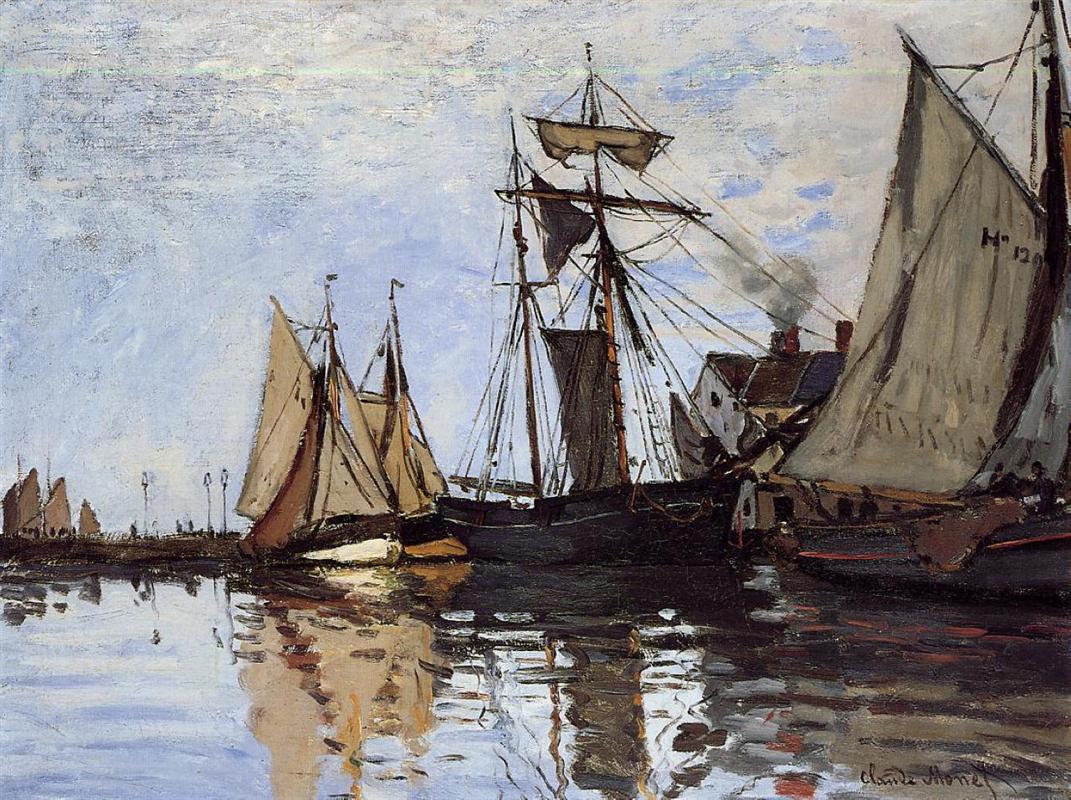
The scene is made up of several boats gathered in harbor waters near the viewer. A tall central vessel rises with its masts and rigging cutting sharply into the pale sky. To the left, smaller sailing boats cluster together, their cream colored sails forming soft triangular accents. To the right, another large sail fills the foreground edge, creating a strong visual barrier that partly crops the scene. In the distance, a line of smaller masts and sails stretches toward the left horizon, suggesting the continuing life of the port beyond the main grouping.
What makes this arrangement so effective is the way Monet balances closeness and openness. The boats in the foreground feel near enough to touch. Their hulls occupy the lower half of the composition with real weight. Yet the open sky above and the receding line of distant craft prevent the scene from becoming cramped. The image breathes. It feels like a direct encounter with a working harbor at a quiet hour.
The lack of dramatic action is also important. Nothing spectacular is happening. The boats are mostly still. Smoke rises softly from a structure in the midground. The water ripples gently. This calm allows Monet to concentrate on relationships of tone and reflection rather than narrative. The viewer is invited not to follow a story but to experience a condition of light and space.
Composition and Spatial Design
Monet’s composition is more sophisticated than it first appears. The painting depends on a subtle interplay between vertical, diagonal, and horizontal elements. The masts provide upward thrust and visual rhythm. The sails introduce diagonals and asymmetrical shapes. The waterline and distant shore establish a steady horizontal base. These elements keep the composition active while preserving equilibrium.
The central dark boat acts as the compositional anchor. Its mast and rigging create a dense network of lines that draw the eye upward and outward. The surrounding vessels then support and complicate that center. On the left, the pale sails create a cluster of lighter shapes that counterbalance the large pale sail at the right edge. This right hand sail is especially important because it enters the frame abruptly, almost as if Monet has cropped the scene from life. That partial form gives the image immediacy. It feels observed rather than staged.
The reflections below double many of these forms in broken, shimmering versions. This creates a secondary composition within the water itself. The upper half of the painting contains the physical boats and sky, while the lower half contains their fluid, unstable echo. The eye moves between the two zones, comparing solidity with dissolution. That relationship would become central to Monet’s later art, where surfaces often seem to hover between representation and pure optical experience.
Depth is handled with restraint. Monet does not rely on elaborate perspective tricks. Instead, he uses overlapping forms, scale shifts, and the recession of masts and shoreline. The harbor opens gently into the distance, but it never loses its compact unity. The scene remains coherent because all parts are tied together by shared light and atmosphere.
Light, Atmosphere, and the Pale Sky
One of the most striking features of this painting is the sky. It is pale, cool, and softly luminous. Rather than serving as empty background, it sets the emotional tone for the whole work. The light is not blazing. It is diffused, almost veiled, as if the day were overcast or gently clearing. This kind of subdued brightness allows Monet to explore delicate tonal transitions.
The sky’s lightness also enhances the silhouette of the boats. Against it, masts and rigging become more legible, and sails take on a translucent quality. The pale background helps the dark structures stand out without turning them into harsh outlines. Everything remains embedded in atmosphere. Even the firmest forms seem softened by air.
This sensitivity to atmospheric conditions points toward the concerns that would later define Impressionism. Monet is already less interested in local color, the fixed color of an object, than in the way light changes the appearance of everything it touches. The boats are not simply black, white, or brown. They are shaped by the cool illumination of the harbor. The sky is not a flat blue field. It is a surface of subtle shifts, textured with brushwork that suggests moving air and thin cloud.
The atmosphere also unifies the composition emotionally. There is no sense of urgency or violence. Instead, the pale sky creates a mood of pause, quiet labor, and reflection. It makes the harbor feel contemplative without stripping it of reality.
Color and Tonal Harmony
The palette of Boats in the Port of Honfleur is restrained, but that restraint is one of its greatest strengths. Monet builds the painting around cool blues, soft grays, muted creams, deep browns, and blacks enriched by touches of red and warmer earth tones. These colors are not loud, but they are carefully orchestrated.
The cool water and sky create the dominant tonal field. Within that field, the sails provide warm pale accents, and the hulls introduce darker masses that stabilize the composition. Small notes of reddish brown in the boats and reflections prevent the painting from becoming monotonous. They add warmth and complexity without disturbing the overall harmony.
Monet’s tonal control is especially evident in the relationship between light and dark. The dark boats do not become dead silhouettes because they are enlivened by subtle variations and by the glimmering reflections around them. Likewise, the pale sails are not blank shapes. They catch light differently across their surfaces and are gently inflected by shadow. This nuanced handling gives the painting a living tonal pulse.
The color scheme also supports the mood. The coolness of the blues and grays suggests moist air and harbor stillness. The muted creams of the sails add softness and a human, practical presence. The darker hulls and rigging introduce weight and seriousness. Together, these choices produce a scene that feels calm, material, and immediate.
Brushwork and Surface
Although this is an early Monet, the handling of paint already reveals a strong interest in visual immediacy. The brushwork is varied across the surface. In the sky, it is light and broken, creating a textured field that suggests movement in the air. In the boats, strokes become more decisive and linear, especially in the masts and rigging. In the water, the paint loosens again into horizontal and wavering marks that capture reflection rather than fixed form.
This variation in touch is essential to the painting’s vitality. Monet is not merely filling in objects. He is adjusting his method according to what he sees. Solid structures demand one kind of mark, flickering water another, open air yet another. That responsiveness is one of the qualities that would later define his mature work.
At the same time, the brushwork has not yet dissolved fully into the freer shimmer of later Impressionism. There is still a degree of firmness here, especially in the dark central boat and the architecture near the right side. That firmness keeps the painting grounded. The surface oscillates between description and suggestion, between stating forms and allowing them to vibrate.
The painting’s texture contributes to its atmosphere. One feels the scrape and drag of pigment across the canvas, the quick notation of reflections, and the layered construction of sky and sail. These physical traces remind us that the image is not only a window onto Honfleur but also an object made by hand, through observation, choice, and painterly intelligence.
Water and Reflection
The water is one of the most beautiful and revealing aspects of this work. Monet does not paint it as a smooth mirror. Instead, he presents it as a living surface that both reflects and distorts. The boats appear again below themselves, but in broken fragments of color and shape. Vertical reflections of masts descend into wavering lines, while hulls and sails dissolve into loose patches of light and dark.
This treatment of reflection is central to Monet’s vision. Water becomes a place where the visible world is transformed. It holds the image of the harbor, yet it also breaks it apart. Solidity above becomes fluidity below. Clear structure becomes shimmering instability. In that sense, the water embodies the very problem that fascinated Monet throughout his career: how to paint a world that is real, material, and constantly changing at the same time.
The reflections also create visual depth and rhythm. They pull the eye downward and spread the color of the boats across the lower half of the canvas. Without them, the dark hulls might feel too heavy. With them, the composition opens into a more dynamic play of surfaces. The pale and dark patches on the water are especially effective because they echo the sails and boats without mechanically repeating them.
There is also a psychological effect. The harbor becomes quieter because of the water’s responsiveness. Reflection slows vision down. It encourages the viewer to linger, compare, and notice subtle differences between object and echo. This patient looking is exactly what Monet rewards.
The Balance Between Realism and Impression
What makes this painting especially important within Monet’s development is the balance it strikes between realism and impression. The boats are recognizable and convincingly structured. The harbor setting is specific. The artist has clearly observed the mechanics of sails, hulls, and rigging. Yet the painting does not aim for exhaustive description. It aims for visual truth as experienced in a particular moment.
That distinction matters. Monet is not copying every detail of the port. He is selecting what contributes to the sensation of being there. He emphasizes tonal relationships, atmospheric unity, and the play of reflected light. Some forms are abbreviated. Some details are suggested rather than fully drawn out. The result is a painting that feels both accurate and alive.
This balance is one reason the work remains so appealing. It satisfies the eye on multiple levels. A viewer can appreciate the boats as concrete objects, but also enjoy the painting as an arrangement of shifting tonal patterns. It offers both substance and immediacy. That doubleness is one of the keys to Monet’s greatness.
In later years, Monet would often move even further toward optical sensation, letting forms dissolve more completely into light and color. Here, however, we see the stage at which observation and structure still hold equal power. That makes the painting not merely a pleasant harbor scene, but a document of artistic transformation.
Mood and Emotional Character
The emotional force of Boats in the Port of Honfleur is quiet but persistent. This is not a painting of excitement or spectacle. It is a painting of pause, attention, and restrained beauty. The boats are still, the water is relatively calm, and the sky gives off a cool, subdued light. Even the small curl of smoke rising near the buildings adds to the sense of a working world at rest rather than a dramatic event unfolding.
This calm mood is deeply connected to Monet’s handling of color and tone. The muted palette prevents sentimentality. The scene is beautiful, but it is not decorative in a shallow sense. It feels real, slightly damp, and touched by routine. At the same time, the softness of the atmosphere and the shimmer of the water make the ordinary harbor quietly poetic.
There is also a sense of patience in the painting. The viewer feels that Monet has stood still long enough to notice not only the boats but the air around them and the unstable life of their reflections. That patience becomes contagious. The picture slows the viewer down. It asks for contemplation rather than quick consumption.
This emotional restraint is one reason the work has such lasting power. It does not depend on theatrical effect. Its mood emerges from careful looking and harmonious construction. The result is both intimate and enduring.
The Painting’s Place in Monet’s Artistic Evolution
Seen within the arc of Monet’s career, Boats in the Port of Honfleur is a revealing early statement. It shows that many of his later concerns were already present in embryonic form. He was already fascinated by changing light, by reflections, by the meeting of sky and water, and by scenes in which atmosphere softens the edges of the world. At the same time, he was still rooted in a more traditional commitment to form and tonal solidity.
This makes the painting especially valuable for understanding how Monet evolved. He did not leap suddenly into pure Impressionism. He moved there through works like this one, where close observation began to loosen academic finish and open painting toward more direct sensory experience. The harbor scene becomes a place where the artist experiments with perception itself.
Honfleur also connects Monet to a broader lineage of coastal and marine painters, while allowing him to distinguish himself from them. Earlier marine painting often emphasized the grandeur of ships or the drama of weather. Monet turns instead toward atmosphere, reflection, and the visual life of ordinary harbor stillness. That shift feels modern. It makes the painting less about maritime narrative and more about seeing.
Because of this transitional quality, the work rewards both historical and visual attention. It is an attractive picture in its own right, but it is also an important signpost on the way to the revolutionary paintings that would follow.
Why the Painting Still Feels Fresh
Many nineteenth century harbor scenes now feel locked into their period, admired mainly for historical charm. Boats in the Port of Honfleur does not suffer that fate. It still feels fresh because Monet’s real subject is not just boats or port architecture. It is perception under changing light. That subject remains alive.
The painting also feels modern because of its cropping and immediacy. The large sail at the right edge, cut by the frame, gives the scene a sense of direct encounter. It feels as though Monet selected a view from life rather than arranging a perfectly centered design. The broken reflections and textured sky further enhance this immediacy. They remind us that vision is partial, shifting, and embodied.
Another reason the work remains engaging is that it combines clarity with openness. We understand what we are looking at, but the painting never becomes over explained. The atmosphere leaves room for feeling and interpretation. The scene is concrete, yet it also hovers on the edge of dissolution. That tension keeps it alive in the viewer’s mind.
Ultimately, the freshness of the painting comes from its honesty. Monet looks closely at an ordinary harbor and finds complexity without forcing drama onto it. He shows that stillness can be visually rich, that muted color can be luminous, and that everyday places can hold extraordinary painterly possibilities.
Conclusion
Boats in the Port of Honfleur is a remarkable early Monet because it captures an artist in the process of becoming himself. The painting is rooted in observation, but it already reaches toward the fleeting and atmospheric qualities that would define his mature style. Through a restrained palette, carefully balanced composition, varied brushwork, and exquisite attention to reflection, Monet turns a quiet harbor scene into a deeply rewarding work of art.
Its beauty lies in its restraint. Nothing is exaggerated. Nothing is forced. The boats stand in calm water beneath a pale sky, and yet within that simplicity Monet discovers endless visual nuance. Dark hulls press against cool light. Rigid masts rise above unstable reflections. Sails catch the air softly. Water breaks the world into shimmering fragments. The harbor becomes both a real place and a meditation on perception.
This painting matters not only because it is by Claude Monet, but because it reveals how great artistic revolutions often begin in acts of concentrated looking. Here, in the port of Honfleur, Monet studies air, light, and water with a seriousness that transforms the ordinary into something unforgettable. The result is a painting that remains quiet, elegant, and profoundly alive.
