Image source: wikiart.org
Introduction
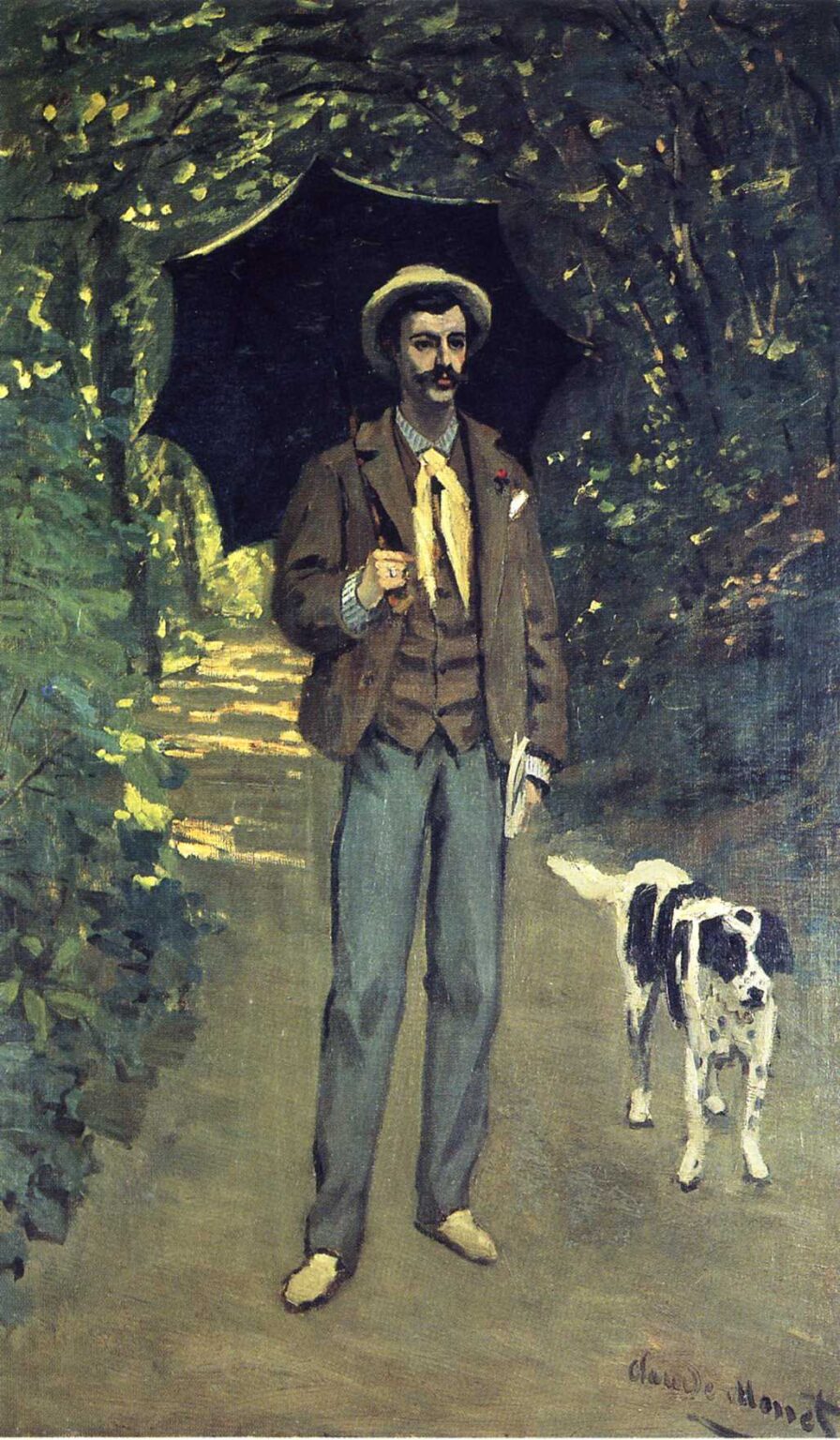
Claude Monet’s Victor Jacquemont Holding a Parasol from 1865 is a fascinating early portrait that reveals how ambitious the young artist already was before Impressionism fully took shape. At first glance, the painting appears simple. A fashionable man stands on a shaded path, umbrella raised above him, while a black and white dog lingers nearby. Trees surround the figure, and broken light falls across the ground. Yet the work becomes richer the longer one looks at it. Monet is not merely describing a man in a park. He is experimenting with atmosphere, social identity, modern leisure, and the visual relationship between figure and setting.
This painting belongs to a crucial period in Monet’s career, when he was still forming his artistic language. He had not yet become the painter most people associate with shimmering haystacks, water lilies, and riverside landscapes. Instead, he was testing how contemporary life could be brought into painting with freshness and immediacy. In this portrait, Monet approaches his subject with an unusual balance of observation and painterly freedom. The man’s clothing and posture are recognizable enough to establish character, but the surrounding foliage and shifting light are handled in a way that already points toward the looser, more atmospheric art that would later define him.
The painting is especially compelling because it sits between traditions. It still belongs to the world of nineteenth century portraiture, where a sitter’s appearance, costume, and bearing matter greatly. At the same time, it begins to push against the rigid finish and formal artificiality expected in conventional portraits. Monet places Victor Jacquemont outdoors, letting nature and light become active participants in the image. The parasol is not merely an accessory. It shapes the composition, casts the figure into a dark silhouette, and creates a dramatic contrast against the greenery. The result is a portrait that feels modern, intimate, and unexpectedly alive.
The Historical Moment of the Painting
Painted in 1865, this work comes from a moment when French painting was undergoing major change. Academic art still dominated official institutions, and many established painters favored polished surfaces, idealized subjects, and carefully arranged compositions. At the same time, younger artists were increasingly drawn to contemporary life, outdoor painting, and a more direct response to visual experience. Monet was part of this generation of restless innovators, even if his most revolutionary achievements were still ahead.
The mid 1860s were formative years for Monet. He was deeply interested in painting modern subjects and in working from direct observation. Rather than treating nature as a distant background for historical or mythological drama, he began to see the visible world itself as worthy of sustained attention. Parks, riverbanks, promenades, gardens, and beaches all became spaces where modern identity could be staged. People in such settings were not heroic types from literature. They were ordinary yet elegant participants in the social life of the present.
That context matters for understanding Victor Jacquemont Holding a Parasol. The painting reflects a society in which dress, manners, and public appearance were central to class identity. Victor Jacquemont’s tailored clothing, hat, parasol, and composed stance all signal urban sophistication. Yet Monet resists turning him into a stiff social emblem. Instead, the setting softens the image. The path, the trees, the filtered light, and the nearby dog suggest movement, companionship, and temporary presence. This is not a person frozen into status alone. He seems caught within an actual moment of outdoor life.
The work also reveals Monet’s developing confidence. He was beginning to challenge the boundaries between portrait painting and landscape painting. Rather than giving one priority over the other, he lets them interact. The sitter does not dominate the environment in the old aristocratic sense, nor does the environment swallow him completely. Instead, the figure and the setting depend on one another. This balance is one of the painting’s greatest achievements.
Composition and the Power of the Parasol
The composition of this painting is strikingly elegant. Victor Jacquemont stands almost at the center of the image, but Monet avoids perfect symmetry. The figure is slightly offset, allowing the dog to occupy the right side and the leafy shadows to frame the upper portion. This asymmetrical arrangement keeps the painting from feeling static. The eye moves naturally from the dark parasol to the face, down through the body, across the path, and then toward the dog.
The parasol is the key structural element. Its large, dark shape spreads behind the sitter’s head and shoulders like a visual backdrop within the larger landscape. It performs several functions at once. It gives the figure silhouette and presence. It simplifies the background immediately behind him, helping his face stand out. It also creates a dramatic mass of shadow that contrasts with the flickering leaves above and the pale pathway below. Without the parasol, the figure might dissolve too much into the surrounding greenery. With it, Monet creates a bold and memorable central form.
There is also a subtle tension between verticality and softness. Victor Jacquemont stands upright, with a composed, almost formal bearing. His body is long and narrow, and the line of his trousers reinforces that sense of upright poise. Around him, however, the natural setting is loose, irregular, and full of shifting contours. Leaves, branches, and patches of light break up the space. The parasol, though structured, also curves gently. This interplay between formal posture and organic environment gives the painting its quiet energy.
The dog is important compositionally as well. It prevents the lower right section from becoming empty and introduces a second living presence that offsets the self containment of the human figure. Because the animal stands slightly apart, it widens the scene and makes the space feel inhabited rather than staged. The dog’s black and white markings echo the painting’s broader contrasts of darkness and light, tying it into the larger visual pattern.
Victor Jacquemont as a Modern Sitter
One of the most interesting aspects of the painting is the way Monet presents Victor Jacquemont as a modern individual rather than a grand historical subject. He is dressed fashionably but not extravagantly. His brown jacket and vest, pale tie, hat, and gloves suggest refinement, yet there is no excessive theatricality. He seems well turned out, thoughtful, and self aware. This balance makes him believable as a real person moving through a real environment.
His facial expression is restrained. Monet does not push for intense drama or sentimentality. Instead, the sitter appears calm, composed, and slightly distant. This reserve suits the portrait. Rather than telling us exactly what Victor is thinking, Monet allows his identity to emerge through posture, bearing, and placement in space. He is at ease outdoors, yet he remains somewhat formal, as if conscious of being seen. That combination of relaxation and social awareness feels distinctly modern.
The figure’s slim silhouette is emphasized by the cut of the clothing and the vertical fall of the trousers. The slight angle of the arm holding the parasol introduces a note of natural gesture, keeping the pose from becoming rigid. In the other hand, he seems to carry a small object or folded paper, a detail that reinforces the sense of everyday presence. Monet is not inventing a symbolic attribute in the traditional portrait sense. He is capturing an impression of a person in motion or pause, someone encountered during a walk.
The red accents on the jacket are small but meaningful. They enliven the otherwise restrained palette of browns, greens, grays, and blacks. These touches help animate the figure and suggest careful dressing without making the costume flamboyant. Monet understands that personality in portraiture often appears through minor visual cues rather than exaggerated expression.
Nature as More Than Background
In many conventional portraits, the setting serves mainly to frame the sitter or suggest social rank. Here, the landscape does more. The leafy path is not decorative filler. It is a living atmosphere that shapes the emotional and visual experience of the painting. Monet treats the trees and shadows with enough attention that they become essential to the work’s meaning.
The greenery arches above Victor Jacquemont, creating a kind of natural canopy. This enclosure produces intimacy. We are not looking at an open public square or a grand estate vista. We are inside a quieter, sheltered passage of nature. The figure is momentarily enclosed by shade, and the dappled light on the ground suggests sunshine beyond the immediate canopy. This play between shaded foreground and brighter patches of light gives the space depth and mood.
Monet is especially sensitive to the instability of outdoor light. Rather than painting every leaf with crisp detail, he allows foliage to break into animated strokes and patches. This approach captures the sensation of leaves catching light unevenly, trembling in breeze or flickering before the eye. The path is similarly alive with variations of warm and cool tone. Light does not simply illuminate the scene. It moves through it.
Because of this treatment, nature becomes a partner in the portrait. Victor Jacquemont is not isolated from his surroundings. His dark parasol, earth toned jacket, and pale trousers all respond to the environment around him. The painting suggests that modern identity is experienced in relation to atmosphere, season, and place. One does not merely stand in nature. One is visually altered by it.
Color and Tonal Harmony
The color palette of this painting is subdued but highly effective. Monet relies on deep greens, muted browns, soft grays, creamy highlights, and the strong dark mass of the parasol. This restraint gives the work cohesion and mood. Rather than dazzling the eye with bright color contrasts, Monet invites close looking through tonal variation and subtle harmony.
The greens are especially rich. They are not uniform. Some areas lean toward yellow green where light strikes the leaves, while others sink into cooler, bluish shadows. This variation prevents the wooded setting from becoming flat. The foliage seems dense, layered, and alive. The path below introduces earthy neutrals that stabilize the image and keep the figure grounded.
Victor Jacquemont’s clothing participates beautifully in this harmony. His brown jacket fits naturally within the woodland environment, while the lighter gray trousers create vertical clarity. The white elements, including the tie, cuffs, and handkerchief, serve as points of brightness. These accents draw attention to the upper body and help balance the deep darkness of the parasol. The dog, with its black and white coat, mirrors these tonal relationships in miniature.
What is most impressive is Monet’s handling of darkness. The parasol and shaded foliage are very dark, but they are never dead. They retain painterly texture and subtle tonal shifts. This prevents the central shadow from becoming empty void. Instead, it feels velvety and atmospheric, a necessary counterweight to the scattered highlights across the path and leaves. The painting’s tonal structure is therefore both dramatic and delicate.
Brushwork and the Young Monet’s Style
Although this is an early work, it already shows Monet’s attraction to painterly immediacy. The brushwork is not as radically loose as in some of his later paintings, but it is freer than the smooth academic finish many of his contemporaries would have preferred. This is particularly evident in the foliage and path, where broad strokes and broken touches create the sensation of unstable light and organic texture.
The figure is handled with greater control, which is appropriate for a portrait. The face, hands, and costume need enough definition to establish identity and presence. Even so, Monet does not overwork them. The clothing is suggested through broad tonal masses and selective highlights rather than minute descriptive detail. This gives the sitter a certain freshness, as though he has been seen directly rather than manufactured through laborious polish.
This mixture of firmness and looseness is one of the most revealing aspects of the painting. Monet seems to be negotiating between inherited expectations and personal vision. He knows the figure must read clearly, yet he also wants the surrounding world to breathe. The result is a canvas that feels transitional in the best sense. It contains the seeds of the later Monet without abandoning the concerns of portraiture.
The visible brushwork also contributes to the painting’s emotional tone. Because the surface does not disappear into illusion, we remain aware of the artist’s hand. This makes the scene feel immediate and lived rather than distant and idealized. It is not simply a representation of a man in a park. It is also a record of Monet’s act of seeing.
The Presence of the Dog
The dog may seem like a minor detail, but it enriches the painting considerably. Without it, the image would be more formal and more isolated. The dog introduces companionship, liveliness, and a touch of unpredictability. It also helps define the scene as part of everyday life rather than ceremonial portraiture.
Animals in portraiture often serve symbolic or decorative purposes, but here the dog feels more natural than emblematic. It stands close enough to suggest familiarity yet separate enough to retain its independence. This small tension adds realism. The dog is not posed as an obedient accessory. It appears simply to be there, sharing the path with its human companion.
Visually, the dog adds contrast and movement. Its black patches echo the darkness of the parasol, while its white fur catches light like the bright accents in Victor Jacquemont’s clothing. Its lower stance also counterbalances the tall vertical figure. Where the sitter is upright and composed, the dog is grounded and alert. This contrast makes the scene more varied and believable.
The presence of the dog softens the social formality of the portrait. It suggests a moment of strolling, pausing, or being accompanied through a shaded garden path. In that sense, it helps complete the painting’s atmosphere of cultivated but informal leisure.
Early Signs of Impressionism
Even though Victor Jacquemont Holding a Parasol predates the full emergence of Impressionism, it contains several qualities that would become central to Monet’s mature work. The most obvious is the interest in outdoor light. Rather than treating light as a neutral means of revealing form, Monet makes it an active, fluctuating presence. Sunlight filters through foliage, breaks across the path, and interacts with the figure’s clothing and the parasol’s shadow.
Another early sign is the refusal to isolate the figure from the environment. Later Impressionism would often dissolve boundaries between objects and atmosphere, emphasizing perception over hard contour. This painting does not go that far, but it already moves in that direction. Victor Jacquemont is distinct, yet he also belongs to the shimmering world around him. He is touched and partly transformed by the conditions of light and setting.
Monet’s brushwork also points forward. The foliage is not meticulously rendered leaf by leaf. Instead, it is suggested through energetic marks that capture visual sensation more than botanical precision. This is not carelessness. It is a different artistic priority, one that values the immediacy of sight.
Most importantly, the painting reflects a modern way of looking. Rather than relying on historical costume, mythological subject matter, or idealized narrative, Monet finds significance in a present day person standing outdoors. Modern life itself becomes worthy of serious painting. That conviction would become one of the foundations of Impressionism.
Mood, Silence, and Psychological Depth
One of the most memorable qualities of this painting is its quiet mood. Nothing dramatic happens. There is no narrative climax, no overt emotional display, no theatrical gesture. Yet the work is not empty. Its silence is expressive. Victor Jacquemont appears self possessed, even slightly introspective, while the shaded path and filtered light create an atmosphere of pause and contemplation.
The dark parasol contributes strongly to this mood. It encloses the upper figure in shadow, creating a visual privacy that contrasts with the brightness of the path. It is almost as if the sitter carries his own zone of solitude with him. This does not make the painting melancholy exactly, but it does lend it inwardness.
The surrounding trees deepen that feeling. They do not overwhelm the figure, but they do create a sheltered, hushed environment. The world beyond the immediate path remains unseen. We are invited into a contained moment rather than a wide public spectacle. This controlled intimacy gives the portrait psychological resonance.
Monet’s restraint is important here. He does not force meaning through exaggerated symbolism. Instead, psychological depth emerges through atmosphere, posture, and visual relationships. The result is subtle but lasting. The painting feels calm at first, then gradually more mysterious. Who is this man? What has interrupted his walk? Why does he seem both present and slightly distant? The work does not answer these questions directly, which is precisely why it remains engaging.
Why the Painting Still Matters
Victor Jacquemont Holding a Parasol matters because it captures Monet at a turning point. It shows a young artist testing how portraiture could be renewed through direct contact with modern life and outdoor experience. It also reminds us that Monet did not suddenly become the painter of light for which he is famous. That achievement developed through works like this one, where he learned how figures, atmosphere, color, and fleeting sensation could coexist on a canvas.
The painting also matters as a statement about modern identity. Victor Jacquemont is neither a heroic monument nor a mere decorative presence. He is a cultivated individual shown in a moment of lived experience. The portrait suggests that personal character is revealed not only through face and clothing but also through one’s relationship to environment, movement, and temporary light.
For viewers today, the work remains appealing because of its balance. It is poised between finish and freedom, formality and intimacy, portrait and landscape. That in between quality gives it freshness. It belongs to art history, but it does not feel trapped by convention. Instead, it feels exploratory and alive.
In the end, Monet transforms a simple scene into something quietly profound. A man stands beneath trees with a parasol and a dog at his side. The moment appears ordinary, yet through composition, tonal control, and sensitivity to atmosphere, it becomes memorable. The painting invites us to look slowly and to recognize how much can be contained within a seemingly modest encounter between person, place, and light.
