Image source: wikiart.org
Claude Monet and The Seine Estuary at Honfleur
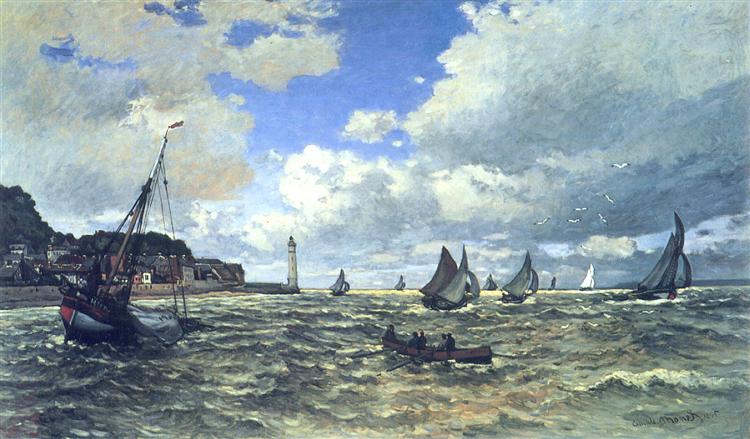
Claude Monet’s The Seine Estuary at Honfleur from 1865 is a remarkable early marine painting that reveals how quickly the young artist was developing his visual language. Long before the fully mature Impressionist style that would later define his name, Monet was already deeply engaged with light, atmosphere, motion, and the experience of seeing nature in real time. This painting stands at an important point in his career because it shows him balancing close observation with growing freedom in paint handling. It is both carefully structured and alive with movement.
The scene presents a wide stretch of water at Honfleur, a port town that held great significance for Monet’s artistic formation. The estuary opens outward toward the horizon, while boats move across choppy water under a dramatic sky filled with swelling clouds. A lighthouse rises in the middle distance, giving the composition a steady vertical anchor amid the restless motion of sea and wind. On the left, darker land and clustered buildings create a visual base that makes the openness of the water and sky feel even more expansive. Everything in the picture seems governed by weather, tide, and changing light.
What makes this work so compelling is the way Monet transforms a maritime subject into a study of sensation. This is not simply a topographical record of a harbor. It is a painting about instability, movement, and atmosphere. The water is never still. The clouds are never fixed. The boats are both solid objects and fleeting silhouettes shaped by changing conditions. Monet observes the visible world, but he also captures the feeling of standing before it, watching it shift from moment to moment.
The painting also demonstrates Monet’s fascination with ordinary modern life. Rather than turning to mythology, allegory, or grand historical narrative, he focuses on a contemporary coastal scene filled with working and sailing vessels. Human presence is visible, but it is integrated into the rhythms of the natural world rather than elevated above them. The result is a painting that feels immediate, open, and grounded in lived experience.
Composition and the Structure of Space
One of the greatest strengths of The Seine Estuary at Honfleur is its compositional balance. Monet arranges the scene so that it feels expansive without becoming empty, and animated without becoming chaotic. The eye begins at the left foreground, where a large dark fishing boat leans into the picture space. This boat is crucial to the whole composition. Its angled mast introduces a strong diagonal, while its heavy dark mass provides contrast against the silvered water and luminous sky. It immediately establishes the sense that this is a working harbor shaped by wind and labor.
From there, the eye moves outward across the restless surface of the estuary. Smaller boats are scattered across the middle ground, each placed carefully enough to guide vision deeper into the image. Monet uses these vessels almost like stepping stones across space. Their sails create repeated triangular forms, which echo one another and help organize the surface of the painting. Even though the water is rough and broken, the composition remains coherent because these repeated shapes create rhythm.
The lighthouse near the center left acts as a visual pivot. It is slender, upright, and pale, standing against the darker and more active forms around it. Without this vertical accent, the composition might dissolve into a horizontal sweep of sea and sky. Instead, the lighthouse stabilizes the view. It offers a fixed point in a scene defined by movement, and it reinforces the idea of navigation, orientation, and human persistence within a powerful natural environment.
The horizon line is set relatively low, allowing the sky to occupy a large portion of the canvas. This choice gives the painting grandeur and drama. The estuary is not simply a stretch of water but part of a larger atmospheric world. The viewer senses the immensity of the weather overhead and the exposed quality of life at sea. At the same time, Monet avoids overwhelming the foreground. The central rowing boat, placed low in the composition, creates an intimate human scale. It reminds us that this broad scene is experienced by individuals moving through it.
The left shoreline with its buildings and dark bluff prevents the composition from feeling too symmetrical. It introduces asymmetry and weight, grounding the image on one side while the rest of the scene opens freely to the right. This asymmetrical structure is essential to the painting’s vitality. It creates the impression of a real view glimpsed from a particular position rather than an idealized arrangement assembled for neatness.
Light, Weather, and the Drama of the Sky
The sky is one of the most memorable aspects of this painting. Monet gives it enormous visual importance, and it shapes the emotional atmosphere of the entire scene. Vast clouds move across a bright blue opening, producing an ever changing pattern of light and shadow. The sky is not a passive background. It is an active force that governs everything below it.
The central burst of brightness where the clouds part suggests sunlight filtering through after or between passing weather. This light does not flood the whole scene evenly. Instead, it falls selectively, striking the water in broken flashes and creating areas of brilliance amid cooler, darker passages. Monet is already thinking in terms of transient effects rather than fixed local color. The sea is not simply green or gray. It changes according to the sky above it. The clouds themselves are not merely white. They are layered with blue, gray, cream, and silver.
This sensitivity to changing light is one of the clearest signs of Monet’s emerging originality. He does not define the clouds with hard outlines or academic finish. Instead, he allows them to form through soft transitions and visible brushwork. They swell and dissolve at the edges, giving the impression that they are in motion. Even though the painting is fixed, the viewer senses the weather passing overhead.
The contrast between the luminous center of the sky and the heavier cloud masses around it creates tension. The scene feels poised between brightness and storm. That tension gives the painting its emotional charge. The estuary appears beautiful, but not calm in a peaceful decorative sense. It is dynamic, unsettled, and exposed. The light seems precious precisely because it appears temporary.
Monet’s understanding of atmosphere is especially strong here because he connects sky and water so closely. The surface of the estuary reflects the instability above. Sunlight breaks across the waves in flickering touches, while darker sections suggest cloud shadows moving over the sea. The result is a unity of elements. Air, light, and water belong to the same shifting system.
Water, Movement, and the Energy of Brushwork
The treatment of water in The Seine Estuary at Honfleur is extraordinary. Monet does not paint the estuary as a smooth reflective mirror. Instead, he shows it as wind stirred, textured, and constantly changing. The brushwork across the surface is varied and energetic, with short broken strokes that suggest wave crests, ripples, and glancing reflections. These marks do not describe every wave in detail, yet they create a convincing sense of movement across the whole expanse.
What is especially impressive is the way Monet combines structure with freedom. The water has direction. It seems to move across the foreground and into space, shaped by wind and tide. But it is also alive with optical activity. Countless touches of pale paint catch the light, making the surface shimmer. This quality anticipates the artist’s later fascination with water as a site of visual instability. Even at this relatively early date, he is less interested in polished finish than in the truth of fleeting perception.
The roughness of the estuary gives the painting physical energy. These are not decorative waves placed for picturesque charm. They feel forceful enough to affect the movement of the boats. The central rowing craft appears small against the restless water, and the sailboats lean according to the pressure of wind. This relationship between the water and the vessels strengthens the realism of the scene. Nature is not a static stage set. It is an active presence that shapes human action.
Monet’s brushwork also helps unify the entire composition. Similar broken strokes appear in water, clouds, and even parts of the distant shore. This creates a surface coherence that is very modern. Instead of rendering each object in a completely separate manner, he allows the whole scene to be held together by the activity of paint itself. The material qualities of the medium become part of the meaning of the work. The viewer becomes aware not just of what is represented, but of how seeing is translated into marks.
Boats, Labor, and Human Presence
Although the painting is dominated by sky and water, the boats are essential to its meaning. They populate the scene with human intention, labor, and navigation. Yet Monet does not isolate them as portrait like objects. Each vessel is integrated into the environment, defined as much by atmosphere and movement as by precise construction.
The large boat in the left foreground feels weighty and grounded. Its dark hull and tilted mast give it a commanding presence, but it is also subject to the same forces as everything else in the scene. It leans, strains, and occupies the unstable threshold between land and water. Smaller sailing vessels across the middle distance add rhythm and scale. Their sails catch the wind differently, so that each one contributes a slightly different silhouette and momentum.
The small rowing boat near the center foreground is especially important because it introduces direct human presence. The figures are tiny, but their visibility matters. They remind us that this estuary is a lived space, not merely a view. People work here, travel here, and depend on these waters. The painting therefore joins natural observation with social reality. It is not sentimental, but it is attentive to the ordinary human use of the landscape.
There is also a subtle tension between human skill and natural power. The lighthouse symbolizes guidance and order. The boats represent craft, labor, and purposeful movement. Yet these human elements exist within a scene ultimately governed by weather and tide. Monet does not present a triumph of man over nature. Instead, he shows coexistence. Human life adapts to the conditions of the estuary, moving within its rhythms rather than mastering them completely.
This balance gives the painting depth. It can be read as a seascape, but also as an image of modern experience. Work, travel, and industry are present, though not emphasized in a harsh or mechanized way. The estuary is a place where nature and everyday activity meet.
Color and Tonal Harmony
The color palette of the painting is restrained, but highly effective. Monet does not rely on loud contrasts or artificial intensity. Instead, he builds the image through harmonies of blue, gray, green, cream, brown, and muted gold. These tones are perfectly suited to the maritime subject. They evoke moisture, wind, cloud cover, and reflective light.
The sky moves between cool blue openings and denser cloud passages tinged with gray and white. The water picks up these same tones, but Monet enriches it with olive greens and silvery highlights. This relationship between sky and sea is crucial. The colors reinforce the idea that both are part of the same atmospheric system. The estuary reflects the sky, but not mechanically. Rather, it transforms those colors through movement and light.
The darker accents are used strategically. The foreground boat, parts of the shoreline, and some sails provide strong notes that keep the composition from dissolving into softness. These dark passages make the lighter areas glow more strongly. The lighthouse, in particular, stands out because of the tonal relationships around it. Monet understands that light often appears most luminous when surrounded by moderated darkness.
What is striking is the sophistication of these tonal relationships in such an early work. Monet is already moving beyond descriptive color toward experiential color. He is painting not just what objects are, but how they appear under specific conditions. This approach would become central to Impressionism, but here it still coexists with a strong sense of form and composition.
A Young Monet Between Realism and Impressionism
This painting is fascinating because it stands between traditions. On one hand, it still retains aspects of mid nineteenth century landscape realism. The composition is carefully organized, the forms remain readable, and the scene has a recognizable structure. On the other hand, Monet is clearly pushing toward something more fluid and immediate. His interest lies not in exact finish, but in atmosphere, motion, and visual sensation.
That transitional quality makes the work especially valuable. It shows the young Monet learning how to preserve solidity while loosening academic conventions. He still cares about composition, but he no longer wants a scene to feel staged or overworked. He wants it to breathe. He wants paint to convey the instability of weather, the shimmer of light, and the felt experience of being present before nature.
The maritime setting at Honfleur was ideal for this development. Coastal scenes offer constant variations in sky, water, visibility, and movement. They reward painters who are attentive to change. In this painting, Monet responds not by imposing rigid order, but by finding structure within flux. That ability would later define many of his greatest achievements.
The work also reveals his confidence as an observer. He is willing to let broad passages remain suggestive rather than exhaustively described. Distant boats are simplified. Figures are tiny. Water is built from strokes rather than linear detail. This trust in visual impression marks a significant step toward modern painting.
Mood, Meaning, and the Experience of Place
The emotional tone of The Seine Estuary at Honfleur is one of alert openness. The scene is beautiful, but not tranquil in a passive way. It feels windy, active, and uncertain. The broad sky and rough water create a sense of exposure, while the boats and lighthouse suggest endurance and movement through changing conditions. There is no dramatic narrative, yet the painting carries emotional depth through atmosphere alone.
Part of that depth comes from the way Monet captures a specific place without reducing it to mere local description. Honfleur is real and recognizable, but the painting also speaks more broadly about coastal life, weather, labor, and the relationship between people and environment. The estuary becomes a space of transition, where river meets sea, where land gives way to open water, and where stability is always challenged by motion.
There is also a quiet grandeur in the painting’s refusal of spectacle. Monet does not need a shipwreck, sunset blaze, or heroic event to make the scene compelling. Instead, he discovers drama in ordinary conditions. A passing brightness in the clouds, a wind driven surface of water, the placement of a few working boats, and the vertical note of a lighthouse are enough to create a powerful experience.
This attention to ordinary reality is one of the painting’s most modern features. It suggests that beauty and meaning can be found in direct perception, in the everyday world as it appears under changing light. That idea would become central to Monet’s later art, but it is already visible here in a vivid and convincing form.
Why The Painting Still Feels Fresh
More than a century and a half after it was made, The Seine Estuary at Honfleur still feels fresh because it is rooted in observation rather than formula. The painting is not trapped by rigid conventions. It breathes with weather, water, and light. Its vitality comes from Monet’s ability to hold several things together at once: structure and spontaneity, realism and freedom, place and atmosphere, human presence and natural force.
The work also remains engaging because it rewards slow looking. At first glance, the viewer may be drawn by the dramatic sky or the sweep of boats across the water. But the longer one looks, the more subtle the painting becomes. The relationships of tone, the directional movement of the waves, the tiny figures in the central boat, and the balance between dark foreground mass and luminous distance all emerge gradually. It is a painting of immediate impact and lasting depth.
In the end, The Seine Estuary at Honfleur reveals a young Monet already thinking like a great painter. He sees that the world is never static. Light shifts, weather turns, water breaks, and forms dissolve and reappear according to changing conditions. Rather than resisting that instability, he makes it the heart of the image. The painting therefore stands not only as a beautiful marine scene, but as an early statement of Monet’s lifelong commitment to painting the living world as it is seen and felt in time.
