Image source: wikiart.org
Introduction
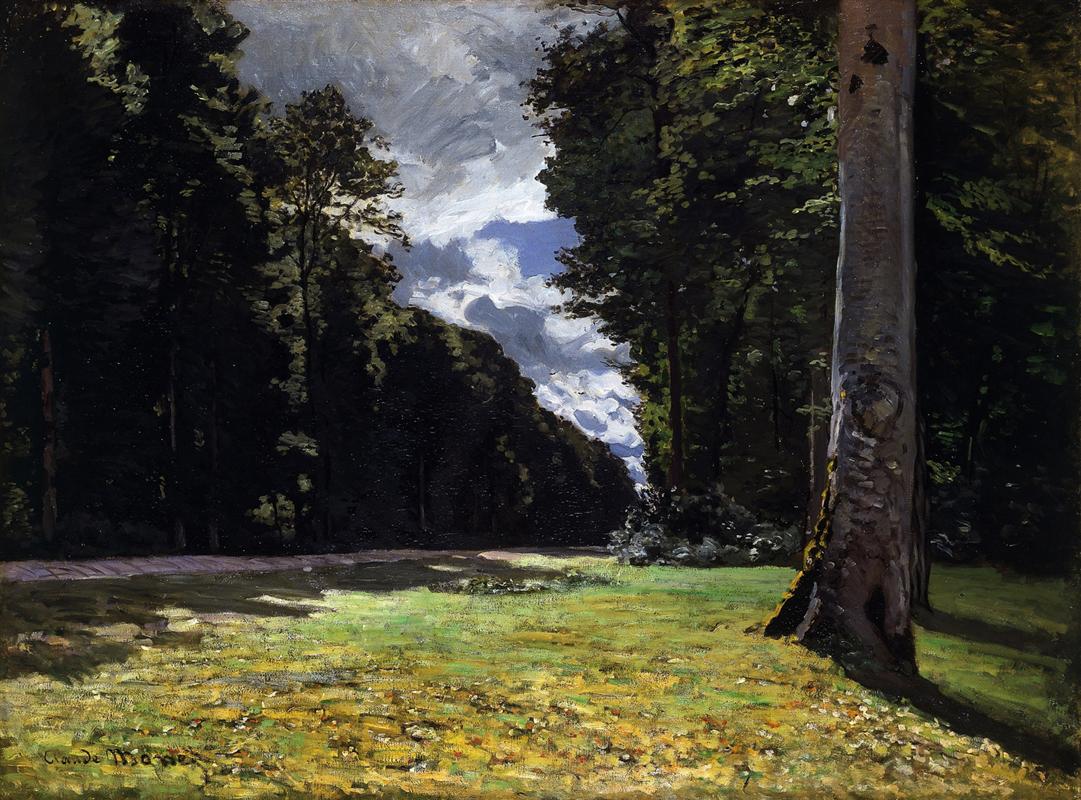
Claude Monet’s The Pave de Chailly in the Fontainbleau Forest from 1865 is a remarkable example of the artist at an early but already highly observant stage of his career. Long before the fully developed shimmer of late Impressionism, Monet was deeply engaged with landscape, atmosphere, and the changing behavior of light. This painting shows those concerns in a form that is more grounded, weighty, and structured than many people might expect from him. It reveals a young painter looking hard at nature, not simply for beauty, but for mood, contrast, and the living presence of a place.
At first glance, the painting seems simple. A forest road or clearing opens before the viewer. Tall trees frame the scene on both sides. A massive trunk stands prominently in the right foreground. Sunlight falls across the grass in bright patches, while deep shadows gather beneath the woods. Above, the sky is unsettled, full of movement and changing weather. Yet the more one looks, the more this image feels suspended between calm and tension. The clearing is sunlit, but the forest is dark. The road is open, but the path seems to disappear into shadow. The sky is bright in places, but also dramatic and stormy. Monet turns what could have been a straightforward woodland view into a subtle emotional experience.
This is one of the reasons the painting matters. It captures a real landscape, but it also captures instability, transition, and visual drama. The forest is not decorative. It feels alive, dense, and almost overwhelming. The light is not evenly spread. It arrives in fragments. The result is a composition that feels immediate and carefully built at the same time. It invites the viewer to walk into it, yet it also keeps part of its mystery intact.
Monet in 1865
In 1865, Monet was still a young artist searching for his direction, though many of the qualities that would later define him were already visible. He was drawn to outdoor painting and to direct observation of the natural world. He was also absorbing lessons from earlier and contemporary French landscape painters, especially those associated with the Barbizon School and the forest of Fontainebleau. This setting had already become an important place for artists interested in nature studied from life rather than imagined in the studio.
What makes this early Monet so compelling is that he is not yet the Monet of water lilies or dissolving cathedrals. He is more solid, more tonal, and in some ways more dramatic. His forms have greater weight. His contrasts are stronger. His brushwork, while already lively, has not yet dissolved objects into vibrating color. Instead, he builds a scene through a balance of dark masses, bright clearings, and an active sky. This gives the painting a seriousness that can surprise viewers who know him mainly through his later work.
At this stage, Monet was deeply interested in how nature could be experienced as both structure and sensation. He was not merely describing a place. He was testing how much immediacy, atmosphere, and optical truth could be brought into landscape painting without losing order. In The Pave de Chailly in the Fontainbleau Forest, that investigation is already well underway. The work belongs to a moment when Monet was learning how to translate outdoor vision into paint while still respecting the compositional discipline expected of serious landscape art.
The Forest of Fontainebleau as Subject
The forest of Fontainebleau held a special place in nineteenth century French art. For many painters, it offered something richer than a conventional pastoral landscape. It contained dense woods, rugged paths, unexpected clearings, ancient trees, and shifting weather. It was a place where nature could appear at once beautiful, wild, and emotionally charged. Artists were attracted to its variety and to its ability to support both realism and poetic interpretation.
In this painting, Monet takes full advantage of those possibilities. Rather than presenting the forest as an idyllic retreat, he shows it as a space of contrast. The trees on the left become a nearly solid wall of darkness. The cluster on the right is slightly more open, but still heavy and enclosing. Between them lies the clearing, luminous and vulnerable beneath a restless sky. The subject is not just a road in a forest. It is the encounter between enclosure and openness.
The location also matters because it places Monet within an important artistic lineage. Fontainebleau had already been painted by artists who were committed to studying nature directly and seriously. Monet enters that tradition, but he brings to it his own heightened sensitivity to light and atmosphere. His version of the forest is less about settled monumentality and more about fleeting conditions. Even here, before his mature Impressionist language emerges, he is alert to change. The clouds seem to move. The sun seems temporary. The shadows seem ready to shift.
That gives the painting a living quality. The forest is not just there. It is happening. The scene feels like a moment caught between weather patterns, between times of day, between one state of illumination and another. That sense of transience would become central to Monet’s later art, and this work shows an early, powerful form of that concern.
Composition and Spatial Design
One of the strongest aspects of The Pave de Chailly in the Fontainbleau Forest is its composition. Monet arranges the elements in a way that feels natural, but also very deliberate. The painting is built on a series of strong verticals and broad horizontal openings. The tree trunks anchor the image. The clearing stretches across the lower half of the composition. The sky opens in the center distance. These structural decisions guide the viewer’s eye while maintaining the illusion of a real observed place.
The large trunk at the right is especially important. It acts almost like a gatepost or visual threshold. Because it is so close to the viewer and so prominent, it intensifies the sense of entering the scene. It also creates asymmetry, which keeps the composition dynamic rather than static. If the image were more evenly balanced, it might feel calm but predictable. Instead, Monet gives the scene tension through imbalance. The right side is weighted by the trunk, while the left side recedes into a deep dark mass of forest.
The opening in the middle distance is equally important. It draws the eye toward the bright, cloud filled sky beyond the trees. This central opening prevents the forest from feeling closed off. At the same time, it does not offer complete release. The path or road remains partially obscured, and the trees still dominate the scene. The viewer senses depth, but not total freedom. This is a landscape that unfolds gradually.
Monet also uses diagonal recession very effectively. The dark edges of the forest seem to angle inward toward the distance, creating a funnel-like movement into the picture space. This brings energy to the composition and helps connect foreground, middle ground, and background. Even without human figures or dramatic action, the painting feels active because the space itself is moving.
Light and Shadow
Light is the emotional center of this painting. Monet does not spread illumination evenly across the scene. Instead, he uses it selectively and dramatically. The grassy clearing in the foreground receives broken sunlight that turns it into a patchwork of yellow green, gold, and pale highlights. These lit areas contrast sharply with the dense shadows of the forest and the darker tones of the path. This contrast creates tension and visual richness.
The light here is not soft and enveloping. It is interrupted. It strikes the ground in fragments, as though filtered through moving branches and unstable clouds. That fragmentation matters because it gives the landscape a fleeting quality. The scene feels temporary, as though a different arrangement of light might appear a minute later. Monet is already interested in the instability of visual experience, and he communicates that through shifting patches of brightness.
The shadows are just as important as the lit areas. The left side of the forest is almost black in places, forming a powerful dark mass. These shadows are not empty. They are full of depth, mystery, and implied detail. Monet does not spell everything out. He lets the darkness retain its complexity. This makes the sunlit clearing feel more precious and more exposed.
The interaction of light and shadow also shapes the mood. A fully sunlit forest scene might feel cheerful or leisurely. A heavily shadowed one might feel ominous or solemn. Monet places the painting between those emotional poles. The result is a mood that is thoughtful, slightly dramatic, and deeply atmospheric. The viewer is not simply looking at a forest in daylight. The viewer is witnessing a struggle between brightness and obscurity.
The Sky and the Sense of Weather
The sky in this painting is one of its most compelling features. It is not a passive backdrop but an active participant in the scene. Monet fills it with vigorous cloud formations that seem to push, swirl, and break apart across the opening above the forest. Areas of pale gray, white, and blue collide in a way that suggests rapidly changing weather. This movement gives the entire painting a charged atmosphere.
Because so much of the forest is dark, the sky becomes a source of visual release. The eye is pulled toward its brightness and activity. Yet this is not a calm blue sky offering simple serenity. The clouds are dramatic. They suggest wind, passing storms, or the aftermath of heavy weather. That uncertainty adds emotional complexity. The landscape below is grounded and heavy, while the sky above is restless and unstable.
Monet’s handling of the sky also shows his growing interest in immediacy. Rather than smoothing the clouds into a polished academic surface, he lets the paint retain energy. The brushwork suggests movement. This helps the viewer feel that the atmosphere is in flux. The sky does not just describe weather. It makes weather visible as a changing force.
This attention to the sky connects the painting to Monet’s later preoccupation with atmosphere. Throughout his career, he would become increasingly interested in how light, air, and moisture alter the appearance of the world. In this early work, that concern is already present, though expressed with greater solidity and contrast. The sky is not yet dissolved into pure vibration, but it is certainly alive.
Brushwork and Surface
The surface of The Pave de Chailly in the Fontainbleau Forest reveals a Monet who is already committed to lively paint handling. The brushwork is visible and purposeful. It does not disappear into a flawlessly blended finish. Instead, strokes remain present enough to remind the viewer that this is a painted interpretation of a moment in nature. That physicality gives the image force.
In the grass, the brushwork becomes particularly active. Small touches of color create the sensation of uneven ground, scattered flowers or leaf fragments, and flickering sunlight. Monet does not labor over every blade. He suggests texture through rhythm. This allows the foreground to feel fresh and immediate rather than stiff or overworked.
The trees are handled differently. Their trunks and shadowed masses are built with broader, heavier applications of paint. This gives them weight and stability. The bark of the large foreground tree is especially striking. It is not rendered in minute detail, but it feels tactile and substantial. The paint communicates the roughness and verticality of the trunk without becoming overly descriptive.
The sky shows another side of Monet’s technique. There, strokes become more sweeping and fluid. The clouds seem shaped by movement rather than careful contour. This variation across the painting is important. Monet adapts his touch to the demands of each element. Grass flickers, trunks stand, clouds shift. The technique supports the subject at every point.
This sensitivity to surface helps explain why the painting remains so engaging. It can be appreciated from a distance as a coherent landscape, but up close it becomes a record of decisions, adjustments, and sensations translated into paint. That dual experience is one of Monet’s great strengths.
Color and Tonal Harmony
Although the painting does not use the high key brilliance often associated with later Impressionism, its color is subtle and effective. Monet works with a restrained palette dominated by deep greens, earthy browns, blackened shadows, muted blues, cool grays, and warm yellow green highlights. This restraint gives the work seriousness and unity. At the same time, it allows small variations in temperature and value to have great impact.
The foreground clearing contains some of the warmest and most inviting notes in the composition. Greens shift toward yellow where sunlight touches them, creating a sense of warmth and life. These passages are balanced by cooler areas in shadow, which prevent the scene from becoming overly decorative. The colors feel observed rather than invented.
The forest itself is built through layered darks. These are not flat black passages, but complex mixtures of green, brown, and blue. That complexity is essential. It keeps the dark areas alive. Even in the deepest shadows, one senses color rather than mere absence of light. Monet understands that shade in nature is never truly empty.
The sky introduces cooler notes that help open the composition. Soft blue appears between the clouds, while gray and white build shifting atmospheric volume. These cooler tones contrast with the warmer ground and create a full environmental experience. The viewer senses air above, earth below, and heavy organic growth on either side.
The tonal structure of the painting is especially strong. Monet organizes the image through clear relationships of dark, middle, and light values. This gives the scene coherence and depth. It also contributes to the painting’s emotional force. The luminous clearing feels brighter because the surrounding forest is so dark. The sky feels more expansive because it rises out of those shadowed walls. Color and tone work together to shape the painting’s drama.
Mood, Presence, and Emotional Meaning
One of the most striking things about this painting is its emotional ambiguity. It is undeniably beautiful, but it is not simply cheerful. The forest is grand, but also imposing. The light is radiant, but temporary. The scene is open enough to welcome the viewer, yet dark enough to keep part of itself hidden. Monet creates a mood that is contemplative and slightly uneasy, though never oppressive.
This emotional richness comes from the balance of opposites. Sunlight and shadow coexist. Openness and enclosure coexist. Stability and movement coexist. The tree trunks stand firm, but the sky churns. The clearing glows, but the path leads toward darkness. The painting therefore feels psychologically alive. It mirrors the way real landscapes can carry more than one emotional tone at once.
The absence of figures also matters. No people distract from the direct encounter between viewer and place. The forest does not serve as a stage for narrative action. It is the subject in itself. This gives the painting a meditative quality. The viewer is left alone with light, weather, space, and silence.
At the same time, the work never becomes abstract or detached. Its emotional power arises from close observation. Monet does not impose an exaggerated drama on the scene. He finds drama in what is already there. That is one of the hallmarks of great landscape painting. It reveals that nature, when truly seen, contains its own complexity, tension, and poetry.
Why This Painting Matters in Monet’s Development
The Pave de Chailly in the Fontainbleau Forest matters because it shows Monet before the style for which he became most famous had fully crystallized, yet it already contains many essential elements of his art. We see his commitment to painting from nature. We see his fascination with transient light. We see his sensitivity to atmosphere, his interest in visual immediacy, and his ability to organize a scene without making it feel artificial.
At the same time, the painting reminds us that Monet did not emerge fully formed as an Impressionist master of color and sensation. He developed through serious engagement with landscape traditions that valued structure, tonal depth, and close study. This work stands at that important point of transition. It is rooted in realism and in the legacy of earlier French landscape painting, yet it pushes toward something freer and more responsive.
For viewers, that makes the painting especially rewarding. It expands the understanding of Monet beyond his most reproduced images. It shows that even in his youth, he was capable of creating a landscape that is visually powerful, emotionally subtle, and compositionally assured. The painting has freshness, but also gravity. It has immediacy, but also discipline.
It also helps explain why Monet would later become so transformative. The seeds are already here. He was already interested in how perception changes from moment to moment. He was already attentive to the instability of weather and the shifting nature of illumination. He was already willing to let brushwork remain visible and alive. In this sense, the painting is not just an early success. It is a key step in the formation of a revolutionary vision.
Conclusion
Claude Monet’s The Pave de Chailly in the Fontainbleau Forest is far more than an early landscape exercise. It is a deeply observant, carefully constructed, and emotionally resonant painting that reveals the young artist’s extraordinary sensitivity to nature. Through its dark forest masses, its glowing clearing, its restless sky, and its vivid interplay of light and shadow, the painting transforms a woodland view into a compelling meditation on atmosphere and change.
What makes the work memorable is its balance. It is structured without being rigid. It is atmospheric without losing form. It is beautiful without becoming sentimental. Monet sees the forest as a living environment shaped by weather, light, and depth, and he invites the viewer to experience it in that same active way. The scene is not static. It feels as though it could shift at any moment.
Seen today, the painting has a special value because it shows Monet on the edge of his mature achievement. It preserves the solidity of mid nineteenth century landscape while pointing toward the more fluid and luminous art he would later create. In that sense, it belongs both to a tradition and to a new future. It is a work of transition, but not uncertainty. Its confidence is clear in every part of the composition.
The painting ultimately reminds us that Monet’s greatness was rooted not only in dazzling color or famous later series, but in a profound ability to look at the world and discover its inner life. In this forest scene, he does exactly that. He makes light feel fragile, shadow feel deep, and weather feel present. He makes a path through the trees into an experience of seeing itself.
