Image source: wikiart.org
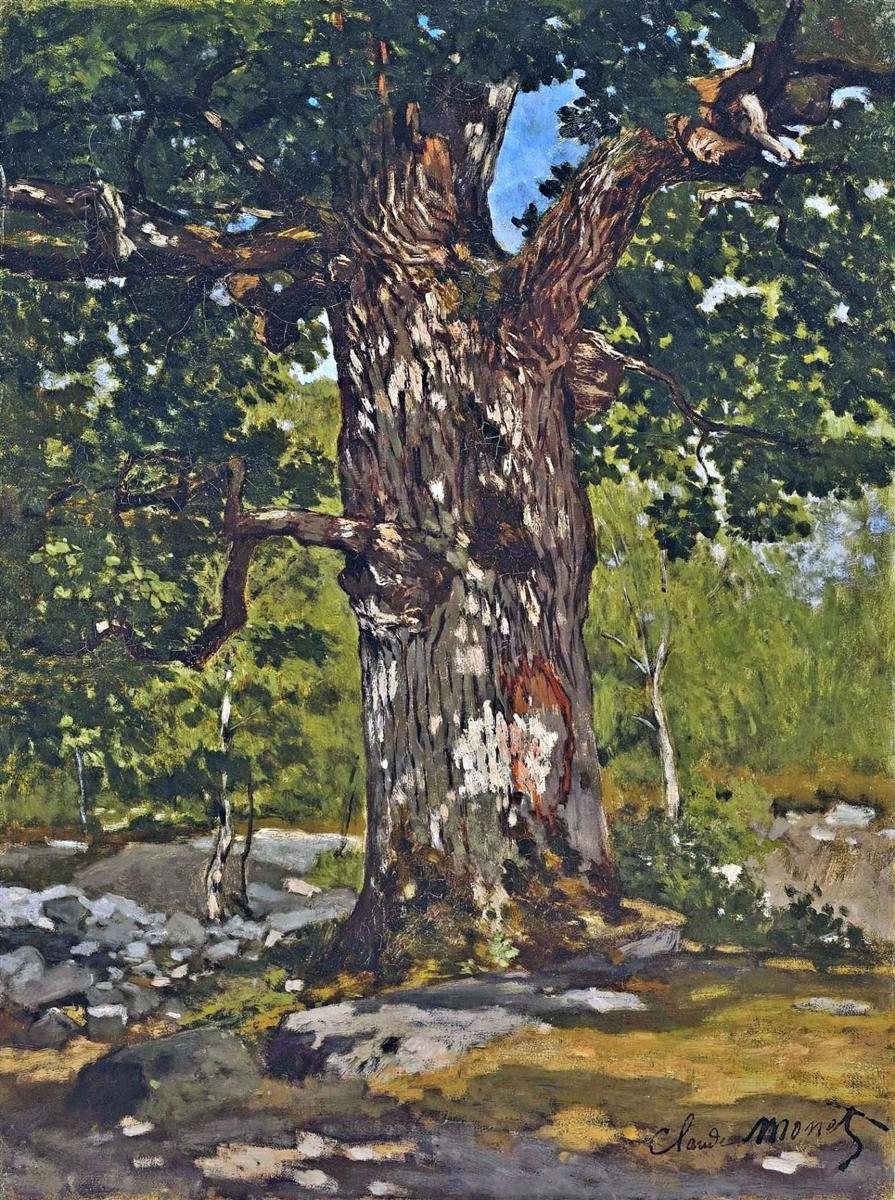
Claude Monet’s The Bodmer Oak (1865)
Claude Monet’s The Bodmer Oak from 1865 is a striking early landscape that reveals how powerfully the young artist could turn a single tree into a commanding subject. At first glance, the painting seems simple. It shows a massive old oak rising from a sunlit clearing, surrounded by rocks, foliage, and patches of open sky. Yet the longer one looks, the more complex the image becomes. This is not just a study of nature, nor is it only a record of a place. It is a painting about scale, age, endurance, and vision. The oak dominates the scene like a monument, but Monet avoids turning it into something stiff or theatrical. Instead, he gives it life through light, color, surface, and atmosphere.
This work belongs to an important moment in Monet’s development. Painted in the mid 1860s, before the height of Impressionism, it shows an artist still rooted in the realist and landscape traditions around him, yet already pushing toward a more personal way of seeing. In The Bodmer Oak, Monet studies nature with seriousness and intensity, but he also begins to organize the natural world around sensation. The tree is solid and specific, yet the painting is equally about flickering light, broken touches of color, and the visual experience of standing before a living form outdoors.
What makes this painting so compelling is the way it balances monumentality with immediacy. The oak appears ancient, weathered, and almost heroic, but it is not idealized into a mythic emblem cut off from ordinary life. It stands in a real place, under real sunlight, its trunk marked by rough bark, scars, and twisting growth. The surrounding greenery is active and unstable, changing with the light. The result is a work that feels both timeless and vividly observed. It captures not only a tree, but a moment of encounter between artist and landscape.
Historical Context and Monet’s Early Career
In 1865, Monet was still a young painter finding his artistic direction. He had not yet fully become the Monet most people imagine today, the master of water lilies, haystacks, and luminous serial views. At this stage, he was deeply engaged with landscape painting as a serious artistic pursuit and was responding to a range of influences, including the painters associated with the Forest of Fontainebleau and the broader movement toward painting directly from nature.
The setting of The Bodmer Oak matters greatly. The Forest of Fontainebleau had already become a celebrated destination for artists by the mid nineteenth century. Painters were drawn to its varied terrain, ancient trees, rugged rocks, and shifting light. It offered both grandeur and intimacy. Instead of the idealized, invented landscapes of earlier academic traditions, Fontainebleau presented nature as something immediate, specific, and worthy of direct study. This environment helped reshape modern landscape painting, and Monet’s painting stands within that important lineage.
At the same time, The Bodmer Oak shows that Monet was not content merely to repeat what earlier landscape artists had done. He was learning from them, but he was also testing how far he could go in translating outdoor experience into paint. The picture has more density and weight than many of his later works, but one can already sense his fascination with transient visual effects. Light does not simply illuminate the tree. It breaks across the bark, flashes through the leaves, and turns the entire surface into an active field of perception.
This early date also reminds us that Monet’s development was gradual rather than sudden. Impressionism did not appear out of nowhere. Paintings like The Bodmer Oak reveal how Monet built his mature language through close observation, disciplined study, and repeated engagement with natural motifs. The picture is therefore valuable not only as a beautiful landscape in its own right, but also as evidence of an artist in formation.
The Monumental Presence of the Tree
The most immediate feature of the painting is the sheer dominance of the oak. Monet places it squarely before the viewer, allowing the trunk to rise almost the full height of the composition. Its heavy branches extend outward with enormous force, creating a structure that feels both stable and organic. This is a tree with presence. It is not decorative background. It is the subject, the central drama, and the organizing principle of the painting.
The tree’s scale transforms the experience of the scene. The viewer is placed close to the trunk, almost at its base, which creates a sense of confrontation. One does not merely look at the oak from a distance. One stands before it, measuring oneself against it. The tree becomes a kind of natural architecture, as commanding as a tower or cathedral column. Its bark resembles carved stone in places, while its branching limbs suggest a vast framework overhead. Monet turns the tree into something monumental without making it unnatural.
At the same time, the oak is not smooth or symmetrical. Its trunk is irregular, furrowed, and twisted by time. One branch juts out awkwardly. Another bends upward and outward with a sense of strain. These details prevent the tree from becoming a mere symbol of strength in the abstract. It feels weathered, individual, and real. Its power comes not from perfection, but from endurance.
This combination of monumentality and specificity is one of the painting’s greatest achievements. The oak stands for age, persistence, and the grandeur of nature, but it never loses its identity as a particular living organism. Monet does not flatten it into a simple emblem. He preserves its roughness, scars, and irregular growth, allowing the viewer to feel both its symbolic weight and its physical reality.
Composition and Spatial Design
Although the tree is the dominant subject, the composition is carefully balanced. Monet does not isolate the oak against an empty background. Instead, he surrounds it with a network of visual elements that help define space and support the central form. The rocks in the foreground, the smaller trees in the middle ground, and the dense foliage behind the trunk all contribute to the sense that the oak belongs to a larger environment.
The placement of the trunk near the center gives the painting stability, but the branches create movement across the upper half of the composition. They spread outward in different directions, breaking up the mass of leaves and opening glimpses of blue sky. These openings are important because they prevent the top of the painting from becoming too dark or heavy. They also create visual rhythm, alternating between solid foliage and luminous air.
The foreground is understated but effective. The ground is uneven, scattered with shadows, stones, and patches of sunlight. Monet does not crowd it with detail, yet he gives it enough variation to ground the massive tree convincingly. The large rock near the bottom edge anchors the scene and echoes the solidity of the trunk. This creates a subtle dialogue between tree and earth, between vertical and horizontal weight.
Depth in the painting is suggested more through overlapping forms, tonal variation, and light than through strict linear recession. The background trees are lighter and less sharply defined, which helps push them back into space. The oak remains the most forceful and tactile element, while the surrounding landscape recedes in softer passages. This approach keeps the composition unified while ensuring that the central motif remains dominant.
What is especially interesting is how the composition combines openness and enclosure. The viewer is in a clearing, yet the surrounding foliage creates a kind of green chamber around the oak. The tree stands both exposed and protected. This tension gives the scene emotional richness. It feels like a place of encounter, a secluded site where something ordinary becomes momentous through attention.
Light, Color, and the Living Surface of Nature
One of the most impressive qualities of The Bodmer Oak is Monet’s handling of light. Even in this relatively early work, he shows a remarkable sensitivity to how sunlight transforms surfaces. The bark of the tree is not rendered in a single brown or gray. It is built from a shifting interplay of warm and cool tones, including creams, violets, earthy reds, grays, and dark browns. Sunlight falls unevenly across the trunk, creating flashes of brightness that make the bark seem rough, layered, and alive.
The foliage is equally nuanced. Rather than painting leaves as fixed, separate objects, Monet treats the canopy as a vibrating mass of greens, deep shadows, and light-struck patches. Some areas are dark and dense, almost opaque, while others open into sparkling fragments of color. This prevents the greenery from becoming monotonous. It feels active, changing, and responsive to the atmosphere.
The touches of blue sky are especially important. They appear in irregular openings among the leaves and branches, creating contrast against the darker canopy. These glimpses of blue bring freshness to the painting and keep the upper part of the composition from collapsing into shadow. They also help convey the sensation of standing under a tree on a bright day, where the eye is constantly adjusting between dense shade and sudden light.
Monet’s palette here is more earthy and restrained than in many of his later paintings, but it is far from dull. The greens are varied, the bark is richly inflected, and the ground contains subtle harmonies of ochre, gray, olive, and muted gold. This color structure gives the painting naturalism without stiffness. It feels observed rather than formulaic.
Most importantly, color in this painting is tied to perception. Monet is not simply filling in local tones. He is responding to how light alters the appearance of things from moment to moment. The oak’s trunk becomes a field of shifting sensations rather than a flat descriptive surface. This attention to visual change points forward to the concerns that would later define Impressionism.
Brushwork and Texture
The surface of The Bodmer Oak is central to its power. Monet uses paint in a way that makes the viewer feel the roughness of bark, the density of leaves, and the broken character of outdoor light. His brushwork is energetic but controlled. He does not dissolve the world into pure abstraction, yet he avoids the polished finish associated with more academic painting. Instead, he allows the handling of paint itself to contribute to the image’s vitality.
The trunk is built with particularly expressive strokes. The marks follow the irregular growth of the bark, emphasizing its fissures, knots, and vertical movement. In some passages, lighter paint sits against darker tones to suggest sharp contrasts of sun and shadow. In others, the strokes twist and overlap, echoing the physical complexity of the wood. The result is a trunk that feels scarred, aged, and deeply tactile.
In the foliage, Monet’s brushwork becomes looser and more fragmented. This is appropriate because leaves and branches do not present themselves to the eye as stable, uniform patterns. They shimmer, overlap, and shift in the light. Monet captures this by breaking the surface into flickering touches that suggest visual movement. The eye never settles for long in these passages. It moves across the surface much as it would in nature.
This contrast between the dense, structured handling of the trunk and the more broken treatment of the foliage is crucial. It creates a hierarchy of attention. The oak feels rooted and enduring, while the surrounding greenery feels transient and alive. Texture becomes expressive. It tells us not only what these forms look like, but how they exist in time.
The brushwork also contributes to the painting’s emotional tone. Because the surface remains active and visible, the picture feels immediate rather than distant. We are aware of the artist’s presence before the motif, translating sight into touch. That sense of direct engagement gives the painting freshness even now.
Nature as Character and Presence
Many landscape paintings depict nature as scenery. In The Bodmer Oak, nature becomes presence. The tree is so forcefully individualized that it almost seems to possess character. Its trunk twists upward with something like determination. Its branches reach and spread with an energy that suggests accumulated life. Even its wounds and irregularities feel expressive. This is not anthropomorphism in a sentimental sense, but it does mean that Monet presents the oak as more than an object.
The idea of a tree as a kind of living witness has deep resonance in art and literature. Old trees often suggest continuity across generations, survival through storms, and silent endurance in the face of time. Monet taps into that resonance without overexplaining it. He allows the visual structure of the painting to carry much of the meaning. The oak appears ancient not because the artist tells us so, but because every part of its form speaks of duration, weight, and weathering.
At the same time, the painting avoids turning the tree into a purely romantic symbol cut off from the observable world. It is not surrounded by dramatic ruins or theatrical weather. There are no figures worshipping it, no narrative clues forcing an interpretation. The oak remains part of an ordinary landscape. That restraint is important because it keeps the painting grounded. The emotional force comes from attention itself, from the seriousness with which Monet looks at the tree and asks the viewer to do the same.
This ability to reveal character through observation would remain one of Monet’s great gifts. He often chose motifs that others might consider humble or repetitive, then transformed them through sustained looking. In The Bodmer Oak, the humble subject is not a flower or a pond but a single tree, and Monet proves that such a subject can carry tremendous visual and emotional weight.
The Painting’s Place in Monet’s Artistic Evolution
Looking at The Bodmer Oak with knowledge of Monet’s later career is fascinating because it shows both continuity and difference. The continuity lies in his devotion to nature, light, and the experience of seeing. Even here, before the flowering of Impressionism, Monet is less interested in rigid contour than in the interaction of light and color across a surface. He is already attentive to fleeting effects and to the instability of visual experience.
The differences are equally revealing. This painting has more mass, more emphasis on structure, and more tonal depth than many of the later works for which Monet is best known. The forms are weightier, the subject is more singular, and the composition feels more rooted in the traditions of mid nineteenth century landscape painting. The brushwork, though lively, does not yet dissolve matter into the broad atmospheric shimmer found in some of his mature canvases.
That makes The Bodmer Oak especially important. It belongs to the threshold between inherited landscape traditions and the new language Monet would help create. One can see him negotiating between solidity and sensation, between form and atmosphere, between description and immediate visual impression. Rather than treating this painting as merely preliminary, it is better to see it as a work that contains the seeds of future developments while also possessing its own distinct character.
It also reminds us that Monet’s greatness did not depend on one formula. He could paint open water, urban leisure, snow, cliffs, gardens, and solitary trees, adapting his method to the demands of each motif. The Bodmer Oak reveals his seriousness as a young landscape painter and his ability to make a concentrated study feel expansive and memorable.
Emotional Atmosphere and Viewer Experience
The emotional tone of The Bodmer Oak is calm but powerful. There is no overt drama in the narrative sense, yet the painting carries a strong sense of presence and gravity. Much of this comes from the tree’s massive scale and the closeness of the viewpoint. The viewer feels small before it, but not oppressed. The effect is more contemplative than threatening.
Sunlight plays an important role in shaping this atmosphere. The scene is not gloomy. Light filters through the canopy and touches the trunk, the ground, and the surrounding foliage in scattered patches. This dappled illumination softens the monumentality of the oak and makes the whole landscape feel inhabited rather than forbidding. It is a place where one might pause, look upward, and become aware of time passing.
There is also a quiet tension between permanence and change. The oak itself seems enduring, almost immovable, while the light around it is fleeting. Shadows shift, leaves tremble, sky appears in fragments. Monet holds these two experiences together. The tree stands for continuity, but the painting reminds us that all perception happens in moments. Nature is both stable and unstable at once.
This balance gives the work much of its emotional depth. It invites contemplation without requiring a fixed symbolic reading. A viewer may respond to the tree as a sign of strength, resilience, solitude, or natural majesty. Another may simply be drawn to the sensory richness of bark, leaves, and sunlight. The painting accommodates both responses because it is grounded in the direct visual experience of place.
Why The Bodmer Oak Still Matters
The Bodmer Oak remains compelling because it demonstrates how much can be achieved through focused attention to a single motif. In an age when landscape painting could easily become formulaic or sentimental, Monet found a way to make one tree feel vast, alive, and worth prolonged study. He did so not through exaggeration or narrative embellishment, but through the intelligent use of composition, color, light, and paint handling.
The painting also matters because it broadens our understanding of Monet. Many viewers know him mainly through his later, more atmospheric works, where forms melt into color and light. This earlier painting shows another side of his talent. It reveals a painter who could build strong structure, convey tactile detail, and give physical presence to a natural subject without sacrificing visual freshness.
For anyone interested in the history of modern art, the work offers a valuable glimpse into the transition from realist landscape toward Impressionism. It shows that modern painting did not begin by abandoning the world, but by looking at it more intently. Monet’s oak is solid, rooted, and specific, yet it is also a vehicle for exploring how sight itself works outdoors.
Above all, the painting endures because it captures a universal experience: the feeling of standing before something in nature that seems older, larger, and more enduring than oneself. Monet transforms that experience into art with remarkable clarity. The oak becomes both a particular tree and a lasting image of strength shaped by time, light, and weather.
Conclusion
Claude Monet’s The Bodmer Oak is far more than an early tree study. It is a powerful meditation on natural grandeur, close observation, and the young artist’s evolving vision. The massive trunk, the twisting branches, the flickering canopy, and the textured bark all work together to create an image of extraordinary presence. Monet gives the oak monumentality without stiffness, realism without dryness, and atmosphere without vagueness.
Seen within the context of his early career, the painting reveals how deeply Monet was already committed to painting nature as lived experience rather than inherited formula. The work still carries the weight and structure of earlier landscape traditions, yet it also anticipates the broken color, active surface, and sensitivity to light that would later define his mature style.
What makes the painting memorable is its ability to turn a single tree into a world. The oak is rooted in a specific landscape, but it also becomes a larger reflection on endurance, perception, and the quiet drama of the natural world. Monet invites the viewer to stop, look carefully, and recognize that even a familiar subject can become extraordinary when truly seen. That invitation remains one of the most powerful aspects of his art, and The Bodmer Oak stands as a remarkable early example of it.
