Image source: wikiart.org
Introduction
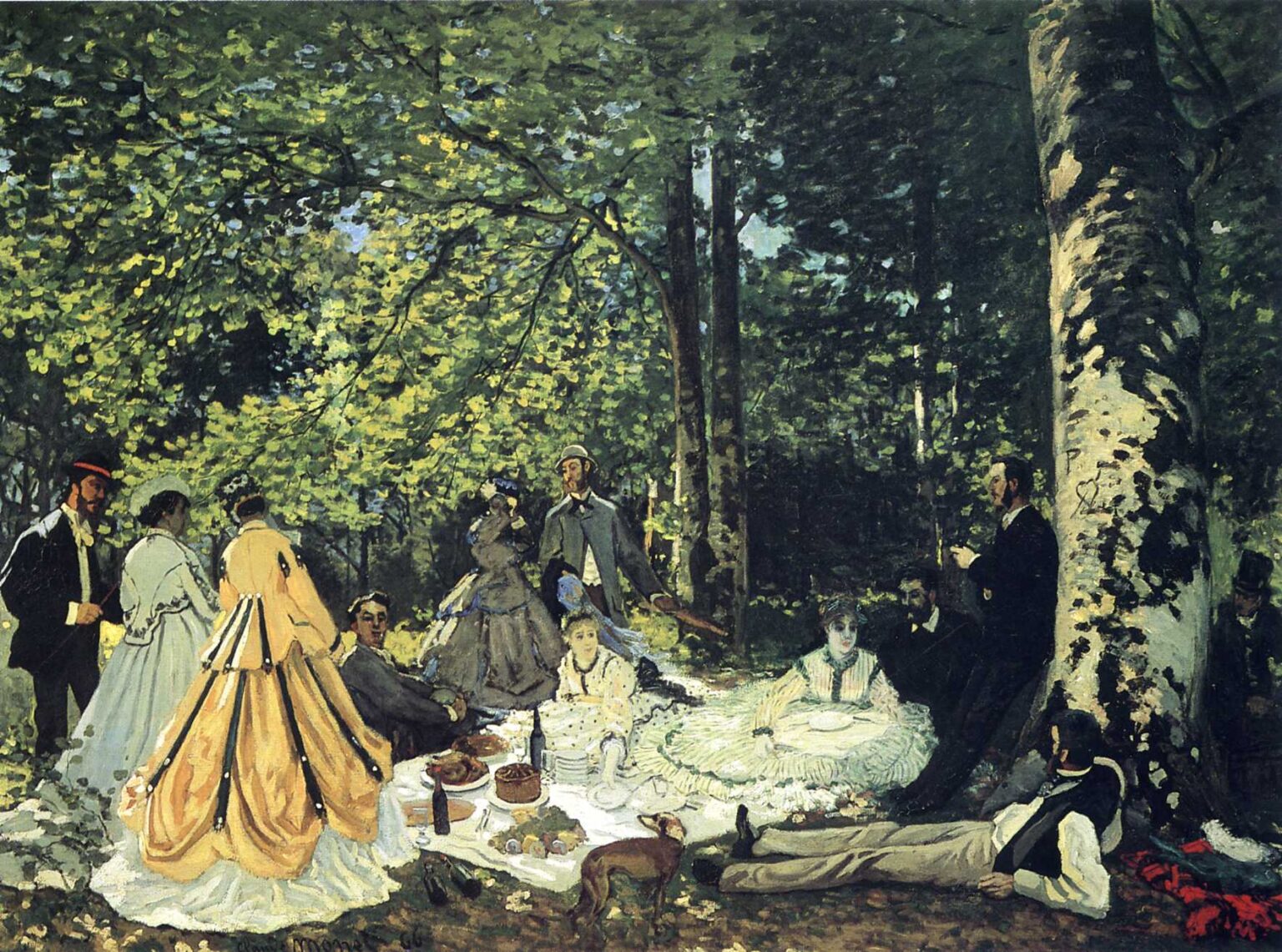
Claude Monet’s Luncheon on the Grass presents a gathering in the woods that feels both elegant and immediate. Painted in 1865, the work stands at a fascinating point in Monet’s career, when he was still a young artist shaping the visual language that would later define Impressionism. At first glance, the scene appears to be a fashionable outdoor picnic, with men and women dressed in contemporary clothes, arranged across a patch of white fabric laid over the forest floor. Yet the painting is much more than a simple leisure scene. It is an exploration of light, atmosphere, modern life, and the challenge of translating fleeting visual experience into paint.
What makes this painting so compelling is the way it combines ambition with freshness. Monet does not treat the forest as a neutral backdrop. The trees, leaves, and filtered sunlight are active forces that shape every part of the image. The figures do not merely sit in front of nature. They exist within it, touched by its shadows, softened by its changing light, and partially absorbed into its mood. The result is a painting that feels alive, as though the air itself is moving through the composition.
The title immediately invites comparison with earlier artistic traditions, especially the long history of outdoor feasting and pastoral leisure in European painting. But Monet transforms those traditions by making the scene unmistakably modern. These are not idealized classical figures in a timeless Arcadian landscape. They are recognizably contemporary people in fashionable dress, brought into a real woodland setting. Their presence gives the work a sense of social specificity, while the natural environment gives it poetry and visual complexity.
This combination of modern subject matter and visual experimentation is central to the painting’s importance. Luncheon on the Grass is not only about people enjoying an afternoon outdoors. It is also about seeing, about the difficulty and pleasure of capturing light scattered through leaves, bright fabric placed against dark shade, and human figures distributed across a space that is both intimate and deep. The painting shows Monet wrestling with large pictorial problems, and in doing so, it reveals the confidence and curiosity that would soon make him one of the most influential painters of the nineteenth century.
The Immediate Visual Impact
One of the first things a viewer notices is the striking contrast between the luminous picnic cloth and the surrounding darkness of the forest. The white surface spreads across the lower center of the painting like a pool of light. It catches the eye at once and becomes the visual anchor of the whole scene. Around it, the figures gather in a loose arrangement that feels natural rather than rigidly posed. Some stand, some sit, and some recline. This variety of postures gives the composition a sense of relaxed movement.
The forest canopy overhead creates an enclosing structure. Branches stretch across the upper part of the painting, and the dense foliage breaks sunlight into scattered flashes. This interplay of brightness and shade gives the scene an almost theatrical atmosphere, but it is not a stage set. It feels observed, not invented. The viewer has the sense of arriving upon a real moment in progress.
At the same time, the painting retains a certain monumentality. The figures are substantial, the setting is expansive, and the composition is carefully organized despite its apparent informality. This balance between spontaneity and structure is one of the work’s most impressive achievements. Monet makes the moment feel casual, but the painting itself is far from casual. It is thoughtfully built, with attention to rhythms of light, vertical tree trunks, and the distribution of color across the canvas.
Another strong element of the painting’s visual impact is the contrast between refinement and natural roughness. The elaborate dresses, dark suits, and neatly arranged meal suggest urban sophistication, while the ground, trees, and shadows remain irregular and untamed. This opposition gives the scene energy. Civilization and nature meet here, but neither fully dominates the other.
Composition and Spatial Design
Monet’s compositional strategy is remarkably ambitious. He places the viewer at a slight distance from the gathering, close enough to observe the figures and details of the meal, but far enough to take in the larger woodland environment. This creates a layered spatial experience. The foreground includes the cloth, food, bottles, and reclining figure, all of which establish a tangible sense of presence. The middle ground contains the central cluster of people, and the background dissolves into darker trees and fragmented light.
The large tree trunk on the right acts as a powerful vertical element. It stabilizes the scene and frames the group, almost like an architectural column. It also emphasizes the scale of the woodland setting, reminding the viewer that nature here is not decorative. It is imposing, textured, and physically present. Other trunks recede into the background, creating depth while maintaining the rhythm of upright forms across the composition.
The figures are arranged in a way that avoids symmetry. This asymmetry is crucial to the painting’s naturalism. Instead of lining up the participants in a formal order, Monet scatters them across the picnic space. A standing woman in a broad golden dress dominates the left side, while seated and reclining figures balance the right. The central seated women in lighter clothing create a bright cluster that echoes the white cloth beneath them. The result is a composition that feels open and fluid.
Even though the gathering seems informal, the placement of the figures leads the eye carefully through the scene. The white cloth draws attention first, then the eye moves upward to the pale dresses and the standing figures, and finally wanders into the darker woods beyond. This movement mirrors the actual experience of seeing outdoors, where the eye shifts between near detail and distant atmosphere.
Monet also uses overlapping forms to create depth and realism. Figures partly obscure one another, dresses spill into neighboring space, and objects on the ground are distributed in a way that suggests genuine occupation of the environment. Nothing appears isolated. Everything belongs to a shared, breathing world.
Light as the True Subject
If one had to identify the painting’s deepest subject, it would not simply be the picnic or the social event. It would be light. Monet is already showing the obsession that would define his mature work. Sunlight filtered through leaves creates a highly unstable visual field. Brightness appears in patches, not in smooth transitions. The white cloth reflects light upward, faces emerge from shadow, and bits of dress shimmer against the darker setting.
This is not the even, controlled lighting of a studio scene. It is broken light, moving light, light that challenges the painter at every moment. Monet seems fascinated by the way outdoor illumination changes the appearance of color and form. White is not merely white here. It becomes blue, cream, pale gray, and warm yellow depending on the surrounding conditions. Dark areas are not flat black. They are full of green, deep blue, and earthy brown.
The handling of light gives the painting its sense of immediacy. We feel that this particular hour, perhaps a warm afternoon under a dense canopy, matters to the image. The scene could not simply be transferred indoors or repainted under another sky without losing its essence. Light is not added to the subject after the fact. It creates the subject.
This concern with transient visual effects would later become central to Impressionism, but here it is already powerfully present. Monet is interested in how light transforms everything it touches. Fabrics glow differently according to angle and shade. Faces emerge softly rather than with hard academic clarity. Even the ground seems animated by the shifting pattern of foliage above.
Because of this, the painting offers more than narrative content. It offers sensory experience. The viewer can almost feel the coolness of the wooded shade, the occasional warmth of sunlight breaking through, and the visual adjustment required to move between bright cloth and dark forest. Monet turns perception itself into a theme.
Color and Tonal Harmony
The color palette of Luncheon on the Grass is rich but controlled. Green dominates the upper and background portions of the painting, yet Monet avoids monotony by varying the greens endlessly. Some are bright and yellowish where sunlight touches the leaves. Others are cool and deep in the shadows. This variation gives the foliage density and vitality.
Against these greens, the clothing of the figures becomes especially important. The pale dresses and white cloth establish areas of high luminosity, while the dark suits of several men provide anchoring accents. The golden dress on the left is one of the most memorable color notes in the work. It introduces warmth and elegance while also standing out dramatically against the cooler forest tones. That dress helps animate the left side of the composition and prevents the color scheme from becoming too subdued.
Monet’s tonal control is equally impressive. He understands that color alone is not enough. The painting depends on the relationship between light and dark. The luminous central zone is surrounded by deeper tones that make it appear even brighter. This tonal contrast creates drama without destroying the natural feeling of the scene.
There is also a subtle conversation between natural and artificial color. The greens and browns of the forest represent the organic world, while the garments introduce dyed fabrics and social fashion into the landscape. This interaction reinforces one of the painting’s central tensions, the encounter between cultivated society and untamed nature.
The overall harmony of the painting comes from Monet’s ability to make these contrasts feel unified. Bright and dark, warm and cool, natural and fashionable, all coexist without fragmenting the image. The scene remains coherent because the same light filters through every element, binding them together in a shared atmosphere.
The Figures and the Modern World
The people in the painting are not heroic, mythological, or rural laboring figures. They are modern individuals at leisure. Their clothing signals urbanity, class, and social refinement. This matters because Monet is painting the life of his own time, not escaping into historical fantasy. He is making contemporary experience worthy of large scale artistic treatment.
The figures do not all interact in a clearly dramatic way. Some appear engaged in conversation, others seem lost in thought, and some simply occupy space quietly. This lack of overt narrative is important. Monet is less interested in telling a story than in presenting a social atmosphere. The painting captures presence rather than plot.
The women’s dresses, with their fullness and delicate light tones, become major pictorial elements in themselves. They reflect and diffuse light beautifully, creating soft radiance in the center of the work. The men’s darker clothing, by contrast, introduces solidity and restraint. Together, these garments help organize the painting visually while also describing a specific social world.
There is something revealing about the way these figures occupy the woods. They are not rustic people who belong naturally to the forest. Their presence there feels chosen, stylish, and temporary. The outdoor meal becomes a cultural act, a way of turning nature into an extension of social life. Yet Monet does not mock this. Instead, he seems intrigued by the visual possibilities it creates.
This modernity places the painting within a broader nineteenth century shift toward representing contemporary life in art. Painters were increasingly drawn to scenes of leisure, urban culture, and changing social habits. Monet contributes to this movement by showing that modern people in modern dress can sustain serious pictorial exploration. The scene may look relaxed, but its artistic ambition is considerable.
Nature as Setting and Presence
The woodland environment is far more than a backdrop. It shapes the entire emotional and visual character of the painting. The tall trees and overarching branches create an almost enclosed world, a green chamber open to air and light. This gives the picnic an intimate atmosphere, even though the setting is outdoors.
There is a strong sense of shelter here. The leaves form a canopy that protects the gathering from harsh exposure. At the same time, the forest is not domesticated. Dark recesses remain in the background, and the rough textures of bark and earth remind us that nature retains its own power and mystery. The people have entered this space, but they do not fully control it.
Monet seems particularly attentive to the sensory complexity of the woods. The filtered sunlight, irregular ground, and shifting patches of shade all suggest direct observation. The forest is a place of visual instability, where edges soften and colors mutate according to light. This made it an ideal setting for an artist increasingly interested in the fleeting nature of perception.
The juxtaposition of elegant leisure and dense woodland also produces a poetic effect. The picnic becomes almost dreamlike, suspended between public sociability and private reverie. The figures are together, but the atmosphere encourages inwardness as well as conversation. The forest deepens the silence around them.
Because of this, the painting can be read not only as a social scene but also as a meditation on temporary human presence within a larger natural world. The group has spread its meal, fabrics, and bottles across the forest floor, but the woods remain vast and enduring. This awareness lends the image a quiet seriousness beneath its surface charm.
Technique and Painterly Experiment
Monet’s brushwork in this painting shows both discipline and freedom. Certain passages are carefully built, especially in the figures and key structural areas of the composition. Yet other passages, particularly in the foliage and shadowed background, are handled with greater looseness. This variation is essential to the work’s vitality.
The leaves overhead are not described one by one in a polished academic manner. Instead, Monet uses broken touches and clusters of color to suggest their flickering density. This allows the surface of the painting to remain active. We sense not only the appearance of foliage but also its movement and visual instability. The same is true of the dappled light across the scene, which is conveyed through painterly contrasts rather than rigid outlines.
In the clothing, especially the light dresses, Monet balances form and luminosity with great sensitivity. Fabric is rendered through broad areas of tone and carefully placed highlights, not merely through line. This helps the garments feel weighty and luminous at the same time. They occupy space while also catching and scattering light.
The painting therefore reveals Monet in a moment of transition. He still retains some connection to established figure painting and large scale composition, but he is already moving toward a more direct and optical way of seeing. Rather than subordinating every brushstroke to smooth finish, he allows paint itself to participate in the sensation of the scene.
This technical approach is one reason the painting feels modern. The viewer is not only meant to decode the subject matter. The viewer is also meant to experience the surface, the marks, and the visual energy of the painted image. Monet is beginning to trust that a painting can communicate through atmosphere and sensation as much as through precise detail.
A Key Moment in Monet’s Development
Luncheon on the Grass occupies an important place in understanding Monet’s artistic development. It shows him testing his ability to unite large figural composition with direct observation of outdoor light. Later, he would become more closely associated with landscapes, water scenes, gardens, and serial studies of changing atmosphere. Here, however, he is still confronting the challenge of bringing human figures into a large, ambitious outdoor setting.
That challenge mattered. It pushed him to consider how people and environment could be painted as part of the same visual system. Instead of treating figures as separate studio inventions inserted into a landscape, he works toward integration. The people belong to the light conditions of the woods. They are subject to the same atmosphere as the trees and ground around them.
This ambition helps explain why the painting feels so significant even apart from its beauty. It is not just a pleasant early work. It is a record of artistic problem solving. Monet is exploring scale, modernity, social life, and perception all at once. In doing so, he lays groundwork for the methods and concerns that would later define Impressionism.
The painting also suggests that Monet’s breakthrough did not arrive suddenly. It emerged through works like this one, where he tested possibilities, absorbed influences, and gradually reshaped the priorities of painting. What we see here is not a finished formula but a searching intelligence at work. That searching quality gives the painting much of its lasting fascination.
Mood, Meaning, and Lasting Appeal
Despite its large cast of figures and lively setting, the mood of Luncheon on the Grass is not noisy or theatrical. It is calm, shaded, and reflective. The people are gathered together, but the atmosphere remains spacious. There is leisure here, but also quiet. That balance between sociability and stillness is one of the painting’s greatest strengths.
The scene evokes pleasure without becoming frivolous. Food, conversation, elegant clothes, and a beautiful setting all suggest enjoyment, yet the forest and the subdued interactions prevent the image from feeling merely decorative. There is depth in its quietness. The painting invites slow looking, just as the afternoon it depicts seems to invite slow living.
Its lasting appeal comes partly from this emotional complexity. Viewers can enjoy it as a beautiful scene of outdoor leisure, but they can also sense its seriousness as a study of light and modern experience. The work is welcoming, yet it rewards sustained attention. The more one looks, the more the relationships among figures, light, color, and space become apparent.
The painting also remains compelling because it captures a moment that feels both specific and universal. It belongs to nineteenth century France, with its fashions and cultural context, yet the basic experience it presents, people gathering outdoors under filtered light, remains instantly understandable. This combination of historical specificity and enduring human appeal gives the work unusual resonance.
In the end, Luncheon on the Grass stands as an early demonstration of Monet’s remarkable ability to turn ordinary experience into visual revelation. He takes a social outing in the woods and transforms it into a rich meditation on perception, atmosphere, and modern life. The painting shows a young artist reaching toward something new, and the energy of that reach still gives the work its power.
Conclusion
Claude Monet’s Luncheon on the Grass is a painting of leisure, but it is also a painting of ambition. It brings together fashionable figures, a dense woodland setting, and an extraordinary sensitivity to light. Every major element of the image, the glowing cloth, the scattered figures, the deep forest shadows, the shimmering leaves, contributes to a larger exploration of how the modern world might be painted with freshness and truth.
What makes the work memorable is the way it unites opposites. It is structured yet informal, elegant yet natural, social yet quiet, carefully composed yet full of visual spontaneity. These tensions give the painting life. Rather than resolving them too neatly, Monet allows them to remain active, and that is part of what makes the scene feel so real.
The painting also offers a glimpse of Monet before the full flowering of Impressionism, already fascinated by transient light and atmospheric unity. In this sense, it is both a beautiful work in its own right and a revealing chapter in the history of modern painting. It shows an artist discovering that the world outdoors, with all its instability and brilliance, could become the foundation for a new kind of art.
To stand before this image is to encounter not just a picnic in the woods, but a turning point in vision. Monet invites us to see how sunlight breaks through leaves, how white fabric glows in shade, how people gather in moments that are at once ordinary and unforgettable. Luncheon on the Grass remains powerful because it captures that delicate transformation, the moment when everyday life becomes art.
