Image source: wikiart.org
Introduction
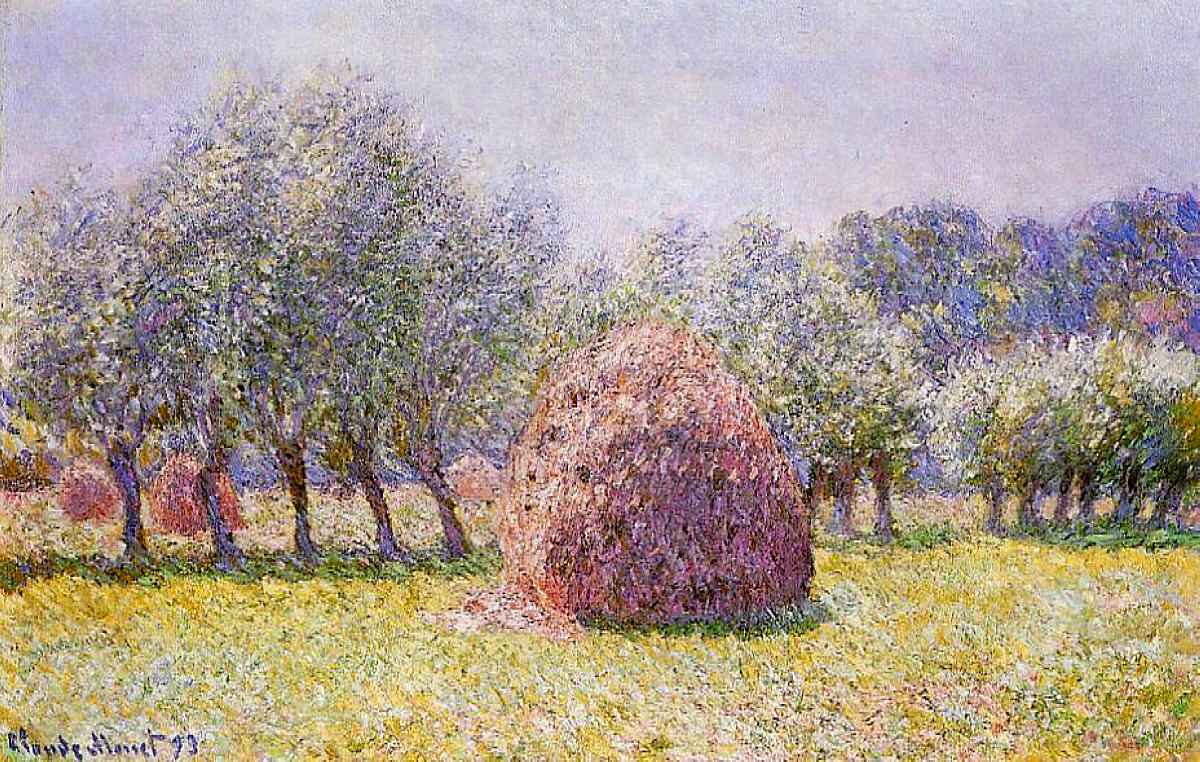
Claude Monet’s Haystack presents a rural subject that might seem simple at first glance, yet the painting reveals remarkable sensitivity to light, atmosphere, and seasonal change. A single haystack rises from the center of an open field, surrounded by blossoming trees and distant forms that soften into a luminous haze. The scene feels calm, spacious, and deeply attentive to nature. Rather than turning the haystack into a rigid agricultural object, Monet transforms it into a living part of the landscape, something shaped by weather, light, and the eye of the observer.
What makes this painting so compelling is the way Monet turns ordinary countryside material into a poetic experience. The haystack is not treated as a static object to be described in precise academic detail. Instead, it becomes the anchor of a wider sensory impression. The field glows with yellow and green tones, the trees shimmer with whites, lavenders, and blues, and the air itself seems to vibrate across the canvas. Monet is less interested in exact line than in the visual truth of a moment, the way light rests on grass, the way blossom catches the eye, and the way forms dissolve when seen in a bright open atmosphere.
This approach gives the painting its emotional power. Nothing dramatic occurs in the scene. There are no figures, no narrative action, and no theatrical gesture. Yet the work feels full of life because Monet shows how landscape can communicate mood through color and light alone. The result is peaceful but not empty, delicate but not weak. Haystack offers a meditation on rural stillness, seasonal abundance, and the fleeting beauty of the natural world.
The Power of an Ordinary Subject
One of the most striking things about Haystack is Monet’s choice of subject. A haystack is an everyday rural form, practical rather than glamorous. In many traditional academic paintings, such an object might serve only as background detail. Monet instead places it near the center of the composition and lets it carry visual and emotional weight. By doing so, he elevates a common feature of agricultural life into the main focus of artistic attention.
This decision reflects a major shift in nineteenth century painting. Artists like Monet were increasingly interested in modern life, natural perception, and subjects drawn from direct experience rather than inherited hierarchy. A haystack, a riverbank, a train station, or a garden could be worthy of serious art if the artist found something visually meaningful in it. In this painting, the haystack becomes more than farm labor made visible. It becomes a mass of color, light, texture, and seasonal presence.
Its appeal lies partly in its shape. The rounded, almost conical form gives the scene a strong central volume. The haystack feels stable and grounded, especially against the more fragile and flickering shapes of the trees. It has a sculptural solidity, yet Monet softens it through color and brushwork so that it never appears heavy or crude. It belongs to the field as naturally as the blossoms and the grass.
There is also something timeless about the subject. Haystacks suggest cycles of work, growth, harvest, and storage. Even without showing laborers, the painting carries a quiet awareness of human presence in the land. The haystack is evidence of cultivation, but it has been absorbed into the beauty of the landscape. This balance between human activity and natural atmosphere is one reason the painting feels both intimate and expansive.
Composition and Spatial Balance
The composition of Haystack is carefully organized, even though it appears spontaneous. Monet places the large haystack slightly right of center, allowing it to dominate the foreground without making the image feel stiff. The trees stretch across the background in a loose line, creating a natural boundary between field and sky. Smaller haystacks or mounded forms appear farther back, adding rhythm and echoing the central shape. These repetitions help unify the space while also suggesting depth.
The painting is balanced through contrast. The large haystack provides mass and warmth, while the trees provide vertical movement and cooler tones. The open field in the foreground gives the viewer room to enter the scene, while the distant tree line closes the space gently rather than abruptly. Nothing feels crowded. Monet understands how much empty space a composition needs in order for color and atmosphere to breathe.
The horizon is relatively high, which gives greater emphasis to the field and the objects within it. This choice pulls the viewer’s attention down into the meadow and the haystack rather than outward toward a dramatic sky. The sky itself is pale and understated. It acts less as a spectacle than as a luminous backdrop that supports the rest of the composition. This restraint is important. If the sky were more dramatic, it might compete with the subtle variations in the field and trees.
Monet also uses asymmetry effectively. The left side contains a denser grouping of trees and several secondary forms, while the central and right areas feel more open. This uneven distribution creates a sense of natural realism. Real landscapes rarely arrange themselves into perfect symmetry, and Monet preserves that irregularity while still achieving harmony. The composition feels observed rather than designed, even though it is clearly controlled by a skilled painter’s eye.
Light as the True Subject
Although the painting is titled Haystack, light is arguably the true subject. Monet sees the landscape not as a collection of fixed objects but as a field of changing illumination. The haystack matters because of the way light touches it. The blossoms matter because of the way light scatters across them. Even the distance matters because of the way light softens forms and blends them into atmosphere.
The haystack itself is a wonderful example of this. It is not painted in a flat brown or beige. Instead, Monet builds it from pinks, rose tones, violets, ochres, and hints of warm earth color. These shifts suggest that what we see is not simply straw, but straw transformed by the hour of the day and the surrounding environment. Light does not merely illuminate the haystack from outside. It seems to penetrate and activate its entire surface.
The field is equally alive with light. Rather than covering the ground in one uniform green, Monet breaks it into shimmering passages of yellow, pale green, cream, and touches of cool shadow. This makes the grass appear sunlit and moving. The viewer gets the impression of a meadow sparkling under soft daylight, perhaps in spring or early summer. Light is not fixed but flickering, almost unstable, which gives the scene a sense of immediacy.
The trees show Monet’s gift for translating bright outdoor conditions into paint. Their blossoms are rendered with touches of white, lavender, blue, and pale pink, so that they seem to catch and reflect light from different angles. Instead of outlining each branch clearly, Monet allows the forms to dissolve into luminous clusters. This creates the impression that light is filtering through blossom and foliage, making the entire grove shimmer at the edge of visibility.
Color and the Atmosphere of Spring
Color is central to the painting’s emotional effect. Monet uses a palette that feels airy, fresh, and gently radiant. Soft violets, pale blues, creamy whites, warm pinks, and sunlit yellows all contribute to the sense of a landscape emerging into bloom. The painting does not rely on sharp saturation or harsh contrast. Its beauty comes from tonal nuance and the relationship between warm and cool passages.
The large haystack introduces the warmest area of the composition. Its pinkish and rosy tones stand out against the cooler blues and lilacs of the trees behind it. This contrast makes the haystack feel present and immediate. At the same time, the warm tones are not isolated. They are echoed subtly in distant forms and in the field, creating a color unity across the canvas. Monet knew how to make one dominant note resonate through an entire image.
The cool colors are especially important in the trees and shadows. Blue and violet appear where one might traditionally expect gray or brown. This is one of the qualities that makes Monet’s landscape painting feel modern. He understands that outdoor shadow is rarely neutral. It is colored by the sky, by surrounding vegetation, and by changing light. These cool notes give freshness to the scene and prevent the pastoral subject from becoming overly sentimental.
The overall atmosphere suggests spring. The blossoming trees, the tenderness of the greens, and the pearly light all point to a season of renewal. Yet Monet avoids making the scene overly decorative. The painting remains rooted in natural observation. Spring is not presented as a symbol in an abstract sense, but as something felt directly through color and air. The viewer senses moist light, mild warmth, and the quiet fullness of a landscape coming into life.
Brushwork and the Impression of Movement
Monet’s brushwork plays a major role in the painting’s vitality. Instead of smoothing every surface into polished finish, he allows individual touches of paint to remain visible. These touches build form, color, and atmosphere at the same time. The result is a surface that feels active and alive. Even though the subject is still, the painting itself seems to move.
In the field, short strokes and broken color create a trembling effect. The grass does not lie flat in a uniform sheet. It flickers with light and seems stirred by a breeze or by the instability of vision in bright daylight. This is one of the great strengths of Monet’s technique. He captures not only what the land looks like, but also what it feels like to stand before it and let the eye wander over countless tiny variations.
The trees are painted with looser, more clustered touches that suggest blossom without spelling out every petal. This allows them to remain soft and atmospheric. Their edges blur into the surrounding light, which is exactly what often happens in real outdoor vision. When the eye looks at sunlit blossom from a distance, it does not isolate every form cleanly. Monet translates that optical softness into paint.
The haystack itself is handled with a different energy. It has more mass, and its strokes often follow the rounded structure of the form, helping the viewer feel its volume. Yet even here, Monet resists hard definition. The edges remain porous, so the haystack merges with surrounding light and grass rather than standing apart like a carved object. This balance between structure and looseness is crucial. It keeps the painting grounded while preserving its atmospheric unity.
Nature Observed, Not Invented
A key aspect of Monet’s achievement in Haystack is the sense that the scene has been truly observed. The painting does not feel assembled from studio formulas. It feels seen. This quality of direct perception is essential to Monet’s art and to the broader development of Impressionism. He wanted to paint the world as it appears in a particular moment, under specific conditions of light and weather.
That observational quality is visible in the irregular spacing of the trees, the shifting tones of the field, and the subtle recession into distance. Nature is not tidied into perfect order. Some trees lean, some forms blur, some areas of the ground seem more brightly lit than others. These variations make the painting convincing because they reflect the real complexity of outdoor sight.
At the same time, observation does not mean mere transcription. Monet organizes what he sees through artistic judgment. He simplifies, selects, and emphasizes. The central haystack becomes larger and more visually important than it might appear in casual vision, because it provides the painting with structure. The blossoming trees are made more luminous through carefully judged color contrasts. The field is broken into many tones to express light more intensely. Observation and invention work together.
This is why the painting feels both truthful and beautiful. Monet does not invent an artificial paradise, but he does reveal the poetry already present in a real landscape. He helps the viewer notice what ordinary seeing often misses: the colored shimmer of shadow, the softness of distant forms, the glow of pale grass in sunlight, and the quiet grandeur of a haystack standing in open air.
The Mood of Stillness and Abundance
The emotional tone of Haystack is gentle, but it is far from empty. The painting conveys a profound stillness, the kind of quiet that belongs to open countryside rather than indoor silence. It is a living stillness, full of light, growth, and suspended motion. The absence of people intensifies this mood. The land seems to exist in its own rhythm, unhurried and self-sufficient.
There is also a strong feeling of abundance. The blossoming trees, the broad field, and the full central haystack all suggest a fertile and generous landscape. Nothing in the scene feels barren or harsh. Even the distant haze contributes to a sense of softness and plenitude. The painting offers a vision of the countryside as a place of nourishment, renewal, and calm labor already completed.
This mood may explain why haystacks held such power for Monet and other painters of rural life. They are humble objects, yet they suggest storage, provision, and continuity. A haystack stands for time as much as for material. It contains the memory of growth and the promise of future use. In Monet’s hands, that practical meaning is deepened by visual beauty. The haystack becomes a symbol of the land’s seasonal generosity without losing its concrete identity.
The painting’s stillness is especially effective because it is not rigid. The surface remains lively, the color varied, and the air full of subtle movement. This creates a beautiful tension between rest and activity. The landscape is quiet, yet every inch of paint seems alive. Monet captures a moment in which nature is both settled and changing, stable and fleeting.
Monet’s Early Vision and Future Direction
Seen in relation to Monet’s broader development, Haystack is especially interesting because it points toward concerns that would later become central to his mature work. Even in this rural scene, one can sense his fascination with repeated natural motifs, transient light, and the transformation of ordinary subjects through close observation. The haystack is not important because of narrative meaning, but because it offers an opportunity to study perception itself.
This approach would become increasingly significant in Monet’s career. He repeatedly returned to subjects that allowed him to investigate changing light and atmosphere, whether river scenes, poplar trees, cathedrals, water lilies, or stacks in open fields. The object remained, but its visual appearance shifted with season, weather, and time of day. In that sense, Haystack can be appreciated as part of a larger artistic impulse that valued visual experience over fixed description.
What is notable here is the freshness of the vision. The painting does not feel burdened by theory. It feels like the result of an artist discovering how much beauty can be found in direct contact with landscape. The rural subject gives Monet freedom to explore color relationships and atmospheric effects without relying on conventional drama. He trusts that perception itself can sustain the painting.
That trust is one of Monet’s greatest contributions to modern art. He shows that painting does not need historical grandeur or literary narrative in order to matter. A field, some blossom trees, and a haystack can become deeply moving when seen with enough sensitivity. Haystack reminds us that the everyday world contains endless visual richness for those willing to look carefully.
Why This Painting Still Resonates
Part of the enduring appeal of Haystack lies in its accessibility. Viewers do not need specialist knowledge to feel its beauty. The subject is immediately recognizable, and the mood is instantly inviting. Yet the painting continues to reward closer looking because of its sophistication. The more one studies it, the more complex its color, structure, and atmosphere become.
Modern viewers may also respond to the painting because it offers a vision of slowness. In a fast and crowded visual culture, Monet’s field feels restorative. It asks the eye to linger rather than consume. The painting is not about spectacle or shock. It is about attention. It teaches the viewer to notice small variations and to value a moment of quiet perception.
There is also a universal quality in its treatment of nature. While the landscape belongs to a specific rural setting, the feelings it evokes are broader: peace, seasonal renewal, warmth, and contemplation. The painting connects the viewer to cycles larger than individual life. Blossom, growth, harvest, storage, and return all seem quietly present within the image.
For these reasons, Haystack remains more than a pastoral scene from the nineteenth century. It is a meditation on the beauty of ordinary things when touched by light and truly seen. Monet invites us to recognize that the world does not need to be exotic or dramatic in order to be meaningful. A haystack in a field, beneath blossoming trees and pale sky, can become unforgettable.
Conclusion
Claude Monet’s Haystack transforms a simple rural subject into a luminous and emotionally rich landscape. Through delicate color, broken brushwork, and a composition built around balance and openness, Monet creates a scene that feels both observed and poetic. The central haystack gives the painting structure, but the true drama lies in light itself, in the way it softens edges, brightens blossom, and turns the field into a surface of shimmering color.
The painting succeeds because it unites solidity and atmosphere. The haystack has presence, yet it remains part of a wider visual field animated by air and season. The trees are rooted in the land, yet they flicker with almost weightless blossom. The meadow is ordinary ground, yet Monet makes it radiant. Every part of the scene belongs to a single harmonious vision in which nature is not fixed, but always changing before the eye.
More than just a pastoral image, Haystack reveals Monet’s ability to find grandeur in the everyday. He does not impose drama on the countryside. He discovers beauty already there, in sunlight, in color variation, and in the quiet persistence of rural forms. The result is a painting that feels serene, generous, and deeply alive.
That is why Haystack continues to captivate viewers. It offers not only a pleasing scene, but a way of seeing. Monet teaches us to look beyond the ordinary label of things and to notice how light, season, and atmosphere transform them. In doing so, he turns a haystack into a subject of lasting beauty and contemplation.
