Image source: wikiart.org
Introduction
Claude Monet’s Farmyard at Chailly from 1865 is a painting that stands at a fascinating point in the artist’s development. Long before his name became inseparable from shimmering water lilies, bustling boulevards, and luminous riverside scenes, Monet was already paying close attention to light, atmosphere, and the ordinary poetry of daily life. In this work, he turns to a rural farmyard and transforms what could have been a simple record of buildings and labor into something richer, warmer, and more quietly observant. The result is a scene that feels both grounded and lyrical.
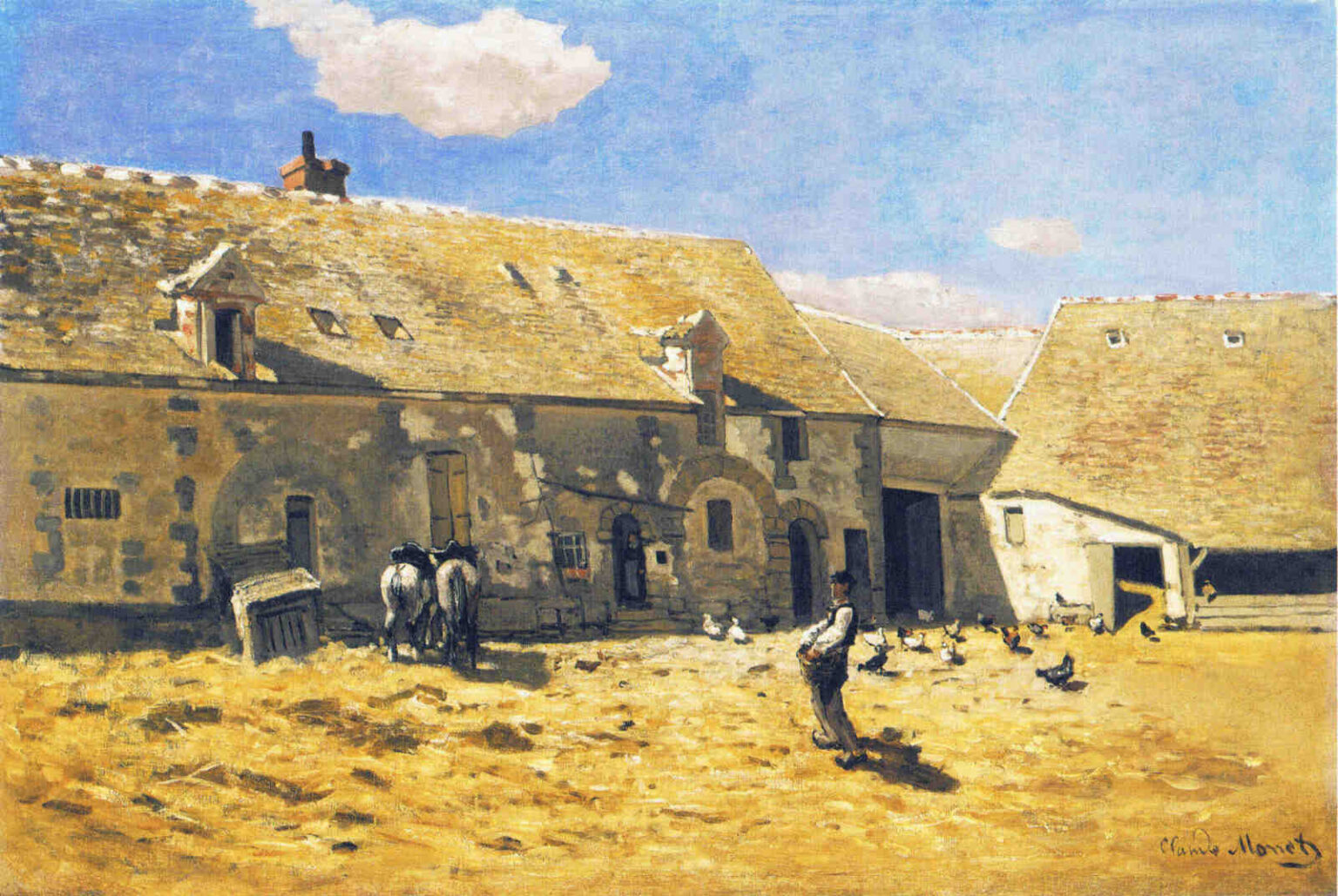
At first glance, the subject appears modest. A large farm building stretches across much of the composition, its sunlit roof dominating the scene. A few figures and animals animate the open yard. Chickens scatter through the warm earth, a man stands in the foreground, and two horses occupy the middle ground near the building. Nothing dramatic seems to happen. Yet that lack of obvious drama is exactly what gives the painting its power. Monet shows that a farmyard under a clear sky can be as visually compelling as any grand historical event. He invites the viewer to look carefully at sunlight on stone, at the glow of a roof under the midday sun, and at the quiet rhythm of rural life.
This painting matters because it reveals Monet before Impressionism fully took shape. Here, one can already sense his attraction to fleeting light and to scenes taken from everyday experience, but one can also see the stronger structural solidity and earthy realism of his earlier phase. Farmyard at Chailly is therefore more than a pleasant rustic scene. It is a record of a young painter learning how to see, how to organize space, and how to let atmosphere become one of the main subjects of a painting.
Historical Context and Monet’s Early Career
In 1865, Monet was still a young artist trying to establish himself. He had not yet reached the mature style that would later define his reputation, but he was already moving away from academic conventions and toward direct observation of the world around him. This was a period in which many French painters were looking to nature and rural life for fresh subject matter. The countryside around Fontainebleau and villages such as Chailly drew artists who wanted to work outside the studio and study how natural light altered surfaces, colors, and mood.
This context is essential for understanding Farmyard at Chailly. Rather than painting a mythological scene or a polished academic interior, Monet chose an ordinary rural enclosure. That choice reflects a broader shift in nineteenth century art, when painters increasingly valued contemporary life and visible reality. Rural labor, village buildings, and open air effects became worthy subjects in themselves. Monet’s farmyard does not idealize country life into something theatrical or sentimental. Instead, it presents the place with a directness that suggests careful looking and lived immediacy.
At the same time, the painting still belongs to a world before Monet’s fully broken Impressionist brushwork. The forms retain weight and clarity. The building feels substantial. The walls and roofs are not dissolved into pure flickers of color. This balance between solidity and sensory perception gives the painting a distinct character. It captures a moment when Monet was absorbing influences from realism, landscape painting, and outdoor study while beginning to move toward his own vision.
The Subject of the Farmyard
One of the most striking things about Farmyard at Chailly is Monet’s decision to focus on a space that many people would have considered too ordinary to deserve artistic attention. A farmyard is not a picturesque ruin, a celebrated monument, or a spectacular natural vista. It is a working place. It belongs to routine, labor, weather, and habit. Yet Monet recognizes that this very ordinariness contains visual richness.
The farmyard is presented as an inhabited environment shaped by human use. The large building, weathered walls, rough ground, scattered animals, and practical openings in the structure all suggest a place that serves everyday needs. Nothing is arranged for elegance. The yard is uneven. The architecture is functional. The chickens move freely, and the horses stand quietly, as if this is simply another day in an ongoing rural cycle.
This attention to the everyday gives the painting its authenticity. Monet is not forcing the scene into a narrative. He does not dramatize the figures or turn them into symbols. Instead, he allows the place itself to speak. The buildings carry the marks of time and use. The animals add motion and life without becoming sentimental. The single standing figure seems absorbed in the routine reality of the place. The viewer is left with the impression of a lived environment rather than a staged composition.
Because the subject is so modest, the viewer becomes more attentive to the painting’s formal qualities. One notices light, mass, proportion, and surface. In that sense, the ordinary subject liberates Monet to explore painting itself. The farmyard becomes an arena for studying how sunlight transforms stone and straw, how architecture can be arranged across a broad canvas, and how a rural setting can be given dignity without being romanticized.
Composition and Spatial Structure
The composition of Farmyard at Chailly is carefully controlled even though it appears natural and unforced. The long roofline of the main building dominates the image, stretching almost horizontally across the scene and creating a strong visual anchor. This large mass gives the painting stability. It occupies much of the upper and middle zones of the composition, establishing the farm as the central presence.
The roof is one of the most important structural elements. Its large sloping plane catches the sunlight and guides the eye across the canvas. Because it spans such a broad area, it unifies the composition while also emphasizing the scale of the building. Smaller features such as windows, chimneys, doorways, and architectural protrusions break up this broad plane and keep it visually interesting. These details prevent the building from becoming monotonous and help the viewer move gradually from one section of the image to another.
In front of the building, the open yard forms a wide horizontal foreground. This area gives breathing space to the composition and allows Monet to distribute smaller elements across it. The standing figure, the chickens, and the horses create points of interest that punctuate the open ground. Their placement prevents the foreground from feeling empty while reinforcing the sense that the yard is an active, usable space.
There is also a subtle tension between openness and enclosure. The broad yard invites the viewer inward, yet the large architecture behind it asserts the boundaries of the place. The farm is both expansive and self contained. This balance helps create the quiet mood of the painting. The scene feels stable, inhabited, and calm, but not static. The figures and animals bring just enough movement to animate the setting.
Light as the True Protagonist
Although the title points to a farmyard, the true protagonist of the painting may be light. Sunlight pours over the roofs and spills across the yard, turning humble materials into sources of visual delight. The straw colored ground glows warmly, and the roof surfaces seem to radiate brightness under the clear sky. Monet is already showing the sensitivity to light that would become one of his greatest strengths.
What makes the light in this painting so compelling is its clarity. It is not the dramatic light of storm or sunset. It is the clean, steady light of a bright day. This gives the scene a sense of honesty and openness. The buildings are fully exposed to view, and their textures are revealed rather than concealed. The shadows, though present, do not overwhelm the image. Instead, they serve as needed contrasts that define forms and deepen space.
Monet pays close attention to how light changes color. The roof is not simply brown or beige. It contains warm yellows, pale creams, and touches of cooler tones where shadow intervenes. The walls are similarly varied, with earthy grays and muted browns interacting with the stronger sunlight above. The ground becomes a broad field of golden warmth. Through these variations, Monet shows that light is not an external addition to objects. It is something that reshapes how they appear.
The sky also plays a major role in the painting’s luminosity. Its blue field provides a cool counterpoint to the warm farmyard below. The cloud forms are soft and bright, reinforcing the sense of open weather and giving the composition additional airiness. The contrast between the sky and the architecture makes the sunlit roof seem even warmer. This dialogue between cool and warm tones is central to the painting’s effect.
Color and the Warmth of Rural Space
The color palette of Farmyard at Chailly is restrained, but it is far from dull. Monet builds the painting around a strong relationship between warm earth tones and a clear blue sky. The result is a scene that feels sun drenched and breathable. The dominant yellows, ochres, creams, and muted browns of the yard and roofs create a sense of heat, dryness, and material presence. These colors evoke straw, dust, weathered stone, and old wood.
The warm palette gives the farmyard an inviting radiance, even though the buildings themselves are plain and functional. Monet understands that color can elevate a modest subject without falsifying it. He does not need brilliant costume or decorative detail. The warmth of sunlight across ordinary surfaces is enough to make the scene visually rich.
The blue sky is especially important because it prevents the composition from becoming too monochromatic. Its coolness refreshes the image. The sky opens the space upward and introduces a note of calm expansiveness. The small clouds, touched with white and pale warmth, help transition between the roof tones and the stronger blue above.
Monet also uses dark accents with care. The openings of doors and windows, the darker parts of the horses, the figure’s clothing, and the scattered chickens all provide necessary points of contrast. These darker passages sharpen the composition and keep the warm expanses from flattening. They function like visual punctuation, giving rhythm to the whole scene.
Architecture, Texture, and Material Reality
A major pleasure of this painting lies in its treatment of material surfaces. Monet does not render every architectural detail with academic precision, but he captures enough to make the farm buildings feel convincingly real. The roof appears rough and sun baked. The walls seem weathered, irregular, and marked by time. Openings in the building suggest thickness and age rather than refined design.
The architecture is important because it embodies the practical reality of rural life. These are not decorative structures. They are built to serve work, shelter animals, store materials, and endure weather. Monet respects that functionality. He does not beautify the buildings into quaint charm. Instead, he shows their heft, wear, and utility.
Texture plays a central role here. The roof’s surface feels almost tactile, with its granular variation and changing reflections of light. The wall beneath carries patches of tone that suggest discoloration, age, and accumulated use. The ground is uneven and rough, filled with marks that imply straw, dirt, and stones. Through these textures, the painting gains physical credibility.
This sensitivity to texture also reinforces Monet’s larger artistic purpose. He is not merely describing objects. He is studying how surfaces receive light. Texture becomes visible through illumination. A smooth surface and a rough one do not reflect the sun in the same way, and Monet responds to these differences with careful brushwork and tonal variation. In doing so, he makes material reality central to the painting’s atmosphere.
Human Presence and Rural Labor
The human figure in the foreground is relatively small, yet it contributes greatly to the meaning of the work. Rather than dominating the scene, the figure belongs to it. He appears as part of the everyday life of the farmyard, neither heroic nor individualized in a portrait like sense. This modest scale matters. Monet is not making the painting about one person’s psychology. He is showing a shared environment shaped by work and routine.
The same is true of the horses and chickens. They are not decorative accessories. They are integral to the rural setting. The horses stand near the building as if paused within the workday. The chickens animate the ground and emphasize the open, inhabited character of the yard. Together, the human and animal presences create an ecosystem of daily activity.
There is something deeply respectful in this treatment. Monet does not sentimentalize labor, but he grants rural life visibility and seriousness. The farmyard is not empty landscape. It is a place where people and animals coexist within a pattern of use. The painting suggests labor without turning it into spectacle. That quietness makes the scene more persuasive.
The figure’s placement also helps the composition. Positioned in the open yard, he becomes a counterweight to the heavier forms of the architecture. His vertical presence breaks the horizontal spread of ground and roof. At the same time, his shadow reinforces the direction and strength of the sunlight. Even a small figure can therefore carry both thematic and formal significance.
Mood and Atmosphere
The mood of Farmyard at Chailly is calm, sunlit, and contemplative. Nothing in the painting feels hurried. Even the animals seem to move within a slow rhythm. This sense of stillness does not come from emptiness but from balance. The painting is alive with detail, yet it remains serene because the elements are harmonized.
Part of this atmosphere comes from the time of day implied by the light. The brightness suggests a settled hour, perhaps late morning or afternoon, when the sun is high enough to bathe the yard broadly and cast defined shadows. The clear weather adds to the sense of stability. There is no looming storm, no dramatic wind, no emotional disturbance in the landscape. Everything appears temporarily at rest.
This tranquility is one reason the painting remains memorable. Monet finds beauty not through excitement but through attentiveness. The mood encourages the viewer to slow down and notice how the farmyard holds together as a visual world. The warmth of the palette, the openness of the sky, and the groundedness of the buildings all contribute to a feeling of quiet assurance.
At the same time, the painting is not empty of emotion. Its emotion lies in its tone of respect for ordinary life and in its sensitivity to the beauty of common things. The viewer may come away feeling not exhilarated but deeply settled, as though having spent a few moments inside the measured pace of a rural day.
Early Signs of the Monet to Come
Although Farmyard at Chailly belongs to Monet’s early period, it already contains hints of the artist he would become. Most notably, one sees his fascination with light as a changing force that can unify a scene. The farmyard is not interesting because of narrative action. It is interesting because light transforms it.
There is also an emerging modernity in the choice of subject. Monet is not painting a timeless allegory. He is painting the visible world around him. This commitment to direct observation would later become one of the foundations of Impressionism. Even here, before the mature style fully arrives, Monet is already treating contemporary reality as a worthy source of artistic meaning.
One can also detect his sensitivity to atmosphere. The air in the painting feels present. The sky is not a mere backdrop, and the open yard is not a blank stage. Instead, the whole image is held together by a shared climate of light and space. This atmospheric unity would become central to Monet’s later masterpieces.
What differs from the later Monet is the greater solidity of form. The architecture is weighty, and the brushwork is more controlled. Yet that difference is precisely what makes the painting so valuable. It allows viewers to witness a transitional moment, when Monet’s gifts for luminosity and direct observation are already visible but still joined to a firmer realism.
Why the Painting Endures
Farmyard at Chailly endures because it demonstrates how much art can be made from what seems ordinary. Monet does not rely on spectacle, glamour, or grand narrative. He shows that a farmyard can hold architecture, labor, sunlight, texture, and atmosphere in a way that feels fully worthy of prolonged attention.
The painting also endures because it offers insight into Monet’s evolution. For viewers familiar with his later work, this scene reveals an earlier chapter in his artistic journey. It shows the discipline beneath the brilliance, the observational seriousness beneath the later spontaneity. It reminds us that the famous painter of fleeting impressions began by studying the world with patience and structural care.
Most of all, the painting remains compelling because of its honesty. It neither exaggerates nor diminishes its subject. It presents a farmyard as a real place, but through a painter’s eye it becomes more than documentary. It becomes a meditation on light, labor, and the quiet dignity of daily life. The roofs glow, the yard breathes, and the simplest elements take on lasting resonance.
Conclusion
Claude Monet’s Farmyard at Chailly is a remarkable early work because it combines realism, atmosphere, and luminous observation in a subject that many artists might have overlooked. The painting’s broad architecture, sunlit roof, warm earth, and modest human activity create a world that feels solid and immediate. Monet sees the farmyard not as a minor corner of life but as a place where light reveals beauty in ordinary things.
The work invites viewers to appreciate how carefully structured the composition is, how subtle the color relationships are, and how much mood can arise from a clear day in a working rural space. It also offers a valuable glimpse into Monet’s development, showing the seeds of the artist who would later revolutionize painting through his studies of light and atmosphere.
In Farmyard at Chailly, Monet proves that art does not need grandeur to achieve significance. A weathered building, a few animals, a standing figure, and the brightness of the sky are enough. Through close looking and sensitive painting, he transforms a simple farmyard into an image of enduring warmth, balance, and quiet human truth.
