Image source: wikiart.org
Introduction
Claude Monet’s Fontainebleau Forest from 1865 is a quiet but revealing work that shows the artist at an important early stage in his career. Long before the fully developed Impressionism of the 1870s and 1880s, Monet was already deeply engaged with the problem that would define so much of his art: how to paint light as it moves across the natural world. In this painting, he turns away from dramatic narrative, idealized scenery, or carefully staged anecdote and instead gives full attention to a stand of trees, filtered sunlight, and the shifting life of a forest interior. The result is modest in subject but rich in atmosphere.
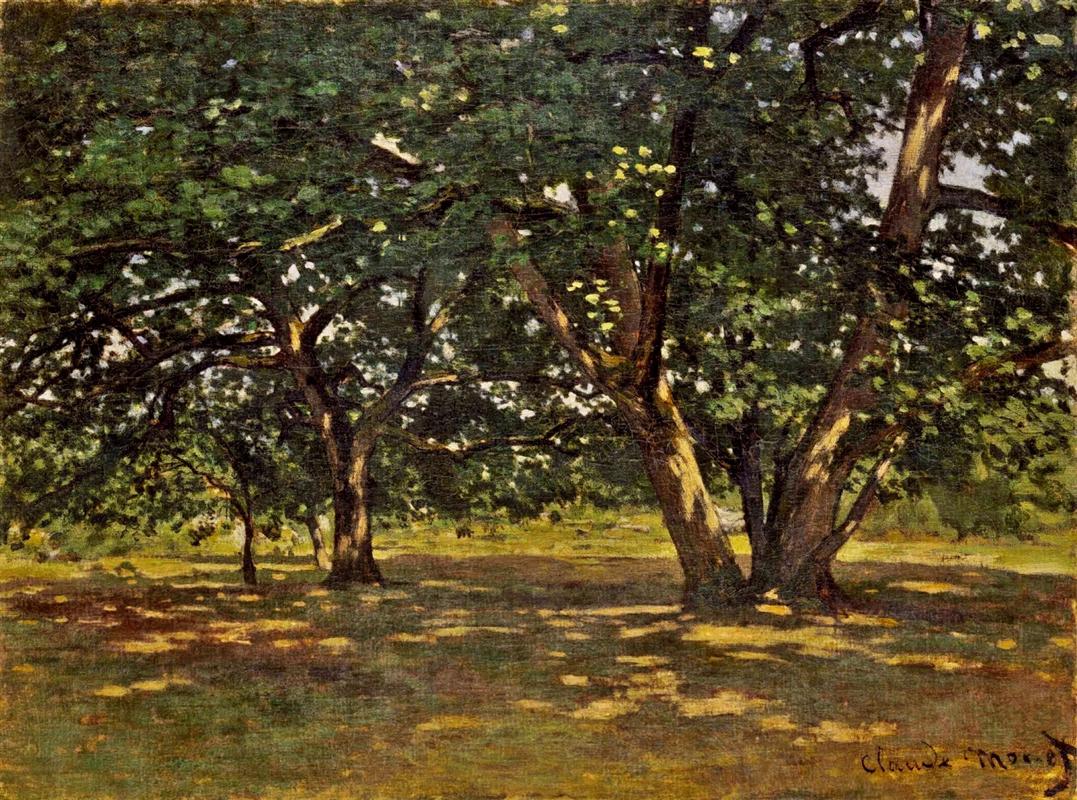
At first glance, the scene may seem simple. There are no figures, no architecture, no large vista opening onto distant sky or water. What we see is a grove of trees whose branches knit together into a dense canopy overhead. Patches of light fall onto the earth below, creating a scattered pattern of gold and green across the forest floor. The trunks twist and rise with a quiet strength, and the whole scene feels hushed, enclosed, and immersive. Yet the painting becomes more compelling the longer one looks at it. Monet transforms what could have been a straightforward landscape study into a sustained meditation on shade, texture, and vision itself.
This is one of the qualities that makes Fontainebleau Forest so interesting within Claude Monet’s early output. Even in 1865, he was moving toward a kind of painting that privileges sensation over story. The subject is not simply a forest. The true subject is the experience of standing within it, letting the eye adjust to shadow, tracing the way sunlight breaks through leaves, and sensing the living structure of nature in terms of both mass and flicker. The painting captures a moment that feels real, specific, and immediate, but it also points to Monet’s growing ambition to make perception itself into the center of art.
The Visual Experience of the Forest
One of the first things that stands out in Fontainebleau Forest is the feeling of being placed inside the wooded space rather than outside it. Monet does not treat the forest as a picturesque backdrop viewed from a comfortable distance. Instead, he brings the viewer close to the trees, beneath the canopy, into a zone where light and shadow mingle. This choice gives the painting an intimate character. It does not present nature as a grand spectacle. It presents nature as a surrounding environment.
The large trees dominate the scene. Their branches spread broadly and low, creating an almost vaulted roof of foliage that fills much of the upper picture. This canopy is dense but not uniform. Light flickers through openings, and Monet allows bits of brightness to punctuate the mass of dark leaves. Because of this, the foliage never becomes a flat ceiling. It feels alive, layered, and unstable in the most convincing way. The eye keeps moving through it, discovering small breaks of sky and sudden touches of sun.
Below, the ground receives the broken pattern of this overhead light. The forest floor is not described in minute detail. Monet does not linger over individual plants or small natural objects. Instead, he paints the earth as an orchestration of tones, with warm ochres, greens, and browns interrupted by irregular zones of brightness. These patches of sunlight are central to the painting’s effect. They suggest movement without showing motion directly. We sense the breeze in the leaves, the angle of the sun, the ever changing shimmer of daylight.
The scene is quiet, but it is not still in a frozen or lifeless sense. It vibrates subtly. That vibration comes from Monet’s attention to visual instability. In nature, especially in a forest, light is never fixed. The eye is constantly adjusting, comparing dark and bright passages, distinguishing trunk from branch, branch from leaf, leaf from sky. Monet understands this and makes it the basis of the painting’s appeal.
Composition and Structure
Although Fontainebleau Forest feels spontaneous, its composition is carefully organized. Monet builds the image around a strong arrangement of tree trunks and branching lines. The most prominent trunks appear toward the right side of the canvas, where a cluster of sturdy forms rises and divides into spreading limbs. These trunks act almost like pillars supporting the entire composition. Their darker, more solid presence anchors the painting and gives it structural weight.
To the left, additional trees recede into space, but not in a rigid, academic manner. Monet creates depth through overlapping forms, differences in scale, and tonal recession rather than through highly polished linear perspective. The more distant trees are lighter and less emphatic, which allows the nearer trunks to stand forward. At the same time, the canopy stretches across much of the image, knitting foreground and background together. This balance between depth and unity is one of the painting’s strengths.
The low horizon also matters. Because the sky is largely obscured by the trees, the composition remains enclosed. There is no dramatic escape into open distance. Instead, the viewer’s attention is held within the immediate world of trunks, leaves, and mottled ground. This creates a strong sense of atmosphere. The painting does not invite the eye to travel far away. It asks the eye to dwell, to adjust, and to remain within the sensory richness of the forest interior.
Monet also avoids excessive symmetry. The composition feels natural because it is slightly irregular. The largest tree group sits off center, and the distribution of light is uneven. Some passages are dense and dark, while others open into softer, more luminous spaces. This asymmetry keeps the scene from becoming static. It feels observed rather than arranged according to formula, even though the underlying design is strong.
What is especially notable is that Monet makes trees themselves into the main event of the composition. They are not decorative framing devices for some other subject. Their trunks, branches, and shadows generate the entire visual rhythm of the painting. This focus reveals an artist who is increasingly willing to trust ordinary landscape elements as worthy subjects in their own right.
Light, Shadow, and Color
The handling of light is where Fontainebleau Forest becomes especially compelling. Monet was already fascinated by transient effects in nature, and this painting shows how early that interest had taken hold. The forest setting gives him a perfect opportunity to explore broken light, since sunlight entering through leaves creates a constantly changing network of highlights and shadows.
Rather than flooding the entire scene with brightness, Monet works through contrast. Much of the upper area is deep green and brown, almost heavy with shade. Against this darker canopy, small touches of pale light become more vivid. The same principle operates on the ground. The sunlit patches stand out because they interrupt a broader field of muted earth tones. This gives the painting a pulsing rhythm, as if light is appearing and disappearing across the surface.
The palette is restrained but subtle. Greens dominate, yet they are not all the same green. Some passages lean toward olive, some toward moss, some toward deeper woodland shadow. Browns and warm earth tones in the trunks and ground provide stability, while touches of yellow and gold animate the illuminated areas. These warmer notes are crucial. They keep the painting from becoming too cool or monochrome and suggest the warmth of afternoon light filtering through foliage.
Monet’s color choices also reveal his sensitivity to relational seeing. In nature, colors are rarely perceived in isolation. A green leaf appears differently depending on whether it is in direct sun or deep shade, next to bark, against sky, or beside another cluster of leaves. In this painting, Monet responds to those shifts. He does not simply color the trees green and the trunks brown. He adjusts hue and value across the entire canvas so that everything feels interconnected by light.
This is one reason the painting feels more modern than a conventional academic landscape. It is less interested in naming objects than in translating optical experience. Light is not an external effect laid on top of solid forms. It is what shapes the forms as we perceive them. Monet is already moving toward the idea that atmosphere and illumination are fundamental to painting, not secondary embellishments.
Brushwork and Surface
The surface of Fontainebleau Forest rewards close attention because Monet’s brushwork plays a major role in conveying the density and vitality of the scene. The handling is not loose in the fully broken Impressionist sense associated with his later work, but it is far from stiff. There is a living responsiveness in the marks, especially in the foliage and ground.
In the canopy, the brushwork often appears layered and varied. Leaves are suggested through clusters of short, irregular touches rather than through carefully outlined forms. This gives the upper part of the painting a textured richness. We feel the accumulation of branches and foliage without needing to identify every element individually. Monet trusts the eye to assemble the scene from fragments of paint.
The trunks are more defined, but even here the treatment is not dry or schematic. Their surfaces catch light unevenly, and Monet uses changes in tone to suggest the roughness of bark and the turning of form. The thicker, darker lines of branches cutting through the foliage add visual energy. They prevent the leafy passages from dissolving into softness and remind us of the underlying architecture of the trees.
On the forest floor, the brushwork becomes broader and more atmospheric. The patches of sunlight are not hard edged shapes but soft, irregular zones that merge into surrounding earth tones. This treatment is important because it preserves the impression of light filtered through moving leaves. Sharp precision would have destroyed the sensation Monet wanted. By letting the edges breathe, he keeps the ground optically alive.
This balance between description and suggestion is one of the most interesting aspects of the painting. Monet does not abandon form, but he does not imprison it in overly exact finish either. The work occupies a productive middle ground. It remains legible and grounded in direct observation, yet it also anticipates the freer, more flickering surfaces that would later become central to Impressionism.
Fontainebleau and the Artistic Context of 1865
The setting of Fontainebleau is significant. The Forest of Fontainebleau, near Paris, had long attracted artists, especially those associated with the Barbizon School. Painters such as Théodore Rousseau, Jean François Millet, and Charles François Daubigny were deeply engaged with the forest and its surroundings, seeking a more direct and truthful response to nature than that offered by traditional studio landscape painting. By the time Monet painted Fontainebleau Forest in 1865, the area already carried strong artistic associations.
Monet’s presence in this environment places him in dialogue with that earlier generation, but not simply in a derivative way. The Barbizon painters had helped establish the value of painting directly from nature and had taken forests, fields, and rural paths seriously as subjects. Monet inherits that seriousness. He also inherits an interest in the unidealized landscape, a landscape valued for its lived atmosphere rather than its mythological or heroic associations.
At the same time, Monet brings something different. His concern with fleeting light effects and immediate sensation pushes beyond the Barbizon model. Where some earlier landscape painters emphasized mood through weighty tonal harmony and solid natural presence, Monet seems more drawn to visual transience, to the instability of appearance under changing conditions of light. In Fontainebleau Forest, the trees have structure and gravity, but the painting’s deepest excitement comes from the interplay of illumination and shadow.
The year 1865 is also important because Monet was still a young artist testing possibilities. He had not yet fully arrived at the serial, open air brilliance of his mature style, but he was already moving away from conventional finish and toward a more perceptual art. This makes the painting especially valuable. It allows us to see not only what Monet had already learned, but also what he was becoming.
Mood and Emotional Resonance
Despite the absence of narrative content, Fontainebleau Forest has a strong emotional atmosphere. It is calm, but not empty. It is shaded, but not gloomy. The painting conveys a sense of shelter and quiet attentiveness. Standing before it, one feels the stillness of a forest on a warm day, where sound is softened and time seems to slow.
Part of this mood comes from the enclosure of the composition. Because the canopy covers so much of the upper area and the trees occupy the foreground so firmly, the viewer is held in a protected space. The forest does not appear threatening. It appears contemplative. The dappled light on the ground further softens the scene, turning the earth into a tapestry of warm and cool passages rather than a harsh or barren surface.
There is also a sense of intimacy in the way Monet handles scale. The trees are large enough to feel impressive, but the setting remains approachable. We are not dwarfed by sublime cliffs or stormy skies. We are invited into a humanly accessible environment, one that can be known through ordinary looking. This intimacy is central to Monet’s art more broadly. Even when he painted expansive views, he often anchored them in immediate sensory experience rather than distant grandeur.
The emotional tone may also be linked to the painting’s lack of figures. Without human presence, the forest becomes more self sufficient. It does not illustrate leisure, labor, or anecdote. It simply exists. Yet this absence does not make the painting impersonal. On the contrary, it sharpens our awareness of the artist’s own presence as observer. We feel that someone stood here, looked carefully, and responded with patience to what the eye was receiving.
What the Painting Reveals About Monet
Fontainebleau Forest is not merely an early landscape by a famous artist. It is a work that reveals essential traits of Monet’s vision. First, it shows his devotion to direct observation. The painting is rooted in what light actually does in a specific place. It does not depend on literary meaning or historical symbolism to justify itself.
Second, it reveals his sensitivity to the unity of environment. Monet does not isolate objects in a detached manner. Trees, light, air, and ground are all interdependent. The painting works because every part affects every other part. This holistic seeing would become even more pronounced in his later paintings of rivers, gardens, haystacks, and water lilies.
Third, it demonstrates his confidence in ordinary subject matter. A patch of forest, observed with seriousness and intelligence, becomes worthy of sustained artistic exploration. This conviction helped open the door to modern painting. Monet and his contemporaries expanded the range of what could count as significant subject matter in art by insisting that visual experience itself had depth, beauty, and meaning.
Finally, the painting shows Monet in a moment of transition. The forms still possess a substantiality linked to earlier landscape traditions, but the handling of light already points ahead. One can sense the artist leaning toward a more liberated treatment of atmosphere and color. This mixture of solidity and emergence gives the painting much of its historical and aesthetic interest.
Conclusion
Claude Monet’s Fontainebleau Forest from 1865 is a powerful example of how a seemingly modest landscape can contain profound artistic ambition. Through a carefully organized composition, a nuanced palette, and a deeply felt response to broken light, Monet turns a stand of trees into an exploration of perception, atmosphere, and natural presence. The painting does not rely on spectacle. Its strength lies in its quiet insistence that a forest interior, honestly seen, can become a rich field of visual discovery.
What makes the work especially rewarding is its position within Monet’s development. It belongs to the early phase of his career, yet it already carries many of the concerns that would define his later achievement. Light is unstable and alive. Color is relational. Form is shaped by atmosphere. Nature is not a backdrop for narrative but a subject of independent value. These elements are all present here, even if they have not yet reached the luminous freedom of the mature Impressionist style.
The painting also reminds us that Monet’s greatness did not suddenly appear in fully formed masterpieces. It was built through close looking, experimentation, and a willingness to trust sensory experience. In Fontainebleau Forest, we witness an artist learning how to translate the complexity of nature into paint without losing freshness or immediacy. The result is a landscape that feels both rooted in its historical moment and alive to viewers today.
To spend time with this painting is to recognize how much can happen within shade, foliage, and scattered light. Monet teaches us that the forest is never visually simple. It is layered, shifting, and full of subtle events. In turning his attention to those events, he creates a work of lasting interest and quiet beauty.
