Image source: wikiart.org
Claude Monet’s The Road from Chailly to Fontainebleau (1864)
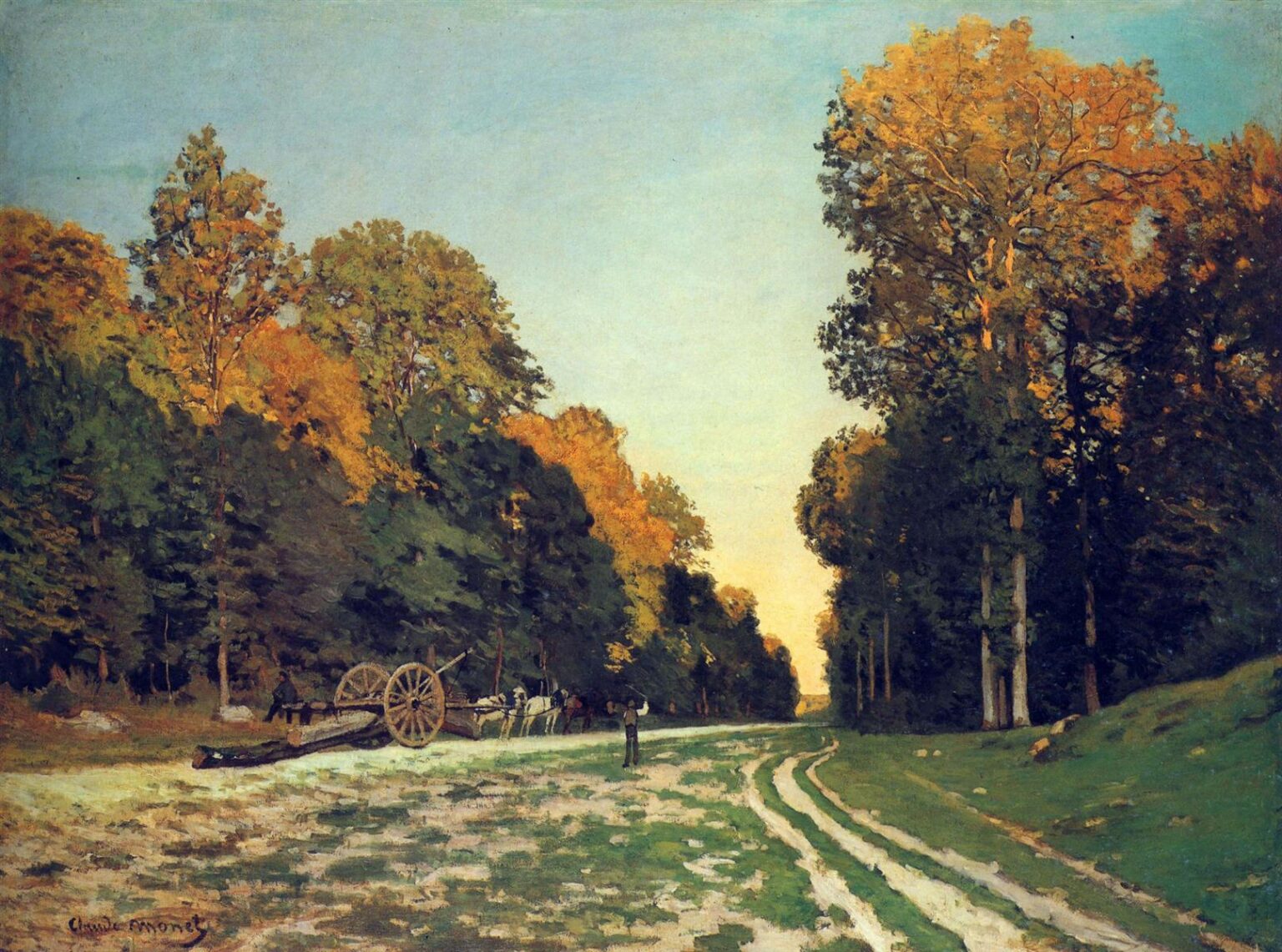
Claude Monet’s The Road from Chailly to Fontainebleau, painted in 1864, belongs to a crucial early moment in the artist’s career. Long before Monet became known for the shimmering surfaces of his mature Impressionist paintings, he was already testing how a landscape could be built from direct observation, light, atmosphere, and a vivid sense of place. This painting shows a road cutting through the forest near Fontainebleau, a region that had already attracted generations of French landscape painters. Yet even in this relatively early work, Monet’s eye feels distinct. He is not satisfied with simply recording a wooded route. He turns it into an experience of depth, air, movement, and changing light.
At first glance, the scene appears calm and straightforward. A broad road stretches into the distance between masses of trees, with a wagon and small figures occupying the left side and center. The image seems rooted in ordinary rural life. But the longer one looks, the more the painting reveals a young artist deeply interested in how nature organizes space and how light can animate an otherwise familiar setting. Monet treats the road, the trees, the open sky, and the scattered human presence as parts of a single living environment. The result is not merely topographical. It is atmospheric, immersive, and already full of the visual intelligence that would shape his later work.
Monet in 1864
In 1864, Monet was still in the formative stage of his artistic journey. He had not yet fully arrived at the style that would later be called Impressionism, but he was moving steadily toward it. He was learning from older traditions while also pushing against them. The forest of Fontainebleau was one of the key places where this evolution could happen. For decades, painters associated with the Barbizon school had gone there to work directly from nature, choosing rural and forest subjects over grand historical themes. Their example helped legitimize landscape as a serious subject in French art.
Monet entered this environment with ambition and sensitivity. He absorbed lessons from earlier painters, especially their respect for direct study of the land and their interest in natural light. At the same time, he brought more freshness, more optical liveliness, and a more fluid handling of paint. In The Road from Chailly to Fontainebleau, one can sense both inheritance and departure. The setting itself belongs to a well-established landscape tradition, but the way Monet sees it is more immediate and less ceremonious. He is less concerned with moralizing nature or arranging it into a solemn poetic formula. Instead, he looks at how the scene actually feels in a given moment.
This is what makes the painting historically fascinating. It stands at the threshold between inherited naturalism and the freer, brighter, more perceptual language Monet would later master. It is the work of an artist learning to trust the eye.
The First Visual Impression
The painting’s immediate effect comes from its combination of openness and enclosure. The road creates a broad entry into the picture, inviting the viewer forward. At the same time, the tall wooded walls on either side make the space feel contained, almost like a corridor cut through nature. This interplay between wide openness and leafy confinement gives the image much of its tension.
The sky is large and pale, occupying a generous portion of the upper canvas. It offers breathing room and light, balancing the darker density of the forest. The trees, however, are not oppressive. Their foliage glows with warm golds, greens, and browns, suggesting late afternoon or early autumn light. This warmth softens the sense of enclosure and makes the road feel hospitable rather than forbidding.
The eye is drawn first to the road’s pale surface and the tracks that curve toward the horizon. These bright, irregular paths act like visual guides, leading the viewer into depth. Then the eye lingers on the wagon, the horses, and the tiny standing figure near the middle. These details give scale to the scene and remind us that this is not untouched wilderness. It is a worked and traveled landscape, shaped by human use but still dominated by the life of trees, light, and open air.
Composition and Structure
Monet’s composition is carefully organized, even though it feels natural and unforced. The road is the key structural element. Rather than running as a single narrow line into the distance, it spreads across the foreground and then narrows gradually, giving the painting a strong sense of perspective. The wagon tracks on the right side are especially important. Their curving movement adds rhythm and keeps the composition from becoming too rigid.
The trees function almost like framing devices, but Monet avoids turning them into symmetrical scenery. The left side is dense and varied, with multiple trees and layered foliage forming a textured edge. The right side includes a particularly prominent tall tree near the front, its crown catching golden light. This asymmetry makes the image feel more observed than staged. The forest is not reduced to a pattern. It retains individuality and irregularity.
The horizon line lies relatively low, allowing the sky to play a strong role. This choice helps the painting feel spacious and airy even though the road is surrounded by woodland. It also makes the upper foliage stand out more dramatically against the pale blue background. The contrast between lit tree crowns and soft sky becomes one of the painting’s major visual pleasures.
Despite the scene’s apparent simplicity, Monet balances masses and intervals with great care. Dark and light areas alternate across the canvas. Open stretches of road are set against thick clusters of foliage. Small figures punctuate the broad landscape without distracting from it. Everything contributes to a coherent flow from foreground to distance.
The Road as the True Subject
Although the painting includes trees, sky, and figures, the true subject is the road itself. Monet is not just painting a forest edge. He is painting passage. The road suggests movement, direction, travel, and transition. It is the element that converts a static landscape into a lived environment.
Roads in nineteenth century painting often carry symbolic weight. They can imply journey, labor, modern access to nature, or the simple fact of human presence in the countryside. In this painting, the road does all of these things without becoming literary or sentimental. It remains a physical reality, pale, uneven, marked by wheels and footsteps, but it also creates an emotional structure. It leads the viewer inward and onward, opening a future within the image.
This forward pull is essential to the painting’s mood. The eye does not stop at the foreground. It travels. The road narrows into the distance until it dissolves into light. That recession gives the scene a quiet sense of possibility. The destination is unseen, yet the path is clear. Monet transforms a rural track into an invitation to look, to move, and to imagine what lies beyond the visible stretch of land.
Because the road is so dominant, the landscape feels less like a fixed view and more like a moment in an ongoing world. Someone has passed through, someone is passing through now, and others will pass through later. The setting is stable, but life within it is continuous.
Light and Atmosphere
One of the most compelling aspects of The Road from Chailly to Fontainebleau is the treatment of light. Even at this early stage, Monet shows a remarkable sensitivity to how illumination shapes perception. The painting does not present light as an abstract glow spread evenly over everything. Instead, light touches different surfaces in different ways.
The upper foliage catches warm sunlight, turning the crowns of the trees into luminous masses of gold and amber. Lower areas remain cooler and darker, filled with shadowy greens and browns. This creates a natural vertical gradient, from deep shade below to warm brilliance above. The effect is convincing and visually rich. It gives the trees substance and atmosphere rather than flattening them into decorative silhouettes.
The road reflects light differently. Its pale surface seems dusty and dry, broken by irregular patches of green and off white. The brightness of the road contrasts strongly with the wooded margins, making it seem sunlit even when parts of it are not directly illuminated. This contrast helps establish the feeling of clear outdoor air.
The sky is especially important to the atmosphere. It is not heavily dramatized. There are no storm clouds, no theatrical sunset, no overwhelming meteorological event. Instead, the sky is calm, expansive, and softly graded. This restraint allows the subtler effects of terrestrial light to dominate. The painting’s atmosphere comes not from spectacle but from balance. It feels like a real hour of the day, quietly observed.
Color and Tonal Harmony
The color palette is one of the painting’s greatest strengths. Monet works with restrained but expressive hues, relying on relationships between warm and cool tones rather than on extreme chromatic contrasts. The blues of the sky are delicate and slightly muted, allowing the golden foliage to stand out without becoming harsh. The greens range from dark forest tones to softer olive and mossy notes. Browns and ochres anchor the lower half of the image and connect road, trunks, and undergrowth.
What makes the palette so effective is the way warm colors emerge from within cooler surroundings. The sunlit leaves are not isolated patches of yellow placed on top of green. They feel embedded in the living structure of the trees. This integration gives the painting cohesion. Every color seems related to the others through light.
Monet also uses tonal contrast with intelligence. The darkest passages are concentrated within the forest masses, especially where trunks and dense foliage merge into shadow. The lightest passages appear in the road and the sky. These extremes create depth and legibility, but the transitions between them are handled with softness. The result is a painting that feels both structured and breathable.
This tonal harmony matters because it reflects Monet’s concern with total visual effect. He is not describing each object separately and then assembling them. He is seeing the landscape as a network of interacting values and colors. That holistic way of looking would later become central to Impressionism.
Trees, Foliage, and Surface
The trees in this painting are more than background material. They define the character of the place. Monet paints them not as generic woodland forms but as varied living presences, each contributing differently to the scene’s rhythm and atmosphere. The crowns are irregular, loose, and full of visual energy. They do not form a uniform canopy. Instead, they rise and cluster in distinct shapes, catching different degrees of light.
The handling of foliage is especially revealing. Monet is already moving away from tight descriptive finish. He suggests leaves and branches through broken touches, patches of color, and textured masses rather than through meticulous line. This approach allows the trees to feel alive and shifting. One senses movement in the air, not because the painting is animated in a literal way, but because the surfaces remain open and responsive.
The tall tree on the right is particularly striking. It stands near the front, its upper branches spreading widely against the sky. Its illuminated crown becomes one of the painting’s visual anchors. On the left, the foliage is denser and more varied, creating a more complex wall of color and shadow. This contrast between the two sides enriches the spatial experience of the road.
Trunks are used sparingly but effectively. Where they appear, they reinforce vertical structure and prevent the wooded masses from dissolving completely into softness. Monet balances solidity and atmosphere. The forest feels rooted, but it also breathes.
Human Presence in the Landscape
The figures in The Road from Chailly to Fontainebleau are tiny, but they are far from insignificant. The wagon, horses, and small standing person give the landscape scale and social context. Without them, the painting would still be compelling as a study of light and space, but it would feel more detached. Their presence reminds us that this is a traveled road, a setting of daily rural activity.
Monet does not make these figures into portraits or narrative protagonists. They are absorbed into the broader visual order of the painting. That is an important choice. Human beings are present, but they do not dominate nature. They are part of the scene’s rhythm, not its center. The wagon rests or moves slowly along the left side, while the standing figure near the center creates a small upright accent against the broad horizontal road.
This modest treatment of people aligns with Monet’s larger vision. He is interested in how human life inhabits a landscape, not in turning the landscape into a stage for anecdote. The figures serve the painting’s sense of reality. They also intensify its mood of passage and distance. Someone is on the road, but the journey itself remains quiet and unresolved.
The wagon adds another dimension. Its large wheels and diagonal placement introduce a note of rustic labor and physical weight. Against the softness of foliage and sky, this object feels practical and grounded. It brings the material life of the countryside into the composition without burdening it with narrative drama.
Fontainebleau and the Legacy of Landscape Painting
The forest of Fontainebleau held a special place in nineteenth century French art. It attracted painters who wanted to escape academic conventions and engage directly with nature. The area offered remarkable variety, including dense woods, open roads, rocky clearings, and changing seasonal effects. It became both a real location and an artistic laboratory.
Monet’s painting participates in that larger history, but it also pushes beyond it. Earlier landscape painters often emphasized stability, gravity, and poetic solitude. Monet certainly preserves some of that seriousness, yet his handling is more immediate. He seems less interested in presenting nature as timeless and monumental, and more interested in capturing a particular visual encounter.
This difference is subtle but important. In The Road from Chailly to Fontainebleau, the landscape is not idealized into a grand emblem. It remains specific, contingent, and observed. The road is uneven. The trees are irregular. The light is temporary. The figures are passing through. These qualities make the scene feel modern in spirit even though it belongs to a traditional subject category.
The painting therefore occupies a fascinating place between schools and generations. It acknowledges the achievements of naturalist landscape painting while already pointing toward a more fluid, perception-based art.
Why This Painting Matters in Monet’s Development
This work matters because it shows Monet learning how to turn observation into structure without losing freshness. That challenge would define much of his later career. He wanted to be faithful to what the eye sees, but he also needed to organize that vision into a convincing painting. In this early landscape, he succeeds to an impressive degree.
One can already see several traits that would later become central to his art. There is the commitment to outdoor light, the sensitivity to atmosphere, the use of color to build form, and the refusal to overstate anecdote. There is also the sense that a painting can be about a moment of visual experience rather than about a dramatic event.
At the same time, the work still retains more solidity and traditional structure than many of Monet’s later paintings. The forms are more anchored, the perspective more explicit, and the composition more firmly arranged. That combination makes the painting especially rewarding to study. It reveals the path Monet was taking from early naturalism toward full Impressionism.
Rather than seeing this work as merely a prelude to later masterpieces, it is better to see it as a strong statement in its own right. It captures a young artist discovering that landscape can hold both order and sensation, both place and atmosphere.
The Emotional Tone of the Scene
The emotional power of The Road from Chailly to Fontainebleau lies in its quietness. Nothing dramatic happens, yet the painting leaves a lasting impression. Its calm comes from the measured relationship between elements. The road opens space, the trees provide shelter, the light warms the upper world, and the figures move gently within it all.
There is also a slight feeling of solitude, though not loneliness. The road extends far into the distance, and the smallness of the people emphasizes the scale of the landscape. But because the light is so warm and the composition so open, the solitude feels reflective rather than bleak. The painting invites contemplation.
One might also read the work as an image of transition. Roads always imply movement from one place to another, and the particular lighting suggests a day moving toward evening or at least toward a softer later hour. The scene becomes, in this sense, a meditation on time passing quietly through ordinary space.
That emotional resonance is one reason the painting remains appealing. It does not force a message. It creates an environment in which the viewer can pause, travel with the eye, and inhabit a moment of stillness shaped by light and distance.
Conclusion
The Road from Chailly to Fontainebleau is an early Monet landscape that already reveals remarkable sophistication. What could have been a simple rural scene becomes, in his hands, a study of spatial movement, tonal balance, natural light, and lived atmosphere. The road leads the eye forward, the forest frames and deepens the scene, the sky opens it, and the small figures root it in everyday reality.
The painting matters not only because it belongs to Monet’s formative years, but because it demonstrates how early he understood that landscape could be more than description. It could be an experience of seeing. He does not merely present trees, road, and wagon as separate motifs. He binds them into a single visual event, held together by light and air.
Viewed today, the painting feels both grounded and prophetic. It remains close to the naturalist tradition associated with Fontainebleau, yet it already carries the sensibility that would transform modern painting. The handling of color is subtle, the atmosphere persuasive, and the composition quietly masterful. Above all, the work shows Monet discovering that the ordinary countryside, when observed with enough intelligence and sensitivity, can become unforgettable.
