Image source: wikiart.org
Introduction
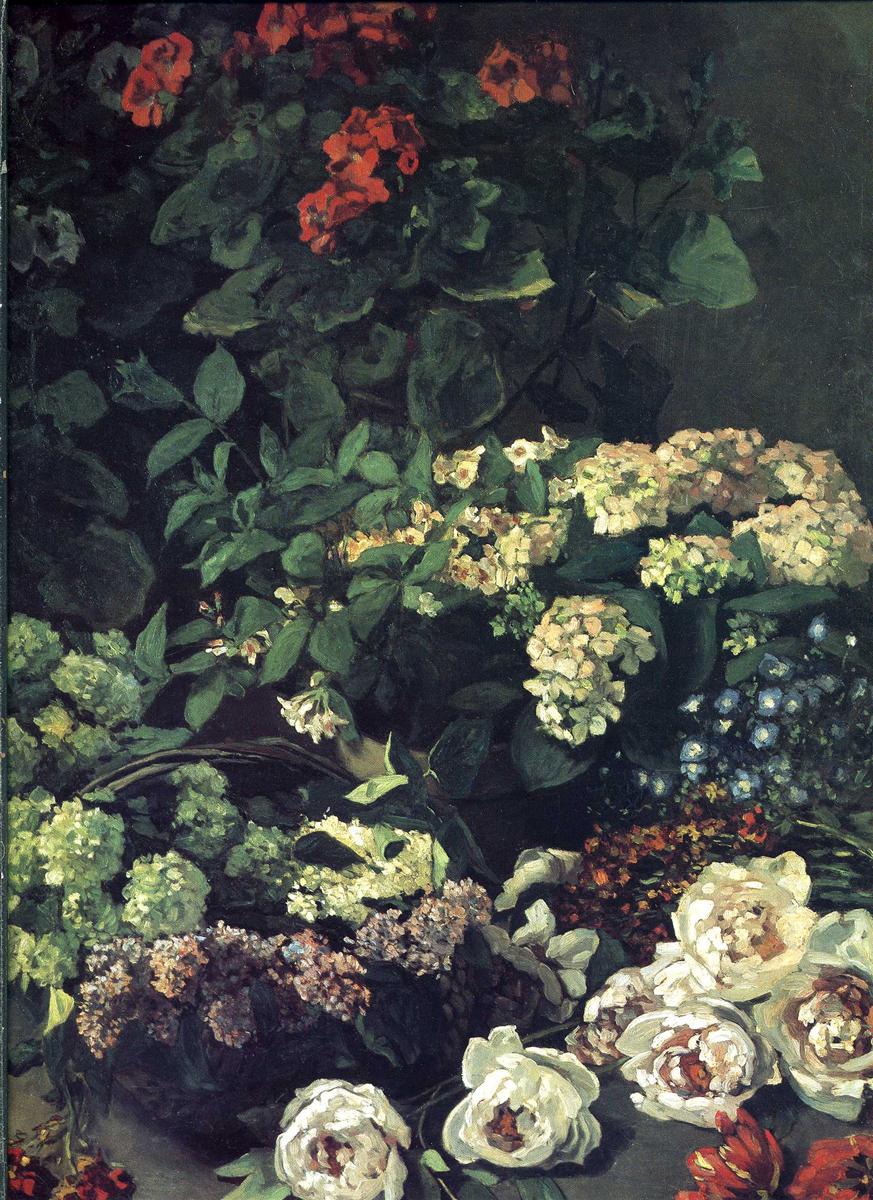
Claude Monet’s Spring Flowers from 1864 offers a striking view into the young artist’s developing vision. At first glance, the painting may seem quieter and darker than the sunlit landscapes most people associate with Monet. Yet that difference is exactly what makes it so compelling. This is a work that reveals an artist still shaping his language, still testing how color, texture, and atmosphere can transform an ordinary subject into something deeply felt. Instead of presenting flowers as neat decoration, Monet turns them into a living environment. The blossoms do not sit passively before the viewer. They emerge, cluster, recede, and glow within a dense world of shadow and foliage.
The painting’s beauty comes from this tension between abundance and mystery. It is full of blooms, but it is not cheerful in a simple or obvious way. Its springtime is lush, intimate, and slightly hushed. White blossoms catch the light in the lower half, while deep greens and shadowy reds occupy the upper field. The result is a composition that feels both rich and enclosed, as though the viewer has stepped into a garden corner where growth is thick, the air is still, and light filters only partially through leaves and petals.
What makes Spring Flowers especially rewarding is the way it lets us see Monet before the fully formed style of Impressionism. The painting already shows his sensitivity to visual sensation, but it also carries the weight, tonal depth, and material density of earlier traditions. Rather than a bright outdoor spectacle, this is a study in atmosphere, arrangement, and the subtle drama of seeing. It captures a season usually linked with freshness and lightness, yet it does so through darkness, compression, and contrast. That unexpected approach gives the work its individuality and its lasting power.
Claude Monet in 1864
To understand Spring Flowers, it helps to place it within Monet’s early career. In 1864, Monet was still a young painter searching for recognition and artistic direction. He had not yet become the emblem of Impressionism that later generations would celebrate. At this stage, he was absorbing influences, developing confidence, and experimenting with different kinds of subjects. The painting belongs to a period when he was looking closely at nature but had not yet fully embraced the broken, high key, open air brightness that would define his mature work.
This early moment matters because Spring Flowers shows Monet in transition. One can sense his attraction to immediate visual experience, which would become central to his later art. At the same time, the painting remains rooted in a darker tonal structure that reflects mid nineteenth century approaches to realism and natural observation. The flowers are not reduced to decorative pattern, nor are they dissolved into pure light. Instead, they have body, volume, and presence. The image retains a sense of weight.
That combination is fascinating because it reminds us that artistic revolutions do not appear overnight. Even a painter as transformative as Monet passed through phases of trial, influence, and gradual refinement. In Spring Flowers, the seeds of his later achievements are already visible in his attention to fleeting effects, his interest in organic abundance, and his refusal to flatten nature into simple prettiness. Yet the work also preserves a moodier, more concentrated side of his early practice. It is both recognizable as Monet and different from the Monet many viewers expect.
A Composition Built from Density and Depth
One of the most striking aspects of Spring Flowers is its composition. The painting does not present flowers in a formal bouquet arranged around a central axis. Instead, it feels immersive and almost overgrown. Blossoms appear at different levels of the pictorial space, with no clean separation between foreground, middle ground, and background. This layered structure creates a sense of depth, but it is a compressed depth, one that keeps the viewer close to the surface while still suggesting recession into shadow.
The lower portion is filled with pale blossoms that seem nearest to the viewer. These flowers are the most legible and luminous forms in the painting. Their soft whites and creamy tones draw immediate attention, especially because they stand out against the surrounding darkness. Above and behind them, clusters of hydrangea like blooms and other flowers create a thick middle zone, while the upper area dissolves into dark foliage punctuated by muted reds. This vertical progression from brightness below to darkness above gives the painting a subtle upward movement, though the overall feeling remains enclosed rather than expansive.
There is also an intentional irregularity in the arrangement. Nothing feels rigid or overly planned. Curving stems, overlapping petals, and partially hidden blossoms create the impression that the viewer is looking into an actual garden corner or floral mass rather than an idealized academic still life. Monet does not organize nature into perfect order. He allows it to remain somewhat unruly. That decision brings vitality to the composition. The painting breathes because it resists symmetry and embraces natural complexity.
This compositional density is essential to the work’s mood. Instead of inviting the eye to rest on one isolated focal point, Monet encourages wandering. The viewer moves from one cluster to another, from white blossom to blue accent, from dark leaves to red petals. The experience is cumulative. Meaning arises not from a single flower but from the total sensation of floral presence.
The Dark Tonal World of the Painting
When many people think of spring, they imagine light skies, tender greens, and open brightness. Spring Flowers challenges that expectation. The painting is dominated by a dark tonal range, especially in the background and upper half. Blacks, deep greens, muted browns, and heavy shadow shape the environment in which the flowers appear. Rather than weakening the painting’s springtime identity, this darkness makes the season feel more intimate and sensual.
The dark ground serves several purposes. First, it gives exceptional force to the lighter blossoms. The whites and pale creams glow because they are surrounded by shadow. Monet uses contrast not just to separate forms but to intensify their presence. The flowers do not simply sit on a dark background. They seem to emerge from it, as if light has briefly touched them before fading again.
Second, the darkness creates atmosphere. This is not the broad daylight of noon. It feels more like filtered garden light, perhaps beneath trees or within a sheltered space where blossoms gather in partial shade. That setting makes the scene feel secluded and private. The viewer is not looking at a public display of flowers but at something discovered, something hidden within a more complex natural environment.
Third, the tonal depth gives the painting emotional gravity. Without it, the subject might risk becoming merely decorative. With it, the flowers acquire drama. Spring here is not just about freshness. It is also about emergence from darkness, about fragility within abundance, about the way beauty often appears most intense when surrounded by shadow. Monet seems less interested in botanical clarity than in the emotional weight of perception itself.
This tonal richness also separates the work from the brighter palette of his later years. It reminds us that the young Monet could work with shadow as powerfully as with light. In Spring Flowers, darkness is not the absence of beauty. It is the condition that reveals beauty more fully.
Color and the Language of Contrast
Although the painting is overall dark, it is far from colorless. In fact, color is one of its greatest strengths. Monet builds the image through subtle but expressive contrasts. Creamy whites, cool blues, dusty violets, warm reds, and many shades of green create a rich but restrained palette. The colors do not shout. They converse.
The whites are particularly important. They dominate the lower right and much of the central area, forming the painting’s main luminous field. Yet these whites are not flat or uniform. Monet modulates them with touches of yellow, pink, gray, and soft green. This variation prevents the blossoms from feeling stiff. Instead, they seem alive, responsive to changing light, and full of delicate internal movement.
The greens are equally nuanced. Some leaves are cool and bluish, while others lean toward olive, moss, or deep forest tones. This range gives the foliage body and complexity. Rather than serving as a neutral backdrop, the leaves become active participants in the composition. They absorb light differently, shape the rhythm of the image, and support the flowers without disappearing behind them.
The red flowers in the upper portion introduce an unexpected intensity. Because they are placed against deep shadow, they appear smoldering rather than bright. Their presence adds warmth and prevents the composition from becoming too monochromatic. They also help balance the pale blossoms below. The eye moves naturally between the red accents above and the white masses beneath, creating a vertical dialogue across the canvas.
Small blue passages deepen this effect further. These cooler notes act almost like visual pauses, moments of calm within the heavier cream and green zones. Monet clearly understood that floral color is not just about variety but about relation. Each hue becomes more expressive because of its neighbors. The painting is a lesson in how contrast can produce unity instead of fragmentation.
Brushwork and Surface Energy
Monet’s handling of paint in Spring Flowers reveals an artist deeply engaged with the physical act of seeing and making. The brushwork is not polished into invisibility. Instead, it remains evident across the surface, especially in the petals, leaves, and dark background passages. This visible handling gives the painting energy and keeps it from becoming too static or finished in an academic sense.
In the flowers, brushstrokes often feel layered and responsive. Petals are suggested rather than rigidly outlined. A blossom may be built from a few loaded strokes of cream and pink, allowing form to emerge through paint itself. This method gives the flowers softness without sacrificing structure. They retain shape, but that shape feels organic and provisional, as if it could change with the light.
The leaves and darker foliage are handled more broadly in places, which helps create the painting’s dense atmosphere. Some passages appear almost swept or massed together, reinforcing the sense of vegetation merging into shadow. Elsewhere, individual leaves are articulated with more care, creating variation in texture and rhythm. This balance between detail and suggestion is one of the painting’s pleasures. Monet knows when to describe and when to let paint stand in for experience.
There is also a tactile quality to the surface. One can sense the artist building the image through repeated decisions, adjusting tones, defining edges, and letting certain forms dissolve. The result feels alive rather than mechanically complete. That liveliness is essential to Monet’s art, even at this early stage. He is already resisting the idea that a painting must be perfectly smooth in order to be convincing. Instead, conviction comes through responsiveness, through marks that feel connected to perception.
This surface vitality points toward his later development. Even though Spring Flowers belongs to an earlier and darker phase, it already shows Monet’s belief that paint can do more than imitate. It can embody sensation.
Flowers as More Than Decoration
A lesser painter might have treated this subject as a simple floral display, aiming only for elegance or prettiness. Monet does something more serious. In Spring Flowers, flowers become a means of exploring mood, temporality, and visual richness. They are not merely decorative objects. They are a subject through which painting itself can be tested.
The abundance of blooms suggests fertility and renewal, which are natural associations for spring. Yet Monet does not present those themes sentimentally. The blossoms are beautiful, but they are also fragile and fleeting. Their petals catch light for a moment against a surrounding darkness that seems vast and continuous. This contrast gives the painting a subtle sense of transience. Spring is here, but it will not last. The flowers are fully present, yet their very freshness implies impermanence.
There is also an interesting tension between cultivated beauty and natural growth. The composition contains hints of arrangement, especially in the way certain clusters are gathered, but it never feels entirely controlled. The flowers seem to belong to a living environment rather than to a polished tabletop presentation. That ambiguity adds depth. We are not just admiring floral forms. We are entering a world in which growth is active, layered, and partly untamed.
Because of this, the painting invites reflection on how nature is experienced. Monet is not cataloguing species or offering botanical precision as an end in itself. He is trying to capture what it feels like to be surrounded by blossoms, leaves, and filtered light. The subject becomes experiential rather than descriptive. Flowers are a vehicle for perception, for atmosphere, for the emotional charge of color emerging from shade.
In that sense, Spring Flowers belongs to a larger nineteenth century interest in making ordinary natural subjects artistically profound. Monet does not need a grand historical narrative. A cluster of blossoms is enough, provided it is seen deeply.
Light in a Painting About Shadow
Light is central to Spring Flowers, but it operates differently here than in Monet’s mature Impressionist landscapes. Rather than flooding the whole image, light appears selectively. It touches certain blossoms, catches on leaves, and then quickly retreats. This selective illumination gives the painting a dramatic and almost theatrical quality, though it remains grounded in natural observation.
The lower right area is especially important in this regard. The pale roses and clustered blossoms there seem to gather and hold the strongest light. They become a visual anchor, a place where the eye lingers before moving outward into darker passages. Other white flowers across the center echo this effect, creating a rhythm of illumination rather than a single spotlight.
What makes this treatment so effective is the way light seems absorbed by matter. The petals do not become radiant abstractions. They remain dense, fleshy, and tangible. Monet is less interested in dissolving form than in showing how light rests on form. This gives the painting a grounded, material beauty. The blossoms shine, but they still feel weighty and real.
At the same time, the surrounding shadow keeps that light unstable. No illuminated area feels permanent or universal. Everything depends on contrast. Without the dark foliage, the white flowers would lose much of their emotional and visual force. Monet seems to understand that light is most moving when it appears as an event rather than a constant condition.
This approach reveals an artist already fascinated by visual change. Even if the style is not yet fully Impressionist, the core concern is familiar. Monet is studying how light transforms what we see. In Spring Flowers, that transformation happens quietly, within a closed and shadowed world. It is not less powerful for being restrained. In some ways, it is more intimate because of that restraint.
The Painting and Monet’s Future Development
Looking at Spring Flowers today, one of its greatest interests lies in how it anticipates Monet’s later career while remaining distinct from it. The work does not yet display the bright, fragmented, open air color of his mature Impressionism, but it does reveal the perceptual sensitivity that would guide his art for decades. The seeds are present, even if the full bloom comes later.
The first of these signs is his commitment to direct visual experience. Monet is clearly not painting from inherited formulas alone. He is looking, comparing, adjusting, and responding to what nature gives him. The second is his interest in how atmosphere shapes form. Even in this dark floral setting, objects are not isolated in a schematic way. They belong to an enveloping visual field. Flowers, leaves, and shadow interact continuously.
Another important link to the future is his emphasis on serial richness within a single motif. Later, Monet would return again and again to haystacks, poplars, cathedrals, water lilies, and river scenes in order to study changing effects of light and season. In Spring Flowers, one already feels that fascination with variation inside repetition. A flower is never just a flower. Each cluster catches light differently, occupies space differently, and contributes uniquely to the whole.
Yet it would be wrong to view the painting only as an immature step toward something else. Spring Flowers has its own integrity. Its darkness, density, and tonal atmosphere are not failures to become later Monet. They are qualities that give this early work its special identity. It shows a side of Monet that is often overshadowed by his more famous achievements. Here we encounter a painter of depth, enclosure, and moody floral abundance. That encounter enlarges our understanding of him.
Why Spring Flowers Still Feels Fresh Today
One reason Spring Flowers continues to resonate is that it avoids the clichés often attached to floral painting. It is not sugary, overly polished, or sentimentally pretty. Its beauty is more complex. The flowers are lush, but they are surrounded by shadow. The palette is rich, but it remains controlled. The composition is abundant, but it never becomes chaotic. These tensions make the painting feel sophisticated and alive.
Modern viewers may also respond to its sense of immersion. Rather than standing back from the subject, Monet brings us close. We do not observe the flowers from a detached distance. We enter their space. That intimacy feels contemporary in its own way. It anticipates later ideas about painting as an environment of sensation rather than a mere window onto objects.
The work also appeals because it demonstrates that spring can be interpreted in more than one way. Instead of brightness alone, Monet gives us renewal with depth, growth with shadow, and tenderness with gravity. This broader understanding of seasonal beauty feels emotionally true. Spring is not always airy and clear. Sometimes it arrives through damp gardens, rich earth, and thick blossoming life that seems to press upward from darkness.
For admirers of Monet, the painting offers the pleasure of discovery. It expands the familiar image of the artist. For general viewers, it offers immediate visual rewards through contrast, texture, and floral richness. For anyone interested in nineteenth century art, it stands as an eloquent example of a major painter in formation, already capable of turning a modest subject into a memorable work.
Conclusion
Spring Flowers is a remarkable early painting because it reveals Claude Monet at a formative moment while also standing as a fully engaging work in its own right. Its dense composition, dark tonal atmosphere, luminous blossoms, and tactile brushwork create a vision of spring that is intimate rather than expansive, contemplative rather than simply cheerful. The painting transforms a familiar subject into an experience of depth, contrast, and visual discovery.
What lingers most after looking at it is the sense of emergence. Flowers rise from shadow. Light touches petals and leaves, then slips away. Color gathers in clusters and dissolves into darkness. Everything feels alive, yet nothing feels permanent. That balance between abundance and fragility gives the painting its emotional resonance.
For viewers who know Monet mainly through his later landscapes, Spring Flowers offers a valuable reminder that his art began in exploration, experiment, and tonal richness. For viewers encountering the painting on its own terms, it offers a beautifully nuanced meditation on nature, perception, and the quiet drama of bloom. Even in this early work, Monet shows that he was never interested in painting nature as static ornament. He wanted to paint its atmosphere, its movement, and its fleeting life. That ambition is already here, unfolding among the blossoms.