Image source: wikiart.org
Introduction
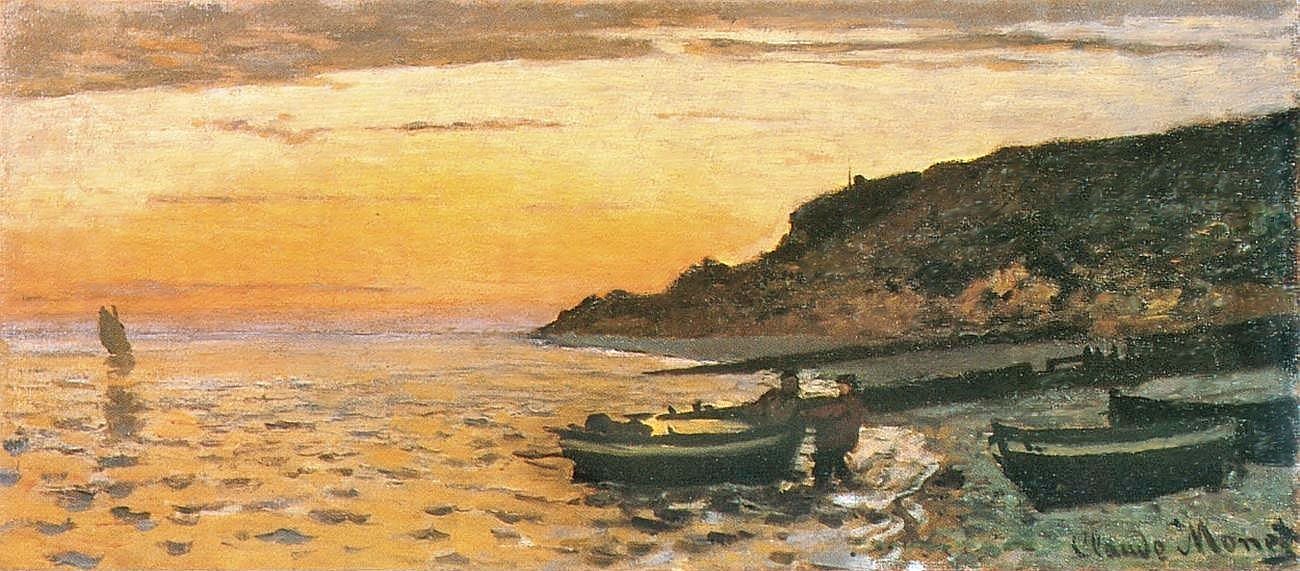
Claude Monet’s Seacoast at Saint-Adresse, Sunset from 1864 is a quiet but deeply revealing painting from the early phase of his career. At first glance, it appears simple: a shoreline at evening, a few boats resting near the water, a glowing sky, and a dark headland cutting across the right side of the image. Yet the longer one looks, the more the painting opens up. What seems modest in subject becomes rich in sensation. Monet is not merely showing a coastal view. He is studying the way light settles over water at the end of the day, the way silhouettes gain force as brightness fades, and the way a landscape can feel both immediate and timeless.
This painting belongs to the kind of subject that would remain central to Monet throughout his life. He returned again and again to coasts, harbors, rivers, skies, reflections, and changing weather. In this early work, one can already see the foundations of that lifelong obsession. The sea is not treated as a static surface. The sky is not just background. Light is the real subject, and everything else exists in relation to it. Boats, cliffs, and shorelines become instruments through which Monet measures atmosphere.
What makes Seacoast at Saint-Adresse, Sunset so compelling is its balance between clarity and suggestion. The location is recognizable as a real place on the Normandy coast, yet the painting is less about topographical precision than about a fleeting visual event. Sunset transforms the scene into a world of gold, gray, violet, and soft shadow. The forms are present, but they are simplified and softened by evening light. Monet does not overdescribe. He gives just enough for the viewer to feel the place and the hour.
The result is a painting that feels meditative, intimate, and modern. Even in 1864, before Impressionism had fully emerged as a movement, Monet was already pushing painting away from polished academic finish and toward direct perception. This is what gives the work its lasting power. It is not dramatic in the theatrical sense, yet it is full of visual drama. It asks the viewer to slow down and notice the unstable beauty of a moment that is already disappearing.
Historical Context and Monet’s Early Development
By 1864, Claude Monet was still a young artist finding his direction, but he had already begun to separate himself from older conventions. He had studied under Eugène Boudin, who encouraged him to work outdoors and observe nature directly. That advice changed the course of Monet’s art. Instead of treating landscape as a studio construction, he increasingly treated it as an encounter with living conditions of light, weather, and air.
Saint-Adresse, near Le Havre, was especially important in Monet’s early years. The Normandy coast gave him access to constantly shifting skies, reflective water, and changing atmospheric effects. These were ideal subjects for an artist interested not just in scenery but in vision itself. The coast offered scale, openness, and variation. It could be bright, stormy, calm, sparkling, or hazy within short spans of time. For Monet, that instability was not a problem to overcome. It was the point.
In the mid 1860s, French painting was still dominated by academic expectations that valued historical subjects, polished finish, and carefully modeled form. Landscape had its place, but it often remained secondary within the hierarchy of genres. Monet and the artists around him began to challenge that system by insisting that ordinary modern life and direct views of nature were worthy subjects in themselves. Paintings like Seacoast at Saint-Adresse, Sunset reflect that shift. There is no mythological narrative here, no literary allegory, no heroic action. The significance lies in seeing.
This early period is crucial because it shows Monet developing the visual instincts that would later define Impressionism. He was already learning to simplify forms, heighten the role of color relationships, and prioritize the sensation of a specific moment over highly finished description. The painting still retains a degree of structure and solidity associated with earlier landscape traditions, but it also points clearly toward something new. Monet is less interested in permanent form than in transient effect.
The Composition and the Structure of the Scene
The composition of Seacoast at Saint-Adresse, Sunset is one of its greatest strengths. Monet organizes the image through a careful tension between open space and solid mass. The left side opens toward the sea and sky, creating breadth and distance, while the right side is anchored by the dark cliff and shoreline, which give the composition weight. This contrast between openness and enclosure creates visual stability without stiffness.
The horizon sits relatively high, allowing the foreground water to occupy much of the image. This is important because it gives Monet room to explore reflection. The sea is not an empty stretch. It becomes a field of broken light, with rippling marks that echo the sunset above. The viewer’s eye moves naturally across this surface, guided by flickers of gold and gray. The reflections do not mirror the sky in a precise, glassy way. Instead, they translate light into movement.
The boats are arranged with intelligence and restraint. Rather than crowding the scene, they punctuate it. The small sailboat at left appears almost isolated against the open water, while the darker boats near the shore provide a stronger foreground presence. These elements establish a rhythm across the composition. They also help the viewer measure depth. The distant boat suggests scale, while the nearer vessels give substance and immediacy.
The cliff on the right side is especially important compositionally. Its dark, broad silhouette acts almost like a curtain, framing the luminous sky and sea. Without it, the painting might feel too diffuse. With it, the glowing sunset becomes more intense by contrast. The landmass also creates a sense of shelter. This is not an endless ocean scene. It is a particular cove or coastal edge, a place shaped by geology and human use.
Monet’s composition feels natural, but it is not casual. It is carefully balanced so that no single element overwhelms the others. The painting holds together through opposition: light and dark, stillness and movement, distance and closeness, openness and mass. This structural clarity is one reason the work feels so satisfying.
Sunset as the True Subject
Although the painting includes boats, cliffs, and shoreline, the true subject of Seacoast at Saint-Adresse, Sunset is sunset itself. Monet is fascinated by the way evening light transforms the visible world. Under this light, objects lose sharpness, contrasts shift, and surfaces begin to glow from within. The sunset does not simply illuminate the scene. It reorganizes it.
The sky is filled with warm tonal transitions, moving through gold, cream, pale orange, and muted gray. Monet avoids hard edges in these passages, allowing the atmosphere to feel expansive and soft. The clouds are not dramatic storms or highly defined formations. They are subtle presences that help modulate the light. Their role is not to distract but to deepen the sense of a sky in transition.
What is remarkable is the way Monet connects the sky to the sea. The water receives the sunset but does not duplicate it mechanically. Instead, it breaks the glow into scattered fragments. This is a painterly solution to a visual problem. Real water is never still for long, and reflection on water is always unstable. Monet captures that instability through short, flickering marks that suggest the restless surface. The sea becomes a trembling record of the sky above.
Sunset also changes the status of objects within the scene. Boats become silhouettes. The cliff becomes a dark mass. Fine details recede. This is part of the painting’s beauty. As daylight fades, description gives way to impression. Monet understands that evening simplifies the world, but in doing so it also intensifies mood. What remains visible becomes more emotionally charged.
There is also a poetic logic at work here. Sunset has long been associated with pause, reflection, and passing time. Monet does not sentimentalize that idea, yet he clearly responds to it. The painting feels suspended between day and night, between visibility and obscurity. That in between state gives the work its emotional depth.
Color and Tonal Harmony
The color palette in this painting is restrained, but it is far from dull. Monet uses a limited range with great sensitivity, allowing color relationships to carry much of the visual impact. Warm golds and oranges dominate the sky and water, while cooler grays, browns, muted violets, and deep greenish blacks shape the land and boats. The harmony between these tones is what makes the painting feel so coherent.
One of the most striking aspects of the palette is its softness. Monet does not push the sunset into exaggerated brilliance. The gold is luminous but controlled. This restraint gives the image credibility and elegance. It feels observed rather than invented. The warmth of the sky is enough to fill the scene with radiance, but it never becomes harsh or theatrical.
The darker tones are equally important. The boats and shoreline are painted in rich shadowed colors that stabilize the composition and intensify the surrounding light. Without these dark passages, the gold reflections would lose much of their force. Monet understands that brightness depends on contrast. He builds the glow of sunset by placing it against forms that absorb light rather than reflect it.
Tonal harmony is central to the painting’s mood. There are no abrupt jumps or discordant notes. Even the dark cliff is integrated into the overall atmosphere because it contains subtle variation rather than flat blackness. Likewise, the sea’s reflections are broken into many small tonal shifts, which keeps the surface alive. Monet is already showing the eye of a colorist who knows that nature’s complexity often emerges through nuance rather than spectacle.
This nuanced handling of color is one of the reasons the painting still feels fresh. It is atmospheric without being vague, and unified without becoming monotonous. Every tone participates in the overall effect of evening calm.
Boats, Shoreline, and Human Presence
The boats in Seacoast at Saint-Adresse, Sunset are modest in size, yet they are vital to the painting’s meaning. They introduce human presence without requiring narrative detail. These are working or local boats, ordinary vessels tied to the life of the coast. Monet does not turn them into symbols in any explicit way, but they quietly connect the natural scene to daily existence.
Because the boats are partly silhouetted, they feel integrated into the light conditions rather than detached from them. They are not showcased as individual portraits of objects. Instead, they function as visual accents within the broader atmosphere. Their curved forms and dark profiles contrast beautifully with the horizontal spread of sea and sky. This makes them compositional anchors, especially in the foreground.
The shoreline also plays an important role. It is neither entirely natural nor heavily urbanized. It feels like a lived edge of land, where sea, rock, and human activity meet. The boats pulled near shore suggest work, return, waiting, or rest. Yet Monet leaves these possibilities open. He does not tell a story directly. He lets the arrangement imply human rhythms without pinning them down.
This restraint is part of the painting’s modern quality. Rather than building a scene around anecdote, Monet allows atmosphere to remain primary. Human presence is there, but it is subdued. People are either absent or barely discernible. The coast is not empty, but it is quiet. The effect is contemplative rather than bustling.
The small sailboat in the distance is especially evocative. Alone on the luminous water, it introduces a note of solitude. It also helps define the scale of the sea and the openness beyond the sheltered shoreline. That tiny shape carries surprising emotional weight. It suggests the broader world outside the immediate cove and adds a feeling of distance that enriches the painting’s mood.
Brushwork and the Surface of the Painting
Monet’s brushwork in this painting reveals an artist moving toward greater freedom. The handling is not loose in the extreme sense associated with some later works, but it is visibly alive. He is not trying to hide the act of painting. Instead, the brushwork becomes part of how the scene is experienced.
In the sky, strokes are blended enough to preserve softness, but they still retain a tactile quality. The paint suggests drifting atmosphere rather than hard architectural form. In the sea, the brushwork becomes more broken and active. Short strokes and small patches of color create the shimmer of reflected light. This is a crucial feature of the painting. The sea feels animated because the brushwork itself has rhythm.
The land and boats are handled more densely, with heavier dark passages that give them substance. Yet even here Monet avoids overly smooth finish. Edges remain responsive to light. Forms are simplified, but they are not deadened. The surface of the painting stays alive from one end to the other.
This is important because Monet’s technique is inseparable from his subject. A sunset over water cannot be convincingly painted through rigid contour and uniform finish alone. It requires a touch that can register change, flicker, and softness. Monet’s brushwork does exactly that. It allows the painting to feel observed in real time, as if the artist were trying to keep pace with a scene that was shifting minute by minute.
The material presence of paint also adds to the work’s immediacy. One senses not only the coastal atmosphere but the painter’s encounter with it. The painting is both a landscape and a record of looking.
Mood, Silence, and the Experience of Time
One of the most memorable qualities of Seacoast at Saint-Adresse, Sunset is its mood of stillness. The painting is not frozen, because the water clearly moves and the light is in transition, but it feels hushed. Monet captures that special quiet that often arrives near the end of the day, when activity diminishes and the landscape seems to hold its breath.
This sense of silence is strengthened by the absence of dramatic incident. Nothing overt is happening. The boats rest, the sea glimmers, the cliff darkens, and the sky slowly fades. Yet this lack of action is precisely what allows the painting to become emotionally resonant. It invites contemplation rather than excitement.
Time is central to that experience. Sunset is temporary by definition. The painting is built around a condition that can last only a short while. This gives the image an undertone of fragility. What we are seeing is beautiful because it is passing. Monet was one of the great painters of such moments. He understood that visual truth often lies not in permanence but in change.
The emotional effect is gentle rather than melancholy, though there is a touch of wistfulness in the fading light. The scene does not feel sad, but it does feel aware of transience. That awareness gives the painting depth beyond its simple subject. It becomes not only a coastal view but a meditation on impermanence.
This ability to turn an ordinary scene into a profound visual experience is one of Monet’s great achievements. He does not need spectacle to create emotional force. He needs only light, atmosphere, and the patience to observe them carefully.
Saint-Adresse and Monet’s Coastal Vision
Saint-Adresse was more than a convenient location for Monet. It was a place that helped shape his artistic language. The Normandy coast provided him with a wide range of visual motifs, including beaches, cliffs, boats, changing weather, and luminous skies. In Seacoast at Saint-Adresse, Sunset, all of these elements come together in a way that feels natural to him. He is clearly at ease with the subject.
Coastal scenes suited Monet because they offered an ideal meeting point of structure and change. Land gives solidity, while sea and sky are endlessly variable. That balance is visible here. The cliff stabilizes the scene, but light and water keep it fluid. This tension would remain fundamental in Monet’s later work, whether he was painting rivers, haystacks, cathedral facades, or water lilies. He was always drawn to subjects that combined form with transformation.
The Saint-Adresse setting also connects this painting to Monet’s roots. Before he became associated with the Parisian avant garde and the full flowering of Impressionism, he was already learning from the coast near his native region. That grounding matters. It reminds us that Monet’s revolution in painting did not emerge from theory alone. It grew from repeated acts of looking, often in places he knew deeply.
Why the Painting Still Matters
Seacoast at Saint-Adresse, Sunset remains significant because it captures a crucial threshold in Monet’s art. It is early, but it is not immature. It shows him moving toward the methods and concerns that would later transform modern painting. Light is already more important than anecdote. Atmosphere is already more important than finish. Perception is already more important than convention.
At the same time, the painting stands on its own as a deeply satisfying work. One does not need to view it merely as a precursor to later masterpieces. Its beauty is complete in itself. The composition is balanced, the color is subtle, the mood is immersive, and the handling of light is exceptionally sensitive. It offers the quiet pleasure of a scene carefully seen and honestly translated into paint.
The painting also continues to appeal because its subject is universally accessible. One does not need specialist knowledge to respond to sunset over water. The experience is immediate. Yet the more one knows about Monet and the history of modern art, the richer the painting becomes. It rewards both instinctive enjoyment and close analysis.
That double quality is one of the marks of great art. It can be entered simply, but it does not end simply. Seacoast at Saint-Adresse, Sunset is exactly that kind of painting. It gives beauty at first glance and complexity with sustained attention.
Conclusion
Claude Monet’s Seacoast at Saint-Adresse, Sunset is a luminous early masterpiece that reveals the core of his artistic vision with remarkable clarity. Through a relatively simple coastal scene, Monet explores light, reflection, atmosphere, and the changing nature of perception. The sunset turns sea and sky into fields of glowing color, while the dark boats and cliff provide structure, contrast, and emotional grounding.
What makes the painting enduring is its union of observation and poetry. It is based on a real place and a real time of day, yet it transcends mere record. Monet transforms a fleeting evening view into a meditation on quiet, transience, and the beauty of unstable light. The work shows a young painter already moving toward modernity, already trusting sensation over convention, and already finding profound meaning in ordinary visual experience.
In this painting, Monet proves that a shoreline at sunset can be as compelling as any grand historical subject. The sea is enough. The sky is enough. A few boats in fading light are enough. Through them, he creates an image of lasting calm and subtle radiance, one that continues to speak to viewers because it captures something both specific and universal: the world at the moment it begins to disappear into evening.