Image source: wikiart.org
Claude Monet and the Coastal World of 1864
Claude Monet’s Lighthouse at the Hospice from 1864 belongs to a formative moment in his career, when he was still shaping the visual language that would later make him one of the defining artists of modern painting. At this stage, Monet had not yet become the fully mature Impressionist associated with the serial studies of haystacks, cathedrals, water lilies, and shifting atmospheric effects. Yet this painting already reveals the young artist’s extraordinary sensitivity to light, weather, and the unstable visual character of the natural world.
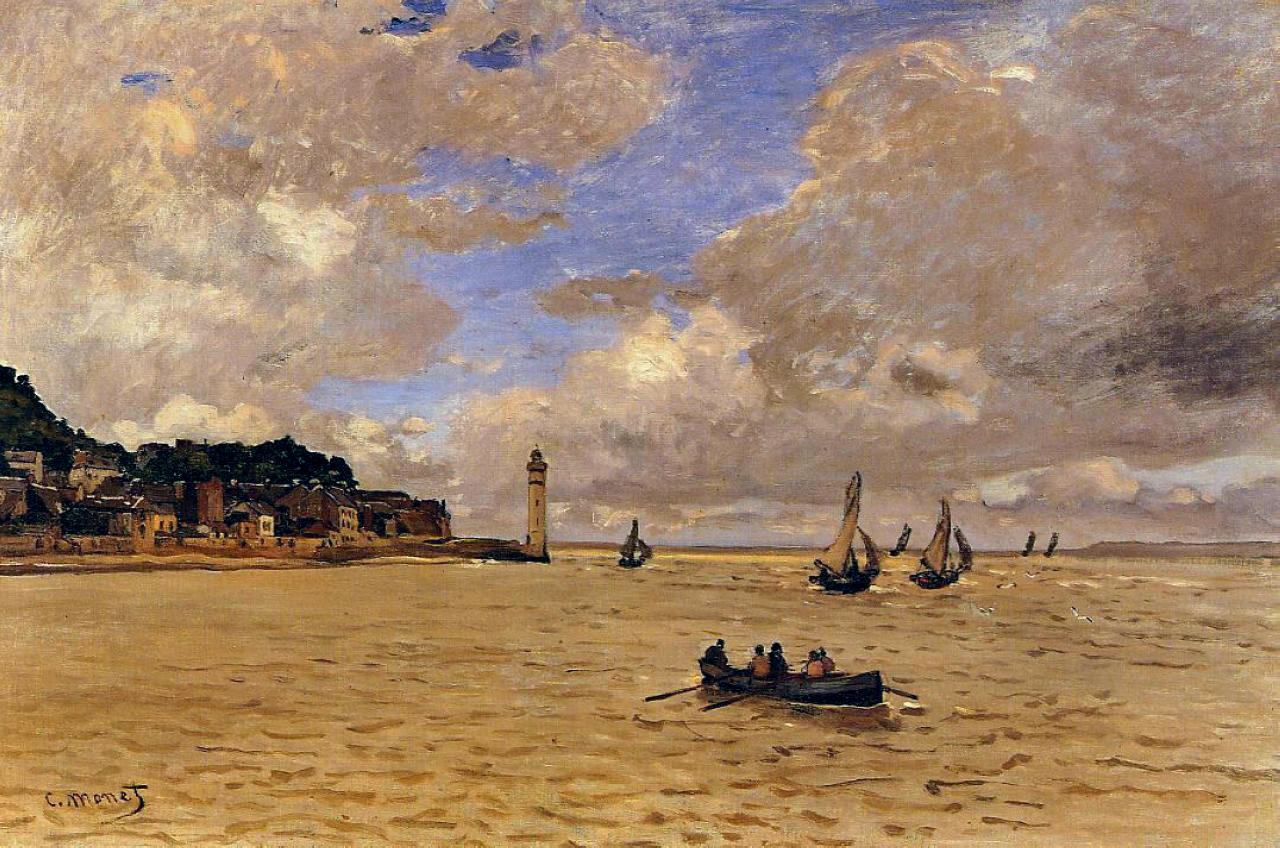
The painting shows a broad stretch of water under a dramatic sky, with a coastal settlement gathered at the left, a lighthouse standing near the middle distance, sailboats scattered across the surface, and a rowboat with figures occupying the foreground. The scene is simple in subject, but rich in mood. Monet turns an ordinary maritime view into a living experience of atmosphere. He is not merely recording a place. He is translating the sensation of standing before open water, watching clouds move overhead, and seeing light spread across the sea in fleeting, subtle variations.
What makes this work so compelling is the balance it strikes between structure and transience. The lighthouse, houses, and boats give the composition order and clarity. The sky, water, and reflections introduce change, motion, and unpredictability. That tension lies at the heart of Monet’s art. Even this early, he seems less interested in permanent description than in the encounter between the eye and a passing moment.
First Impression of the Scene
At first glance, Lighthouse at the Hospice feels spacious and airy. The sky dominates the composition, occupying much of the canvas and immediately setting the emotional tone. The clouds are large, varied, and softly broken, and between them opens a patch of blue that gives the view both depth and freshness. Below, the water spreads outward in a broad horizontal plane, carrying the colors of the sky in muted golds, silvers, browns, and pale violets.
The shoreline at the left introduces a sense of habitation. A cluster of low buildings rises gently against a dark band of trees, giving the painting a human scale. The lighthouse becomes a vertical landmark, a fixed point that anchors the eye amid the openness of sea and sky. To the right, sailboats move through the distance, their triangular forms punctuating the horizon. In the foreground, the small rowboat creates intimacy within the otherwise expansive setting.
This initial visual impression is one of calm movement. Nothing in the painting is frozen. The clouds appear to shift, the boats seem to glide, and the water gently ripples beneath changing light. Monet captures a world that feels active but not turbulent. There is energy here, but it is measured and natural, arising from the ordinary rhythms of the coast.
Composition and Spatial Design
The composition is carefully constructed, though it never feels rigid. Monet organizes the view through a strong horizontal structure, with sea and sky spreading across the width of the canvas. This wide arrangement emphasizes openness and distance, allowing the viewer to feel the breadth of the coastal landscape.
The left side of the painting is denser and darker. The buildings and trees create a compact mass that gives visual weight to that side of the composition. Without this cluster, the picture might feel too empty or diffuse. Monet uses it to establish balance, setting the inhabited shore against the open water and sky.
Near the center, the lighthouse acts as a pivot. Its upright form interrupts the horizontal expanse and becomes a focal point. Because it is slender and vertical, it does not dominate the scene aggressively. Instead, it stabilizes it. The eye moves naturally from the shoreline to the lighthouse, then outward across the water toward the sailboats and horizon.
The foreground boat is equally important. Positioned low and slightly right of center, it draws the viewer into the painting. It creates a sense of participation, as though we are not simply looking at a distant harbor but sharing the space of the water with its occupants. This device gives the picture depth. The foreground boat, middle distance lighthouse, and far sailboats form a layered sequence that leads the eye gradually through the scene.
Monet’s spatial design is subtle rather than theatrical. He does not rely on exaggerated perspective or dramatic framing. Instead, he builds depth through intervals, tonal contrasts, and the natural recession of forms into light and distance.
The Sky as the Emotional Center
In this painting, the sky is not background. It is the emotional center of the work. The clouds occupy much of the canvas and establish the mood before the viewer has fully absorbed the details below. Monet gives the sky a monumental presence, but he avoids heaviness. It feels full and active rather than oppressive.
The cloud formations are broad and varied, painted with soft edges and modulated tones. Creamy whites, warm grays, beige, and touches of violet mingle across the surface. Between them appears a field of blue, which opens the composition and gives relief from the thicker masses. This blue is especially important because it introduces coolness into a palette otherwise dominated by warm neutrals and muted browns.
The sky suggests a moment after rain or during unsettled weather, when clouds are breaking and light is beginning to spread. This transitional quality gives the painting much of its vitality. Monet is drawn not to static weather but to change, to the instant when one condition gives way to another. That attraction would remain central throughout his career.
By allowing the sky to dominate, Monet also shows how small human structures and activities are in relation to the wider natural world. The lighthouse, boats, and shoreline all exist beneath an atmosphere that is shifting, luminous, and vast. This relation between human presence and natural immensity gives the scene a poetic quality.
Water, Reflection, and Surface Movement
The water in Lighthouse at the Hospice is painted with extraordinary sensitivity. Rather than treating the sea as a flat zone, Monet renders it as a changing surface that records the light above. Its color is not simply blue or gray. Instead, it carries golden browns, pale ochres, soft mauves, and muted silver tones. These variations make the water feel alive.
The surface is marked by loose horizontal strokes that suggest ripples without overly defining them. Monet is not painting each wave in a descriptive manner. He is painting the visual effect of water seen from a distance under changing light. This approach gives the sea both immediacy and softness. We sense movement, but not through literal detail. We sense it through texture and tonal vibration.
The light across the water is especially striking. Much of the surface seems illuminated, as though sunlight is breaking through the clouds and touching the sea unevenly. This creates an effect of shimmer, though the painting remains restrained and atmospheric rather than dazzling. The luminosity is quiet. It spreads gently rather than flashing brightly.
This handling of water anticipates Monet’s later achievements. Again and again in his career, he would turn to surfaces that register light in unstable ways, rivers, ponds, harbors, and flooded landscapes. In this early coastal scene, one already sees his fascination with how water transforms vision by reflecting the sky, altering color, and dissolving clear boundaries.
The Lighthouse and the Built Shore
The lighthouse gives the painting its title, but Monet does not isolate it as a grand monument. Instead, he integrates it into the broader rhythm of the scene. It stands upright near the edge of the shore, modest in scale yet visually crucial. Its pale body rises against darker and lighter surroundings, making it legible from a distance without overwhelming the composition.
As a symbol, the lighthouse suggests guidance, vigilance, and connection between land and sea. In practical terms, it marks the coastal environment as a place of navigation and human labor. Yet in Monet’s treatment, it is not presented with heroic drama. It is part of daily life, quietly present within the larger atmosphere.
The buildings to the left reinforce this sense of lived reality. Their forms are simple and somewhat generalized, but they convey the character of a coastal settlement. Monet does not dwell on architectural detail. He is more interested in how the houses sit beneath the trees, how they catch light, and how their earthy colors contrast with the brighter tones of water and sky.
Together, the lighthouse and shore create a stable counterweight to the fluid sea and clouds. They embody permanence within a world of change. This contrast enriches the painting. The eye rests on these solid forms even as the surrounding atmosphere seems to shift.
Boats and Human Presence
The human presence in this painting is small in scale but essential in meaning. The rowboat in the foreground and the sailboats farther back introduce life, movement, and narrative possibility. They remind us that this is not an empty seascape but a working and inhabited environment.
The foreground boat is especially effective. Its dark shape stands out against the luminous water, and the tiny figures seated within it create a note of intimacy. We cannot identify them individually, and Monet does not ask us to. Their importance lies in their scale and placement. They serve as a bridge between the viewer and the wider space of the painting. Through them, we imagine the human experience of the water, the weight of the oars, the slow movement across the surface, the quiet exposure beneath the vast sky.
The sailboats in the middle and far distance extend this sense of human activity. Their sails catch the light and wind, adding vertical accents that echo the lighthouse. They also help animate the horizon, preventing it from becoming merely a dividing line between sea and sky. Each boat contributes to the rhythm of the composition.
Monet often used such figures and vessels not as subjects in themselves but as measures of atmosphere and scale. Here, they deepen the scene’s realism while preserving its spacious, contemplative mood.
Color Harmony and the Subtle Use of Light
One of the most beautiful aspects of Lighthouse at the Hospice is its restrained color harmony. Monet does not rely on intense saturation. Instead, he creates richness through nuanced relationships among warm and cool tones. Golds, browns, creams, grays, and muted violets dominate the painting, while soft blue in the sky introduces contrast and freshness.
This palette gives the scene a distinctive mood. It is neither brilliantly sunny nor darkly stormy. It occupies an in between condition, where light is filtered through cloud and reflected off water in softened ways. That ambiguity is central to the painting’s appeal. The colors feel observed rather than invented. They suggest a particular hour and weather condition without forcing the scene into a single emotional key.
The light in the painting is dispersed rather than concentrated. There is no single dramatic beam or sharp highlight. Instead, illumination is spread across the sky and sea, touching forms unevenly. This diffused quality is important because it allows Monet to focus on atmosphere as a whole rather than on isolated effects.
The painting’s quiet brilliance lies in its ability to make subtle light feel significant. Monet shows that nature does not need to be spectacular in order to be visually profound. A cloudy day on the coast, rendered with sensitivity, becomes enough.
Brushwork and the Early Monet Style
Although this work predates the full flowering of Impressionism, Monet’s brushwork already reveals his modern instincts. The paint handling is loose enough to preserve freshness, yet controlled enough to maintain coherence. He is not smoothing everything into academic finish, nor is he breaking the image apart entirely. He stands between convention and experiment.
In the sky, the strokes are layered and softly blended, allowing cloud masses to form without becoming overly hard or literal. In the water, shorter horizontal marks create the sense of rippling surface. On the boats and shoreline, darker and more compact touches give definition where needed. Throughout the canvas, brushwork is used to convey visual sensation rather than polished illusion.
This is one reason the painting feels alive. It has not been overworked into stillness. The marks retain the energy of perception. They suggest a painter responding directly to what he sees, adjusting his touch according to the demands of cloud, water, architecture, and distance.
The young Monet was still absorbing influences from landscape tradition and contemporary painting, but he was also moving decisively toward a freer, more immediate language. In this picture, one senses an artist discovering that paint itself can communicate atmosphere.
Place, Memory, and Coastal Identity
A coastal scene like this carries more than visual interest. It also evokes a specific regional identity. Normandy and its surrounding shores were central to Monet’s artistic development. These harbors, beaches, skies, and tidal waters gave him a setting in which weather changed quickly and light never remained fixed for long. Such locations were ideal for a painter interested in fleeting appearances.
In Lighthouse at the Hospice, the place feels both specific and universal. The lighthouse and shoreline anchor the view in a real coastal environment, but the broader mood speaks to something more general: the relationship between people and the sea, the rhythm of maritime life, and the experience of open air under changing skies.
There is also a sense of memory in the work. The painting does not feel like a dry topographical record. It feels like a distilled visual impression, something retained after looking, walking, and returning to the motif. Whether painted directly on site or developed through studio refinement, it carries the freshness of observation combined with the selectivity of memory. That combination gives it poetry.
Its Place in Monet’s Development
This painting is especially interesting because it shows Monet on the threshold of major transformation. In 1864, he was still young, still searching, still building the artistic vocabulary that would later redefine modern landscape painting. Yet many of the essential components are already here: the primacy of atmosphere, the instability of light, the interest in water as a reflective surface, the use of ordinary modern life as worthy subject matter, and the desire to paint not just objects but conditions of seeing.
Later Monet would push these concerns much further. His colors would grow brighter, his touch more broken, and his commitment to serial observation more radical. But early works like Lighthouse at the Hospice remain valuable because they reveal the roots of those later achievements. They show that his mature vision did not appear suddenly. It was built through careful looking, repeated engagement with landscape, and a willingness to trust sensation over convention.
This painting also demonstrates that even before the famous exhibitions associated with Impressionism, Monet had already begun to challenge established expectations. He was making atmosphere central. He was allowing weather to shape composition. He was treating a harbor not as a setting for historical drama but as a complete subject in itself.
Why the Painting Still Matters
Lighthouse at the Hospice continues to matter because it captures something enduring about Monet’s art and about landscape painting more broadly. It reminds viewers that visual depth can emerge from subtlety, that ordinary places can become profound through attentive observation, and that atmosphere is not an accessory to subject but part of subject itself.
The painting also offers a more intimate view of Monet than his most famous late works. It reveals the artist before canonization, before the iconic water lilies, before the public image of the master Impressionist fully formed. In that sense, it feels personal and exploratory. It allows us to witness the early confidence of a painter who already understood that nature’s passing effects were worth sustained artistic attention.
Its beauty lies in restraint. Nothing is overstated. The lighthouse is modest, the boats are small, the palette is muted, and the weather is transitional rather than extreme. Yet precisely because of this restraint, the painting feels truthful. It honors the complexity of a real moment on the coast, where light, cloud, water, and human activity coexist without theatrical exaggeration.
Conclusion
Claude Monet’s Lighthouse at the Hospice is an early masterpiece of atmosphere, balance, and visual sensitivity. It transforms a harbor scene into an experience of changing weather and luminous space. Through its spacious composition, nuanced color, responsive brushwork, and quiet human presence, the painting shows Monet already moving toward the artistic concerns that would define his career.
The sky breathes across the canvas, the water records the shifting light, and the lighthouse stands as a calm point of orientation within an ever changing environment. The boats and shoreline keep the scene grounded in everyday coastal life, while the handling of paint gives everything freshness and immediacy. What emerges is a work that feels both observational and poetic, rooted in a specific place yet expansive in emotional reach.
This painting is important not because it announces Impressionism in a loud or obvious way, but because it reveals the subtle beginnings of Monet’s great lifelong project. He is learning to paint the world not as a fixed arrangement of objects, but as a field of light, air, time, and sensation. That vision would later transform modern art. In Lighthouse at the Hospice, it is already quietly, beautifully present.
