Image source: wikiart.org
Introduction
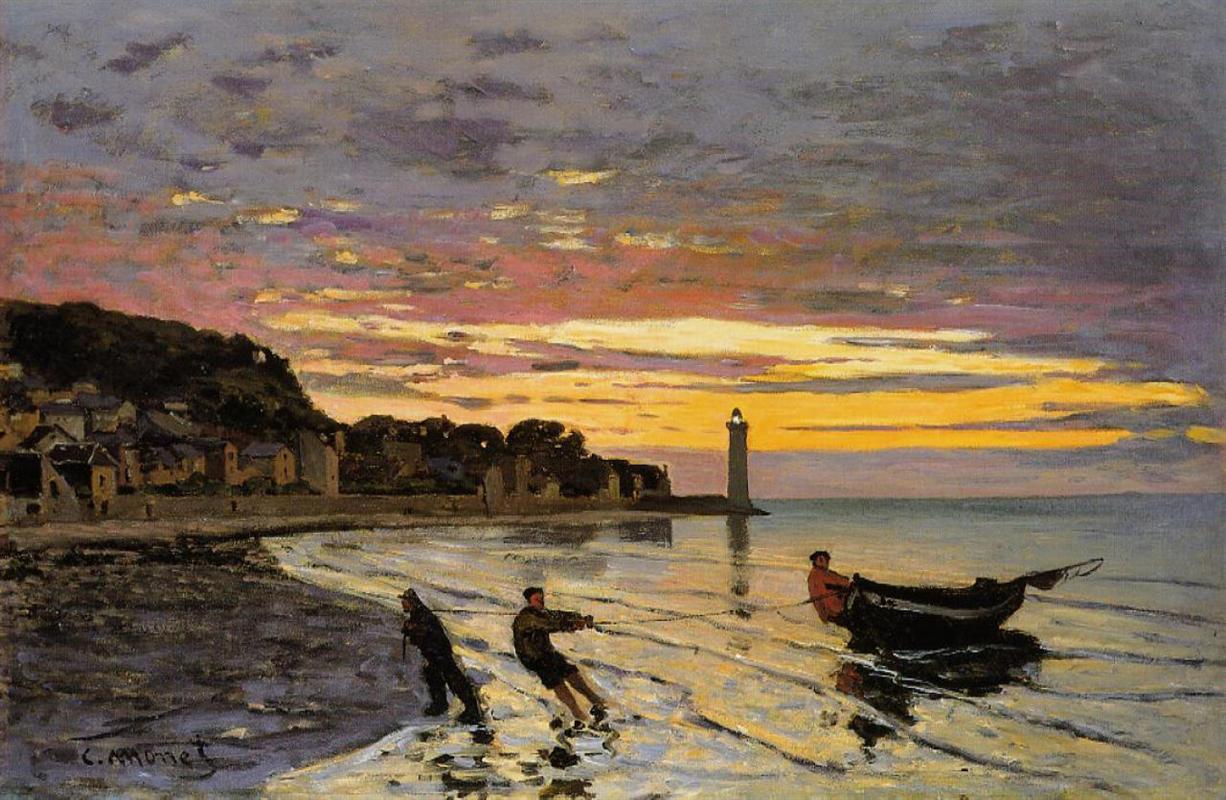
Claude Monet’s Hauling a Boat Ashore, Honfleur from 1864 is a remarkable early work that reveals how deeply the young painter was already engaged with light, atmosphere, and the poetry of ordinary coastal life. Although it predates the fully developed Impressionist style that would later make Monet one of the most celebrated artists in modern painting, this scene contains many of the qualities that would define his mature work. The painting is rooted in observation, but it also transforms a practical moment of labor into something lyrical, reflective, and visually radiant.
At first glance, the subject seems simple. A small group of figures works together to pull a boat toward the shore. The setting is Honfleur, a harbor town on the Normandy coast that played an important role in Monet’s artistic development. The action is modest and everyday. Yet Monet does not treat it as a straightforward document of work at sea. Instead, he turns the scene into a study of evening light, wet sand, clouded sky, and quiet human effort. The result is a painting that feels both immediate and contemplative.
What makes this work so compelling is the balance it achieves between realism and atmosphere. The boat, the workers, the distant lighthouse, and the shoreline are all clearly present, but none of them exists in isolation. Every element is bound together by the changing light of sunset and by the reflective surface of the water. Monet is not simply showing what Honfleur looked like. He is exploring how a moment in Honfleur felt, how color and labor and weather and place merge into a single visual experience.
Monet’s Early Career and the Importance of Honfleur
In 1864, Monet was still in the early phase of his career, developing the visual language that would later change the course of painting. He had not yet reached the full flowering of Impressionism, but he was already moving away from academic finish and grand historical themes. He was increasingly interested in painting modern life and in studying nature directly. This painting belongs to that critical period when Monet was absorbing influences, refining his eye, and discovering that landscape and everyday scenes could carry profound artistic power.
Honfleur was especially meaningful in this development. Located in Normandy, it offered artists a rich variety of visual motifs, including harbor views, fishing boats, changing weather, and soft coastal light. The town and its surroundings had already attracted painters, and Monet found in the region a setting that encouraged direct observation. In a coastal environment like this, nothing remains visually static for long. The sea shifts, the sky transforms by the minute, and reflections constantly alter the appearance of the shore. These conditions were ideal for an artist increasingly fascinated by the instability of visual perception.
In Hauling a Boat Ashore, Honfleur, Monet uses this location not merely as a backdrop but as an active presence. Honfleur becomes more than a named place. It becomes a meeting point between nature and human life. The village tucked into the darker mass of land at the left, the lighthouse standing against the glowing horizon, and the gently curving bay all help create a sense of place that feels both specific and atmospheric. Monet is painting a coastal town, but he is also painting the mood that descends upon it at day’s end.
The Composition and the Pull of the Shoreline
The composition of this painting is subtle and carefully organized. Monet leads the viewer’s eye through the scene with the curve of the beach and the placement of the figures. The shoreline begins at the left, where the clustered houses and dark landmass anchor the image, and then arcs gently toward the center and right, where the boat sits in the shallow water. This sweeping curve creates a natural movement across the painting and gives the scene its quiet sense of momentum.
The human action is central, but Monet does not isolate it in a theatrical way. The figures are woven into the landscape, almost absorbed by it. Two figures in the foreground lean backward as they pull on a rope, their bodies angled in a way that conveys effort and coordination. Another figure remains in the boat, helping guide it toward land. Their placement creates a diagonal tension that gives the scene structure. The rope, though not heavily emphasized, becomes an invisible line of force connecting labor, vessel, and shore.
The lighthouse in the middle distance provides a vertical counterpoint to the horizontal calm of sea and beach. It stands near the center of the image but slightly off to one side, helping to stabilize the composition while also deepening the spatial field. This contrast between the upright form of the lighthouse and the long lateral stretch of the horizon makes the painting feel carefully balanced. Nothing appears rigidly symmetrical, yet everything seems to belong exactly where it is.
Monet’s sense of space here is especially effective because it relies less on sharply defined contours than on tonal relationships. The darker forms of land and buildings recede into shadow, while the pale glow of sky and water opens out toward the distance. The viewer experiences space not through linear precision alone but through gradations of light and color.
Light as the True Subject
Although the painting depicts a boat being hauled ashore, light is arguably the true subject. The event taking place on the beach is important, but Monet’s deepest interest lies in the luminous conditions surrounding it. The sky, water, and wet sand are all transformed by the warm afterglow of sunset, and this glow becomes the emotional center of the work.
The horizon burns with pale gold and yellow, gradually shifting into pink, mauve, violet, and cool gray higher in the sky. These transitions are handled with great sensitivity. Monet does not treat the sunset as a dramatic spectacle in the conventional sense. There is no exaggerated blaze, no excessive theatricality. Instead, the light is diffused through layers of cloud, creating a softened brilliance that spreads across the scene and reflects back from the shallow water.
This reflection is one of the painting’s most beautiful features. The wet shore catches the sky’s radiance and turns the ground itself into a shimmering field of color. The figures and boat stand upon a surface that seems alive with changing tones. Rather than separating land and water in a rigid manner, Monet lets them flow visually into one another. The result is a landscape in which boundaries seem softened by light.
This interest in fleeting effects of illumination points clearly toward Monet’s later achievements. Even at this early stage, he is less concerned with fixed local color than with appearance under particular conditions. The boat is dark because it is silhouetted against brightness. The sand glows because it mirrors the sky. The village recedes into shadow because evening has already begun to dim its forms. Everything is relative to light.
Color and Atmosphere
The color structure of Hauling a Boat Ashore, Honfleur is one of its greatest strengths. Monet builds the painting around a delicate opposition between warmth and coolness. The horizon carries yellow and orange tones, the clouds hold pink and lavender accents, and the upper sky descends into gray blue and muted purple. These colors are not merely decorative. They create the atmosphere of a specific hour, that suspended moment when day has not quite vanished but night is beginning to gather.
The darker passages on the left side of the painting are especially important. The hillside and houses are rendered in earthy browns, blacks, and deep greens, forming a heavy visual mass that contrasts with the openness of the sky and sea. This dark zone gives the painting emotional depth. Without it, the scene might feel too airy or sentimental. Instead, Monet uses shadow to intensify the brilliance of the sunset.
The figures are touched with small notes of reddish and warm brown color that help them stand out against the reflective shore. These accents are economical but effective. They keep the workers from dissolving entirely into the surroundings while also linking them chromatically to the warm tones of the sky. Even the black shape of the boat participates in the color design, acting as a strong dark silhouette against the luminous water.
Atmosphere here is created through color relationships rather than through detailed description. The clouds are broken into patches and streaks, and the surface of the painting suggests movement and change. The viewer senses humid air, cool evening breeze, and the fading warmth of the sun. Monet is not only painting what is visible but also what is perceptible through mood and sensation.
Human Labor in a Quiet Key
One of the most striking aspects of this work is the way Monet handles human labor. The activity depicted is real and physical. Pulling a boat ashore requires effort, coordination, and practical skill. Yet Monet does not dramatize the work in a heroic or sentimental fashion. The figures are small and relatively anonymous. Their gestures are readable, but their individuality is not the point. What matters is their integration into the coastal rhythm of daily life.
This restraint gives the painting dignity. The workers are not turned into symbols of struggle or spectacle. They are simply part of the life of Honfleur, part of a world in which sea, shore, and labor are interdependent. Monet observes them with sympathy, but also with distance. He allows the action to remain ordinary, and in doing so, he reveals its quiet beauty.
There is a kind of harmony between human effort and natural setting in this painting. The figures pull against the rope, but the scene as a whole does not feel tense or violent. The sea is calm, the light is gentle, and the boat moves gradually toward safety. Labor here is not presented as conflict with nature. It is shown as participation in a coastal environment governed by time, tide, and weather.
This understated treatment is important because it shows Monet’s sensitivity to the poetry of common experience. He did not need a grand historical event or a mythological subject to create significance. A few workers, a small boat, and an evening shoreline were enough, provided they were seen with intelligence and feeling.
The Lighthouse and the Sense of Distance
The lighthouse is one of the most memorable elements in the painting. Rising near the center of the horizon, it acts as a visual marker that stabilizes the scene and adds symbolic resonance without becoming overly explicit. On a practical level, it helps define the harbor setting and suggests navigation, safety, and coastal life. On a compositional level, it punctuates the broad horizontal spread of the painting with a firm vertical line.
Its reflection in the water is especially important. This mirrored streak helps connect the middle distance to the foreground and echoes the larger theme of surfaces transformed by light. The lighthouse is not merely an isolated structure. It participates in the optical play that animates the whole image.
The presence of the lighthouse also extends the emotional reach of the work. It draws the eye out beyond the immediate action of hauling the boat and toward the open expanse of sea and sky. This gives the painting a contemplative quality. The viewer is invited not only to witness a small human task but also to feel the vastness surrounding it. There is a sense that the workers and the boat belong to a larger world of tides, routes, weather, and evening light.
Monet often found ways to combine intimacy and openness, and this painting is an early example of that ability. The figures are close enough to be legible, but the horizon remains spacious. The shoreline curves inward, yet the sea stretches away. The result is a scene that feels both grounded and expansive.
Brushwork and the Movement Toward Impressionism
Because this painting comes from 1864, it is fascinating to look at it in relation to the later Monet that most viewers know. The brushwork is more controlled than in many of his mature Impressionist canvases, yet it is already lively and responsive. He is not building form through smooth academic modeling. Instead, he uses visible strokes and broken passages of paint to suggest clouds, reflections, and shifting textures.
In the sky, the brushwork creates a layered, flickering effect. The clouds are not outlined in a conventional manner. They are built from patches and touches of color that give them movement and instability. The water and wet shore are treated similarly, with strokes that capture the trembling appearance of reflected light. This broken handling allows Monet to record visual sensation more directly than polished finish would have permitted.
At the same time, the painting still retains a degree of structural clarity that reflects his early formation. The forms do not dissolve entirely. The boat, figures, buildings, and lighthouse remain legible and anchored. This combination of solidity and looseness is part of what makes the work so interesting. It shows an artist in transition, someone still connected to earlier landscape traditions but already discovering a more modern approach to seeing.
This transitional quality is one reason the painting feels so alive. It contains the discipline of observation and the freedom of painterly exploration. Monet has not abandoned form, but he has begun to subordinate it to atmosphere. He is learning that the truth of a scene lies not only in its objects, but in the light that transforms them.
Mood and Emotional Resonance
The emotional tone of Hauling a Boat Ashore, Honfleur is quiet, reflective, and slightly melancholic. It is not a sad painting, but it carries the introspective quality often associated with evening. The sun is low, the day’s work is winding down, and the world seems momentarily hushed. Even the act of hauling the boat has a measured rather than urgent rhythm.
The mood emerges largely from Monet’s handling of time. Sunset is a threshold, a moment of transition between activity and rest, visibility and darkness, day and night. By choosing this hour, Monet gives the painting a contemplative atmosphere. The labor taking place on the shore becomes part of a larger meditation on endings, returns, and the closing of the day.
There is also a strong sense of calm. The sea is gentle, the shoreline is stable, and the sky, though filled with cloud, glows softly rather than threateningly. The figures work within a world that feels secure and cohesive. The lighthouse reinforces this feeling, standing as a fixed point amid shifting light.
Yet the painting avoids becoming merely tranquil. The contrast between dark foreground forms and luminous horizon gives it emotional complexity. The encroaching shadows suggest the passage of time and the inevitable fading of the visible world. This tension between radiance and dimming light gives the scene its depth. It is beautiful because it is fleeting.
Nature, Work, and the Poetry of the Everyday
A major achievement of this painting is the way it unites natural beauty with ordinary labor. In many traditions of painting, scenes of work and scenes of beauty were kept separate, as though daily effort belonged to one realm and aesthetic pleasure to another. Monet dissolves that separation. The workers on the shore are not intrusions into a landscape. They are part of its meaning.
This union reflects a modern sensibility. Monet is not idealizing rural or coastal life in a sentimental way, nor is he turning labor into social commentary. Instead, he finds visual poetry in the simple fact that human beings move through light, weather, and place. The boat is both a tool and a form. The shore is both a workplace and a reflective surface. The sunset is both a natural phenomenon and an emotional atmosphere.
This sensitivity to the everyday would become central to modern art. Artists increasingly turned toward scenes that earlier generations might have considered too ordinary for serious painting. What mattered was not the grandeur of the subject but the intensity of perception brought to it. In this sense, Hauling a Boat Ashore, Honfleur stands at an important threshold. It suggests that ordinary life, seen clearly and painted truthfully, can carry lasting beauty.
Why This Painting Still Matters
This work remains important because it shows Monet before the full fame of Impressionism, already thinking in a fresh and deeply visual way. It allows viewers to see how his later achievements emerged from careful looking, from sustained engagement with landscape, and from a willingness to treat fleeting conditions as worthy of serious art.
The painting also endures because of its humanity. Nothing in it feels forced. The workers are believable, the setting is tangible, and the light feels observed rather than invented. Monet does not need spectacle to hold attention. He trusts that a harbor at sunset, a boat near shore, and a few figures at work can sustain profound visual interest. He is right.
For modern viewers, the painting offers both historical insight and immediate pleasure. It helps illuminate the development of Monet’s art, but it also stands on its own as a moving and beautiful image. Its appeal lies in the harmony it creates between observation and atmosphere, structure and softness, labor and serenity.
Conclusion
Hauling a Boat Ashore, Honfleur is an early Monet painting of remarkable sensitivity and depth. It captures a modest coastal task, yet transforms it into a meditation on light, labor, and evening calm. Through its curved shoreline, glowing horizon, reflective wet sand, and carefully placed figures, the painting achieves a sense of unity that feels both natural and artfully composed.
What is most striking is how fully Monet understands that the visible world is never static. The sea changes with the sky, the shore changes with the tide, and color changes with the hour. In this painting, he records not just a place and an action, but a fleeting state of being. Honfleur becomes a world of reflection, atmosphere, and quiet human presence.
Even in 1864, Monet was already discovering that painting could do more than describe objects. It could capture the meeting point of sensation and time. That is what gives this scene its lasting power. The boat may be nearing shore, the day may be fading, but the painting continues to hold that luminous moment in suspension, inviting viewers to linger within it.