Image source: wikiart.org
Introduction
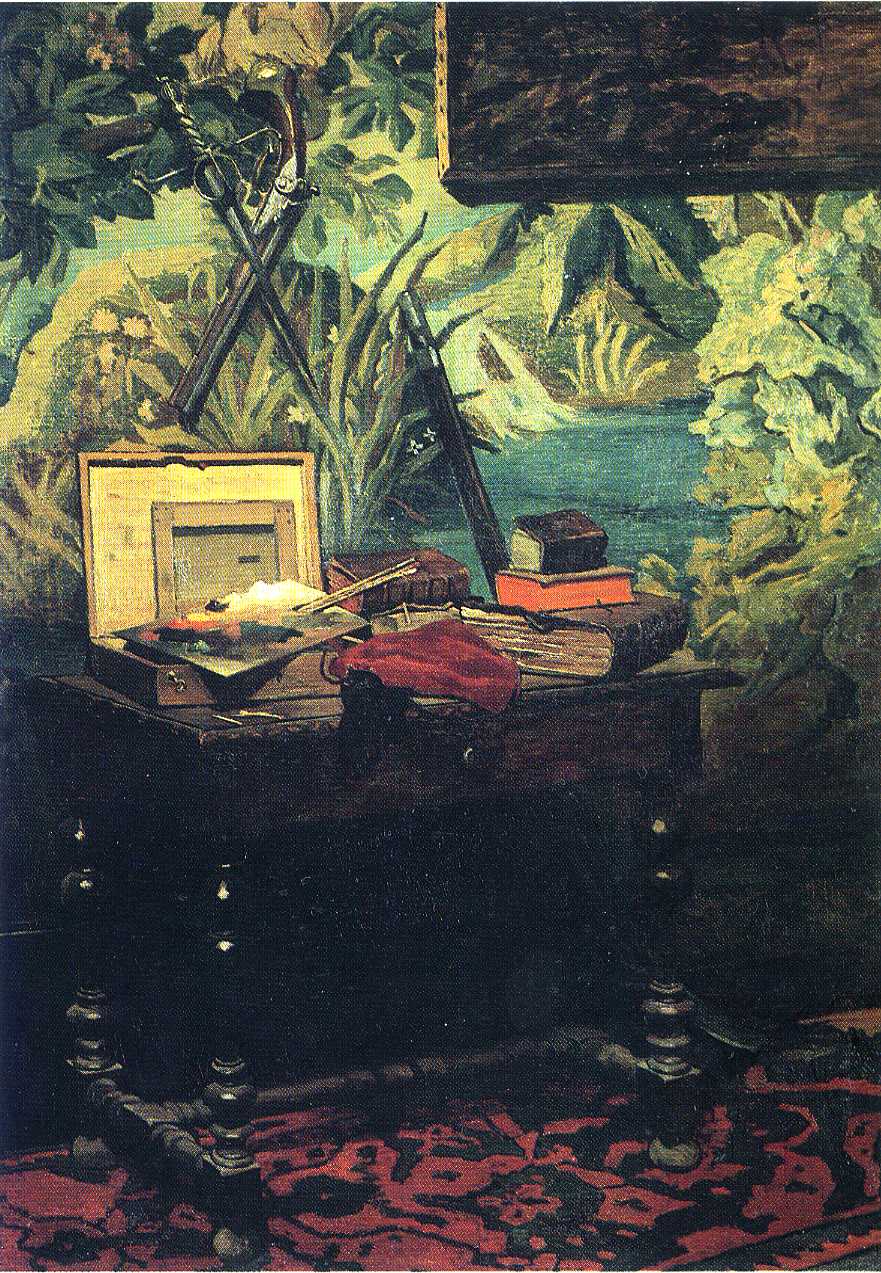
Claude Monet’s A Corner of the Studio from 1861 is a fascinating early work because it reveals a side of the artist that many viewers do not immediately associate with his name. Monet is most often remembered as the painter of shimmering rivers, poppy fields, haystacks, cathedrals, and gardens filled with changing light. In this painting, however, he turns inward. Instead of showing an open landscape or a fleeting outdoor effect, he presents an interior filled with objects, textures, and quiet concentration. The result is a picture that feels intimate, almost private, as though the viewer has stepped into a secluded working space and paused before a table where the life of the artist has briefly come to rest.
The painting does not rely on dramatic action or a human figure to hold attention. Its interest comes from arrangement, atmosphere, and the suggestive power of ordinary things. Books, papers, framed material, fabrics, plants, and furniture all combine to create a scene that is both descriptive and mysterious. This is not simply a record of studio possessions. It is a meditation on artistic life, on looking, and on the material world that surrounds the painter. Even in this relatively early stage of his career, Monet shows a striking sensitivity to how objects exist in space and how color can unify a scene that might otherwise feel visually crowded.
What makes A Corner of the Studio so compelling is the tension it holds between order and abundance. The studio corner appears inhabited and active, yet no one is present. The tabletop is full, but not chaotic. The room feels enclosed, but it is animated by foliage and subtle light. Monet invites the viewer to study a corner of creative life and, in doing so, transforms an ordinary arrangement into something reflective and poetic. The painting offers an early glimpse of his interest in perception itself, even before the mature Impressionist style for which he would later become known.
The Historical Moment of the Painting
Painted in 1861, A Corner of the Studio belongs to a formative period in Monet’s development. He was still a young artist, learning how to position himself within the artistic culture of nineteenth century France. This was a time when academic expectations remained strong, and many artists still pursued carefully finished compositions, historical subjects, or conventional studio exercises. At the same time, new attitudes toward nature, modern life, and direct observation were beginning to shift the direction of French painting.
Monet had not yet become the fully developed painter of serial light effects that later transformed modern art. In this early work, one can see him navigating questions that mattered deeply to his generation. How should an artist represent reality? What kinds of subjects deserved sustained attention? Could a painting of everyday surroundings carry emotional or intellectual weight without relying on grand narrative? These questions hover behind A Corner of the Studio, giving it importance beyond its modest subject.
The painting also belongs to a broader tradition of studio imagery. Artists had long depicted their own working spaces, whether to signal profession, intellect, taste, or the act of creation itself. Yet Monet’s handling of this theme feels less theatrical than many earlier examples. There is no obvious self promotion here, no elaborate display of artistic heroism. Instead, the room is observed with seriousness and sensitivity. The studio becomes not a stage set but a lived environment, a place where art, reading, collecting, arranging, and seeing all overlap.
Because this painting comes so early in Monet’s career, it is valuable as evidence of his range. It reminds us that the future leader of Impressionism did not emerge fully formed. He experimented. He looked closely at objects and interiors as well as landscapes. He tested moods, tones, and compositional problems. In that sense, A Corner of the Studio is a document of artistic becoming.
A Studio Corner as a Subject
The choice to paint only a corner of the studio is especially meaningful. Monet does not offer a full room, a panoramic view, or an explanation of the space. Instead, he isolates one section, inviting concentrated attention. This partial view creates intimacy. It feels discovered rather than displayed. The viewer encounters the studio not as a public room but as a private fragment.
That fragment is rich with clues. The table and surrounding objects suggest work, study, and collection. The framed piece leaning against the furniture introduces an image within the image, while the books and papers point toward thought and preparation. The plants and foliage soften the interior and complicate the space, making it feel organic rather than rigid. The whole scene suggests a life shaped by visual curiosity.
A corner is an interesting place in any room. It is where things accumulate, where function meets pause, where objects are stored, used, forgotten, or rediscovered. By choosing such a spot, Monet embraces a subject that resists conventional beauty. This is not a polished salon interior. It is a lived space, imperfect and layered. Yet through painting, the corner becomes visually arresting.
The subject also reflects the importance of attention itself. Great painters often reveal that nothing is too humble to deserve looking. A table edge, a folded cloth, a stack of books, or a shadow beneath furniture can become worthy of contemplation when seen through a painter’s eye. Monet’s later landscapes would prove this on a monumental scale. Here, in a smaller and quieter register, he demonstrates the same principle. The ordinary becomes significant through sustained observation.
Composition and Structure
The composition of A Corner of the Studio is dense yet carefully controlled. Monet organizes the space around the sturdy dark table that occupies the lower central part of the painting. This table acts almost like an anchor. Its heavy mass grounds the composition, while the turned legs create a sense of rhythm and vertical stability. On top of it sits a layered arrangement of objects that break the solidity of the furniture with lighter tones and varied shapes.
The eye moves first across the tabletop, where books, papers, fabric, and other items form a compact still life. From there, it rises into the tangle of foliage and hanging elements behind. The upper section of the painting is looser and more atmospheric, while the lower section is darker and weightier. This contrast between above and below gives the picture balance. The dark table and patterned carpet pull downward, while the leafy forms and pale background open the space upward.
Monet also uses overlapping forms to build depth. The framed object in front, the central plants, the hanging items, and the darker painting or panel in the upper right all create layers that make the corner feel inhabited by multiple planes of visual activity. Even though the setting is crowded, the composition does not collapse. Each mass supports the others. The verticals of table legs, the diagonal lines of propped objects, and the irregular shapes of leaves all contribute to a sense of structured complexity.
The cropping is important too. Objects are cut off at the edges, especially near the top and sides, which gives the impression that the scene continues beyond the frame. This makes the studio feel larger than the painting reveals. It also adds immediacy, as though Monet chose not to tidy or rearrange the space for the viewer’s convenience. The composition therefore feels observed rather than staged, a quality that adds to its realism and charm.
Objects and Their Quiet Symbolism
One of the pleasures of this painting lies in studying the individual objects and considering what they imply. The books immediately suggest intellectual life and artistic education. They point toward reading, collecting knowledge, and perhaps consulting texts or albums as part of studio practice. The framed item leaning against the table introduces another layer of artistic reflection. It may imply earlier work, a print, a study, or a visual reference. Whatever its exact identity, it reinforces the idea that this is a space of images.
The fabrics placed across the tabletop add softness and a sense of recent use. Cloth in still life painting often serves several purposes. It introduces rich texture, creates color contrast, and suggests touch. Here, the red or reddish fabric is especially important because it brings warmth into a painting dominated by greens, browns, and muted yellows. It feels like a small but deliberate accent, a pulse of color amid more subdued tones.
The plants are equally significant. Their presence prevents the studio from feeling purely scholarly or mechanical. They connect the interior to nature, something especially relevant for Monet, whose mature career would revolve around the observation of the natural world. Even in this interior, living foliage pushes into the scene. It is as though the outside world has already entered the studio and begun to transform it.
These objects together create a portrait without a person. We learn about the absent inhabitant through possessions, arrangements, and traces of activity. The painting becomes not only a depiction of things but an indirect study of temperament. The artist who occupies this space appears attentive, curious, visually sensitive, and surrounded by both culture and nature. That psychological dimension gives the painting a depth that exceeds its literal subject.
Color and Tonal Harmony
The color scheme of A Corner of the Studio is subdued, earthy, and atmospheric. Monet does not rely on bright, high key color in the way he would in many later paintings. Instead, he builds the scene through closely related tones of green, brown, ochre, muted blue, cream, and deep shadow. This restrained palette suits the interior subject and helps unify a composition that contains many different elements.
Green plays a major role. It appears in the foliage, in the wall or background area, and in various softened transitions throughout the image. Rather than making the scene feel fresh in a straightforward decorative way, these greens are often muted and mixed with other tones. They carry a slightly dim, indoor quality. This creates atmosphere and also binds the organic elements to the studio setting.
The browns and dark blacks of the furniture are essential for structure. They give the painting weight and seriousness. Without them, the scene might feel too airy or scattered. Monet uses dark values not just to define objects but to shape the mood. The lower half of the painting especially depends on deep tones that evoke shadow, stillness, and material solidity.
Against this tonal field, smaller accents become powerful. The reddish cloth near the center draws the eye because it interrupts the cooler and darker surrounding colors. The pale framed object and scattered papers serve a similar function. They lift parts of the composition and create moments of visual pause. Monet is already showing a sophisticated understanding of how limited palettes can be enriched by selective contrasts.
This harmony of muted tones contributes greatly to the painting’s emotional effect. The image feels reflective and enclosed, not festive or theatrical. Its colors encourage prolonged looking. Rather than offering instant brilliance, they reveal themselves gradually. That quality of slow visual unfolding is one of the painting’s greatest strengths.
Light, Shadow, and Atmosphere
Light in this painting is quiet and indirect. There is no single dramatic source that floods the room or casts sharp theatrical shadows. Instead, illumination seems dispersed across the scene, touching some objects more clearly than others and allowing darker regions to remain thick with ambiguity. This approach gives the interior a lived and believable atmosphere.
The tabletop catches enough light for the objects to become legible, yet much of the furniture below sinks into darkness. This creates a strong contrast between the accessible zone of work and the shadowed lower world beneath it. The effect is not merely descriptive. It shapes the emotional tone of the painting. The visible objects seem close to consciousness, while the darker recesses suggest depth, memory, or neglected space.
The foliage behind the table receives light in broken patches, which prevents the background from flattening into a simple wall. Instead, it becomes a textured field of half seen forms. This handling of light through leaves anticipates Monet’s later sensitivity to dappled, unstable illumination in outdoor scenes. Even here, inside the studio, he is interested in how light shifts across irregular surfaces.
Shadow is equally important. Monet does not treat it as empty absence. The dark regions are full of color and atmosphere. They hold the composition together and contribute to the sense of quiet occupation. In later Impressionist work, Monet would often use vibrant color to suggest shadow outdoors. In this early interior, the shadows are heavier and denser, yet they already feel observed rather than formulaic.
Atmosphere is the result of this interplay between softened light and enveloping shadow. The painting seems hushed. Nothing moves, but the room is not dead. It has presence. The objects appear suspended in a moment of still attention, as though the artist has just stepped away and might return at any time.
Texture and the Pleasure of Looking
A major appeal of A Corner of the Studio lies in its textures. Monet pays careful attention to the difference between polished wood, soft cloth, paper, plant leaves, carpet, and painted surfaces. These distinctions are not merely technical displays. They enrich the viewer’s sensory experience and make the scene feel physically immediate.
The wooden table appears heavy and tactile, with turned legs that catch light in small highlights. The cloth laid across the tabletop seems softer and more absorbent, a contrast that makes both materials more convincing. The books suggest compact density, while the papers and framed piece introduce flatter, more delicate surfaces. The carpet at the bottom adds another visual register through its pattern and color, anchoring the whole composition in domestic richness.
The foliage is handled differently from the more solid objects. Leaves are suggested through looser, more varied brushwork, which gives them life and visual movement. This contrast between firm and fluid textures keeps the painting active. Monet does not paint everything with the same touch. He adjusts his handling according to the character of each material, allowing texture to become a language of differentiation.
These tactile variations encourage slow looking. The eye lingers on one object, then another, appreciating not just what is depicted but how it has been painted. The pleasure of the work is therefore both representational and painterly. One enjoys the studio corner as a scene and as an orchestration of surfaces transformed by the artist’s hand.
The Mood of Absence and Presence
Although the painting contains no figure, it feels deeply human. That is one of its most interesting qualities. The room is filled with evidence of occupation, yet the occupant is absent. This creates a subtle emotional tension. The objects suggest recent activity, but the silence of the image turns them into traces.
This kind of absence can make an interior painting feel contemplative. The viewer begins to imagine the person who arranged or used these things. The studio becomes an extension of character. Its fullness suggests a mind at work, a person who reads, collects, studies, and observes. Yet because the painter withholds any direct portrait, the space remains open to interpretation.
At the same time, the painting is not melancholy in any dramatic sense. Its stillness is calm rather than sorrowful. The absence of a figure allows the objects themselves to become the protagonists. Their arrangement carries the emotional weight. The painting feels like a pause, a moment between actions, rather than a scene of loss.
This balance of presence and absence is one reason the work feels intimate. Viewers are not confronted by a posed subject or guided by narrative. Instead, they enter a quiet environment and build meaning through careful observation. That active participation makes the painting especially rewarding.
Early Signs of Monet’s Artistic Vision
Even though this painting differs from the sunlit landscapes most people associate with Claude Monet, it contains early signs of the vision that would later define his work. One of those signs is his sensitivity to atmosphere. He is not simply cataloging objects. He is creating an environment in which light, color, and space interact.
Another sign is his interest in perception over strict description. The painting is detailed enough to establish the setting, yet it does not feel rigid or overworked. Some forms remain suggestive, especially in the foliage and darker areas. Monet seems more concerned with the total visual experience than with precise outline. This approach would become central to his mature art.
There is also an emerging modernity in his subject choice. By devoting serious attention to an ordinary studio corner, Monet elevates everyday experience. He shows that painting need not depend on grand historical subjects to achieve richness. The ordinary world, if truly seen, contains endless artistic potential. That conviction would later support the Impressionist project of painting modern life and transient sensation.
The fusion of interior and nature is another intriguing feature. The plants and leafy backdrop feel almost as important as the books and furniture. This suggests an artist already attuned to the visual vitality of the natural world, even when working inside. In later decades, nature would become Monet’s central arena. Here, one can sense that attraction already taking hold.
Why This Painting Matters
A Corner of the Studio matters because it complicates and deepens our understanding of Monet. It shows him before the full emergence of Impressionism, working through problems of interior space, object arrangement, tonal control, and atmosphere. Rather than being a mere curiosity, the painting reveals how broad his interests were and how carefully he observed the environments around him.
It also matters as a studio image that avoids clichés. Instead of presenting the artist as a romantic hero, it presents artistic life through material surroundings. This makes the painting feel honest and grounded. The room is not idealized beyond recognition. It is full, slightly obscure, and convincingly lived in.
For modern viewers, the work offers another pleasure as well. It reminds us that creativity often happens not in spectacular settings but in corners, in tables crowded with tools and references, in rooms where thought and looking accumulate over time. The painting honors that modest reality. It suggests that art grows from sustained attention to one’s immediate world.
Seen today, the work has a special charm because it captures the early formation of a major artist. It allows us to look at Monet not only as the master he became but as a young painter learning how to transform observation into meaning. That process is visible in every part of the composition, from the dark furniture to the leafy background.
Conclusion
Claude Monet’s A Corner of the Studio is a quiet but richly rewarding painting. It turns a small interior fragment into a serious visual experience, full of mood, texture, and thought. Through careful composition, restrained color, subtle light, and a sensitive handling of objects, Monet transforms an ordinary studio corner into a reflection on artistic life itself.
The painting stands out because it combines intimacy with complexity. It feels immediate and personal, yet it also raises broader questions about looking, creativity, and the value of everyday subjects. Its books, fabrics, plants, and furniture do more than fill a room. They create a portrait of an artistic environment, one shaped by study, observation, and the slow accumulation of visual experience.
As an early work, it is especially valuable. It shows Monet before his mature style fully arrived, yet already deeply engaged with problems that would remain central throughout his career. He is attentive to atmosphere, to tonal harmony, to the instability of light, and to the expressive possibilities of ordinary things. Those qualities would later blossom in his most celebrated paintings, but they are already present here in quiet form.
In the end, A Corner of the Studio proves that Monet’s greatness did not begin only in fields, rivers, and gardens. It was also present in interiors, in shadowed rooms, in tabletops filled with books and cloth, and in corners where the artist learned to see. This painting invites viewers into that early world and rewards them with a vision that is humble, thoughtful, and deeply alive.
