Image source: wikiart.org
Introduction
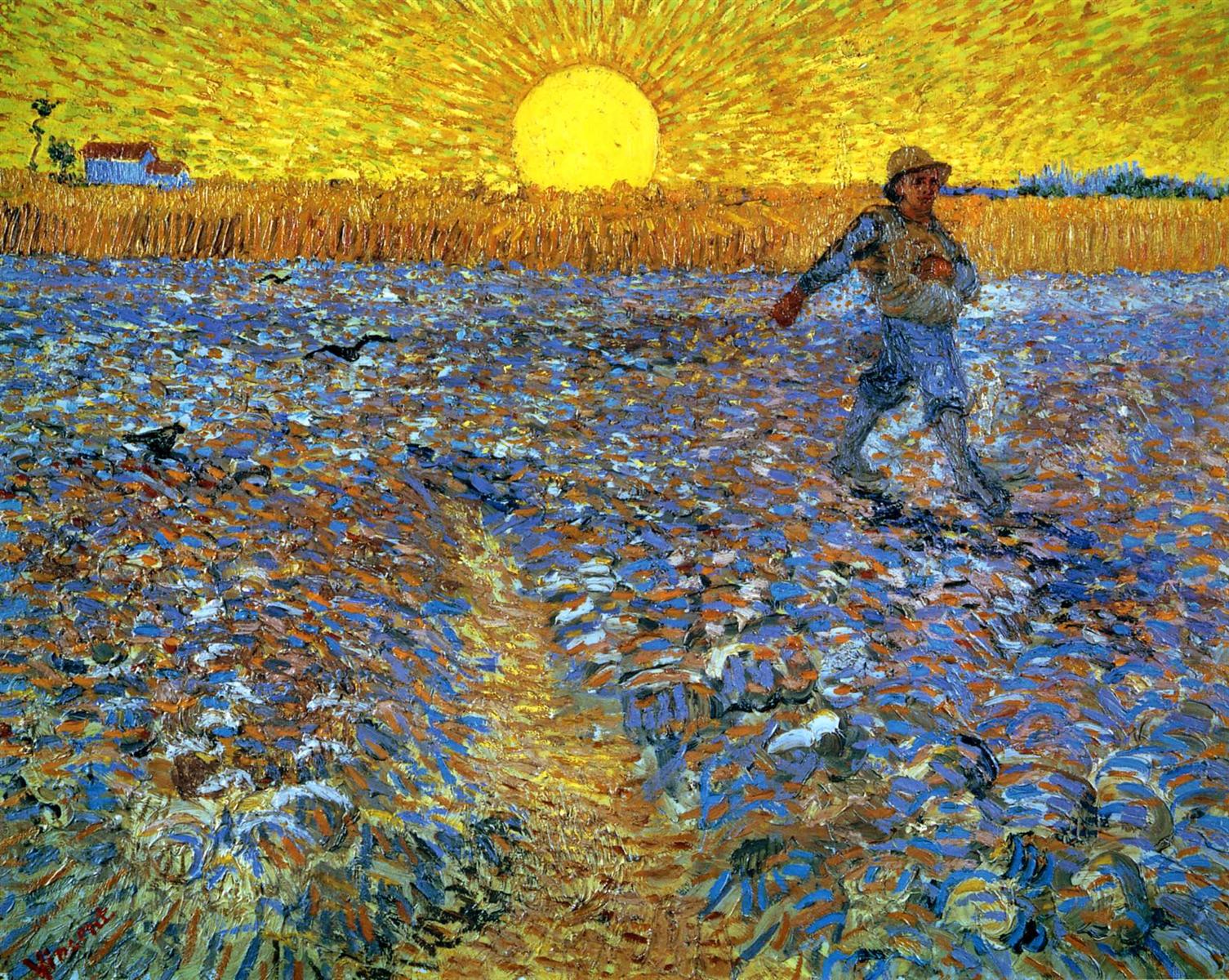
Vincent van Gogh’s The Sower from 1888 is one of the most powerful paintings of his Arles period. At first glance, the scene seems simple. A farmer walks across a field, casting seed into the earth beneath a huge glowing sun. Yet the longer one looks, the more this painting opens into something much larger than a rural task. It becomes a vision of labor, time, nature, renewal, and human endurance. Van Gogh takes an ordinary agricultural subject and turns it into an image that feels monumental, symbolic, and almost cosmic.
This painting belongs to a subject that mattered deeply to Van Gogh throughout his career. He returned again and again to peasants, fields, sowers, reapers, and the rhythms of agricultural life. These were not casual choices. For him, rural labor carried moral and emotional weight. It represented honest work, closeness to the land, and participation in the great cycles of life. In The Sower, that theme reaches an especially intense visual expression. The sun is enormous, the colors are bold and unnatural, and the brushwork vibrates across the surface. The result is not a calm record of the countryside. It is an interpretation charged with feeling and meaning.
The painting is also important because it shows Van Gogh at a moment when his style had become unmistakably his own. By 1888, he had absorbed lessons from Dutch art, French modern painting, Japanese prints, and the example of Jean-François Millet. Yet in The Sower, those influences are transformed into something highly personal. The field is not painted in muted naturalistic browns. Instead, it flashes with blue, gold, white, orange, and black. The sky does not quietly recede into the background. It radiates outward with intense energy. The whole scene seems alive, as though nature itself is in motion.
The Subject and Its Meaning
The subject of a sower had a long history before Van Gogh painted it. It carried agricultural, religious, and symbolic associations. At the most basic level, a sower is someone who casts seed into the earth, beginning the process that may later lead to harvest. This alone makes the image about hope and trust. Sowing is an act of faith. The work is done in the present, but its result lies in the future. The sower places seed into soil without complete control over weather, growth, or outcome.
That idea clearly appealed to Van Gogh. He was drawn to images that connected human effort with larger cycles beyond human control. In The Sower, the figure is not posed like a hero in a history painting, yet he is given heroic significance through scale, placement, and atmosphere. He walks with purpose across the field, his body leaning forward, one hand near the seed bag and the other extended in action. He becomes an emblem of persistence. He does not dominate nature, but he participates in it.
The subject also carries spiritual resonance. Van Gogh was deeply interested in questions of meaning, suffering, faith, and renewal, even after moving away from conventional religious roles. The act of sowing could easily stand for creation, sacrifice, patience, and rebirth. Seed must disappear into the ground before new life emerges. That makes the image quietly profound. The painting is not only about farming. It is about beginning again, about the invisible future contained within present labor.
At the same time, The Sower is grounded in ordinary life. Van Gogh never loses sight of the physical reality of the scene. The figure steps through rough earth. Birds pick at the field. A cottage sits low on the horizon. The painting holds together both the everyday and the symbolic. That balance is one reason it remains so memorable. It is accessible as a rural scene, but it also feels timeless and universal.
Van Gogh in Arles in 1888
To understand The Sower, it helps to place it in the context of Van Gogh’s time in Arles. In February 1888, he moved from Paris to the south of France, seeking stronger light, more intense color, and a new direction for his work. Arles gave him exactly that. The bright Mediterranean sun, open fields, orchards, and seasonal transformations had a profound effect on his painting. His palette became more vivid, and his compositions took on a heightened expressive force.
The landscape around Arles offered Van Gogh constant material. He painted orchards in bloom, wheat fields, bridges, roads, gardens, and the everyday life of the town and countryside. He was especially interested in how southern light altered color relationships. In many Arles paintings, yellows become more brilliant, blues more electric, and complementary contrasts more daring. The Sower grows directly out of that environment. The immense sun and blazing field would not have emerged in the same way from his earlier Dutch period.
Arles was also a period of great ambition. Van Gogh wanted to create paintings that were modern but also spiritually serious. He did not want mere description. He wanted expression. He wanted color to carry emotional and symbolic meaning. In The Sower, he does exactly that. The painting is based on observation, but it is intensified through artistic decision at every level. The colors are chosen for impact, the forms are simplified, and the composition is organized to feel monumental.
This was also a period when Van Gogh was thinking about artistic inheritance. He admired earlier painters of peasant life, especially Millet, but he did not want simply to imitate them. He wanted to remake their subjects through his own vision. The Sower is therefore both a continuation of an older tradition and a radical modern reimagining of it.
The Influence of Jean-François Millet
No discussion of The Sower can ignore the importance of Jean-François Millet. Van Gogh revered Millet and saw him as a painter of human dignity, especially in relation to peasant labor. Millet’s sowers, reapers, and gleaners had a direct moral gravity that Van Gogh deeply admired. For Van Gogh, Millet was not merely a source of imagery. He was an artistic and emotional guide.
But Van Gogh’s The Sower is not a passive copy of Millet. It is better understood as a dialogue with Millet’s subject. Millet often gave rural laborers a solemn weight grounded in earth tones and strong, simple forms. Van Gogh keeps the seriousness of the subject but reinvents its visual language. In the 1888 The Sower, the figure is set against a dazzling yellow sky and sun, while the plowed field flashes with blue and orange. The result is far more intense and visionary than anything like straightforward realism.
This transformation matters. It shows how Van Gogh took an inherited subject and pushed it into a new expressive realm. He keeps the peasant worker at the center, but he surrounds him with a world charged by light and color. Millet gives Van Gogh the theme, but Van Gogh gives it a new emotional weather. The field becomes less a location than an energized space in which labor, nature, and time are fused.
Van Gogh’s attraction to Millet also reveals something about his values. He was not primarily drawn to aristocratic portraits or classical mythology. He believed common people and humble tasks deserved the highest artistic attention. The Sower embodies that belief with unusual force. It elevates agricultural work without sentimentalizing it. The figure remains part of the land, neither idealized into fantasy nor reduced to mere anecdote.
Composition and Spatial Design
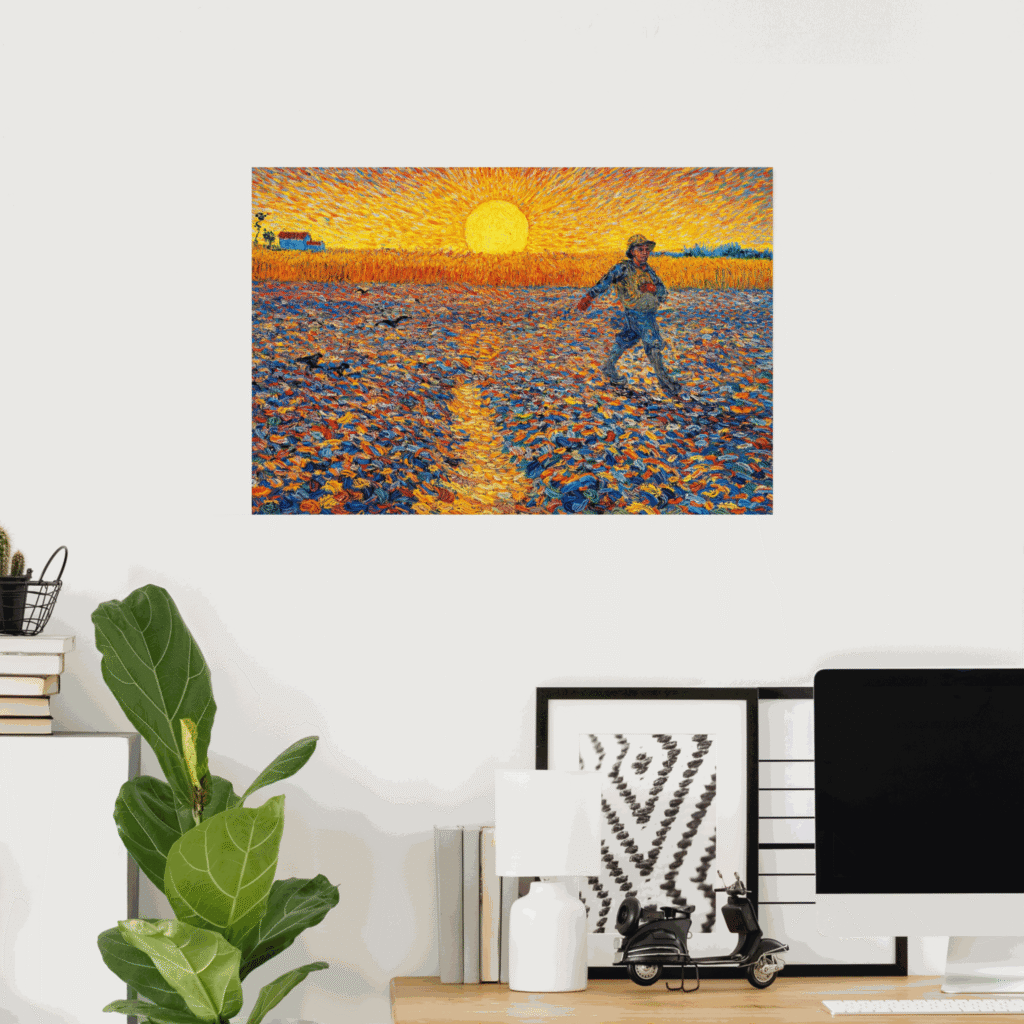
One of the most striking things about The Sower is its composition. The painting is organized with remarkable clarity, yet it feels dynamic rather than static. The large sun sits near the center of the horizon, becoming an immediate focal point. From it, the sky seems to radiate outward in waves of yellow and orange. Below, the field stretches across the foreground in a wide band of textured color. The sower moves across this open space from right to left, creating a strong sense of motion.
The division between sky, wheat, and plowed ground is simple, but highly effective. These horizontal bands give the composition structure, while the moving figure disrupts that structure with diagonal energy. His stride cuts across the field, and his scattering gesture reinforces the sense of movement. He is not simply standing in the landscape. He activates it.
The path or lighter strip in the foreground also plays an important role. It pulls the viewer’s eye into the painting and creates depth without relying on detailed modeling or academic perspective. Van Gogh simplifies space, but he does not flatten it completely. Instead, he builds depth through color contrast, placement, and directional brushwork.
The small house on the left horizon and the line of trees on the right provide balance. They keep the horizon from becoming empty and help frame the immense sun. Meanwhile, the birds in the field animate the space and remind the viewer that sowing happens in tension with natural forces. Birds can consume the seed, so their presence introduces a subtle note of uncertainty. This is not only a scene of hope. It is also a scene of risk.
Overall, the composition feels both expansive and concentrated. The field opens widely before us, yet every part of the canvas is energized. There are no dead zones. The eye moves continually between the sun, the figure, the field, and the darting birds. The whole surface is orchestrated to sustain attention.
Color and Emotional Intensity
Color is one of the main reasons The Sower feels so unforgettable. Van Gogh does not use color merely to imitate appearances. He uses it to heighten emotion and significance. The sky burns with yellow, gold, and orange around a huge pale sun. The plowed earth, instead of remaining brown, becomes a dazzling mixture of blue, white, ocher, and orange. This color scheme is both surprising and deliberate.
The contrast between warm and cool tones is central to the painting’s effect. The yellow sky and wheat radiate heat, light, and energy. The blue field below creates a complementary opposition that makes both areas more vivid. The eye experiences tension and excitement in this contrast. The field almost seems to shimmer under the pressure of the sun above it.
Van Gogh’s color choices also shape the emotional meaning of the work. Naturalism is less important than expressive truth. The blue in the earth does not make the scene colder. Instead, it intensifies the brilliance of the warm tones and gives the field a living, restless surface. The entire painting feels animated by color relationships. The visual experience becomes emotional before it becomes analytical.
The figure’s clothing participates in this chromatic drama. His pale blue garments connect him to the field, while the warmer hat and flesh tones keep him distinct. He is both part of the landscape and separate from it. That duality is important. He belongs to the earth, yet he also acts within it, shaping the future through his labor.
The huge yellow sun is especially significant. It is far larger than strict observation would require. Its scale pushes the scene toward symbolism. It becomes a force rather than just an object in the sky. It can be read as nature’s generative power, as time passing, as divine presence, or as the overwhelming energy under which human work unfolds. Van Gogh leaves the meaning open enough to sustain many interpretations, but he clearly wants the sun to dominate the emotional atmosphere.
Brushwork and Surface Energy
Van Gogh’s brushwork in The Sower is essential to its impact. The painting does not merely depict movement. It is built out of movement. Across the sky, the strokes radiate in many directions, making the air feel alive with light. In the field, the marks twist, curve, and cluster into dense passages that suggest furrows, clods, and rough ground without ever becoming overly descriptive. The paint itself seems to pulse.
This active surface is one of the ways Van Gogh turns landscape into experience. The viewer does not encounter a polished illusion of space. Instead, one encounters a painted world whose construction remains visible at every moment. The marks are expressive units. They carry energy, rhythm, and emotion.
The difference in brushwork between the sky and the field also matters. The sky’s radiating pattern suggests expansion and luminous force. The field’s shorter, more varied strokes suggest material density and constant irregularity. The contrast helps distinguish the elements while keeping them in dialogue. Light above and earth below are rendered through related but distinct rhythms.
The figure is also defined through energetic drawing and paint handling. He is not anatomically smooth or carefully finished in an academic sense. His form emerges through contour, broken color, and the force of gesture. This makes him feel active rather than posed. The body is understood not through polished detail, but through movement.
Van Gogh’s brushwork can sometimes be mistaken for spontaneity alone, but The Sower shows how controlled it really is. The painting feels immediate, yet its rhythms are carefully balanced. The marks guide the eye and reinforce the painting’s structure. Surface energy is not accidental here. It is one of the main carriers of meaning.
The Sower as Symbol of Life and Renewal
The deeper meaning of The Sower emerges most fully when one sees the figure as more than a farmer in a field. He becomes a symbol of life moving forward through uncertainty. Sowing is one of the clearest images of trust in the future. Seed is scattered now so that growth may come later. Much remains unseen. The labor is real, but the result is delayed.
This gives the painting emotional depth. The sower works under an enormous sun, across rough land, surrounded by birds that may threaten the seed. Yet he continues. There is no hesitation in his stride. He acts because the cycle of life depends on such action. In this way, the painting becomes an image of perseverance.
It is also an image of continuity. Human beings come and go, but sowing, growing, and harvesting repeat across generations. Van Gogh seems deeply aware of this continuity. The individual figure is important, yet he also stands for something larger than himself. He is part of an ancient rhythm linking labor, nature, and survival.
The symbolism can also be read in personal terms. Van Gogh often invested painting itself with the intensity of sowing. To create was to place something into the world without certainty about how it would be received or what future it might have. Seen this way, The Sower carries an autobiographical undertone. The painter, like the farmer, works through effort, hope, and vulnerability.
What makes the symbolism so effective is that it never feels forced. Van Gogh does not overload the image with literary detail. The meaning arises from the basic action, the scale of the sun, the intensity of the color, and the seriousness of the figure. The painting remains rooted in visible reality even as it points beyond it.
Why The Painting Still Feels Modern
Although The Sower was painted in 1888, it still feels remarkably modern. Part of that comes from Van Gogh’s refusal to separate representation from expression. He paints a recognizable subject, but he transforms it through color, scale, and brushwork in ways that anticipate later developments in modern art. The painting is not abstract, yet it values emotional force over strict natural description.
Its modernity also lies in its honesty about perception and feeling. Van Gogh does not pretend that seeing is neutral. The world arrives filtered through intensity, memory, conviction, and imagination. The Sower makes that process visible. It shows us not only what a field and a worker looked like, but what they meant to the artist.
The painting also remains modern because its central themes are still relevant. Labor, hope, uncertainty, and renewal are not historical curiosities. They remain part of human life. The image of a person working toward a future that cannot yet be seen still carries enormous emotional power. In a world that often feels unstable, the act of sowing still reads as brave.
There is also something modern in the painting’s tension between beauty and harshness. The colors are dazzling, but the field is rough. The scene is radiant, yet not idyllic. The work being done is necessary, not decorative. Van Gogh allows intensity and difficulty to coexist. That complexity keeps the painting from becoming sentimental.
Conclusion
The Sower by Vincent van Gogh is far more than a rural scene. It is a painting about labor, light, time, and belief. Through a simple subject, Van Gogh creates an image of extraordinary depth. The walking figure, the blazing sun, the vibrating field, and the urgent brushwork all combine to turn sowing into a vision of human persistence within the great cycles of nature.
The painting stands at the meeting point of observation and symbolism. It belongs to the fields around Arles, but it also belongs to a timeless imaginative world in which ordinary work becomes almost sacred. Van Gogh draws from Millet and from rural tradition, yet the result is unmistakably his own. His bold color contrasts, restless surface, and emotional intensity transform the subject into something both immediate and unforgettable.
What continues to make The Sower so moving is its sense of forward motion. The figure keeps walking. The seed keeps falling. The future remains unseen, but the act continues. In that sense, the painting offers more than beauty. It offers a vision of effort joined to hope. That is one reason it still speaks so strongly today. It reminds us that creation often begins in uncertainty, and that meaning is often found in the willingness to keep sowing.