Image source: wikiart.org
Introduction
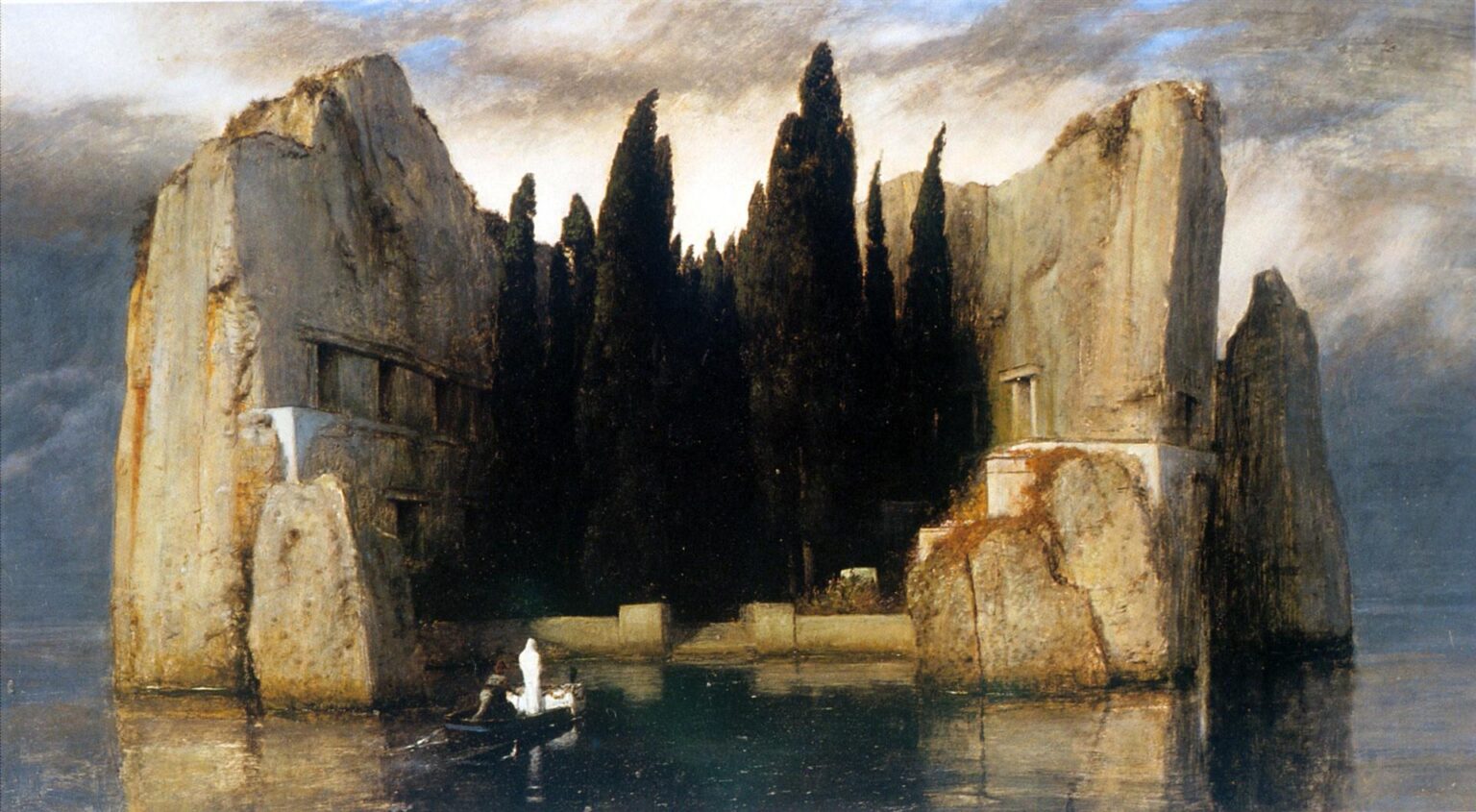
Arnold Böcklin’s The Isle of the Dead from 1883 is one of the most haunting and unforgettable images in nineteenth century European painting. At first glance, it seems simple. A rocky island rises from still water. Dark cypress trees cluster at its center. A small boat approaches the entrance, carrying a standing white figure and what looks like a coffin. Yet the longer one looks, the more unsettled the scene becomes. The painting feels both silent and immense, both dreamlike and precise. It appears to show a place outside ordinary life, a threshold between the visible world and the unknown.
This power comes from Böcklin’s ability to fuse landscape, architecture, myth, and emotion into a single image. He does not tell the viewer exactly what is happening, and that is part of the painting’s lasting force. The island seems to be a tomb, a sanctuary, a memory, and a vision all at once. The water is calm, but the atmosphere is tense. The composition is orderly, but the mood is deeply unsettling. Rather than describing death in a literal or dramatic way, Böcklin creates a place where death feels present as an idea, a destiny, and a mysterious realm.
The Isle of the Dead became one of Böcklin’s most famous works because it speaks to fears and fantasies that are difficult to express directly. It presents death not as violent spectacle, but as solemn passage. It evokes mourning, isolation, ritual, and silence. It also opens itself to many interpretations. Some viewers see it as a symbolic vision of the afterlife. Others read it as a meditation on grief, memory, or the inner life of the imagination. Its meaning remains open, but its emotional effect is unmistakable.
Arnold Böcklin and the World of Symbolism
Arnold Böcklin was a Swiss painter whose work often moved away from straightforward realism and toward myth, allegory, fantasy, and psychological atmosphere. Although he lived during a period when naturalism and academic painting were highly influential, Böcklin followed a more personal path. He drew from classical mythology, Renaissance art, and poetic invention, creating images that often seem to belong to an in between world where nature and spirit meet.
This tendency places him close to Symbolism, even if his work does not fit neatly into any single category. Symbolist artists were less interested in simply recording visible reality than in suggesting ideas, moods, dreams, and states of mind. They used imagery to point toward meanings that were emotional or spiritual rather than purely descriptive. In Böcklin’s case, landscape became one of his great vehicles for this symbolic language. He could turn mountains, groves, ruins, and seas into spaces of mythic intensity.
The Isle of the Dead is one of the clearest examples of this approach. It is based on recognizable elements, rock, trees, water, architecture, and a boat, but together these forms create a world that feels impossible to locate in ordinary geography. The painting does not function like a travel scene or a topographical view. It feels imagined, inward, and visionary. Its realism is selective. The textures of rock and water are convincing, but the arrangement of forms is too charged with meaning to be read as mere description.
This is what gives Böcklin such a distinct place in nineteenth century art. He shows that painting can evoke the unseen without abandoning the visible world. The island in this image is concrete enough to feel real, yet strange enough to seem like a mental or spiritual destination. The result is a painting that stands between Romanticism and Symbolism, between landscape and dream, between image and metaphysical suggestion.
The Scene and Its Immediate Emotional Impact
The subject of The Isle of the Dead is presented with extraordinary restraint. There is no dramatic gesture, no explicit narrative, and no crowd of figures to guide interpretation. Instead, the painting depends on a concentrated arrangement of forms that immediately shapes the viewer’s emotional response. The island rises vertically from the water like a natural fortress. The cliffs are pale and severe, enclosing a dark mass of cypress trees at the center. The water in the foreground is nearly motionless, reflecting the island with eerie clarity. A small boat moves toward the island, and the white standing figure becomes the brightest and most fragile presence in the scene.
This contrast between stillness and movement is essential. The island itself appears fixed, eternal, and inaccessible. The boat introduces the only sense of transition, as if the entire painting captures a single irreversible moment. Something is approaching its destination. Something is crossing from one realm to another. Because the image refuses to explain itself fully, the viewer experiences this arrival almost intuitively. The painting feels ceremonial.
Böcklin also understands the emotional power of emptiness. There are no signs of ordinary life here. No birds animate the sky. No waves disturb the water. No vegetation softens the stone except for the cypresses, which are themselves traditional symbols of mourning and cemeteries. This emptiness intensifies the psychological mood. The island is not merely deserted. It feels set apart, withdrawn from the world of everyday human activity.
The white figure plays a crucial role in this atmosphere. Because it is turned away and remains anonymous, it becomes a projection point for the viewer. It may be a mourner, a soul, a priestly attendant, or the dead person symbolically present before burial. The ambiguity deepens the painting’s emotional reach. We do not meet an individual character with a defined story. We encounter a human presence reduced to ritual and silence. This makes the scene feel universal.
Composition and the Architecture of Isolation
One reason The Isle of the Dead remains so compelling is the extraordinary discipline of its composition. Böcklin structures the image around a strong central mass. The island occupies most of the picture plane, pressing forward and dominating the scene. Its shape is almost symmetrical, though not perfectly so, and this near symmetry gives the painting a monumental stillness. The central cluster of cypress trees rises like a dark vertical core, framed by massive rock faces on either side.
This architecture of forms creates a sense of enclosure. The cliffs seem to guard the interior like walls, while the trees make the center of the island appear even darker and less penetrable. Although the island is open at the front, it does not feel welcoming. Instead, the entrance resembles a solemn threshold. The viewer can see enough to sense depth, but not enough to feel access. The painting pulls the eye inward, then halts it.
The boat is positioned low in the composition, close to the surface of the water, which increases the scale of the island. This makes the human presence appear very small in relation to the looming mass ahead. Such scale relationships are important to the painting’s meaning. The individual confronts something vast, impersonal, and final. The island becomes more than a location. It becomes a visual equivalent for mortality itself.
Böcklin also balances vertical and horizontal forces with remarkable care. The water stretches outward in a calm horizontal plane, while the cliffs and trees rise in sharp verticals. This tension stabilizes the composition while also giving it spiritual resonance. Horizontal space often suggests passage, rest, or stillness. Vertical forms can suggest ascent, authority, or separation. Here the meeting of the two produces a mood of suspended transition. The journey is almost complete, but the final encounter has not yet happened.
The composition’s clarity is one of the reasons the painting imprints itself so strongly on memory. It feels inevitable. Every form appears necessary. Nothing distracts from the island, the boat, and the act of approach. The painting is not crowded with symbols. Instead, it is built from a few elemental forms arranged with near ritual precision.

Light, Color, and the Poetics of Silence
The color palette of The Isle of the Dead is relatively restrained, but it is handled with enormous sensitivity. Böcklin avoids bright, festive color and instead builds the painting from muted earth tones, pale stone hues, deep greens, shadowy blacks, and cool greys. These colors immediately set the emotional tone. The painting feels heavy, solemn, and meditative.
The pale rock faces are especially important. They catch a subdued light that makes them appear ancient and weathered. Their surfaces feel both solid and ghostly. They are not warm, inviting stone. They resemble tomb walls, worn monuments, or cliffs stripped down to bare essence. Against them, the cypress trees appear almost black, forming a dense interior darkness that the eye cannot fully penetrate.
The sky contributes to this mood through soft but troubled tonal variation. It is neither fully stormy nor fully serene. Clouds spread across it in uncertain layers, creating an atmosphere that feels suspended between calm and foreboding. This unsettled sky prevents the painting from becoming too static. Even in its stillness, the scene carries emotional weather.
The water acts as a mirror, but not a cheerful one. Its surface is smooth and reflective, yet its reflections feel muted and shadowed. The island’s image in the water seems less like a literal mirror image than an echo, a darkened double. This strengthens the painting’s dreamlike quality. Reflection here suggests another world beneath or beyond the visible one.
Perhaps most striking of all is Böcklin’s use of white in the standing figure and coffin. These touches are small in scale, but enormous in effect. They become focal points, drawing the eye instantly. White here is not used as brightness in a joyful sense. It reads as ceremonial, funereal, and spectral. It punctuates the darkness with a presence that feels fragile, human, and sacred.
Through these choices, Böcklin creates a poetics of silence. The painting does not need action because the colors themselves carry emotional pressure. The muted palette and controlled lighting turn the entire surface into a meditation on stillness, grief, and mystery.
Death as Journey Rather Than Event
One of the most powerful aspects of The Isle of the Dead is the way it imagines death not as a violent incident, but as a journey. The painting does not show struggle, fear, or bodily decay. It shows approach. This makes its meditation on death feel more philosophical than dramatic. Böcklin presents death as passage to a separate domain, one that is hidden yet unmistakably waiting.
The boat is central to this idea. Across many cultural traditions, the boat is associated with crossing, transport, and transition. In ancient mythology, especially Greek traditions, the ferryman guiding souls across water to the underworld is a familiar image. Böcklin does not illustrate this myth in a direct narrative way, but he clearly draws on its resonance. The small vessel moving toward the island suggests that the dead must be carried somewhere, that death is a crossing rather than an ending that can be seen.
The coffin strengthens this interpretation. It anchors the symbolic reading in the material reality of burial, yet the scene remains too stylized to be understood as a simple funeral. Instead, the coffin becomes an object of passage. It is the visible sign that someone has died, but the painting’s focus is less on the corpse than on the destination. What matters here is where the dead are going, or perhaps how the living imagine that destination.
This is why the painting often feels both comforting and terrifying. It offers form and ritual where death might otherwise seem chaotic. The island is a place prepared for arrival. The passage appears calm. Yet the destination is closed, dark, and unknowable. There is dignity in the journey, but no reassurance about what lies within the island’s interior.
By treating death as voyage, Böcklin gives the viewer space for contemplation. He removes the immediate shock of mortality and replaces it with solemn inevitability. The result is not sentimental. It is grave, mysterious, and emotionally controlled. The painting asks the viewer not simply to fear death, but to dwell on its presence as one of the defining boundaries of human experience.
Symbolism, Myth, and Open Meaning
A major reason The Isle of the Dead has endured is that it never collapses into a single fixed meaning. It is rich in symbolism, but Böcklin does not turn the painting into a puzzle with one solution. Instead, he creates a network of suggestive forms that invite interpretation.
The cypress trees are among the most recognizable symbols in the painting. Traditionally linked with cemeteries, mourning, and immortality, they immediately frame the island as funerary space. Their dark, flame like verticality adds both solemnity and mystery. They seem to guard the dead while also reaching upward, linking earth and sky.
The rocky island can be read in several ways. It may represent a tomb, a sanctuary, a mythical land of the dead, or even the inner landscape of grief itself. Its carved openings suggest sepulchral chambers, but it is never fully reduced to architecture. Nature and burial monument merge. This fusion is important because it suggests that death belongs to both human ritual and the larger order of existence.
The water can symbolize separation, purification, or transition. Water divides the island from the viewer and from ordinary land. It creates distance that cannot be crossed casually. At the same time, its stillness makes it feel ceremonial, as if this passage must occur in silence and reflection.
The standing figure in white is perhaps the most open symbol of all. Its identity remains unclear, and that uncertainty is part of the painting’s power. It could represent the soul of the deceased, the mourner accompanying the body, or a ritual guide. Because it is anonymous, it can stand for any human being facing mortality. It is both particular and universal.
This openness has allowed generations of viewers to find different meanings in the work. Some see melancholy, others transcendence. Some see pagan myth, others private mourning. Some see a dream image shaped by personal grief, while others see an archetypal vision of the boundary between life and death. Böcklin’s genius lies in holding these meanings together without forcing the viewer into one reading.
Why The Isle of the Dead Still Feels Modern
Although The Isle of the Dead belongs to the nineteenth century, it continues to feel surprisingly modern in its emotional and psychological effect. One reason is its refusal to explain itself fully. Modern viewers are often drawn to art that leaves space for uncertainty, and Böcklin’s painting does exactly that. It presents a precise image but an unresolved meaning. This combination keeps the work alive.
The painting also feels modern because it treats landscape as psychological space. The island is not simply scenery. It is a state of mind made visible. Later artists and filmmakers would often use environments in this way, turning physical settings into expressions of fear, memory, desire, or alienation. Böcklin anticipates that approach with remarkable force.
Its mood of isolation also speaks strongly to contemporary sensibilities. The painting captures a sense of separation that feels timeless. The island is detached, self contained, and unreachable except through ritual passage. In an age deeply aware of loneliness, existential uncertainty, and the fragility of human life, this image continues to resonate.
At the same time, the work avoids the emptiness of pure despair. It is dark, but not nihilistic. Its solemn order suggests that death, however mysterious, belongs to a larger pattern. The boat moves calmly. The island waits. The scene is grave, yet composed. This gives the painting a meditative quality that still attracts viewers looking for art that can hold fear and beauty together.
Böcklin also created an image that remains unforgettable because it is visually simple in the best sense. Many complex ideas are condensed into a few shapes, tones, and symbols. That economy makes the painting easy to remember and difficult to exhaust. It lingers in the imagination long after one has stopped looking.
Conclusion
The Isle of the Dead is one of Arnold Böcklin’s greatest achievements because it transforms a simple scene into a profound meditation on mortality, memory, and the unknown. Through its stark island, its dark cypresses, its silent water, and its mysterious boat, the painting creates an atmosphere of extraordinary emotional concentration. It does not narrate death. It evokes the feeling of approaching it.
What makes the work so powerful is its balance of clarity and ambiguity. The forms are unmistakable, yet their meaning remains open. The scene is calm, yet charged with tension. The image is still, yet full of inward movement. Böcklin invites the viewer into a world where landscape becomes symbolic, ritual becomes visual, and silence becomes the deepest kind of expression.
The painting endures because it speaks to something fundamental in human experience. Death is universal, but it is also deeply mysterious. We can imagine its rituals, its thresholds, and its symbols, but we cannot fully know it. The Isle of the Dead gives shape to that mystery without trying to solve it. It offers no final answer, only an unforgettable vision of passage toward a place beyond ordinary sight.
That is why the painting continues to fascinate. It is not only an image of death. It is an image of how the human imagination confronts death, with fear, dignity, beauty, and silence. In that sense, Böcklin’s island remains not just a destination for the dead, but a lasting monument within the history of art itself.