Image source: wikiart.org
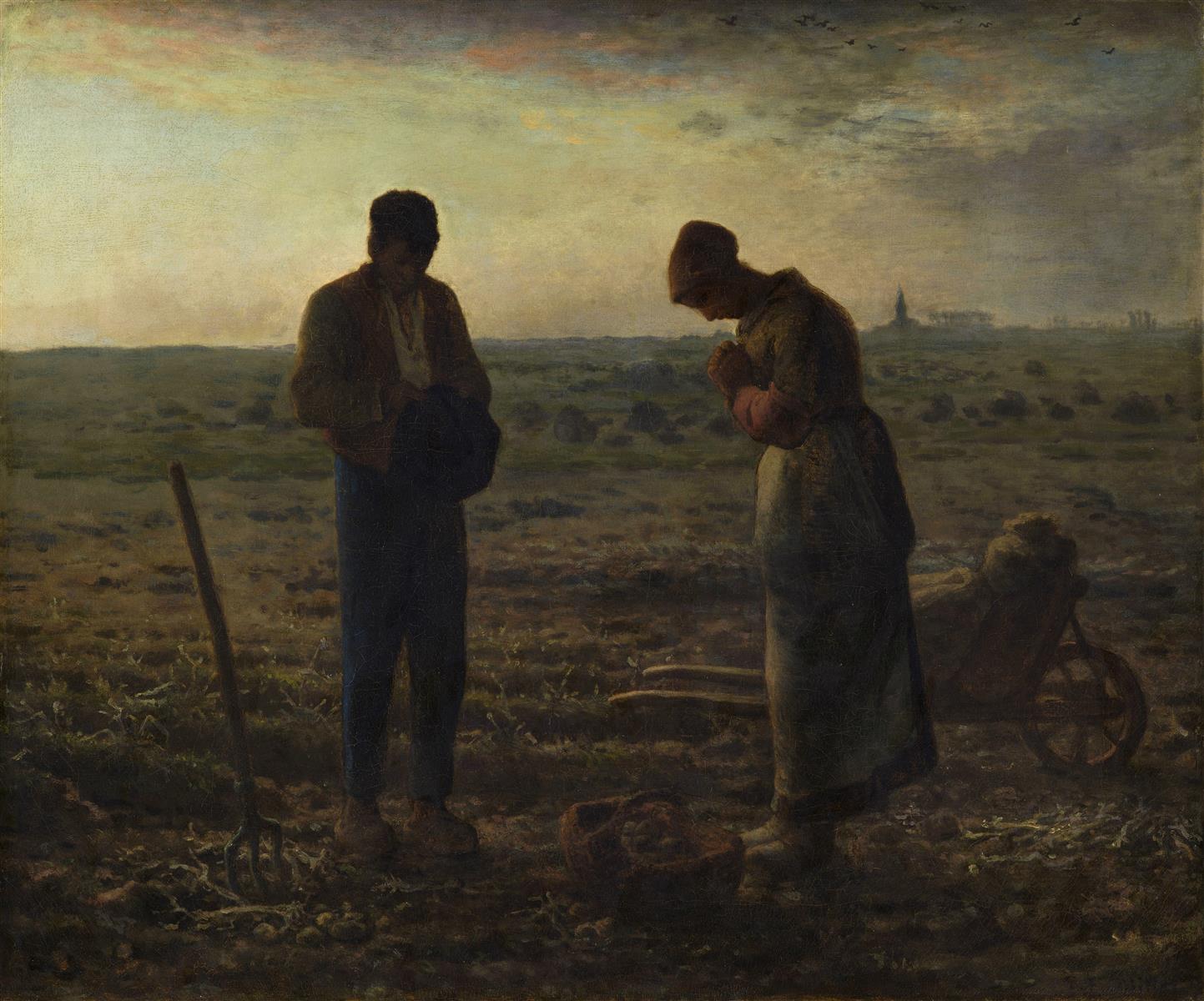
The Angelus by Jean-Francois Millet
Jean-Francois Millet’s The Angelus is one of the most recognizable images in nineteenth century French painting. Created in 1859, the work shows two peasants standing in a field at dusk, their heads bowed in prayer as the evening bell calls them to pause from labor. At first glance, the painting seems simple. There are no dramatic gestures, no elaborate costumes, and no theatrical action. Yet the power of The Angelus lies precisely in that restraint. Millet transforms an ordinary rural moment into something solemn, emotional, and quietly monumental.
The painting belongs to the world of peasant life that Millet explored throughout his career. He was deeply interested in the dignity of manual labor and the spiritual seriousness of people whose lives were tied to the land. In The Angelus, he does not present country life as charming decoration or rustic entertainment. Instead, he gives it gravity. The two figures appear almost sculptural against the open field and glowing sky, and their stillness fills the scene with reverence. What might have been a passing moment becomes an image of endurance, humility, and faith.
Part of the painting’s lasting appeal comes from the balance Millet achieves between realism and symbolism. The figures are undeniably ordinary people. Their clothes are rough, their tools are plain, and the field around them is uneven and hard. At the same time, the scene carries a meaning larger than its literal subject. Prayer, labor, hunger, time, and mortality all seem present in this quiet pause. The Angelus is not only about two peasants praying. It is about the structure of life itself, about the way work and worship, body and spirit, earth and sky meet in one moment.
Historical Context and Millet’s Rural Vision
Millet painted during a period of major social and economic change in France. The nineteenth century was marked by industrial expansion, political upheaval, and widening divisions between urban and rural life. As cities grew and modern industry transformed society, the countryside could seem both old fashioned and essential, distant yet foundational. Millet turned repeatedly to rural workers not because he wanted to create nostalgic fantasies, but because he saw peasant life as a serious and truthful subject for art.
He was associated with the Barbizon School, a group of artists who worked near the Forest of Fontainebleau and focused on landscape and rural subjects. Unlike academic history painters, these artists often looked to ordinary life and the natural environment rather than to classical mythology or grand historical narratives. Millet’s contribution to this movement was especially distinctive because he brought an unusual moral weight to images of laborers. He painted sowers, gleaners, shepherds, and wood gatherers with a scale and gravity that had traditionally been reserved for heroic or religious figures.
That choice was significant. In earlier art, peasants were often treated as comic types, picturesque background figures, or symbols of rustic simplicity. Millet changed that. He made them central. He gave them silence, mass, and seriousness. This approach was admired by some viewers and viewed with suspicion by others. Because he painted working people with such dignity, some critics associated his art with social unrest or political sympathy for the lower classes. Whether or not those fears were justified, they show how powerful his images seemed in their own time.
The Angelus emerges from that context. It is not a sentimental diversion from the realities of rural life. It grows out of Millet’s sustained interest in the lives of people who depended on the land and whose days were structured by labor, weather, and religious custom. The painting reflects a world in which work was physically demanding and prayer was woven into daily routine. That combination of hardship and devotion is central to its effect.
The Scene and Its Immediate Meaning
The subject of The Angelus is straightforward. A man and a woman have stopped their work in a potato field in response to the church bell ringing for the Angelus, a traditional Catholic prayer recited morning, noon, and evening in memory of the Annunciation. The man removes his cap and bows his head. The woman clasps her hands in prayer. A wheelbarrow, sacks, and a pitchfork stand nearby, evidence of the labor they have interrupted. In the distance, a church steeple rises faintly on the horizon.
Millet captures the moment after activity has stopped but before it resumes. That pause is everything. The figures are neither walking nor speaking nor gesturing to each other. They are suspended in stillness. The field, which moments before was a place of work, becomes a place of contemplation. The transition is subtle but profound. Nothing outwardly miraculous happens, yet the atmosphere changes completely. A familiar rural practice becomes a sacred interval.
One reason the scene feels so moving is that Millet does not dramatize it. He avoids sentimentality. The figures do not look upward in ecstatic vision. There are no angels in the sky, no rays of divine intervention, and no visible congregation. The holiness of the moment is interior. It is expressed through posture, silence, and repetition. This kind of restraint allows the painting to feel sincere rather than staged. The prayer is not performed for the viewer. It seems to take place independently of us.
The title helps frame the painting’s meaning, but the work itself conveys that meaning even before the title is known. The bowed heads, the folded hands, and the distant church are enough to communicate the spiritual pause. Even viewers unfamiliar with the specific prayer can sense the structure of the scene. It is a moment of respect, humility, and ritual, carried out within the demands of ordinary life.
Composition and the Monumentality of Simplicity
Millet’s composition is remarkably controlled. The two figures stand near the center of the painting, separated by a slight gap but joined by shared action. Their bodies form a quiet rhythm of vertical shapes against the broad horizontal spread of the landscape. The field stretches outward in all directions, but the figures anchor the composition and give it focus.
What is especially striking is the scale Millet gives them. They are not tiny staffage figures lost in a panoramic landscape. They are large enough to dominate the foreground, and their presence feels weighty. Even though their gestures are modest, their stillness gives them monumental force. The man’s broad body and lowered head create a strong, compact form. The woman, slightly bent forward in prayer, forms a complementary shape that adds tenderness and inward concentration. Together they create a balanced pair, distinct yet united.
The emptiness around them also matters. The open field is not crowded with anecdotal detail. Millet resists the temptation to fill the scene with distractions. This sparseness amplifies the emotional intensity of the central act. The horizon line sits low enough to give the sky a major role, while the long expanse of land emphasizes the isolation of the two workers. That isolation does not feel lonely in a purely negative sense. Instead, it makes the moment more intimate and more universal. The pair seem alone, yet they also seem to stand for countless rural laborers whose days followed similar rhythms.
Millet also uses objects carefully. The pitchfork at the left, the basket and sack near the woman, and the wheelbarrow to the right ground the scene in physical work. These are not decorative accessories. They remind us that the prayer occurs in the middle of toil. The field is not a pastoral fantasy. It is a workplace. By placing these tools around the figures, Millet frames their devotion within the realities of labor and necessity.
Light, Color, and Atmosphere
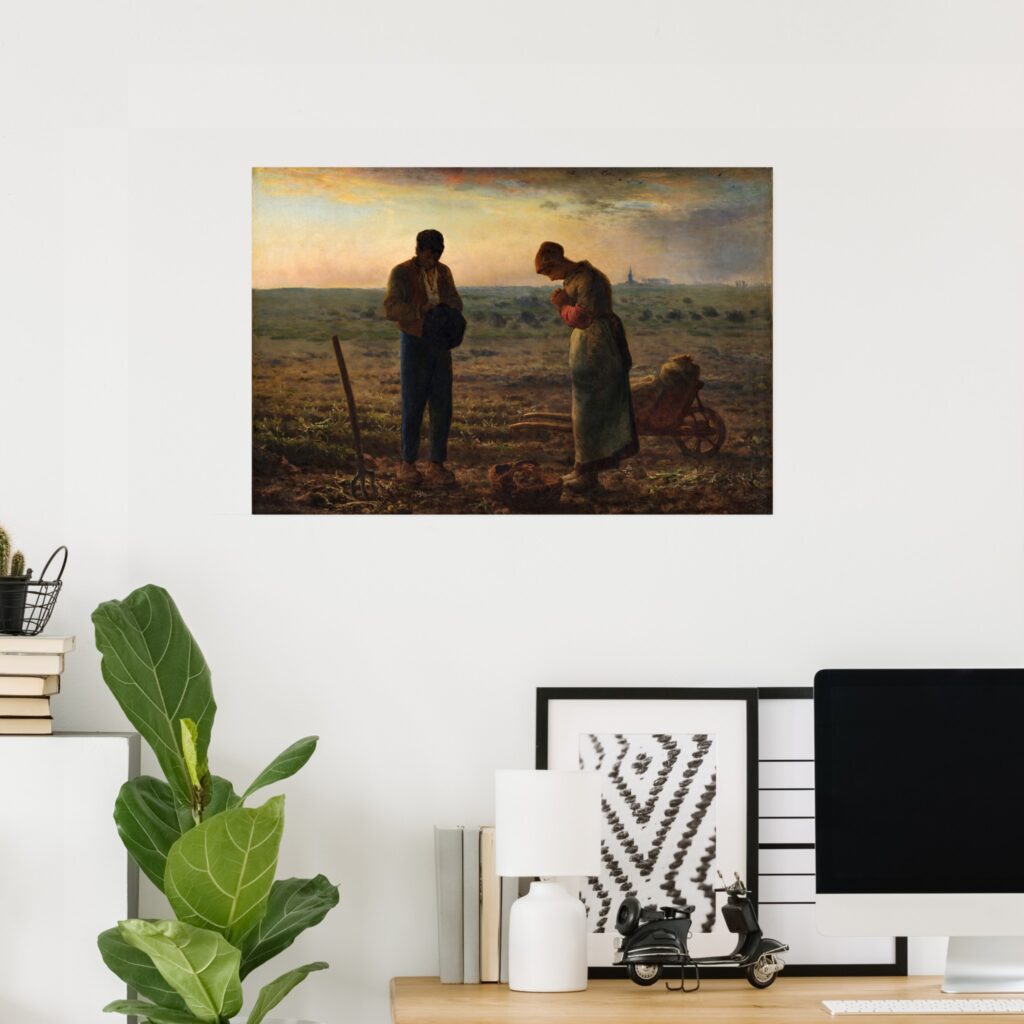
The emotional force of The Angelus depends heavily on its light. Millet sets the scene at dusk, when the day is ending and the last glow of sunlight lingers across the horizon. The sky is luminous but subdued, filled with muted golds, grays, and soft browns. This evening light creates a mood of calm reflection. It also suggests transition, the movement from labor into rest, from daylight into evening, from action into prayer.
The figures are partly silhouetted against the brighter sky, which gives them visual clarity while keeping their features subdued. We do not focus on facial detail. Instead, we read the body language. This is important because it makes the painting less about individual identity and more about shared human experience. The man and woman are specific peasants, but they are also types in the best sense of that word, embodiments of labor, devotion, and rural existence.
Millet’s color palette is earthy and restrained. Browns, ochres, muted greens, and soft blue gray tones dominate the field and clothing. Nothing is brilliant or ornamental. The colors belong to soil, cloth, and fading light. This harmony between figures and environment reinforces the idea that these people are rooted in the land. They are not separate from the field. Their lives arise from it.
The subdued palette also contributes to the solemnity of the scene. Brighter colors might have made the image more decorative or cheerful. Millet instead chooses tones that feel worn, humble, and serious. Yet the painting is not bleak. The sky retains warmth, and that warmth prevents the atmosphere from becoming hopeless. The light suggests consolation. It surrounds the figures gently, making the moment feel tender rather than harsh.
The Figures and the Language of Gesture
Millet says a great deal through very little. The figures do not perform elaborate motions, but every aspect of their posture matters. The man stands with his hat removed and his head lowered. His arms rest close to his body, and his stance is steady, solid, and humble. The woman bows more deeply and clasps her hands before her chest. Her gesture is more explicitly devotional, yet it remains restrained and natural.
These poses establish character without requiring narrative detail. The man seems tired, serious, and grounded. The woman appears devout and inwardly focused. Neither figure turns toward the other, but their silence connects them. They share a ritual without needing to acknowledge one another directly. This creates a powerful sense of communal privacy. Their prayer is together, but it is also individual.
Millet’s treatment of the figures avoids prettification. The bodies are sturdy and somewhat rough. The clothing is plain and functional. The woman’s apron and head covering, the man’s work clothes and hat, all speak of routine and necessity. This lack of idealization is crucial to the painting’s meaning. Millet is not interested in turning peasants into elegant allegories. He gives them dignity without denying the hardness of their lives.
At the same time, the figures possess a kind of grandeur that exceeds realism alone. Their silhouettes are simplified and strong. Their gestures are legible from a distance. In this way Millet approaches the condition of monumental art. These laborers seem almost timeless, as though they belong not only to a particular field in nineteenth century France but to a broader human history of work, prayer, and survival.
Spiritual Meaning and the Sacred Within Daily Life
The spiritual dimension of The Angelus is one of the main reasons it has remained so beloved. The painting presents faith not as an extraordinary event but as a daily practice embedded in ordinary life. The peasants do not leave their field to enter a church. Instead, the prayer reaches them where they are. The distant bell calls across the landscape, linking the visible world of labor to the unseen world of belief.
This is an important aspect of the painting’s emotional logic. The sacred is not separated from material life. It interrupts and sanctifies it. The potatoes in the basket, the tools in the soil, the tired bodies of the workers all remain present during prayer. Millet suggests that spiritual life does not float above hardship but exists within it. In that sense, The Angelus offers a deeply incarnational vision of faith, one in which the earthbound realities of hunger, fatigue, and labor are not denied but gathered into devotion.
The work also carries an undertone of mortality. Evening prayer itself suggests the passing of time. The field has been worked all day, and night is approaching. Some viewers have also sensed a mournful note in the bowed figures and the small basket between them, as if the painting touches not only on prayer but on loss. Whether or not that interpretation is emphasized, the image certainly has a gravity that goes beyond routine piety. It feels aware of the fragility of human life.
That awareness may help explain why the painting resonates even with viewers who are not religious. The scene communicates reverence in a broad sense. It is about pausing before something greater than oneself, acknowledging dependence, limits, and gratitude. The exact theology may belong to a specific Catholic tradition, but the emotional structure of the moment is widely legible.
Labor, Poverty, and Human Dignity
Another major aspect of The Angelus is its treatment of labor. Millet does not romanticize peasant work as carefree or picturesque. The field looks rough, the light is fading, and the workers appear weary. Their prayer takes place not after abundance but amid effort and scarcity. The basket of potatoes reminds us that what they harvest is humble food, tied to survival rather than luxury.
This material reality gives the painting much of its force. The figures are not praying from comfort. Their devotion exists alongside poverty and physical toil. That conjunction creates moral depth. Millet presents dignity as something independent of wealth, status, or refinement. The peasants possess seriousness because of who they are and how they bear their lives, not because society has granted them prestige.
In this sense, The Angelus participates in a broader nineteenth century revaluation of ordinary people as worthy artistic subjects. Yet Millet goes further than mere inclusion. He invests rural workers with a kind of silent nobility. Their value is not rhetorical or political in an obvious way. It is conveyed through form, scale, atmosphere, and attention. He paints them as if their lives matter absolutely.
This can be understood as both an artistic and ethical statement. To look carefully at humble laborers and to paint them with gravity is already to challenge social habits of disregard. Millet’s peasants are not background. They are the center. Their prayer, their fatigue, their pause at dusk become worthy of contemplation by anyone who stands before the painting.
Silence, Time, and Emotional Power
Few paintings communicate silence as effectively as The Angelus. Everything in the image seems hushed. We imagine the distant ringing of the bell, but otherwise the scene feels almost suspended outside noise. That silence is not emptiness. It is full of meaning. It allows the viewer to feel the pause, the inward turn, the temporary stilling of effort.
Millet also captures time in a subtle way. The painting represents a brief interval, yet it opens onto larger cycles. There is the cycle of the day, moving from work to evening prayer. There is the cycle of the agricultural year, with sowing, tending, and harvest. There is the cycle of human life, shaped by labor, ritual, and eventual death. All of these larger patterns are folded into the single moment the painting depicts.
This layered sense of time gives the image unusual emotional richness. The peasants pause for a minute or two, but the act seems ancient and repeated. It belongs to generations. The field has likely seen many such evenings, many such workers, many such prayers. The distant church reminds us of community and continuity, while the open land reminds us of solitude and the individual burden of work. Between those poles, the figures stand quietly, fully present.
The emotional effect is difficult to reduce to one feeling. The painting is solemn, but not despairing. Tender, but not sentimental. Serious, but not cold. It invites contemplation rather than reaction. Its sadness, if we call it that, is inseparable from its beauty. The dusk light, the bowed figures, and the humble tools all contribute to a mood that feels both grounded and transcendent.
Millet’s Technique and Artistic Achievement
Millet’s handling of paint in The Angelus supports the painting’s themes. The surface is soft and unified rather than sharply detailed. Forms emerge through tonal relationships and atmospheric blending more than through crisp contour. This approach helps create the enveloping dusk effect and keeps the composition coherent. The figures feel embedded in the environment rather than cut out from it.
At the same time, Millet is careful about structural clarity. The silhouettes of the figures are easy to read, and the major objects in the foreground are placed with purpose. The painting does not dissolve into vagueness. Instead, it balances atmosphere with solidity. This balance is one reason the work feels both poetic and real.
Millet’s technical achievement also lies in his ability to give grandeur to a modest subject without falsifying it. He enlarges the emotional register of the scene without turning it into melodrama. He simplifies, but he does not flatten. He dignifies, but he does not idealize beyond recognition. Such balance is difficult to achieve, and it helps explain why the painting became so influential and memorable.
Reception, Legacy, and Enduring Appeal
Over time, The Angelus became one of Millet’s most famous works and one of the defining images of rural devotion in European art. It appealed to a wide audience because it could be read in several ways at once. Some viewers responded to its religious feeling, others to its sympathy for peasant life, and others to its poetic atmosphere. That breadth of meaning helped the painting travel beyond its original context.
Its legacy also reflects changing attitudes toward realism and symbolism. On one level, the work is deeply rooted in observed rural life. On another, it feels almost archetypal. That dual nature has allowed it to remain relevant long after the specific world it depicts began to fade. Even in modern societies far removed from nineteenth century farming, the image still speaks through its themes of labor, reverence, time, and human vulnerability.
The painting endures because it addresses basic experiences with unusual seriousness. People work. People pause. People hope, pray, grieve, and continue. Millet does not exaggerate these facts. He lets them stand in their quiet fullness. The result is an image that feels larger than its modest scale of action.
Conclusion
The Angelus is a masterpiece of quiet intensity. Jean-Francois Millet takes an ordinary rural custom and reveals its emotional, spiritual, and social depth. Through a restrained composition, muted color, solemn light, and deeply expressive posture, he creates an image that honors both the hardship of peasant life and the dignity of those who live it. The painting is not dramatic in a conventional sense, yet it carries profound weight. Its stillness becomes its power.
What makes the work unforgettable is the way it joins opposites without forcing them. It is about labor and prayer, poverty and dignity, realism and symbolism, silence and meaning. The figures are specific enough to feel real and simple enough to become universal. Standing in the field at dusk, heads bowed before the evening bell, they embody a way of meeting life with humility and endurance.
Millet’s achievement in The Angelus is not only that he painted peasants sympathetically. It is that he made their pause in the field seem worthy of the deepest contemplation. He found grandeur not in spectacle but in attentiveness. He showed that an ordinary moment, honestly seen, can hold the weight of human existence.