Image source: wikiart.org
Carel Fabritius and the Quiet Brilliance of The Goldfinch
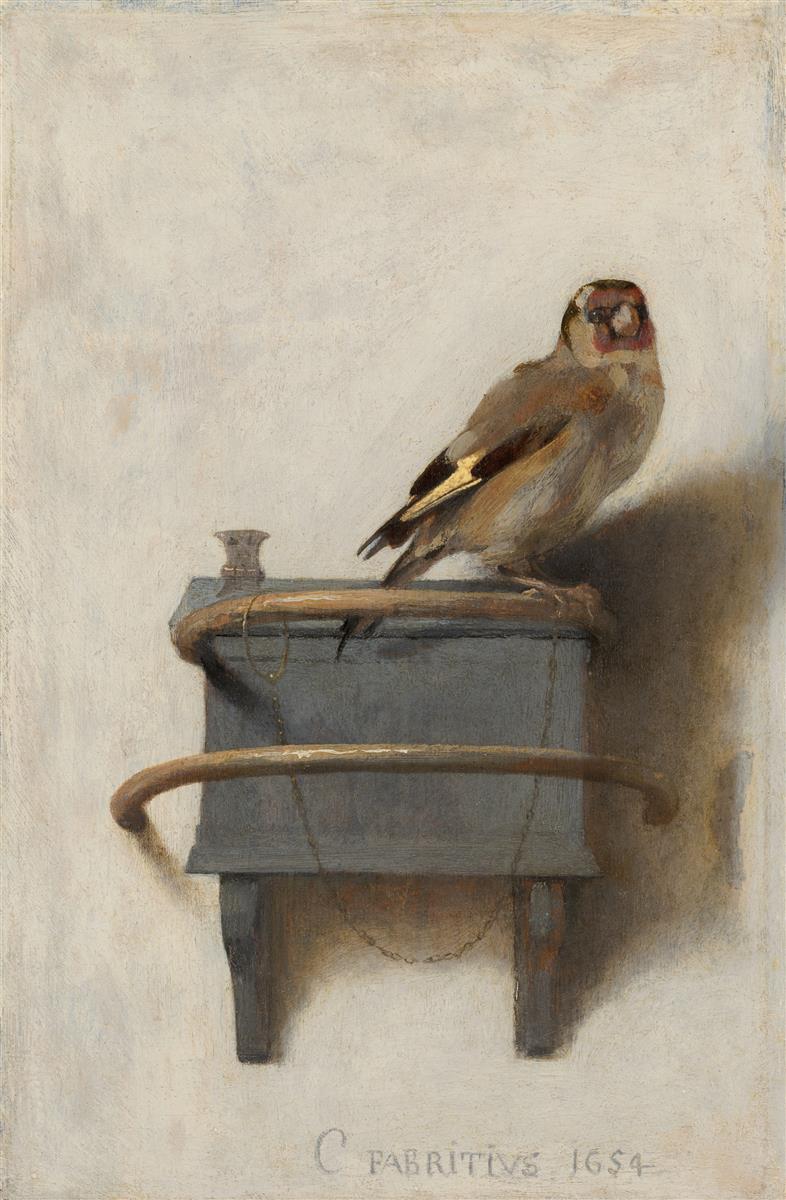
Carel Fabritius’s The Goldfinch, painted in 1654, is one of the most memorable small paintings in Dutch art. At first glance, its subject seems almost too modest to deserve such lasting attention. A single bird perches on a wooden box against a pale wall. There is no grand narrative, no crowded domestic interior, no impressive landscape, and no dramatic religious scene. Yet this very restraint is what gives the painting its uncommon power. Fabritius transforms an ordinary creature into an object of deep attention, and he does so with a precision and delicacy that make the image feel both immediate and mysterious.
What makes The Goldfinch so compelling is the tension between simplicity and richness. The composition is stripped down almost to the point of austerity, but the experience of looking at it is anything but empty. The viewer notices the bird’s alert posture, the warm tones of its feathers, the slight curve of the perch, the chain hanging below, and the soft fall of shadow against the wall. Every element matters. Because there is so little in the picture, the eye dwells on each form with unusual intensity.
This painting often surprises modern viewers because it feels strangely contemporary. Its blank space, its directness, and its emphasis on a single isolated subject can seem closer to later artistic ideas than to the visual density commonly associated with seventeenth century Dutch painting. But that modern feeling grows from Fabritius’s originality within his own time. He was capable of creating an illusion of reality that feels vivid without becoming theatrical. He gives the bird presence, not by overwhelming detail alone, but by carefully balancing light, surface, form, and emptiness.
Historical Context and Fabritius’s Place in Dutch Art
To understand The Goldfinch, it helps to place it within the world of the Dutch Golden Age. Seventeenth century Dutch painters were celebrated for their close observation of everyday life. They painted interiors, still lifes, portraits, animals, and city views with extraordinary skill. Their art often combined visual exactness with moral meaning, whether explicit or subtle. Within this culture, the depiction of a small bird was not an unusual subject in itself. Birds appeared in still lifes, genre scenes, and symbolic works. What is unusual is Fabritius’s treatment of the subject.
Carel Fabritius was one of the most gifted painters of his generation, and although his surviving body of work is small, it has had an outsized influence on art history. He is often discussed in relation to Rembrandt, under whom he likely trained, but Fabritius developed a distinct voice of his own. Where Rembrandt often emphasized darkness, interior depth, and dramatic psychological atmosphere, Fabritius moved toward greater luminosity and openness. His handling of space feels lighter, his surfaces less weighed down, and his images often possess a startling clarity.
The Goldfinch belongs to the final year of his life. That fact lends the picture an added poignancy, though its meaning does not depend on biography. Fabritius died in 1654 in the Delft gunpowder explosion, a catastrophe that also destroyed many works of art. The small number of paintings that survive from him has contributed to his reputation as a brilliant but tragic figure, an artist of immense promise whose career was cut short. In that sense, The Goldfinch has come to stand not only as a masterpiece in itself but also as a symbol of what was lost.
Yet the painting should not be viewed only through the lens of tragedy. It is above all a work of remarkable control and confidence. Fabritius was not merely producing a charming image of a pet bird. He was exploring what painting could do when the subject was reduced to essentials. He was interested in illusion, in the relationship between object and wall, in the effect of light on a plain surface, and in the ability of a small image to command sustained attention.
The Subject: A Common Bird Made Unforgettable
The goldfinch was a familiar bird in Europe and often kept as a pet. Its small size, bright markings, and lively character made it appealing, and in art it could carry symbolic associations, especially in religious contexts. The goldfinch was sometimes linked to Christ’s Passion because of medieval legends surrounding the bird. But in Fabritius’s painting, the symbolic meaning is not forced forward. The image feels grounded in ordinary life. This is a real bird, perched where it has likely perched many times before, attached by a chain to a simple feeding box.
That chain is a crucial detail. It reminds us that the bird is both admired and confined. The painting does not sentimentalize this fact, but it also does not ignore it. The goldfinch is alive, alert, and poised, yet it remains tethered. This introduces a subtle emotional complexity. The picture is serene, but not entirely innocent. It contains a quiet awareness of control, limitation, and domestic possession.
At the same time, the bird does not appear crushed by confinement. It retains dignity. Its posture is upright, its head turned slightly as if aware of the viewer’s presence. Fabritius gives it individuality without turning it into a human substitute. The goldfinch is not a mascot or a decorative detail. It is treated as a living being worthy of focused representation.
This is one reason the painting remains so affecting. It bridges categories. It is part animal study, part still life, part trompe l’oeil image, and part meditation on presence. The goldfinch exists as both a natural creature and a painted object. We see feathers, wood, metal, plaster, and shadow, but we also feel the concentration of the artist’s gaze. Fabritius asks us to take seriously something that many people would overlook. In doing so, he reveals how much visual and emotional depth can reside in the smallest of subjects.
Composition and the Power of Empty Space
One of the first things a viewer notices is how much of the painting is made up of empty wall. This blank field is not a background in the casual sense. It is an active part of the composition. The pale surface around the bird creates a zone of calm that isolates the subject and gives it extraordinary emphasis. There is nothing to distract from the goldfinch and its perch. The wall becomes a stage of silence.
This use of space is one of the painting’s most radical features. In many Dutch works, space is filled with descriptive detail, objects, textures, or architectural depth. Fabritius chooses instead to leave the surrounding area open. The result is a composition that breathes. The eye moves across the pale surface before settling on the bird, then returns again to the wall, noticing the subtle tonal variations and the shadow that anchors the central form.
The placement of the goldfinch is also carefully judged. It is not centered in a rigid or mechanical way. Instead, it sits slightly to one side, with enough surrounding space to keep the image dynamic. The box beneath it provides a stable vertical structure, while the curved perch introduces a softer rhythm across the lower portion of the image. The hanging chain adds a delicate vertical accent, balancing the bird’s compact body and the broader masses of wall and shadow.
Because the composition is so spare, every relation becomes legible. The slight tilt of the bird, the horizontal line of the perch, the rectangular solidity of the box, and the soft irregularity of the shadow all contribute to the painting’s equilibrium. There is a profound sense of order, but it never feels cold. The space around the bird is not empty in a lifeless sense. It is full of air, light, and quiet.
Light, Shadow, and Illusion
Fabritius was deeply interested in how light defines form, and The Goldfinch demonstrates his sensitivity with remarkable subtlety. The illumination is soft but decisive. It falls across the wall and the bird in a way that creates a convincing sense of physical presence. The shadow cast behind and beside the bird and box is especially important. It makes the perch seem to project into real space rather than sit flat against the picture plane.
This is where the painting approaches trompe l’oeil, the art of visual deception. Fabritius does not pursue illusion in an aggressive or flashy way. He does not crowd the surface with tricks. Instead, he relies on a restrained interplay of light and shadow to suggest that the bird, box, and perch occupy actual space in front of the wall. The effect is gentle but persuasive.
The shadow also adds emotional atmosphere. It deepens the otherwise pale field and gives the scene a sense of time and place. Without it, the image might feel too abstract or detached. With it, the bird seems truly present in a lit environment. The shadow grounds the composition, and its softness prevents the illusion from becoming harsh.
Fabritius understands that realism is not only a matter of detail. It is also a matter of relations. The brightness of the wall, the muted tones of the box, the darker marks of the bird’s wings, and the warm touches in the plumage all work together to create a believable visual world. Nothing is overstated. The illusion depends on calibration rather than spectacle.
Color and Surface
The palette of The Goldfinch is subdued, but it is far from monotonous. Fabritius uses a narrow range of tones with great sensitivity. The creamy off white of the wall sets the overall key. Against it, the bird’s browns, ochres, blacks, reds, and pale grays become more vivid than they would in a busier composition. The goldfinch’s famous markings, especially the warm golden band on the wing and the reddish area around the face, are not bright in an absolute sense, but they glow because the surrounding tones are so restrained.
This economy of color is essential to the painting’s effect. Fabritius does not overwhelm the viewer with decorative richness. He allows small accents to carry great weight. The bird’s coloring becomes a focal point, not because it is painted with flamboyance, but because it stands out within a carefully moderated tonal system.
The surface handling is equally important. Fabritius’s brushwork has a tactile intelligence. Some passages are smooth and thin, particularly in the wall, while others feel denser and more textured, especially in the bird and the perch. This variation prevents the painting from becoming inert. The viewer senses both the softness of feathers and the sturdiness of wood, yet the handling remains painterly. Fabritius never loses sight of the fact that this is paint on a flat support.
That balance between illusion and painterliness is one of the work’s greatest achievements. The bird appears tangible, but the surface never becomes mechanically descriptive. The viewer is allowed to enjoy both the reality of the depicted object and the artistry of its making. Up close, the forms are built from strokes and tonal adjustments. From a distance, they cohere into a convincing presence.
The Emotional Tone of the Painting
Although The Goldfinch is small and quiet, it carries a distinct emotional atmosphere. The dominant mood is one of stillness. The bird does not flutter wildly. The scene is neither sentimental nor dramatic. Instead, Fabritius offers a moment of pause. The goldfinch is watchful, calm, and self contained. The empty wall around it enhances this sense of silence.
That stillness is part of what gives the painting its contemplative power. Viewers often respond to it as if encountering not just an image, but a kind of suspended moment. The painting invites slowness. It asks the eye to rest and observe. In a culture saturated with spectacle, that quality feels especially powerful today, but it must have had force in Fabritius’s own time as well.
There is also a quiet tenderness in the way the bird is rendered. Fabritius does not idealize the creature, yet he attends to it with evident care. The result is not cute or decorative. It is intimate in a more serious way. We feel that the artist has truly looked at this bird, not merely noted its type. He has registered its weight, posture, and character.
At the same time, the chain introduces an undercurrent of tension. The painting does not become sad, but it is not wholly carefree either. The goldfinch exists within human control. That fact makes the bird’s alert dignity more moving. The image becomes, in part, a reflection on vulnerability. The creature is cherished, displayed, and confined all at once.
Why The Goldfinch Feels So Modern
Many viewers are struck by how modern The Goldfinch appears. This reaction is understandable. The painting’s pared down composition, its emphasis on a single object, and its broad areas of near emptiness anticipate artistic values often associated with much later periods. There is an almost minimalist confidence in the way Fabritius allows blank space to dominate the image. He does not fear silence.
The modern feeling also comes from the painting’s directness. There is no elaborate frame within the painted world, no decorative setting to soften the encounter. The bird confronts us almost as an isolated fact. We are asked to consider it in its singularity. That kind of concentration can feel closer to modern still life or even modern photography than to the narrative richness of much seventeenth century art.
Yet what is fascinating is that Fabritius achieves this modern effect without abandoning the concerns of his own age. He is still deeply invested in light, illusion, material presence, and observation from life. The painting is not modern because it rejects the past. It feels modern because Fabritius found a visual language so distilled and clear that it remains fresh centuries later.
This is often the mark of a truly great work. It belongs to its historical moment, but it also exceeds that moment. The Goldfinch is unmistakably a Dutch seventeenth century painting, yet it speaks across time with unusual immediacy. Its quietness has not become obsolete. Its restraint has not weakened its impact. If anything, those qualities have made it more enduring.
The Signature, the Date, and the Sense of Presence
At the bottom of the painting, Fabritius included his name and the date, 1654. This inscription does more than record authorship. It anchors the painting in a specific moment and reminds the viewer that this exquisite study was made by a real hand in a real year. Because the work is so intimate, the signature feels almost like a whispered confirmation of presence.
There is something especially poignant about the date because it marks the final year of Fabritius’s life. But even aside from biography, the inscription contributes to the work’s sense of self awareness. This is not an anonymous image of a bird. It is a crafted object, signed by an artist who understood its value. The modesty of the subject is matched by the confidence of the execution.
The painting’s small scale also matters here. It is not monumental, yet it holds itself with extraordinary authority. The signature helps reinforce that authority. Fabritius seems to say that this simple goldfinch, painted with full seriousness, deserves a place among significant works of art. History has proven him right.
The Lasting Legacy of The Goldfinch
The continuing fame of The Goldfinch rests on more than novelty or charm. It endures because it demonstrates how much can be achieved through restraint, observation, and sensitivity to form. Fabritius proves that a painting does not need grandeur to be unforgettable. A bird on a perch, painted with intelligence and feeling, can become one of the most haunting images in European art.
Its legacy also lies in its ability to alter our expectations. After seeing The Goldfinch, viewers may look differently at small things, at empty space, at the relationship between object and light. The painting trains attention. It teaches us that visual depth can emerge from simplicity, and that emotional resonance can arise from quiet rather than drama.
In art historical terms, the work stands as one of the clearest expressions of Fabritius’s distinct genius. He absorbed lessons from Rembrandt but moved in his own direction, toward brightness, openness, and refined illusion. In cultural terms, The Goldfinch has become an emblem of survival, fragility, and artistic concentration. In purely visual terms, it remains a masterpiece of balance.
What lingers after viewing the painting is not only the image of the bird itself, but the quality of attention the painting creates. Fabritius does not merely show us a goldfinch. He teaches us how to see it. The work slows perception, sharpens awareness, and turns a fleeting subject into a lasting presence. That is why The Goldfinch continues to captivate viewers centuries after it was painted. Its stillness is alive, its simplicity is profound, and its quiet world remains impossible to forget.