Image source: wikiart.org
John Singer Sargent’s Madame X: A Complete Analysis of Style, Scandal, and Modern Portraiture
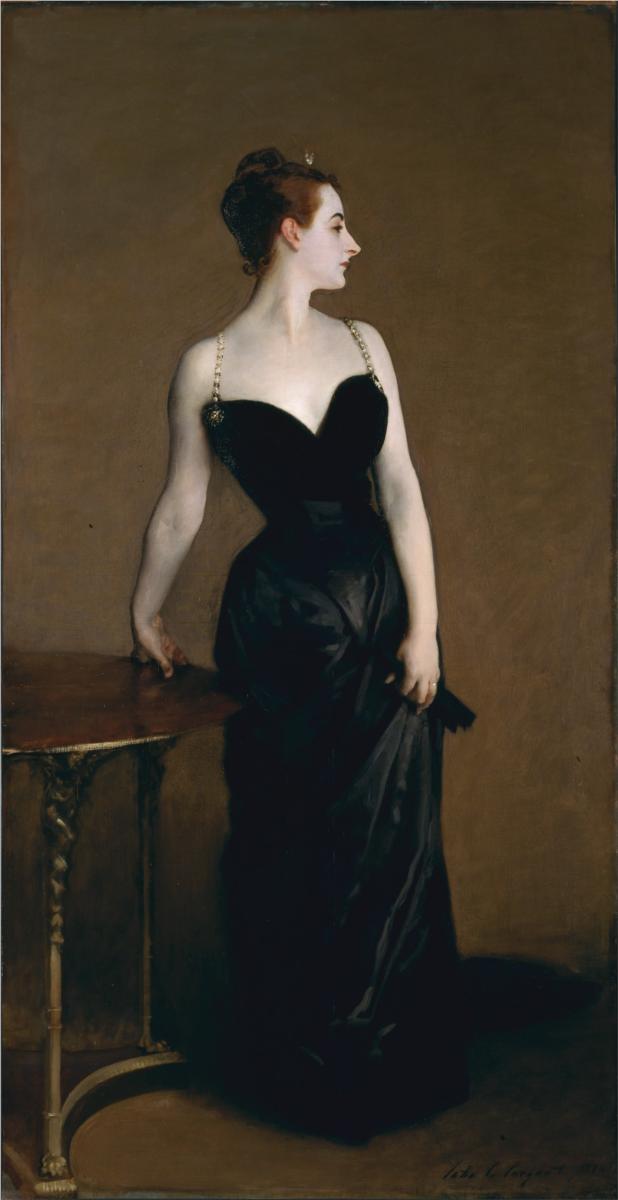
John Singer Sargent’s Madame X is one of the most arresting portraits of the nineteenth century. Painted in 1884, it has lost none of its ability to stop viewers in their tracks. At first glance, the image appears simple. A woman in a black evening gown stands against a warm brown background, turning her head away from the viewer while one hand rests lightly on a table. Yet the longer one looks, the more the portrait reveals itself to be a carefully controlled drama of beauty, distance, performance, and social risk. Sargent took the conventions of elite portraiture and pushed them toward something sharper, stranger, and more modern.
The painting is famous not only because it is visually powerful, but also because it became the center of controversy when it was first exhibited. That history has shaped the way it is still seen today. Even without knowing the scandal, however, the picture carries a sense of tension. The subject appears elegant and self possessed, but also slightly inaccessible. She is present before us in full length, yet emotionally remote. The body is displayed, the face is turned away, and the overall effect is one of cool magnificence rather than warmth. Sargent does not give viewers an intimate personality study. Instead, he presents a dazzling surface whose control is so absolute that it becomes unsettling.
This tension is what makes Madame X such an enduring masterpiece. It is not simply a flattering society portrait. It is a painting about appearance itself, about what it means to be seen, admired, judged, and remembered. Sargent turns fashionable portraiture into something almost theatrical, but the performance never slips into simple decoration. Every formal choice, from the severe silhouette of the dress to the nearly sculptural brightness of the skin, contributes to a larger meditation on beauty and social identity. The portrait is elegant, but its elegance has an edge. That edge is one reason the painting still feels modern.
The Woman Behind the Portrait
The subject of Madame X was Virginie Amélie Avegno Gautreau, a celebrated Parisian socialite known for her beauty and her striking public presence. She was an American born woman who had married a French banker and become a notable figure in elite Parisian society. Sargent did not paint an anonymous ideal. He painted someone already famous in her social world, someone whose image circulated through gossip, fashion, and reputation before it ever appeared on canvas.
This fact matters because the portrait depends on the interaction between private person and public persona. Gautreau was not only an individual sitter. She was already a spectacle. Sargent seems to have understood that what made her compelling was not sweetness or intimacy, but distinction. He did not try to soften her into a conventionally approachable beauty. Instead, he heightened the qualities that made her memorable. Her pale skin, elongated profile, dark hair, and poised bearing become elements in a highly stylized construction of social allure.
The title Madame X adds another layer to this dynamic. Although the sitter’s identity was known at the time, the painting later acquired its more mysterious title, which gives the portrait an almost symbolic force. She becomes not only Gautreau, but an icon of fashionable femininity and social performance. The name turns a society portrait into a legend. It distances the woman from the historical moment even as it intensifies her aura. She becomes less a person one knows and more a figure one contemplates.
That transformation from sitter to symbol is central to the painting’s power. Sargent records a specific face and body, yet he also creates a type. She is the embodiment of cultivated glamour, but also of modern detachment. Her identity seems both precise and elusive. We are invited to look, but not to know too much. The portrait holds back just enough to make its mystery permanent.
Composition and the Art of Control
One of the most remarkable aspects of Madame X is its compositional discipline. The figure stands vertically in a tall format, dominating the canvas with an almost architectural clarity. The pose is carefully balanced. Her torso faces forward, her head turns to the side, and one arm reaches outward to the table. This produces a subtle tension between stability and movement. She appears posed, but not stiff. The image feels still, yet charged.
Sargent reduces the setting to essentials. There is no elaborate interior, no distracting decoration, no narrative props beyond the small table at the left. This restraint focuses all attention on the figure and on the abstract relationships between line, mass, and light. The sweep of the dress, the long pale neck, the angled profile, and the curve of the arm create a network of elegant contours that guide the eye through the composition. Even the negative space around her matters. The large expanse of brown background isolates her, making her appear even more singular and statuesque.
The table plays an important structural role. It anchors the left side of the composition and gives the extended arm somewhere to land. Without it, the figure might seem too weightless or decorative. With it, the pose gains authority. The hand resting on the tabletop suggests composure, but it also creates a physical relationship between body and space. This is not just a floating vision of beauty. It is a body placed deliberately within a shallow, controlled environment.
The composition also depends on contrast. Her black dress stands against the warm brown background with great force, while the brightness of her skin emerges almost like light from darkness. Sargent uses these oppositions not only to make the figure vivid, but to simplify her into a striking visual statement. She becomes a set of bold relationships between dark and light, curve and vertical, exposure and concealment. This clarity is one reason the portrait remains so memorable after a single glance.
The Power of the Pose
The pose in Madame X is one of the most discussed elements of the painting, and with good reason. It is unusual, self aware, and slightly confrontational. Gautreau does not meet the viewer’s gaze. Instead, she turns away in profile, as if occupied by a world beyond the frame. This refusal of direct eye contact creates distance. She is available to be seen, but not fully available to the viewer. The result is a portrait that feels cool rather than inviting.
Her posture contributes strongly to this impression. The body is upright and poised, with the chest lifted and the waist tightly defined by the dark gown. The line of the neck is especially important. It is elongated and graceful, almost exaggerated in its elegance, giving her the presence of a classical statue. Yet the effect is not antique calm alone. There is also something deliberately artificial about the pose, as though Sargent wants us to see that this beauty is a performance as much as a natural state.
The turned head intensifies the drama. Profile views have a long history in portraiture, often associated with medals, cameos, and antique forms of idealization. Sargent uses the profile not to flatten the sitter into mere type, but to sharpen her distinctiveness. Her nose, chin, and forehead form a clean and unmistakable silhouette. The face becomes a line of pure design. This emphasis on profile also reinforces her emotional inaccessibility. We do not encounter her inwardly. We encounter her as image.
The right hand, which gathers a fold of the dress, adds another note of control. It is not a relaxed gesture. It feels deliberate, almost ceremonial. Together, the hands, the turn of the head, and the vertical stance create a figure who seems intensely aware of her own effect. She is not being casually observed. She is staging herself, and Sargent makes that act of self presentation the subject of the painting.
Color, Light, and the Black Dress
The color scheme of Madame X is deceptively restrained. Much of the painting is built from blacks, browns, flesh tones, and subtle highlights. Yet this limited palette is exactly what gives it such force. Sargent knows that a narrow range can produce greater intensity when handled with precision. The black dress is the visual center of the composition, but it is not a flat block of darkness. Its surface is alive with tonal variations, soft reflections, and folds that catch the light just enough to suggest texture without weakening the severity of the silhouette.
Black in portraiture can easily appear heavy or dull. Here it becomes sophisticated and dramatic. The gown defines the sitter’s body with extraordinary economy. Its plunging neckline frames the pale upper chest and shoulders, setting up one of the most important contrasts in the painting. The dark fabric seems to absorb light, while the skin seems to emit it. This makes Gautreau’s body appear almost luminous, as though she is carved from ivory or marble.
The background is equally important. Its warm brown tones provide a subdued field that supports the figure without competing with her. Sargent keeps it atmospheric and soft, allowing the figure’s sharper contours to emerge with clarity. The result is not a realistic room in detail, but a pictorial space designed to heighten the figure’s presence. This background also contributes to the painting’s mood. Its warm darkness feels elegant but slightly airless, reinforcing the sense that the subject exists within a rarefied social world.
Light falls across the sitter in a highly selective way. Sargent does not flood the entire scene with even illumination. Instead, he concentrates brightness on the face, neck, shoulders, and arms. These exposed areas become the painting’s most startling visual accents. The skin is so pale against the surrounding darkness that it appears almost unreal. This treatment of light pushes the portrait beyond ordinary likeness toward a more stylized vision of beauty. Gautreau is not just represented. She is staged as a visual phenomenon.
Scandal, Reception, and Social Anxiety
When Madame X was exhibited at the Paris Salon of 1884, it provoked a backlash that has become nearly as famous as the painting itself. Part of the controversy centered on the gown and on the original position of one shoulder strap, which in the first version appeared to have slipped off the shoulder. That small detail was enough to transform a portrait of elegance into an object of public unease. Viewers saw not simply a beautiful woman, but a suggestion of impropriety, display, and erotic self consciousness.
The reaction reveals much about the limits of acceptable femininity in upper class portraiture at the time. Society could admire beauty, fashion, and refinement, but only within carefully maintained boundaries. Sargent approached those boundaries and crossed them. He painted Gautreau not as a modest ornament of society, but as a woman whose beauty had force, intention, and theatricality. The portrait seemed too aware of its own sensual power. It did not reassure viewers. It exposed the tension between admiration and judgment that structured elite social life.
Sargent eventually repainted the strap into a more secure position, but the damage to the painting’s reception had already been done. Gautreau reportedly suffered embarrassment, and Sargent himself was shaken by the criticism. Yet from a modern perspective, the controversy is revealing because it points to what is genuinely bold in the portrait. The painting was not scandalous merely because of exposed skin. Many portraits of the period displayed shoulders and arms. What made this one unsettling was the total effect of the figure. She appears proud, detached, and entirely conscious of being seen. There is no softening anecdote, no domestic setting, no sentimental expression to make her harmless.
In this sense, the scandal tells us that Madame X was ahead of its time. It anticipated a more modern kind of portrait, one interested not only in status but in psychological tension and public image. The outrage was a sign that Sargent had captured something society preferred not to confront directly: the instability of respectability when it becomes entangled with spectacle.
Sargent’s Technique and Painterly Intelligence
John Singer Sargent was one of the greatest portrait painters of his era, and Madame X shows why. The painting combines meticulous control with visible freedom, especially in the handling of fabric and background. Sargent was a master of making surfaces appear both convincing and alive. He could render flesh with soft delicacy, satin with fluid shimmer, and background atmosphere with a few confident passages that never call too much attention to themselves.
The technical brilliance of the portrait lies partly in its restraint. Sargent does not overload the canvas with descriptive detail. He chooses carefully where to sharpen and where to soften. The face, shoulders, and neckline are given great attention because they carry so much of the portrait’s expressive charge. Other areas, especially in the lower dress and the background, are handled more broadly. This variation creates hierarchy. The eye knows where to go because the painting itself directs attention through differences in finish.
His brushwork in the black dress is especially impressive. Black fabric can be notoriously difficult to paint because it must convey volume and texture without losing its darkness. Sargent solves this by using subtle tonal shifts and controlled highlights. The dress has weight and drape, but it also retains a sleek, almost abstract unity. It reads both as luxurious material and as a graphic shape.
The flesh tones are equally skillful. Gautreau’s skin is rendered with a cool, refined palette that makes her appear almost sculpted. There is very little rosy warmth. Instead, the skin has a porcelain clarity that contributes to the portrait’s chill. This was a daring choice. A warmer treatment might have made her seem more accessible, more conventionally alive. Sargent instead emphasizes elegance at the edge of artifice. He paints beauty so polished that it becomes slightly inhuman, and that quality is central to the portrait’s fascination.
Femininity, Fashion, and Modern Identity
At its core, Madame X is a painting about the construction of feminine identity in modern urban society. Everything about the portrait points to the importance of appearance as a social language. The dress, hairstyle, pose, and bearing all communicate status, taste, and self possession. Yet the painting also suggests that such identity is never simple. It is built through performance, discipline, and exposure to judgment.
Fashion is crucial here. The black gown is not merely clothing. It is a formal device that shapes the body into a dramatic silhouette. It conceals and reveals at the same time. The shoulders and upper chest are exposed, but the rest of the body is enveloped in dark fabric. This combination gives the figure both sensuality and severity. She looks glamorous, but also armored. The dress makes her desirable, yet it also makes her untouchable.
Sargent seems deeply interested in this duality. Gautreau is presented as a woman whose power lies partly in being seen, but also in controlling the terms of that visibility. She does not smile, does not lean toward the viewer, does not offer emotional openness. Her beauty is public, but her inner self remains withheld. This creates a distinctly modern image of femininity, one shaped not by domestic intimacy but by spectacle, image management, and cool self fashioning.
The portrait also complicates easy ideas of empowerment. Gautreau appears powerful in her poise and striking presence, yet the history of the painting reminds us that female visibility in public culture came with enormous risk. To stand out was to invite scrutiny. To be memorable was to become vulnerable to gossip and moral judgment. Sargent captures that paradox with extraordinary precision. Madame X is not simply a celebration of beauty. It is a study of beauty as a social force that attracts both admiration and punishment.
Why Madame X Still Feels Modern
Many nineteenth century society portraits now seem tied to their moment, but Madame X continues to feel alive because its concerns are still recognizable. It is a picture about image, allure, public perception, and the instability of fame. It understands that beauty in modern society is never innocent. It is performed, circulated, and judged. That insight gives the painting a relevance that reaches far beyond its original context.
The portrait also feels modern because of its formal boldness. Sargent strips away many of the reassuring conventions of aristocratic portraiture and leaves us with something leaner, colder, and more concentrated. The space is spare, the color scheme reduced, the mood tense. Rather than surround the sitter with symbols of character or luxury, he turns her body itself into the main site of meaning. The result has a clarity that anticipates later modern aesthetics, where design, surface, and psychological ambiguity often matter more than narrative detail.
There is also the question of ambiguity. Great modern works often resist a single stable reading, and Madame X does exactly that. Is it admiring or critical? Is Gautreau shown as triumphant, trapped, artificial, independent, or all of these at once? The portrait never settles into one answer. That openness is part of its strength. It allows each generation to find new meanings in the image, from discussions of gender and performance to broader reflections on celebrity and self presentation.
In the end, Madame X endures because it combines beauty with unease. It is exquisitely made, instantly recognizable, and deeply intelligent about the world it depicts. Sargent transformed a society portrait into a lasting work of art by refusing to flatter in any ordinary way. He painted not just a woman in an elegant dress, but a culture of looking, desiring, and judging condensed into a single unforgettable figure.
Conclusion
Madame X remains one of John Singer Sargent’s defining achievements because it joins technical brilliance to psychological and social complexity. The painting is beautiful, but its beauty is sharpened by restraint and tension. Gautreau’s turned head, luminous skin, and severe black gown create a portrait that is at once glamorous and unsettling. Sargent gives us a figure who seems fully aware of her own power as an image, yet also exposed to the risks that such visibility brings.
The portrait’s scandal has become part of its legend, but the painting would be remarkable even without that history. Its power lies in how completely every element works together. Composition, color, pose, and finish all contribute to a vision of modern femininity defined by elegance, distance, and performance. Sargent does not merely record appearance. He shapes it into something iconic.
That is why Madame X still commands attention. It offers the pleasure of surface and the depth of interpretation. It is both a masterpiece of portrait technique and a subtle examination of social identity. Few paintings capture with such precision the moment when beauty becomes image, and image becomes fate.