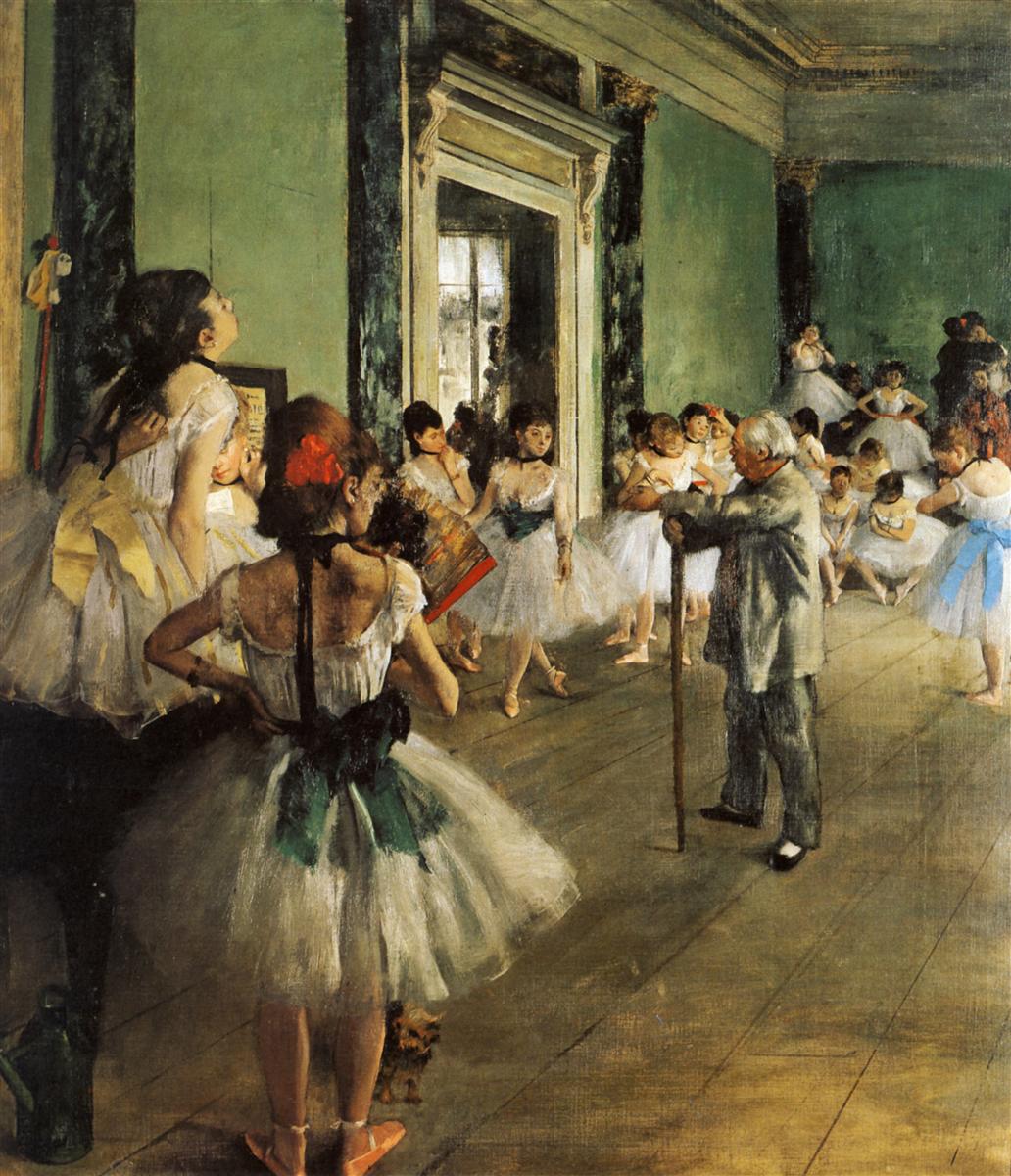
Image source: wikiart.org
Edgar Degas and the world of The Ballet Class
Edgar Degas’s The Ballet Class from 1874 is one of the most compelling images of nineteenth century modern life. At first glance, it appears to show a simple rehearsal scene. Young dancers gather in a studio, some attentive, some distracted, while an elderly ballet master stands at the center directing the lesson. Yet the longer one looks, the more the painting opens into something richer and more complex. This is not an idealized picture of dance as pure grace. It is a study of work, fatigue, routine, elegance, discipline, and observation. Degas turns what could have been a polished theatrical subject into a vivid and psychologically layered scene from everyday artistic labor.
The painting is deeply associated with Degas’s fascination with the Paris Opéra and the world surrounding ballet. He was drawn not only to performance, but also to the hidden spaces behind it. Instead of focusing only on a dancer posed beautifully on stage, he often explored rehearsals, waiting rooms, practice sessions, and moments of rest. In doing so, he revealed the contrast between public glamour and private effort. The Ballet Class belongs to that vision. It gives viewers access to the room before the finished spectacle, where bodies stretch, sag, lean, listen, and recover.
What makes this painting especially powerful is its refusal to simplify the scene. Degas does not present the classroom as orderly or symmetrical in a conventional academic sense. Instead, he arranges the figures so that the room feels alive and irregular, filled with shifting attention and overlapping gestures. Some dancers turn away, some listen, some adjust their clothing, and some seem almost lost in their own physical state. This creates a sense of lived reality. The painting feels observed rather than staged, even though Degas carefully structured every part of it.
The result is a work that combines beauty with truthfulness. It invites admiration for the dancers’ world, but it also insists on seeing the strain, repetition, and human complexity that underlie artistic achievement.
Historical context and Degas’s interest in modern Paris
To understand The Ballet Class, it helps to place it within the broader culture of Paris in the late nineteenth century. Degas was painting during a time of rapid urban change. Paris was being transformed by modernization, new boulevards, shifting social structures, and a growing urban culture centered on entertainment, fashion, and public spectacle. The ballet became one of the defining institutions of this world. It occupied a special place in the city’s imagination, combining refinement, prestige, performance, and social ritual.
Degas was fascinated by modern subjects, but he approached them differently from many other painters of his time. While some artists emphasized open air leisure or bright landscapes, Degas often turned toward interiors, rehearsal rooms, theaters, laundries, and racecourses. He was interested in contemporary life, but he did not always present it as carefree or idyllic. Instead, he focused on observation, structure, and the behavior of people within specific spaces.
Ballet offered him a perfect subject because it joined grace and labor in the same setting. Audiences saw beauty and elegance on stage, but Degas understood that behind the polished performance lay years of instruction, endless repetition, and the management of the body. He painted dancers not as abstract symbols of lightness, but as workers in a demanding artistic system. This perspective gives The Ballet Class its seriousness. The painting is not just decorative. It is analytical in the best sense, attentive to what the eye often misses.
The presence of the ballet master is also important in this context. His figure represents authority, tradition, and discipline. The classroom is not a dreamy space of free expression. It is a place governed by correction, hierarchy, and training. Degas captures that structure without turning the scene into something harsh. He shows a world where refinement is created through effort, posture, and repetition.
Composition and the feeling of a real room
One of the most remarkable features of The Ballet Class is its composition. Degas constructs the scene so that it feels both carefully organized and spontaneously glimpsed. The room stretches inward, drawing the viewer’s eye from the dancers in the foreground toward the figures at the back. The ballet master stands near the center, but he is not presented like a heroic focal point in a traditional history painting. Instead, he anchors the space as part of a larger web of human activity.
The composition feels asymmetrical, which is one reason it seems so natural. The dancers are distributed across the room in clusters rather than arranged in a neat line. Some stand close to the picture plane, especially the figure seen from behind in the foreground, while others recede into the distance. This creates a strong sense of depth and makes the studio feel occupied rather than decorated. Degas uses the floorboards, walls, and doorframe to guide the eye through the space, but he avoids the rigid centered balance of academic painting.
The foreground dancer with her back to the viewer is especially significant. Her broad white tutu and dark ribbon dominate the lower left portion of the canvas, creating both a visual anchor and a barrier. She partly blocks our entry into the room, making us feel as though we are standing at the edge of the class, observing from a slightly awkward but revealing angle. This is characteristic of Degas. He often used unusual viewpoints and cropped arrangements that suggest immediacy and visual truth.
The large doorway near the center also plays an important role. It divides the wall and introduces another layer of space beyond the main room. Reflections and openings complicate the interior, making it feel less flat and more atmospheric. Instead of presenting a single simple chamber, Degas suggests a network of spaces, glances, and movements. The painting breathes because its structure allows the eye to wander.
This compositional freedom is one of the reasons the painting feels modern. It does not look like a frozen tableau. It looks like life captured in passing, even though that effect is the result of great control.
The dancers as individuals rather than ornaments
Another major strength of The Ballet Class lies in the way Degas treats the dancers. Although they wear similar white costumes and belong to the same institutional setting, they do not dissolve into sameness. Each figure seems to have her own posture, mood, and degree of attention. Degas resists the temptation to turn ballet into a decorative repetition of identical forms. Instead, he presents a group of individuals connected by training but separated by experience.
Some dancers stand upright and ready, listening to instruction. Others appear tired or distracted. One bends forward. Another leans casually. Some gather in pairs, while others seem briefly isolated in thought. These variations are crucial because they give the painting its psychological realism. Degas is not simply painting dancers as symbols of grace. He is painting young people inhabiting their bodies in different ways at a specific moment in time.
The figure of the ballet master intensifies this sense of individuality. He is not merely a prop or costume figure. His presence organizes the room and shapes the responses of the dancers around him. He appears to be speaking or correcting, and the dancers’ body language reflects their differing relationships to authority. Some seem attentive, others appear less engaged, and some are perhaps waiting for their turn. This subtle range of reactions creates a believable social atmosphere.
The dancers’ faces are not all fully defined in a portrait-like manner, but Degas still gives each one enough character to prevent anonymity. He relies on gesture as much as facial expression. A tilted head, a bent arm, a shifted hip, or a slumped shoulder can reveal as much as a detailed face. This emphasis on bodily language is perfectly suited to the subject of dance, where meaning is constantly expressed through posture and movement.
The painting therefore becomes not only a scene of ballet instruction, but also a study of human presence. Degas notices how people wait, how they listen, how they endure boredom, and how they inhabit shared spaces. That human truth is one of the painting’s lasting attractions.
Color, light, and the atmosphere of the studio
The color palette of The Ballet Class is quieter and more complex than the bright whiteness of the tutus might suggest. Degas builds the room out of muted greens, warm browns, creams, blacks, and soft grays. These colors create an atmosphere that feels interior, slightly worn, and very real. The studio is not idealized into a sparkling fantasy world. It has weight, air, and age.
The green walls are particularly important. They provide a subdued background that allows the pale dresses of the dancers to stand out while also giving the room a distinctive tonal identity. The green is not merely decorative. It shapes the emotional mood of the painting. It contributes to a sense of coolness and calm, but also to a subtle seriousness. This is a working room, not a dream palace.
The whites of the tutus are equally complex. They are not flat or uniform. Degas modulates them with warm and cool tones, shadows, and flickering strokes so that fabric seems light, airy, and mobile. The tutus catch the light differently depending on their position, which helps distinguish each figure and enrich the visual texture of the scene. White becomes an active color in the painting rather than a blank one.
Light itself is handled with remarkable subtlety. It seems to enter the room indirectly, touching surfaces rather than flooding them. Degas is not concerned with dramatic illumination. Instead, he creates a diffused studio light that reveals forms gently and unevenly. This kind of lighting supports the painting’s atmosphere of observation. It feels true to an interior where dancers practice rather than perform.
The darker tones also matter. Black ribbons, dark hair, shadowed architectural elements, and the gray clothing of the ballet master provide contrast and structure. They keep the painting from dissolving into softness. Degas balances delicacy with firmness, brightness with weight. This balance is central to the painting’s visual success.
Movement and stillness in the same image
A painting of dancers naturally raises the question of movement. Yet one of the most striking things about The Ballet Class is that it does not show dance in its most obviously dynamic form. There is no grand leap, no spectacular turn, no climactic stage effect. Instead, Degas explores the relationship between movement and pause. The room is full of dancers, but many of them are resting, waiting, adjusting, or listening. The painting becomes a meditation on the intervals that make performance possible.
This is a brilliant choice because it brings the reality of dance closer to the viewer. Ballet is not made only of finished poses. It is built from repetition, correction, observation, and recovery. Degas captures these quieter states with extraordinary sensitivity. A bent knee, a slouched torso, a lifted arm, or a foot positioned in preparation can suggest both the memory of motion and the anticipation of motion. The body is never completely still, even when resting.
The figure at the center, the ballet master, provides another kind of movement. His gesture and stance imply direction, instruction, and rhythm. He gives the room its internal order. Around him, the dancers’ varied poses create a scattered but coherent choreography of attention. The painting is therefore dynamic without being theatrical. It moves through subtle relationships rather than dramatic action.
Degas’s brushwork reinforces this effect. Some passages are precise, while others are loose and almost flickering. The tutus in particular seem to tremble at the edges, as if movement still lingers in the fabric. This painterly quality prevents the scene from becoming rigid. The eye senses motion even where the body rests.
By focusing on these in-between moments, Degas reveals something profound about artistic practice. Beauty is not only found in the perfected instant. It is also present in effort, transition, and incompletion.
Discipline, repetition, and the reality behind elegance
One of the deepest themes in The Ballet Class is discipline. Everything in the room points toward structure and training. The dancers are not simply expressing themselves freely. They are being shaped by rules, by the authority of the instructor, and by the demands of an institution. Degas does not make this oppressive, but he makes it visible. That visibility is essential to the painting’s honesty.
The ballet master stands as the embodiment of this disciplined world. He is older, solid, and fully clothed, contrasting sharply with the young dancers in their delicate rehearsal dress. He represents knowledge, correction, and continuity. His cane or staff emphasizes his role as guide and authority figure. Around him, the dancers display the consequences of long practice. Their bodies are elegant, but they also show effort. Their poses are not effortlessly angelic. They are the result of labor.
This theme gives the painting a modern seriousness. Degas refuses to separate beauty from work. The scene is attractive, but it is not sentimental. It does not invite viewers to imagine ballet as a purely magical realm. Instead, it reveals the routine that underlies grace. The dancers must wait, repeat, listen, and endure fatigue. Even their stillness feels conditioned by training.
There is also a subtle social dimension here. The world of ballet in Degas’s Paris was bound up with institutions, class structures, and public culture. While The Ballet Class does not turn these issues into overt commentary, it hints at them through its focus on discipline and hierarchy. The room is a place where bodies are shaped for display, but the display is not yet happening. We see the preparation rather than the finished social product.
This is one reason the painting remains compelling. It shows the reality behind the surface. It invites admiration, but it also invites thought.
Degas’s technique and the modernity of his vision
Degas’s technique in The Ballet Class is central to its power. He combines strong draftsmanship with loose, atmospheric handling. This allows the painting to feel both structured and immediate. He understands anatomy, proportion, and spatial arrangement with great precision, yet he never lets the work become stiff. The brushwork breathes. It suggests rather than overdefines.
This balance reflects Degas’s unique position in nineteenth century art. He is often associated with Impressionism, but he was never identical to the plein air painters who concentrated on outdoor light and fleeting weather. His modernity lay elsewhere, in his unconventional viewpoints, his fascination with urban life, his cropped compositions, and his sensitivity to the fragmentary nature of visual experience. The Ballet Class embodies that modernity perfectly.
The painting feels like a slice of life, but it is not casual. Degas constructs the scene with great intelligence. The angles of the room, the spacing of the figures, and the relationship between foreground and background all reveal deliberate control. At the same time, the image avoids polish in the academic sense. Some edges blur. Some forms remain sketch-like. This gives the painting vitality and keeps it close to perception.
His treatment of surfaces is equally impressive. Wood floors, gauzy tutus, hair, walls, and clothing are all rendered differently, yet they belong to the same visual world. Degas does not overload the canvas with detail. He gives just enough to make texture convincing. The eye completes the rest, which is part of the pleasure of looking.
This technique serves the subject beautifully. Ballet is an art of both rigor and fluidity, and Degas paints it with exactly those qualities. The structure of the room and bodies is clear, but the atmosphere remains soft, shifting, and alive.
Why The Ballet Class still feels fresh today
More than a century after it was painted, The Ballet Class still feels immediate. Part of that freshness comes from Degas’s refusal to turn the dancers into distant museum figures. They remain recognizable as people caught in a shared space of work and expectation. Their physicality, distraction, effort, and vulnerability all feel real.
The painting also remains fresh because it does not depend on a single simple meaning. It can be admired for its composition, its color, its historical interest, its psychological observation, or its portrayal of artistic labor. Different viewers can enter it in different ways. Some may be drawn to the elegance of the tutus and the atmosphere of the studio. Others may notice the tension between discipline and fatigue. Others may respond to the sense of looking into a private world normally hidden from view.
Its modernity also continues to speak to contemporary audiences. Many later artists and photographers would explore cropped viewpoints, informal groupings, and backstage realities, but Degas was already doing so with extraordinary sophistication. The painting feels observational in a way that anticipates modern visual culture, yet it never loses the depth and seriousness of great painting.
Perhaps most importantly, The Ballet Class endures because it understands that beauty is complex. It is not presented as something effortless, pure, or detached from ordinary life. Instead, Degas shows beauty emerging from labor, routine, and time. That insight gives the painting emotional weight. It honors the dancers without idealizing them beyond recognition.
Conclusion
The Ballet Class is one of Edgar Degas’s finest achievements because it unites formal brilliance with human truth. It is a painting about ballet, but it is equally a painting about observation, discipline, and the reality behind artistic refinement. Degas transforms a rehearsal room into a rich field of relationships, gestures, textures, and moods. Every part of the composition contributes to the sense that we are witnessing something genuine.
The asymmetrical structure of the room, the individuality of the dancers, the subdued palette, and the tension between stillness and motion all work together to create a scene that feels immediate and deeply considered. Degas does not merely record what a ballet class looks like. He shows what it feels like to inhabit that world. The result is intimate, intelligent, and quietly profound.
By focusing on rehearsal rather than performance, Degas reveals a side of beauty that is often overlooked. He reminds us that elegance is built from effort, that grace depends on discipline, and that the most revealing moments often occur away from the public eye. That is why The Ballet Class continues to captivate viewers. It is not just a painting of dancers. It is a painting of life organized by art, and art shaped by life.