Image source: wikiart.org
Introduction
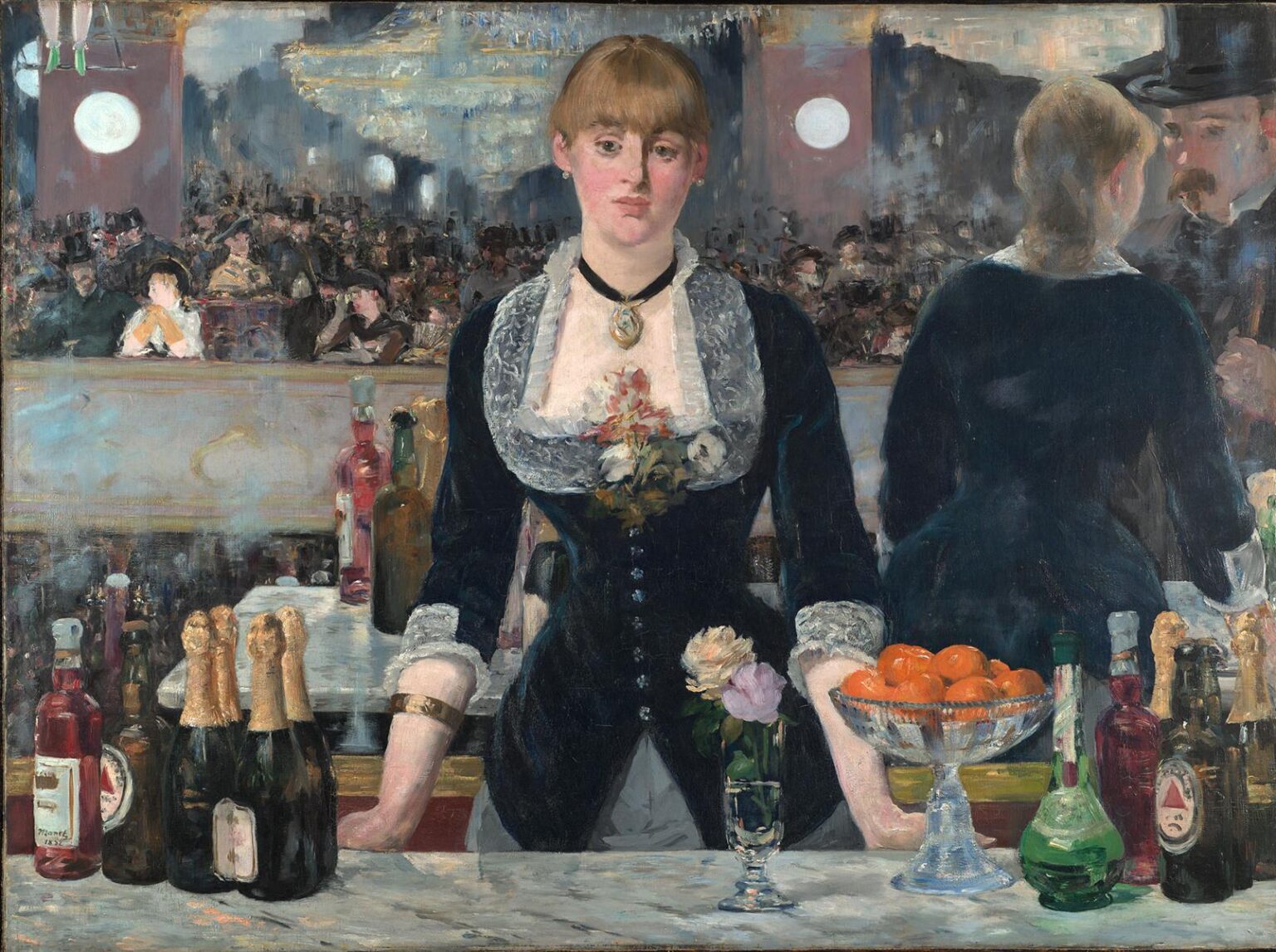
Edouard Manet’s A Bar at the Folies-Bergere from 1882 is one of the defining paintings of modern life in nineteenth century art. At first glance, it appears to be a straightforward scene: a barmaid stands behind a counter, facing the viewer, with bottles, fruit, and flowers arranged in front of her while a crowded entertainment hall swirls behind her in reflected light and noise. Yet the longer one looks, the stranger and more compelling the painting becomes. The image is both immediate and elusive. It presents a recognizable public setting, but it also unsettles the viewer through its mirror reflections, ambiguous spatial relationships, and the distant emotional state of its central figure.
This painting is often treated as a major summary of Manet’s artistic concerns. It brings together his fascination with urban spectacle, modern alienation, the unstable relationship between viewer and image, and the tension between appearance and reality. The Folies-Bergere itself was a famous Parisian venue known for music, performance, social mixing, and entertainment. Manet turns that glittering public world into something psychologically complex. Instead of simply celebrating pleasure and nightlife, he offers a vision of modern experience in which display, labor, desire, and detachment all exist at once.
What makes this painting so lasting is the way it refuses to settle into a single meaning. It is both glamorous and lonely, polished and unstable, socially busy and emotionally quiet. The barmaid is presented not only as a worker in a fashionable leisure space, but also as a person whose expression resists the cheerful world around her. The scene is full of surfaces, reflections, commodities, and spectators, yet the central human presence seems inward and inaccessible. That tension is the heart of the painting’s power.
The Setting and the World of Modern Paris
The Folies-Bergere was one of the most famous entertainment venues in Paris during the late nineteenth century. It represented a new kind of urban social world, one built around spectacle, consumption, and the pleasures of modern city life. People came there to see performances, mingle in crowds, drink, flirt, and participate in the theatrical energy of a rapidly changing metropolis. In choosing this setting, Manet placed his painting squarely within the world of contemporary Paris.
This choice matters because Manet was one of the artists most committed to painting modern life rather than retreating into only historical, mythological, or rural themes. He understood Paris not merely as a backdrop but as a subject in itself. The city was a place of transformation, where class boundaries could blur in public, where commerce shaped social interaction, and where images and performances increasingly defined how people saw one another. The Folies-Bergere embodied that modern condition. It was full of distraction and visual stimulation, but also full of role playing, display, and impersonality.
In this painting, the setting is not described with careful academic precision. Instead, it is suggested through flickering impressions of people, lights, and movement. The chandeliers glow in the upper background. Figures in evening dress gather in the distance. The sense of a busy nightlife venue comes through atmosphere rather than exact detail. This is important because Manet is not documenting the hall in a literal way. He is capturing how it feels to occupy such a space, where the eye is constantly drawn from one bright, shifting element to another.
At the same time, the entertainment hall is presented through a barrier. The viewer does not move freely into the crowd. The bar counter and the woman standing behind it form a threshold. We are placed in the position of a customer, yet the scene does not invite easy participation. Instead, the painting creates a subtle sense of distance. Modern Paris is present, but it is not entirely available. It is seen through reflection, mediation, and emotional separation.
The Central Presence of the Barmaid
The barmaid is the emotional and compositional center of the painting. She stands frontally before the viewer, her body upright, her hands resting on the marble counter. Her dark dress, pale skin, and softly illuminated face make her instantly dominant within the composition. Though the background is crowded, she anchors the scene with a calm stillness that contrasts sharply with the bustle around her.
Her expression is one of the most memorable features of the painting. She does not smile. She does not perform for the viewer in a simple way. Instead, she appears tired, distracted, resigned, or absorbed in private thought. Different viewers may read different emotions into her face, but what matters most is that she seems emotionally separate from the festive environment around her. The hall behind her is full of noise, movement, and pleasure, yet she appears withdrawn from it. This contrast between public spectacle and private inwardness gives the painting much of its emotional depth.
The woman’s role is also socially significant. She is both an individual and a worker. She is there to serve drinks and participate in the functioning of the leisure industry. Her body is part of the setting’s visual economy. Customers look at her as well as at the goods on display. In that sense, the painting raises questions about labor, gender, and visibility in modern urban culture. She is present to be seen, yet her expression resists easy possession. She occupies a public role, yet her inner life remains closed.
Manet paints her with dignity, but not with idealization. She is not turned into a mythic beauty or romantic heroine. Her face feels specific and contemporary. Her stance is formal, but also somewhat heavy and weary. This realism is part of Manet’s modernity. He gives the central figure presence without sentimentality. She is neither simply glamorous nor merely pitiable. She exists in a complex social position, and the painting allows that complexity to remain unresolved.
The Mirror and the Problem of Reflection
One of the most famous and debated aspects of A Bar at the Folies-Bergere is its use of the mirror. Behind the barmaid stands a large mirror that reflects the crowd, the lights, and, crucially, the barmaid herself. In the reflection, however, her mirrored figure appears shifted to the right. There is also a male customer who seems to be standing before her, engaged in some kind of interaction. This reflected arrangement creates one of the great visual puzzles in Western painting.
At first, the mirror seems to offer a logical explanation of the space. It shows what lies behind the viewer and extends the scene beyond the flat picture plane. But the reflection does not align neatly with what we expect. The barmaid’s reflected body seems displaced in a way that feels awkward if understood as a strictly accurate optical rendering. This has led to countless interpretations. Some see it as a deliberate distortion designed to unsettle the viewer. Others argue that the apparent inconsistency can be explained by the viewer standing slightly off center. Whatever the technical explanation, the painting clearly uses reflection to destabilize certainty.
This matters because the mirror is not just a device for spatial expansion. It becomes a metaphor for the nature of modern perception itself. We think we are seeing clearly, but what we see is filtered, shifted, and hard to place. The painting offers information and confusion at the same time. The mirror promises truth, yet it complicates reality. In a world of spectacle and social performance, appearances cannot be trusted completely.
The mirror also changes the viewer’s position. Are we the male customer whose reflection appears on the right? Are we standing where he stands, or somewhere else entirely? The painting never fully settles the question. As a result, the viewer becomes implicated in the scene. We are not detached observers. We occupy an unstable role within the social and visual structure of the painting. We look at the barmaid, but the mirror suggests that looking itself is part of the subject.
This is one reason the work feels so modern. It is not just a scene to be consumed. It is a scene that makes the act of viewing uncertain, active, and morally charged. The painting makes us aware of the gap between seeing a person and knowing them.
Composition and Spatial Tension
Manet’s composition is remarkably controlled even as it creates ambiguity. The barmaid stands almost exactly at the center, giving the painting an immediate frontality. The counter stretches horizontally across the foreground, grounding the image and acting as a barrier between viewer and subject. This counter is filled with objects that are visually attractive and materially specific, yet they also reinforce the theme of display.
The symmetry of the arrangement is never absolute, but it is strong enough to create a sense of order. Bottles are distributed on both sides. The bowl of oranges provides a bright visual weight on the right. The vase of flowers near the center lower area adds softness and delicacy. The dark mass of the woman’s dress holds the middle of the canvas together. Behind her, the reflected crowd dissolves into a more fluid pattern of movement and light.
The most striking spatial tension comes from the relationship between flatness and depth. The counter and the frontal pose of the barmaid press toward the surface of the painting. At the same time, the mirror opens up an implied depth behind her. But this depth is not stable. It is reflective, fragmented, and optically confusing. Manet thus creates a composition that seems balanced while also subtly disturbing conventional perspective.
This tension between surface and depth has broader significance in Manet’s work. He was deeply interested in the painting as a painted object, not just as an illusionistic window into another world. In this canvas, the physical flatness of the surface remains palpable even as the mirror suggests recession into space. The result is a visual experience in which the viewer is constantly aware of both representation and artifice.
The painting feels carefully arranged, but not static. It holds stillness and movement together. The woman is quiet and solid. The reflected world behind her is active and unstable. That contrast gives the composition its distinctive rhythm and emotional force.
Objects, Commodities, and the Language of Display
The bottles, fruit, and flowers in the foreground are far more than decorative details. They are essential to the meaning of the painting. On the most basic level, they define the setting as a place of service and consumption. Drinks are available for purchase. The oranges add color and freshness. The flowers suggest refinement and femininity. Together they create an appealing display that draws the eye and situates the barmaid within a commercial environment.
Yet these objects also carry symbolic weight. They belong to a world in which social interaction is inseparable from buying, selling, and visual presentation. The bar is a place where pleasure is mediated through commodities. Bottles gleam under the light. Fruit catches the eye. Everything is arranged to be seen and desired. The woman herself stands among these items of display, and the painting subtly invites comparison between the goods on the counter and the laboring body behind it. This does not reduce her to an object, but it does emphasize how closely modern public life links people, images, and commodities.
Manet handles these still life elements with extraordinary skill. The glass surfaces, labels, foil tops, and reflective textures are painted with brevity and confidence. He does not overwork them, yet they feel immediate and convincing. Their presence recalls the tradition of still life painting while integrating it into a scene of modern urban life. In doing so, Manet brings together old pictorial categories and new social realities.
The oranges are especially striking because of their vivid color. They punctuate the cooler tones of the painting and draw attention to the right side of the counter. Their brightness gives visual pleasure, but it also intensifies the sense of display. Everything in the foreground seems available for inspection. The painting makes the viewer aware of looking as a kind of consumption.
This is one of the reasons the barmaid’s withdrawn expression matters so much. The objects are readable, tangible, and inviting. She is not. In a world organized around surfaces and exchange, her inwardness remains the one thing that cannot be bought or fully accessed.
Color, Light, and Brushwork
Manet’s handling of paint in this work is central to its effect. The color palette is rich but restrained. Blacks, silvery whites, smoky blues, rose tones, and scattered accents of orange and green create a sophisticated harmony. The overall atmosphere feels luminous without becoming overly bright. Light seems to shimmer across the scene rather than flood it evenly.
The black dress of the barmaid is especially important. Manet was famous for his use of black, and here it gives the central figure gravity and elegance. The deep darkness of the dress contrasts with the whiteness of her skin, lace, and neckline, making her body stand out with immediate force. At the same time, the black is not flat or dead. It contains subtle tonal variations that give it volume and life.
The background is painted with a looser, more atmospheric touch. Faces and forms emerge and dissolve within a vibrating field of light and shadow. This brushwork suggests the unstable, fleeting quality of modern spectacle. By contrast, the foreground objects and the woman’s figure are more firmly defined, though still painted with Manet’s characteristic economy. He never indulges in excessively smooth finish. The painting remains visibly made, its brushstrokes contributing to its vitality.
Light in this painting does not function only to reveal form. It also creates mood. The glowing reflections and bright spots in the mirror evoke the sensory excitement of the Folies-Bergere, yet the frontal figure remains oddly insulated from that excitement. The light touches her but does not transform her emotional state. This separation between visual brilliance and psychological distance is one of the painting’s most powerful effects.
Manet’s brushwork gives the picture both immediacy and instability. Things are seen clearly enough to register, but not so completely that they become fixed and closed. The painting feels alive because it allows perception to remain active. The eye keeps moving, comparing, questioning, and returning.
Modern Alienation and Emotional Distance
For all its surface glamour, A Bar at the Folies-Bergere is often understood as a painting about alienation. This interpretation arises above all from the barmaid’s expression and from the strange distance the painting places between people. The entertainment hall is crowded. The scene is public, lively, and social. Yet the emotional core of the work is solitude.
The barmaid seems isolated even while surrounded by others. She performs a social role, but her face suggests fatigue, detachment, or inward retreat. She is present physically, but emotionally elsewhere. The mirror doubles her image, but it does not resolve her identity. Instead, it makes her seem even more inaccessible. The reflected interaction with the male customer hints at social exchange, but the frontal figure remains disconnected from it.
This is a deeply modern theme. Urban life brings people together physically while often separating them psychologically. Public spaces create contact without intimacy. Individuals become visible to one another, yet remain unknown. Manet captures this condition without turning it into melodrama. The painting is quiet, but its quietness is full of tension.
There is also an important tension between spectacle and inner life. The Folies-Bergere is a place designed to entertain and distract. It offers sensory richness, social excitement, and visual abundance. But the central figure resists absorption into that world. Her stillness interrupts the flow of pleasure. She reminds us that behind public roles and polished surfaces there are private states that remain unresolved.
The painting therefore becomes more than a scene of nightlife. It becomes a meditation on what it means to exist in a society increasingly shaped by commerce, performance, and looking. It asks whether genuine human connection is possible in such a world, or whether people are destined to meet one another only through roles, reflections, and transactions.
The Painting’s Lasting Importance
A Bar at the Folies-Bergere remains one of the greatest paintings of the nineteenth century because it combines visual brilliance with intellectual and emotional complexity. It is instantly memorable as an image, yet it continues to generate discussion because it cannot be reduced to a simple message. It is about modern Paris, but also about painting itself. It is about a barmaid, but also about spectatorship, gender, and the social theater of the city. It is about reflection, but also about uncertainty and estrangement.
As one of Manet’s final major works, it can be seen as a culminating statement. He takes the modern urban scene and transforms it into something layered and profound. He does not idealize modern life, nor does he condemn it outright. Instead, he presents its beauty and its disquiet together. The painting glitters, but it also questions. It invites looking, but it also makes looking uncomfortable.
That complexity is what gives the work its enduring power. It speaks to a world in which surfaces are seductive, public life is theatrical, and human beings often remain mysterious even when directly before us. The barmaid’s face, the unstable mirror, the dazzling clutter of objects, and the blurred crowd behind her all combine to create a painting that feels both rooted in its moment and permanently relevant.
In the end, A Bar at the Folies-Bergere is not simply a portrait of a place or a person. It is a portrait of modern seeing itself. It shows how vision can be full of information and yet leave us uncertain, how beauty can coexist with loneliness, and how the public world can be both exciting and emotionally remote. That is why the painting continues to fascinate viewers more than a century after it was made.