Image source: wikiart.org
Introduction
Katsushika Hokusai’s The Great Wave off Kanagawa, created around 1831, is one of the most recognizable images in the history of art. Even people who do not usually follow Japanese painting or printmaking often know this image instantly. Its enormous curling wave, its fragile boats, and the distant silhouette of Mount Fuji have become part of global visual culture. Yet the power of this work goes far beyond familiarity. The print remains compelling because it combines immediate drama with extraordinary formal control. It is at once simple and complex, decorative and frightening, natural and symbolic.
Although it is often casually described as a painting, The Great Wave off Kanagawa is in fact a woodblock print, part of Hokusai’s famous series Thirty-six Views of Mount Fuji. That distinction matters because the image was designed to circulate widely rather than exist as a single, unique object. Its influence therefore began not in elite rarity but in repetition, in the sharing of an image that could move through everyday life while still carrying immense artistic sophistication.
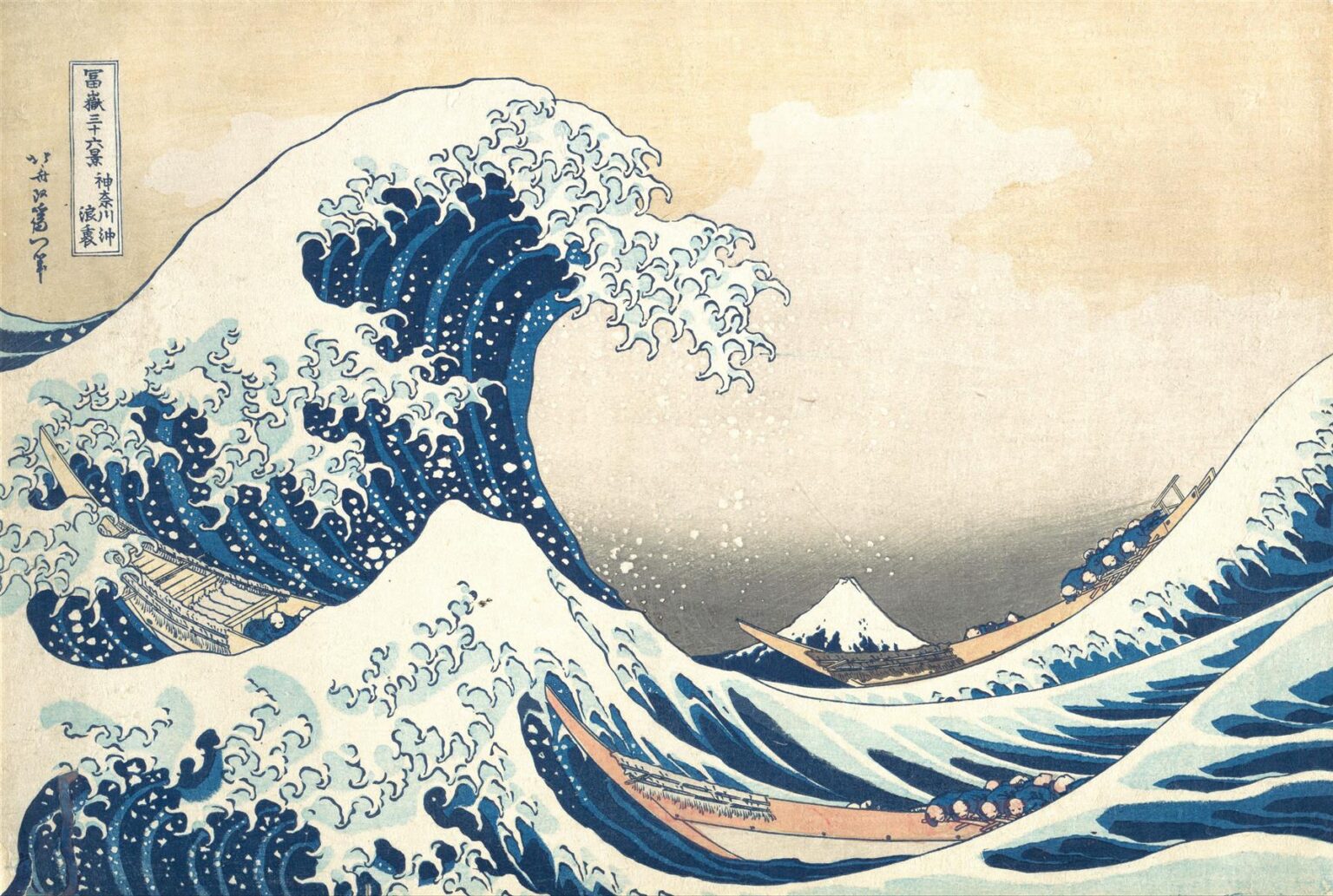
What makes this work so memorable is the way Hokusai turns a moment of danger into a carefully balanced visual structure. The print shows a towering wave about to break over three boats as Mount Fuji appears small but steady in the distance. In one glance, the viewer sees motion and stillness, fear and discipline, scale and fragility. The image feels immediate, as though it captures a split second, but it is also deeply constructed. Every line, every contour, and every spatial relationship contributes to its force.
Historical Context and Hokusai’s Vision
Hokusai worked during the Edo period, a time when urban culture in Japan flourished and printed imagery became a major artistic form. Ukiyo-e, the genre to which this print belongs, is often associated with scenes of pleasure districts, actors, courtesans, and celebrated places. Hokusai expanded the possibilities of the form by giving landscape an intensity and imaginative power equal to any figure subject. In The Great Wave off Kanagawa, landscape is not a passive backdrop. It is the central actor.
The print belongs to a moment when interest in travel, famous sites, and printed series had become especially strong. Mount Fuji held religious, cultural, and poetic importance, and Hokusai’s series turned the mountain into a constant point of reference seen from different distances, weather conditions, and human situations. In this particular image, Fuji is not dominant through size. It is dominant through permanence. The mountain stands quietly in the distance while the sea erupts in the foreground.
This contrast reveals much about Hokusai’s vision. He was not simply depicting a scenic view. He was thinking about the relationship between human life and forces larger than the self. The sea is temporary in each specific motion, yet endless in energy. Fuji is immovable in appearance, yet it is dwarfed by the sudden violence of the wave’s crest. Hokusai builds a world in which stability and instability coexist, and that tension gives the print its psychological depth.
Composition and the Architecture of the Image
One reason The Great Wave off Kanagawa has remained so influential is its extraordinary composition. At first glance, the image seems explosive and chaotic, but its structure is astonishingly precise. The giant wave arches across the upper left of the print like a living form. Its curve creates a sweeping frame that draws the eye inward and downward. Beneath it, the boats slice through the water on a diagonal, reinforcing the sensation of movement and danger.
The most remarkable compositional decision is the relationship between the wave and Mount Fuji. The wave’s arched body echoes the triangular shape of the mountain, and the mountain appears almost as a miniature answer to the enormous form above it. This repetition creates visual unity across the image. The wave is wild, unstable, and aggressive. Fuji is calm, distant, and still. Yet formally they mirror one another, which binds them together.
The placement of empty sky is equally important. A large section of the upper right remains relatively open, allowing the wave and mountain to breathe within the composition. Without that quiet space, the image might feel overcrowded. Instead, the emptiness intensifies the drama. The viewer senses the vastness of the scene and the looming force of the water. Hokusai understood that visual power does not come only from detail. It also comes from restraint.
The boats create another crucial layer of order. Their long, narrow forms guide the eye through the scene and establish a rhythm beneath the great curve of the wave. They also introduce a sharp human dimension. These are not decorative objects. They are vehicles of labor, discipline, and vulnerability. Their presence makes the wave feel more dangerous because we immediately understand what is at stake.
The Wave as Form and Force
The wave itself is one of the most iconic shapes in world art. Hokusai does not present water as a soft, flowing surface. He transforms it into a force that seems almost animate. The crest resembles a claw or a hand with spreading fingers. The foam bursts outward in small, sharp tendrils that feel both beautiful and threatening. The wave appears to reach, grasp, and descend.
This transformation of nature into expressive form is one of the print’s greatest achievements. The wave is believable as water, but it also becomes something larger than literal observation. It turns into a symbol of overwhelming energy. The viewer senses not only the physical danger of the sea but also the emotional experience of being confronted by something too vast to control.
Hokusai’s handling of foam is especially masterful. The white froth at the top of the wave is broken into intricate, curling fragments that resemble snow, spray, and scattered claws all at once. This ambiguity makes the image richer. The foam is delicate, but the mass beneath it is immense. The viewer is caught between admiration for the elegance of the design and alarm at its destructive potential.
The wave also dominates because it is shown at the instant before impact. Hokusai chooses a suspended moment rather than the aftermath. That decision creates unbearable tension. The viewer does not see the boats overturned or the sea settled. Instead, one remains in the charged pause before resolution. This is one reason the image stays alive in the imagination. It is perpetually about to happen.
Mount Fuji and the Power of Stillness
If the wave commands immediate attention, Mount Fuji provides the image with its deeper anchor. It sits far in the distance, small and sharply defined, a quiet triangular form beneath the storm of the sea. Many viewers notice the wave first and Fuji second, but that delayed recognition is part of the print’s intelligence. Hokusai wants us to discover the mountain within the violence.
Fuji matters not because it overwhelms the scene physically but because it introduces another measure of time. The wave belongs to an instant. The mountain belongs to centuries. The wave rises and falls. Fuji endures. This contrast between fleeting motion and lasting presence gives the print philosophical resonance. It suggests that human life unfolds between temporary crises and larger continuities.
The mountain also stabilizes the composition emotionally. Without Fuji, the print would be a powerful marine drama. With Fuji, it becomes something more reflective and symbolic. The viewer sees not only danger but also order, not only threat but also permanence. Fuji’s calmness does not cancel the violence of the wave. Instead, it makes that violence more meaningful.
There is also a subtle visual irony in the relationship between wave and mountain. The wave appears larger, more dramatic, and more immediate than Fuji, yet Fuji is in another sense the true subject of the series. Hokusai plays with our expectations by allowing the supposed secondary element to dominate the composition while the named motif remains quiet in the background. This inversion gives the print its intellectual elegance.
Color, Line, and Printmaking Brilliance
The color scheme of The Great Wave off Kanagawa is limited, but its effect is profound. Hokusai relies on a restrained palette of deep blue, pale blue, off-white, and muted beige or gray tones. This economy creates visual clarity while also enhancing emotional impact. The strong blue of the wave feels cold, forceful, and immense. The paler tones of foam and sky create contrast without distracting from the main forms.
The famous blue is crucial to the print’s identity. It gives the water depth and authority. Rather than using a broad range of colors to create excitement, Hokusai lets variation within blue carry the image. Dark passages define weight and movement. Lighter passages suggest translucency and spray. The result is both decorative and naturalistic. The print feels stylized, yet the sea still seems physically convincing.
Line is equally essential. Hokusai’s contours are crisp, rhythmic, and assured. The wave is not modeled through soft shading in a Western sense. Instead, it is built through decisive outlines and patterned internal curves. This gives the image a graphic strength that helps explain its lasting appeal. It reads clearly from a distance, but the closer one looks, the more intricate it becomes.
The printmaking process also matters to its meaning. Because the image was carved into woodblocks and printed in multiple impressions, it carries the logic of design and reproduction. Hokusai had to think in terms of shapes, color areas, and line systems that would remain powerful across editions. That demand for clarity sharpened the image rather than limiting it. The print’s boldness is inseparable from its medium.
Human Presence and Vulnerability
Although the giant wave dominates the image, the boats and their occupants are essential to its emotional power. They are small, almost easy to overlook beside the massive water, but they transform the print from a study of nature into a drama of human survival. The long boats bend with the motion of the sea, and the figures appear crouched low, as if bracing themselves against impact.
These are not heroic figures displayed for individual admiration. Hokusai does not isolate a single person or offer expressive faces. Instead, the human presence is collective and functional. This anonymity is important. The print is not about one named protagonist conquering nature. It is about ordinary laboring bodies exposed to a force far greater than themselves.
The boats cut through the composition like narrow blades, but their elegance does not protect them. They seem both disciplined and fragile. Their shape suggests speed and purpose, yet against the wave they are nearly helpless. This balance between skill and vulnerability makes the image especially moving. Human beings are not shown as powerless in an absolute sense, but neither are they in command.
The inclusion of workers rather than aristocratic passengers also reflects the broader world of Edo visual culture, in which scenes of daily life and commerce could become art. Hokusai gives grandeur to labor without sentimentalizing it. The fishermen or rowers are not romanticized heroes. They are simply present within a world of risk, work, and endurance. That honesty strengthens the image.
Movement, Tension, and the Sense of Time
One of the great achievements of The Great Wave off Kanagawa is the way it creates a vivid sensation of time. The image feels cinematic long before cinema. We do not merely see the scene. We feel that we have entered a tense sequence, a moment poised between what has just happened and what will happen next.
This effect comes partly from Hokusai’s use of diagonals and curves. The boats angle sharply through the frame, suggesting forward movement. The wave arches downward, suggesting imminent collapse. The foam scatters outward, suggesting wind, spray, and instability. All these directional cues pull the eye through the print in a dynamic way. Nothing feels static except Fuji, and that stillness becomes more striking because everything else moves.
The moment chosen is psychologically perfect. Hokusai does not show the sea before the crisis or after it. He captures the instant of suspense. This creates a powerful emotional experience because the viewer mentally completes the action. One imagines the wave crashing, the boats pitching, the men straining. The image activates imagination through incompletion.
This suspended drama helps explain why the print continues to resonate with modern viewers. It speaks to a common human experience: the feeling of being on the edge of something overwhelming. The wave can be read literally as nature, but it can also be felt more broadly as crisis, uncertainty, or fate. That openness gives the work unusual durability across time and culture.
Symbolism and Deeper Meanings
The most obvious meaning of The Great Wave off Kanagawa is the power of nature. The sea is immense, unpredictable, and indifferent to human effort. Yet the print does not simply celebrate destruction. It is too balanced, too thoughtful, and too structured for that. Hokusai seems more interested in the relationship between instability and endurance.
The wave may symbolize sudden danger, but Mount Fuji suggests permanence. The boats suggest human courage and labor, but also fragility. Together these elements create a meditation on scale. Human life is small, but not meaningless. Nature is vast, but not chaotic in a purely random sense. The world contains order even within threat.
Some viewers see the wave as almost monstrous, and that reading has merit because of its claw-like crest. Yet it may be more accurate to say that Hokusai gives nature a kind of living presence. The sea is not evil, but it is active. It commands respect. The print asks the viewer to confront beauty and danger at the same time, without simplifying either.
There is also a deeper spiritual or philosophical dimension in the relation between the visible and the enduring. Fuji, sacred and distant, appears beyond immediate struggle. The men in the boats remain within the realm of action and danger. The print thus holds together two scales of existence: daily life and larger continuity. This may be one reason the image feels both dramatic and contemplative.
Global Influence and Enduring Legacy
Few works of art have traveled as widely in the imagination as The Great Wave off Kanagawa. Its influence extends far beyond Japanese print culture into European modernism, popular design, contemporary illustration, fashion, advertising, and digital media. That broad appeal comes from the image’s unique combination of clarity and depth. It is instantly legible, yet endlessly interpretable.
Artists and viewers across cultures have admired the print for its bold contour, flattened space, and dynamic design. It helped reshape how many later artists thought about composition, pattern, and the expressive potential of line. The print does not depend on illusionistic depth in the Western academic sense. Instead, it organizes space through overlapping forms, strong outlines, and striking contrasts. That alternative vision proved deeply influential.
Its popularity in modern culture can sometimes make it seem overly familiar, but familiarity should not be mistaken for simplicity. The image became iconic because it solves so many visual and emotional problems at once. It is dramatic without being melodramatic. It is decorative without becoming superficial. It is symbolic without losing contact with physical reality.
Most importantly, it remains alive because it continues to speak to viewers on first encounter. One does not need specialized knowledge to feel the tension between the wave and the boats. One does not need training in art history to sense the grandeur of the composition. The print is intellectually rich, but it is also immediately human in its emotional impact.
Conclusion
The Great Wave off Kanagawa endures because Hokusai created more than a famous image of the sea. He created a visual structure in which natural force, human vulnerability, and lasting order exist together in perfect tension. The giant wave terrifies and fascinates. The boats humanize the danger. Mount Fuji steadies the scene with quiet permanence. Every part of the composition contributes to a feeling that is both immediate and profound.
The print also demonstrates Hokusai’s extraordinary ability to unite design and meaning. Its lines are elegant, its colors restrained, its forms unforgettable. Yet none of these qualities exist only for decoration. Each serves the image’s larger emotional and philosophical force. The work shows how a print can be both widely accessible and artistically complex.
That is why The Great Wave off Kanagawa still feels fresh nearly two centuries after it was made. It captures a moment of peril, but it also captures something enduring about human life: our smallness before the world, our persistence within it, and our instinct to find beauty even at the edge of fear.