Image source: wikiart.org
Introduction
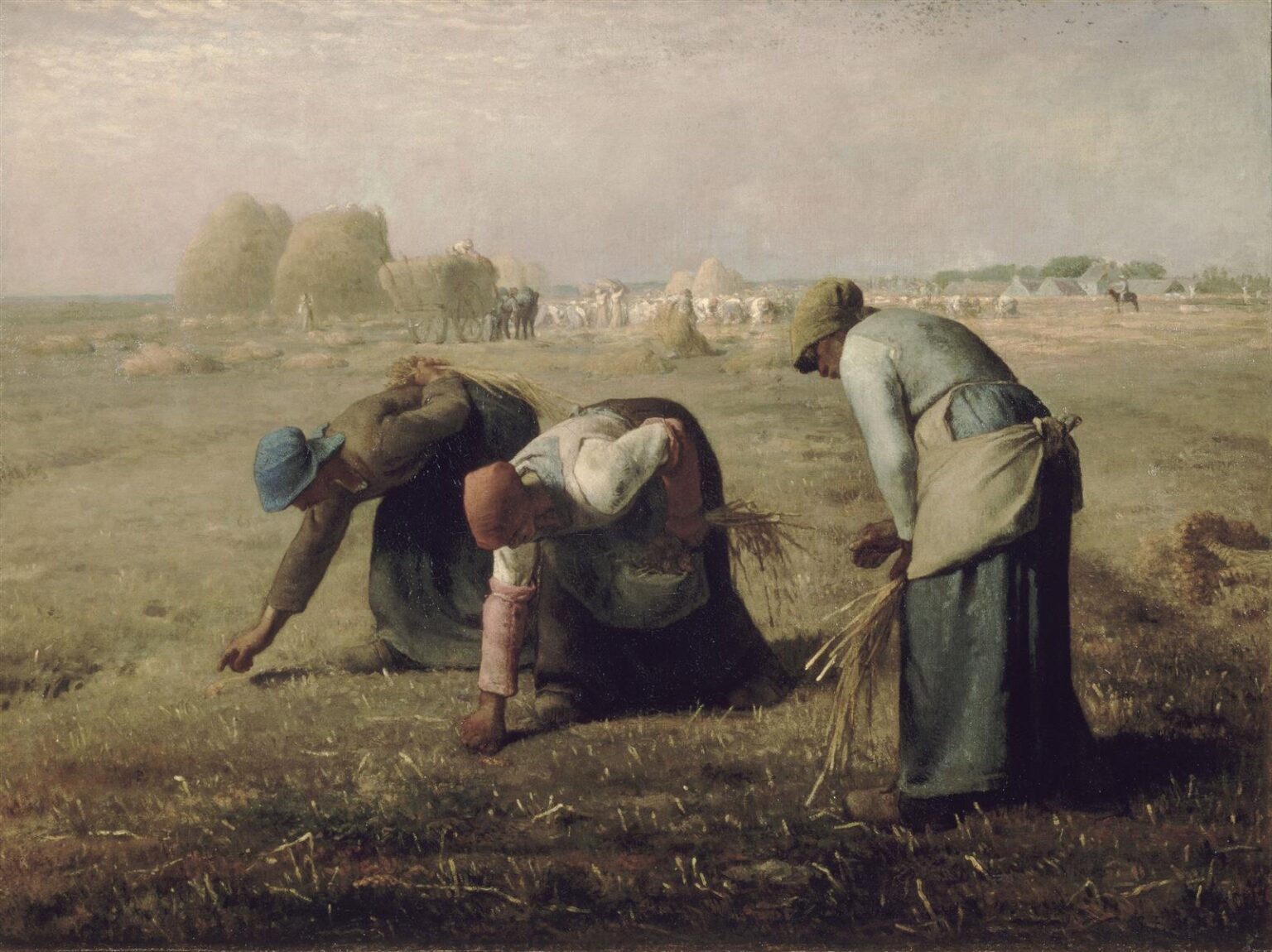
Jean-François Millet’s The Gleaners from 1857 remains one of the defining images of nineteenth century French art. At first glance, the painting appears quiet and simple. Three peasant women bend over a harvested field, gathering the scattered remnants of wheat left behind after the main crop has been collected. There is no dramatic gesture, no heroic pose, and no obvious narrative climax. Yet this very restraint is what gives the picture its force. Millet transforms an ordinary rural task into an image of immense dignity, social weight, and emotional depth.
What makes The Gleaners so compelling is the way it elevates labor that many people of Millet’s time would have overlooked. The women are not shown as decorative figures in a picturesque landscape. They are workers, shaped by repetition, necessity, and physical strain. Their bent bodies become the main structure of the composition, and through them Millet asks the viewer to look carefully at the lives of the rural poor. He does not sentimentalize them, but neither does he reduce them to symbols of misery. Instead, he presents them with seriousness, gravity, and permanence.
The painting belongs to a moment in French art when artists were increasingly interested in ordinary life rather than mythological or aristocratic subjects. Millet helped lead this shift, especially through his focus on peasants and agricultural labor. In The Gleaners, he captures not just a task but a whole social condition. The women gather what remains after the harvest, which immediately places them at the edge of abundance. Behind them lies wealth, productivity, and a broad golden field. In the foreground lies scarcity, effort, and survival. This tension between plenty and poverty gives the painting much of its meaning.
Even today, the work feels modern in its moral clarity. It asks who is seen and who is ignored. It examines labor, class, gender, and human endurance without turning into propaganda. That balance is one reason the painting has remained so influential. The Gleaners is not only one of Millet’s greatest achievements but also one of the most powerful visual meditations on work and social inequality in European art.
Historical Context and the Meaning of Gleaning
To understand The Gleaners, it is important to understand what gleaning actually meant. Gleaning was the practice of collecting leftover stalks of grain from fields after the main harvest had been completed. It was traditionally permitted to the rural poor, especially women, widows, and children. In practical terms, it provided one of the last means of survival for those without land or sufficient income. In symbolic terms, it represented the thin line between subsistence and hunger.
By the middle of the nineteenth century, France was changing rapidly. Industrialization and urban growth were reshaping society, while memories of revolution remained strong. Questions of class, labor, and poverty were politically charged. A painting that focused on poor peasant women was not neutral. Millet’s decision to make gleaners the main subject of a large, serious canvas gave a monumental presence to people who were usually overlooked or dismissed. This was unsettling to some contemporary viewers, especially those from wealthier backgrounds, because the painting made rural poverty impossible to ignore.
Millet himself had deep roots in the countryside, and this background shaped the honesty of his vision. He was associated with the Barbizon School, a group of artists who turned toward rural landscape and peasant life, often working with close observation of nature. Yet Millet went beyond landscape painting in the usual sense. He used the rural world to address the human condition, and in doing so he gave peasant labor a kind of epic gravity.
The timing of the painting also matters. In the years following the Revolutions of 1848, social unrest and fear of the poor remained vivid in France. Many viewers read images of laborers through a political lens. The Gleaners could be seen as a reminder of poverty within a nation that celebrated prosperity and progress. The women are not protesting, but their mere visibility carries weight. They stand, or rather bend, as witnesses to social inequality.
This historical context helps explain why the painting had such impact. It was not simply admired as a rustic scene. It was debated because it forced people to confront the reality that economic abundance often depended on invisible labor, and that those who worked hardest were not always those who benefited most.
Composition and the Power of the Three Figures
One of the most striking aspects of The Gleaners is its composition. Millet organizes the painting around three women placed prominently in the foreground. Their bodies occupy most of the lower half of the canvas, and their repeated bending motions create a rhythm that is both visual and physical. Each figure is caught in a slightly different phase of the same action, which gives the scene a sense of continuity rather than frozen stillness.
The repetition of their poses is essential. Millet does not isolate one woman as an individual heroine. Instead, he emphasizes shared labor. The three figures form a kind of visual sequence, as though the same movement were unfolding across space. This repetition suggests routine and endurance. Gleaning is not a dramatic event but a task performed again and again, stooping, searching, collecting, and rising only slightly before bending once more.
At the same time, the figures are not mechanical. Each woman has her own weight, gesture, and bodily presence. The left figure reaches downward with extended arm, the central figure bends deeply with concentrated effort, and the right figure gathers a small bundle in her hand. These differences prevent the composition from becoming rigid. Millet creates harmony without sacrificing life.
The foreground placement of the women is also important because it compels the viewer to confront them directly. They are close, large, and substantial. Behind them stretches the expansive harvested field, dotted with haystacks, wagons, laborers, and distant signs of activity. This deep space creates a contrast between the monumental scale of the gleaners and the wider harvest economy taking place beyond them. The women may be poor, but they are not visually diminished. In fact, Millet gives them greater structural importance than the distant workers who gather the main crop.
The horizon line sits fairly high, allowing the field to spread broadly across the picture plane. This creates a sense of vastness while keeping attention anchored on the women below. The result is a composition that feels both expansive and intimate. The land is wide, but the human act at its center is specific and immediate. Through this balance, Millet turns a simple field scene into a profound statement about presence and value.
Light, Color, and Atmosphere
Millet’s handling of light and color is quiet but deeply effective. The palette of The Gleaners is built from earthy browns, muted golds, dusty blues, faded greens, and soft flesh tones. Nothing is excessively bright or ornamental. The colors belong to the world of soil, straw, cloth, and weathered skin. This restraint reinforces the painting’s seriousness. It does not tempt the viewer with dazzling surface effects. Instead, it asks for patient looking.
The warm tones of the field suggest late summer or early autumn, the season of harvest. There is a golden haze over the scene, especially in the distance, where sunlight seems to settle over the stacked grain and open land. This warm atmosphere might initially suggest abundance, yet in the foreground the mood is more sober. The gleaners work close to the ground, surrounded by duller, rougher tones that emphasize fatigue and material hardship.
Millet uses light to unify the painting rather than to dramatize individual details. There are no theatrical spotlights or sharp contrasts. Forms emerge gradually through tonal relationships, which gives the picture a natural and almost timeless quality. The softness of the light also contributes to the painting’s mood of endurance. This is not a moment of sudden revelation but a long day of labor under an unchanging sky.
The contrast between foreground and background is especially subtle and meaningful. In the distance, the harvest appears brighter, fuller, and more expansive. The haystacks catch the light, and the scene seems animated by productivity. In the foreground, however, the gleaners occupy a darker and more shadowed zone. This visual division echoes the social division at the heart of the work. The field has produced abundance, but these women are left to gather fragments.
Millet’s atmosphere also conveys dust, heat, and exhaustion. One can almost feel the dryness of the stubble field and the repetitive discomfort of bending close to the earth. The air is not fresh and sparkling but dense and sunworn. This sensory realism helps anchor the painting in lived experience. The scene feels inhabited, not staged. Through color and atmosphere, Millet deepens the emotional truth of the subject without resorting to sentimentality.
The Dignity of Labor
A central achievement of The Gleaners is its presentation of labor as dignified, even when it is exhausting and socially marginal. Millet does not beautify hard work in a superficial way. The women’s bent backs, heavy skirts, coarse clothing, and absorbed movements all speak to the physical demands of their task. Yet he also grants them solidity, gravity, and compositional importance. They are not decorative peasants placed into a charming countryside. They are the moral center of the painting.
This dignity comes in part from the seriousness of Millet’s approach. He paints the women with respect and with an almost sculptural sense of form. Their bodies have weight. Their gestures have necessity. Their labor is not treated as anecdotal detail but as something foundational to human life. In this way, Millet challenges traditional hierarchies in art, which often reserved large, carefully composed paintings for historical, religious, or mythological subjects.
The women’s anonymity is also significant. We do not know their names or personal stories. Yet rather than reducing them, this anonymity broadens their meaning. They come to represent countless rural laborers whose work sustained society while remaining largely unseen. Millet makes visible a whole class of people through the concentrated presence of these three figures.
There is also a quiet heroism in their perseverance. They do not dominate the land, and they are not rewarded by it in obvious ways. Their task is humble and secondary, performed after the main harvest is done. Yet they continue, searching carefully for what others have left behind. This persistence gives the painting emotional depth. It speaks to survival, resilience, and the human capacity to endure hardship without spectacle.
Millet’s respect for labor helped shape the painting’s legacy. Later artists and viewers recognized that The Gleaners offered a new model of seriousness in modern art. It suggested that ordinary work, especially the work of the poor, could carry the same emotional and moral weight as traditional noble subjects. That was a radical idea, and it remains one of the reasons the painting still resonates.
Social Class, Poverty, and Silent Tension
Although The Gleaners is calm on the surface, it contains deep social tension. The very act of gleaning reveals a hierarchy. The field has already been harvested by others, and what remains is only what was missed or discarded. The gleaners exist on the margins of production. They are near the source of wealth but excluded from its full benefit. This condition is central to the painting’s emotional and political power.
Millet makes this tension visible through spatial contrast. In the background, there are signs of successful harvest and organized agricultural activity. Wagons are loaded, grain is gathered, and the field stretches with evidence of plenty. In the foreground, the women bend low for scraps. The distance between these zones is not only physical but social. It represents a whole structure of inequality.
Yet Millet does not turn the scene into open accusation. There is no violent confrontation, no direct criticism written into gesture or expression. Instead, the tension remains silent. That silence may be even more powerful. It forces the viewer to recognize injustice without the painting needing to declare it. The women do not appeal for pity. They simply continue working. Their quiet persistence becomes a form of truth.
The gender of the figures matters as well. These are women performing labor associated with poverty and necessity. Their presence points to the ways economic hardship often fell heavily on women, especially in rural communities. Millet neither idealizes nor diminishes them. He presents them as physically capable, socially vulnerable, and utterly real.
For some nineteenth century viewers, this realism was unsettling. The poor were not being shown as comic, quaint, or invisible. They were given scale and seriousness. This challenged comforting ideas about rural life as naturally harmonious. The Gleaners reveals that the countryside could also be a place of hardship, hierarchy, and constant labor.
Because the painting expresses these issues indirectly, it has endured better than many overtly political works. It remains open to interpretation while preserving its moral force. Modern viewers can see in it questions about class, access to resources, invisible work, and human worth. In that sense, the painting continues to speak across time.
Realism and Millet’s Artistic Vision
Millet is often associated with Realism, and The Gleaners is one of the clearest examples of why. Realism in nineteenth century art involved a commitment to contemporary life, observable experience, and subjects that had often been excluded from high art. But Millet’s realism is not merely descriptive. He does not paint the world with cold neutrality. He gives it weight, structure, and emotional depth.
In The Gleaners, realism operates through close observation of bodies, clothing, landscape, and labor. The women’s postures feel true to the physical action being performed. Their garments are practical and worn, not arranged for elegance. The field looks dry, worked, and expansive. All of this grounds the scene in reality. Yet Millet also shapes the composition carefully to create meaning. He is not simply recording what he sees. He is interpreting it.
His realism therefore combines observation with monumentality. The women are ordinary peasants, but they are painted with a compositional dignity usually reserved for more traditionally important subjects. This tension between humble subject and grand treatment is central to Millet’s art. He wanted viewers to take peasant life seriously, not as a curiosity but as a fundamental part of human existence.
There is also a spiritual dimension to his realism, though not in a narrowly religious sense. Millet often found greatness in simple acts of labor and rural life. In The Gleaners, the repetitive bending of the women almost takes on the rhythm of ritual. Their work becomes something larger than itself, a recurring human act tied to survival, land, and time. This gives the painting a quiet solemnity.
That solemnity distinguishes Millet from artists who treated rural subjects as charming entertainment. He does not erase hardship, but he also does not sensationalize it. His vision is compassionate, grounded, and disciplined. This balance is what makes The Gleaners feel both specific to its historical moment and universal in its emotional reach.
Why The Gleaners Still Matters
More than a century and a half after it was painted, The Gleaners continues to matter because it addresses themes that remain unresolved. Work, inequality, hunger, visibility, and dignity are not topics confined to nineteenth century France. The painting still feels relevant because it asks a question that every society must answer: how do we see the people whose labor supports the world, especially when that labor is poorly rewarded?
The image is memorable because it is so stripped down. Three women, a field, leftover grain, distant harvest. Nothing more is needed. Millet builds meaning through relation rather than excess. The women’s bent bodies against the broad horizon, the closeness of effort against the distance of abundance, the silence of the scene against the magnitude of its implications. These contrasts continue to move viewers because they are so clearly and powerfully expressed.
The painting also endures as a masterpiece of artistic restraint. Millet does not overstate his message. He trusts form, atmosphere, and composition to carry it. This allows the painting to remain emotionally open. Some viewers may focus on labor, others on poverty, others on beauty, endurance, or social criticism. The work contains all of these possibilities without collapsing into any single one.
Its continued fame also comes from the humanity of its treatment. The gleaners are poor, but they are not reduced to victims. They are workers with presence and purpose. That distinction matters. Millet sees them fully, and in doing so he invites viewers to reconsider how value is assigned in both art and society.
Ultimately, The Gleaners is a painting about what remains. It is about the remnants left in a field, but also about the people left at the edge of prosperity. Millet turns those remnants into the center of a great work of art. In that transformation lies the painting’s lasting power. It reminds us that art can restore visibility to those history and society often push aside, and that the quietest images can sometimes carry the deepest truths.