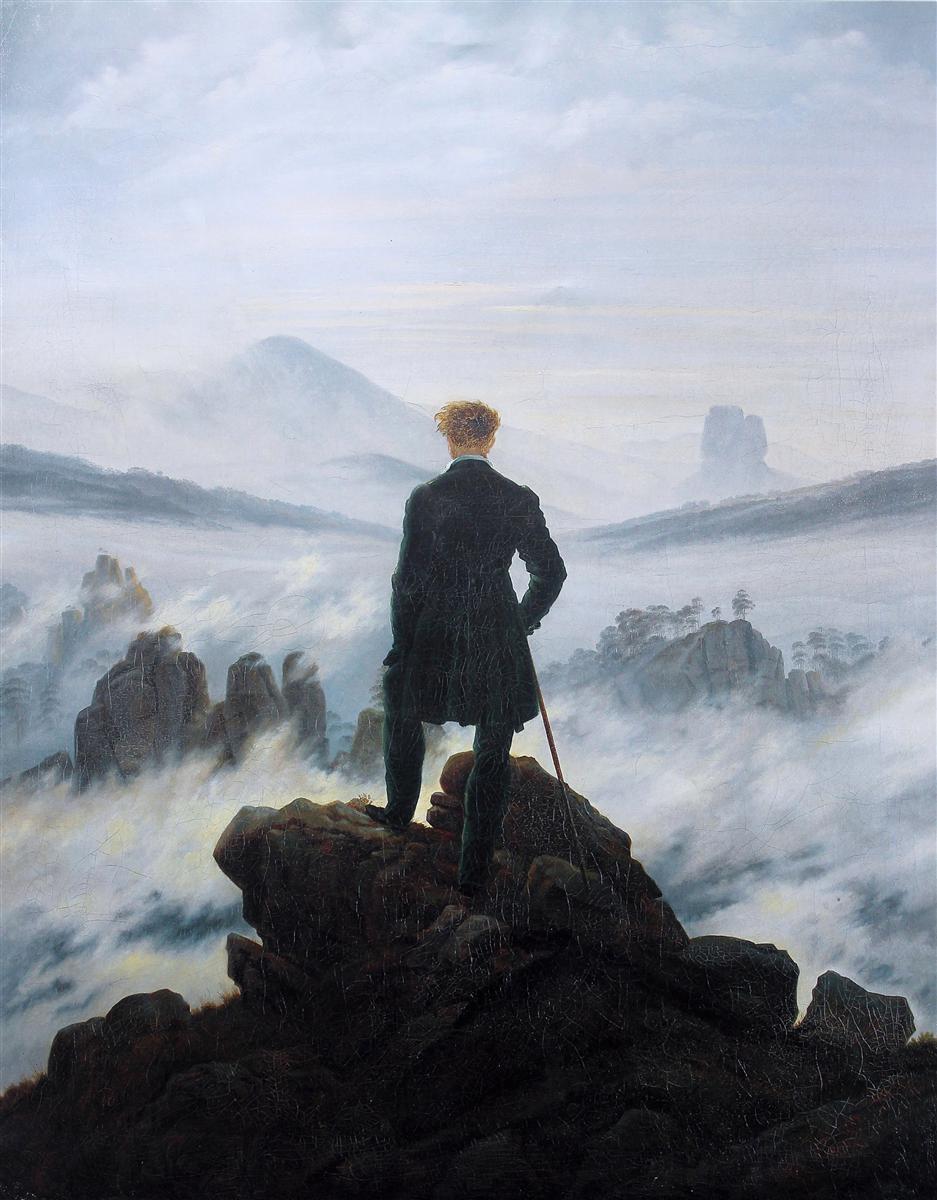
Image source: wikiart.org
Introduction
Caspar David Friedrich’s The Wanderer Above the Sea of Fog, painted in 1818, is one of the defining images of European Romanticism. Few paintings have become so deeply associated with a mood, a worldview, and a way of seeing nature. At first glance, the composition seems simple. A solitary man stands on a rocky summit, his back turned toward the viewer, looking out across a landscape flooded with mist. Yet the longer one looks, the more expansive and mysterious the painting becomes. It does not simply show a traveler admiring a view. It stages a powerful encounter between the human mind and the vast, unstable world beyond it.
This work has endured because it captures a feeling that is both historical and timeless. It belongs to a specific moment in early 19th century German art, when painters and writers were intensely concerned with nature, spirituality, emotion, and the limits of reason. At the same time, it speaks directly to modern viewers because it visualizes experiences that remain deeply familiar: solitude, uncertainty, wonder, self reflection, ambition, and the desire to find meaning in a world that often feels too large to grasp.
The painting’s power lies in its balance between clarity and ambiguity. We see a sharply defined figure planted firmly on the foreground rocks, but the world before him dissolves into clouds and vapor. The landscape appears grand, but it is also elusive. Mountains rise and fade. Cliffs emerge and disappear. Space seems to open infinitely, yet nothing can be fully measured or possessed. Friedrich transforms a mountain view into a philosophical image. Nature here is not merely scenery. It is a mirror for thought, emotion, and spiritual longing.
The Visual Structure of the Composition
The composition is built around a striking contrast between solidity and instability. In the foreground, the dark rocky outcrop is tangible and weighty. It occupies the lower part of the painting with an almost sculptural presence. On this summit stands the wanderer, upright and poised, feet apart, cane in hand. His stance creates an immediate sense of control and stability. He appears to have reached a place of vantage and command.
Beyond him, however, the entire world changes character. The middle ground and distance are overwhelmed by fog. Mountain ridges, rocky formations, and wooded slopes break through the mist in scattered fragments. Their forms are partially visible, never fully resolved. This shifting visual field gives the scene its remarkable tension. The figure seems stable, but the landscape is in flux. He stands on a point of certainty while gazing into a space of uncertainty.
Friedrich carefully organizes the painting so that the viewer’s eye follows the wanderer’s line of sight into the distance. The figure is placed near the center, but not in a rigidly symmetrical way. The surrounding peaks and mist carry the eye outward and upward, creating a sense of vast atmospheric depth. The painting does not rely on dramatic movement or action. Its drama comes from stillness, from the pause between arrival and understanding.
The horizon is obscured rather than clearly defined, which is crucial to the painting’s emotional effect. A traditional landscape often offers visual order through a clear recession into space. Here, Friedrich denies complete visual certainty. The eye keeps searching for stable depth cues, but the fog interrupts them. As a result, the scene feels both open and inaccessible. This is not a landscape that can be easily mastered by looking. It resists full comprehension.
The Wanderer as a Romantic Figure
The solitary man at the center of the composition has become one of the most recognizable figures in Western art. He is not presented as a specific portrait in any ordinary sense. Instead, he functions as a symbolic presence, an embodiment of the Romantic self. He stands alone, removed from society, facing nature in a moment of heightened awareness. His dark green coat and reddish hair make him visually distinct against the pale atmosphere, but his turned back prevents direct psychological access. We do not see his face, and that absence is essential.
Because his face is hidden, the figure becomes both individual and universal. He is a particular person, yet he can also stand in for the viewer. Friedrich places us just behind him, almost as if we have climbed to this height ourselves. This device encourages identification. We are invited not merely to observe the wanderer, but to share his experience of seeing.
The figure’s stance suggests confidence, but it does not eliminate ambiguity. He looks assertive, even heroic, planted above the clouds like someone who has overcome physical and spiritual obstacles. Yet he is also isolated, small in relation to the immensity before him. That duality is central to Romanticism. The individual seeks meaning, insight, and self realization through encounters with nature, but such encounters also reveal human limitation.
The wanderer is not engaged in labor, conversation, or narrative action. He is thinking, perceiving, and confronting. His stillness turns the act of looking into the subject of the painting. Friedrich makes inward experience visible through outward pose. The man’s physical presence on the summit suggests achievement, but the sea of fog before him reminds us that arrival does not end uncertainty. Reaching the peak only opens a deeper encounter with mystery.
Nature as Mystery Rather Than Scenery
One of the most important aspects of The Wanderer Above the Sea of Fog is Friedrich’s treatment of nature. This is not nature presented as a catalog of topographical details or a celebratory panorama of geographic beauty. It is nature transformed into an emotional and spiritual field. The mountains, rocks, and mist are real enough in visual terms, but they are arranged and interpreted in ways that exceed literal description.
The fog is especially important. It veils the landscape, softens contours, and creates the impression that the world is constantly shifting before our eyes. Fog conceals, but it also reveals selectively. It gives glimpses rather than certainties. This makes the natural world feel alive, unstable, and resistant to possession. We are not given a perfect survey of the land. Instead, we are made to experience partial vision.
That partial vision aligns with the painting’s larger philosophical concerns. Human beings want understanding, order, and perspective. Yet nature, in Friedrich’s vision, cannot be fully reduced to those desires. It remains larger, stranger, and more spiritually charged than the rational mind can fully contain. The landscape becomes a place where knowledge gives way to wonder.
The rocky peaks rising through the mist resemble islands in an atmospheric ocean. This effect makes the earth itself seem fluid. Solid ground appears suspended in a sea of cloud. Such imagery blurs ordinary distinctions between land and air, stability and movement. Nature is not static. It seems to breathe, shift, and unfold according to laws beyond human control.
Friedrich’s vision of nature is also deeply inward. The landscape reflects an emotional state without becoming merely symbolic in a simplistic way. The fog can suggest uncertainty, the heights aspiration, the solitude introspection, and the open distance longing. Yet none of these meanings is forced. The painting retains its mystery because it never collapses into one fixed interpretation. Nature remains both external reality and inner metaphor.
The Sublime and the Romantic Imagination
The painting is often discussed in relation to the sublime, a concept that was central to Romantic art and thought. The sublime refers to experiences of greatness, vastness, or power that overwhelm ordinary perception and provoke a mixture of awe, fear, admiration, and humility. Friedrich’s painting exemplifies this idea not through storm or catastrophe, but through silence and scale.
The wanderer does not face violent natural destruction. Instead, he confronts a world so expansive and indeterminate that it exceeds easy understanding. The sublime here is atmospheric rather than theatrical. The sea of fog transforms the landscape into something boundless, almost metaphysical. The visible world becomes unstable, and that instability produces a profound emotional charge.
What makes Friedrich’s treatment of the sublime especially powerful is that it is inwardly focused. The painting is not about dramatic action in nature, but about the mental and spiritual effect of nature on the observer. The wanderer’s position on the summit suggests that he has achieved a privileged viewpoint, yet what he sees is not clarity in any simple sense. He sees depth, complexity, and mystery. The sublime experience is therefore double edged. It elevates him, but it also unsettles him.
This tension between empowerment and humility is at the heart of the painting. The man stands above the fog, which might suggest mastery. But the world before him still cannot be fully grasped. He is elevated, yet not all knowing. He is central to the composition, yet small in relation to the forces around him. Friedrich presents the self not as ruler of nature, but as a conscious being awakened by contact with something immeasurably larger.
The Romantic imagination thrives in precisely this space. It is drawn to moments when the visible world seems to point beyond itself. In this painting, the mountains and mist are not simply beautiful objects. They become thresholds to thought, feeling, and spiritual reflection. The viewer is asked to sense what cannot be fully named.
The Meaning of the Rückenfigur
A key feature of Friedrich’s art is the use of the Rückenfigur, a figure seen from behind. In The Wanderer Above the Sea of Fog, this device is central to the painting’s emotional and philosophical effect. By showing the man from the back, Friedrich withholds facial expression and directs attention toward the act of viewing itself.
The Rückenfigur does several things at once. First, it creates identification. The viewer can imaginatively step into the figure’s place more easily than if the figure were facing outward with a fixed and readable expression. The turned back opens rather than closes meaning. We project ourselves into the scene.
Second, it emphasizes contemplation over action. Because we do not see the man speaking, moving, or reacting in an obvious way, the moment becomes meditative. The painting is about a relation between person and world rather than a story unfolding in time. It holds us in a suspended instant of reflection.
Third, the Rückenfigur preserves mystery. If Friedrich had shown the wanderer’s face, the image might have become too psychologically specific. Instead, the hidden face prevents closure. We cannot say exactly what the man feels. Is he triumphant, troubled, inspired, lost in thought, or spiritually transported? The answer remains open, which is one reason the painting continues to invite interpretation.
Friedrich used this device in other works as well, but here it reaches a particularly memorable form. The solitary figure facing a mist covered landscape has become iconic because it visualizes a deeply human experience: standing before something greater than oneself and trying to absorb it inwardly.
Color, Light, and Atmosphere
The painting’s palette is restrained, and that restraint is essential to its mood. Friedrich avoids brilliant color in favor of subtle transitions among pale grays, soft blues, muted whites, earthy browns, and deep green black tones. The effect is quiet, cool, and meditative. Nothing in the color scheme distracts from the emotional gravity of the scene.
The upper sky is pale and delicate, with faint tonal variations that suggest early light filtering through a hazy atmosphere. The sea of fog below echoes these tones, creating a broad field of luminous softness. Against this pale world, the wanderer’s dark clothing and the rock beneath him stand out sharply. Friedrich uses tonal contrast rather than bright color contrast to organize the composition.
This relationship between dark foreground and luminous distance helps produce the painting’s emotional drama. The foreground feels immediate, heavy, and finite. The distance feels airy, expansive, and elusive. The eye moves from tangible darkness into radiant uncertainty. In visual terms, the painting becomes a journey from matter into atmosphere.
Light in this work is diffuse rather than direct. There is no dramatic beam of sunlight or strongly defined source. Instead, light seems to permeate the fog itself. This gives the landscape a spiritual quality. The mist does not merely obscure. It glows faintly, turning concealment into a kind of revelation. Friedrich often used atmospheric light to suggest a reality that exceeded ordinary vision, and that tendency is especially strong here.
The overall surface of the painting also contributes to its effect. The softened forms and layered atmospheric passages create a sense of distance that feels almost tactile. Friedrich wants us to sense the chill air, the damp vapor, and the precarious elevation. The painting is visual, but it also evokes physical sensation. We can almost imagine the silence of the summit and the slow movement of clouds below.
Spiritual and Philosophical Dimensions
Although The Wanderer Above the Sea of Fog can be appreciated purely as a landscape, its deeper force comes from its spiritual and philosophical dimensions. Friedrich was not interested in nature as neutral scenery. For him, nature could be a vehicle for inner truth, religious feeling, and metaphysical reflection.
In this painting, the natural world appears as something that invites contemplation of the unseen. The fog hides much of the landscape, yet this concealment does not feel merely frustrating. It feels suggestive. The invisible seems as important as the visible. What cannot be clearly seen gains spiritual weight. This is one reason Friedrich’s landscapes often feel close to prayer or meditation.
The painting also raises questions about knowledge and perspective. The wanderer stands at a high point, a place traditionally associated with insight and overview. Yet what lies before him is not transparent clarity. He has reached a commanding position, but the world remains mysterious. This suggests a profound philosophical idea: that higher vision does not necessarily mean complete certainty. Wisdom may involve recognizing the limits of what can be known.
There is also a sense of existential confrontation in the image. The solitary figure is alone with nature and, by implication, alone with himself. No social framework mediates the experience. No city, road, or domestic detail interrupts the scene. The painting strips away ordinary distractions and places the individual before immensity. In doing so, it suggests that self knowledge may arise not from comfort, but from exposure to the vast and unknown.
At the same time, the work is not despairing. It is solemn, but not hopeless. The wanderer does not recoil from the view. He faces it. The painting suggests that mystery is not something to avoid, but something to inhabit. Uncertainty becomes a condition of spiritual intensity rather than a failure of understanding.
Historical Context and Romanticism
Painted in 1818, The Wanderer Above the Sea of Fog belongs to the mature period of German Romanticism. This was a time when artists, philosophers, and writers were reacting against the dominance of Enlightenment rationalism and turning toward imagination, emotion, subjectivity, and the spiritual power of nature. Friedrich became one of the movement’s most important painters because he gave visual form to these concerns with exceptional clarity and originality.
Unlike artists who used grand historical narratives or mythological scenes to convey elevated meaning, Friedrich often turned to landscape. But his landscapes are never merely descriptive. They are charged with inner life. Mountains, forests, ruins, seas, and skies become settings for spiritual reflection. Human figures, when present, are often small, contemplative, and absorbed in nature rather than acting upon it.
This approach distinguished Friedrich from many earlier landscape traditions. In much 18th century painting, nature could function as a backdrop for narrative or as an ordered spectacle. Friedrich instead made landscape itself the site of meaning. In The Wanderer Above the Sea of Fog, the natural world is not secondary to the figure. It is the essential counterpart to him, the vast reality that gives his contemplation significance.
The painting also reflects a Romantic fascination with travel, elevation, and solitary experience. The wanderer is more than a tourist or hiker. He is a seeker, a consciousness in search of relation to the infinite. This ideal of the solitary observer confronting sublime nature became central to Romantic culture, and Friedrich gave it one of its most enduring visual forms.
Why the Painting Still Feels Modern
One reason this painting remains so widely admired is that it continues to feel emotionally current. Modern viewers may not share Friedrich’s exact religious or philosophical framework, but the image still resonates because it speaks to experiences that remain deeply recognizable. Many people know what it feels like to reach a pause in life, look outward, and confront a future that is open yet unclear. The sea of fog can stand for uncertainty, possibility, anxiety, freedom, or all of these at once.
The painting also appeals because it captures the complexity of self consciousness. The wanderer appears strong and self possessed, yet the world before him is unstable and immeasurable. That combination of confidence and vulnerability feels distinctly modern. We often imagine ourselves as agents shaping our lives, but we are also constantly reminded that much remains beyond control.
There is another modern quality in the painting’s ambiguity. Friedrich does not tell us exactly what to think or feel. He creates a scene that remains open to projection and reinterpretation. Viewers from different times and cultures can find themselves in it. Some see triumph, others introspection, others loneliness, others spiritual awakening. The painting’s openness is part of its durability.
Its visual simplicity also contributes to its lasting impact. The image is easy to remember: one figure, one summit, one sea of mist. Yet that simplicity contains immense conceptual depth. It is an image that works immediately and continues to unfold over time. That is one mark of a masterpiece.
Conclusion
The Wanderer Above the Sea of Fog endures because it condenses some of the greatest concerns of Romantic art into a single unforgettable image. Caspar David Friedrich transforms a mountain landscape into a meditation on vision, selfhood, mystery, and the human relationship to nature. The lone figure on the summit appears at once powerful and fragile, grounded and searching. Before him stretches a world that is beautiful, unstable, and impossible to fully possess.
The painting’s brilliance lies in the way it joins outward form and inward meaning. The rocks, fog, mountains, and light are not decorative elements. They are the language through which Friedrich explores the deepest emotional and philosophical questions of his age. What does it mean to stand alone before the unknown? Can nature offer insight without surrendering its mystery? Is elevation a form of mastery, or does it reveal how limited we remain?
Friedrich never answers these questions in a fixed way. Instead, he holds them open within the painting’s stillness. That openness is what keeps the work alive. The wanderer stands on the edge of knowledge, and so do we. We look with him into a world that is at once real and symbolic, visible and veiled, intimate and immeasurable.
In this way, The Wanderer Above the Sea of Fog is far more than a famous landscape. It is a profound image of human consciousness itself, poised between certainty and uncertainty, between earth and atmosphere, between the known world underfoot and the vast mystery stretching beyond sight.