Image source: wikiart.org
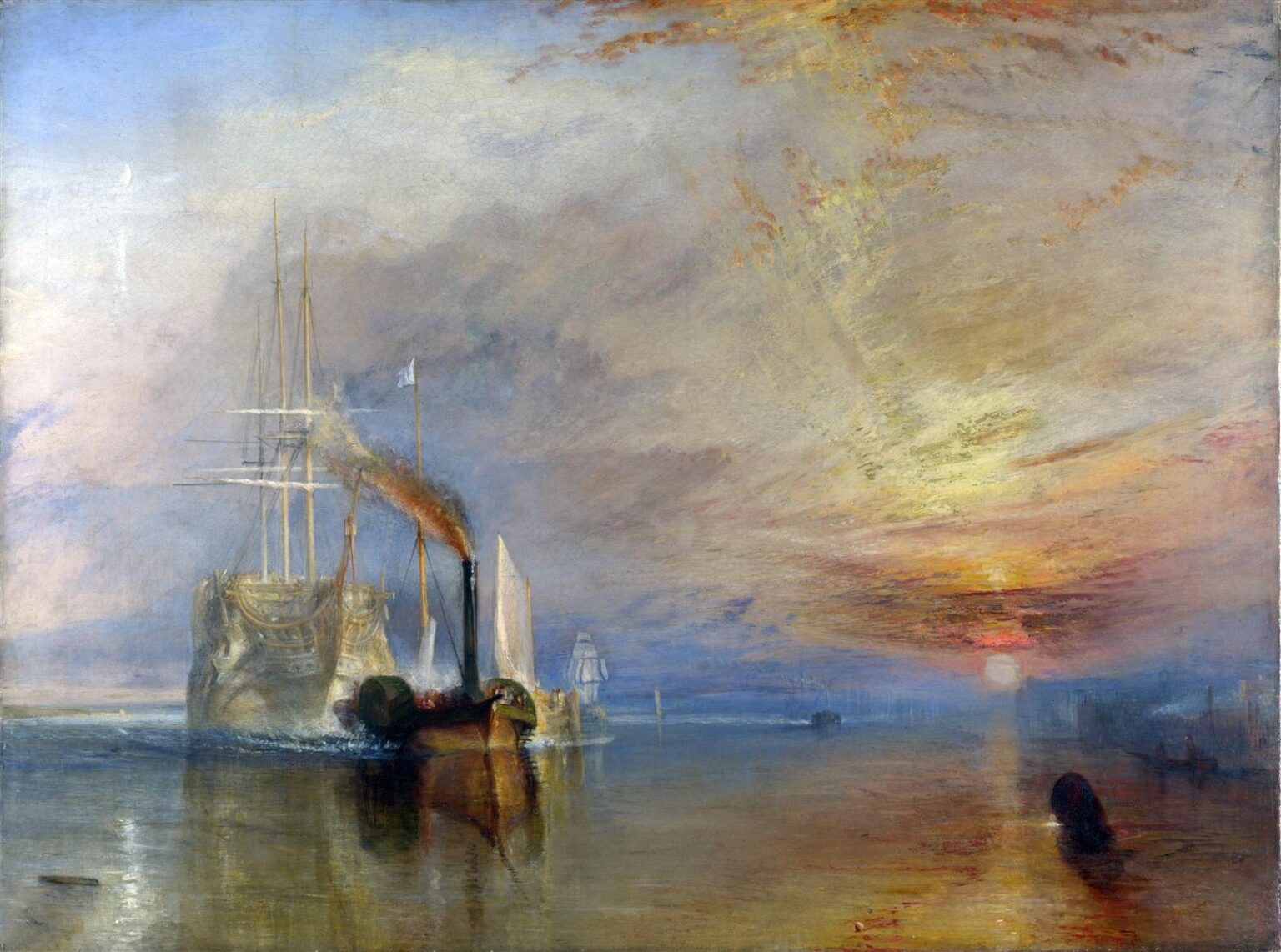
The Fighting Temeraire by J.M.W. Turner
J.M.W. Turner’s The Fighting Temeraire is one of the most admired paintings in British art, and it remains powerful because it unites history, atmosphere, and emotion in a single unforgettable image. Painted in 1839, the work shows the old warship HMS Temeraire being pulled by a small steam tug toward its final berth, where it will be broken up. Turner transforms that moment into something much larger than a simple record of a ship being moved. He turns it into a meditation on glory, aging, industrial change, and the passing of an era.
At first glance, the painting appears serene and almost dreamlike. The river is calm, the sky glows with a magnificent sunset, and the old vessel seems to float like a ghost over the water. Yet beneath that beauty is a deeply melancholy subject. This is not a triumphant naval scene. It is the farewell of a legend. The Temeraire had played a famous role at the Battle of Trafalgar, one of the most celebrated British victories at sea. In Turner’s painting, however, that heroic past has given way to silence and decline. The great ship no longer moves under its own power. It is being dragged, small beside the future that is replacing it.
This contrast between nobility and obsolescence is what gives the painting its emotional force. Turner does not present history as a fixed monument. He shows it dissolving before our eyes. The old sailing ship belongs to one world, while the squat, dark tugboat belongs to another. The result is one of the clearest and most poetic visual statements about transition in nineteenth century art.
The historical story behind the painting
The subject of the painting comes from a real event. HMS Temeraire was a celebrated British warship that had earned fame during the Napoleonic Wars, especially at Trafalgar in 1805. By the late 1830s, however, the ship had become outdated. Advances in naval technology and changes in warfare had made old wooden sailing ships less useful than they once were. In 1838, the Temeraire was taken to be dismantled, and Turner chose to paint that moment shortly afterward.
The historical background matters because it gives the image much of its meaning. The Temeraire was not just any vessel. It represented national pride, military courage, and the memory of Britain’s age of sail. Audiences in Turner’s time would have understood the reference immediately. To them, this was a famous hero of the sea being escorted to its death. The painting therefore would not have felt neutral or detached. It would have carried the emotional charge of a public farewell.
Turner did not paint the event as a documentary record. He altered details to increase symbolic power. In reality, the ship was towed during the day, but Turner places it in the golden light of sunset. That choice is central. Sunset suggests closure, mortality, and the ending of a long day, which parallels the end of the ship’s life. At the same time, the setting sun fills the scene with extraordinary beauty. Turner makes decline visually radiant. The result is not simply sad. It is mournful, majestic, and almost sacred.
This imaginative treatment shows how Turner worked as both an observer and a poet. He took a factual event and reshaped it into an image with broader meaning. The painting is therefore historical, but it is also deeply symbolic. It tells us not only what happened to the ship, but what the event meant in emotional and cultural terms.
Composition and the drama of contrast
One of the most striking aspects of The Fighting Temeraire is its composition. Turner organizes the scene so that the old warship and the steam tug become the main visual and symbolic opposition. The Temeraire sits left of center, tall, pale, and almost immaterial. Its masts rise delicately into the sky, and its form seems to shimmer rather than solidify. It looks like a memory made visible. The tugboat, by contrast, is darker, lower, and more compact. It emits a thick plume of smoke and cuts across the water with practical force.
This opposition is the foundation of the painting. The Temeraire is large but passive. The tug is small but active. The old ship is beautiful and noble. The tug is gritty, mechanical, and unsentimental. Turner could have made the contrast crude, but instead he balances it carefully. The tug is not demonized. It is simply the agent of a new age. That makes the scene more moving, because the replacement of the old does not occur through violence. It happens quietly, almost inevitably.
The broad expanse of water and sky gives the painting its meditative quality. Turner leaves much of the canvas open, allowing atmosphere and reflection to dominate. This spaciousness prevents the work from feeling crowded or theatrical. The emotional drama unfolds through distance, light, and placement rather than through action. The old ship drifts with solemn dignity, surrounded by a world that seems aware of its passing.
The placement of the sun on the right side of the canvas also matters. It draws the eye across the picture and counterbalances the Temeraire on the left. The viewer moves visually from ship to tug, from tug to glowing sunset, and from sunset back across the water. This movement creates a rhythm that reinforces the theme of transition. The painting never feels still in a dead sense. Instead, it feels suspended in a moment of change.
Turner’s use of light and color
Turner’s genius as a painter is nowhere more evident than in his treatment of light, and The Fighting Temeraire is a superb example of that gift. The sky is filled with veils of gold, pink, blue, gray, and orange, all softly blending and shifting across the surface. The sunset is intensely luminous, but it does not overwhelm the painting. Instead, it infuses the whole scene with emotional atmosphere.
Light in this painting does far more than describe the time of day. It becomes a carrier of meaning. The sinking sun on the horizon suggests the close of life, the end of a historic age, and the fading of former greatness. Yet the brilliance of the color also grants the moment grandeur. The Temeraire is not disappearing into dullness. It is passing out beneath a sky of extraordinary splendor. That contradiction between loss and beauty is central to Turner’s vision.
The old ship is rendered in pale, almost spectral whites and creams. It catches and reflects the surrounding light so delicately that it seems less like solid wood than like a glowing apparition. Turner gives it the look of something already half removed from the world. The tugboat, by contrast, is dark and earthy, with black smoke and warmer industrial tones. It has weight and density. Where the Temeraire seems ethereal, the tug seems bluntly physical.
The reflections in the water extend these color relationships downward, creating a second world beneath the surface. Turner uses reflection not just to increase beauty, but to blur the boundary between material reality and poetic transformation. The water becomes a field where color dissolves, reforms, and trembles. This effect makes the painting feel unstable in the best sense. Everything seems in motion, yet nothing is sharply fixed. That uncertainty suits a subject about transition, memory, and disappearance.
The meaning of the ghostly ship
The most unforgettable thing about the Temeraire in Turner’s painting is its ghostlike quality. The ship appears almost transparent, as though it belongs more to memory than to the present. Turner does not emphasize the hard structure of the hull in a detailed, technical way. Instead, he softens its edges and lets it glow against the surrounding air. The result is that the vessel seems already halfway transformed into legend.
This ghostliness has several possible meanings. On one level, it reflects the ship’s status as a relic of the past. The age it represents is vanishing. On another level, it suggests a kind of dignity beyond ordinary material existence. The Temeraire is not shown as wreckage or debris. It is shown almost as an honored spirit being led away. Turner gives it a quiet nobility that the practical world cannot erase.
That effect is emotionally important because it keeps the painting from becoming merely tragic. The ship may be going to destruction, but Turner paints it with reverence. It remains visually superior to the tugboat even in defeat. The modern vessel does the towing, but it does not command the same emotional authority. The eye and the heart remain with the pale old ship. Turner makes sure that the viewer understands what is being lost.
There is also something broader at work here. The ship can be read as a symbol of heroic memory itself. Societies often celebrate their past, but history does not remain active forever. It must eventually yield to new systems, new technologies, and new values. Turner does not deny that change. But he insists that what disappears should still be seen, felt, and honored. In that sense, the Temeraire becomes more than a naval vessel. It becomes a symbol of the fragile relationship between progress and remembrance.
Steam power and the modern world
The tugboat in The Fighting Temeraire may be small, but it carries enormous meaning. It represents the industrial future, a world driven not by wind, wood, and sail, but by coal, smoke, iron, and machinery. Turner clearly understood that the nineteenth century was transforming the structure of daily life and national power. Steam technology was not just a technical innovation. It was changing how people thought about movement, labor, warfare, and time itself.
What makes the painting so compelling is that Turner does not present modernity in a simple way. He neither celebrates it without reservation nor condemns it outright. The tug is dark, noisy, and visually coarse compared with the elegant warship it pulls. Yet it is undeniably effective. It possesses the power to move what once would have been among the most formidable vessels in the world. That fact alone expresses the arrival of a new era.
The smoke rising from the tug is especially important. It cuts into the sky and introduces an element of harshness into an otherwise luminous atmosphere. The smoke marks the intrusion of industrial force into a world of natural beauty and traditional craftsmanship. At the same time, it creates a dramatic visual link between the tug and the glowing clouds above. Turner turns even pollution into painterly spectacle. This complexity is part of what makes the work so rich. Modernity appears disruptive, but also compelling and inescapable.
Many viewers read the painting as an elegy for the age of sail, and that is certainly true. But it is also a painting about history moving forward whether one welcomes it or not. The tugboat is not a villain. It is the future. Turner seems to acknowledge that progress comes at a cost, especially when it replaces forms of beauty and heroism that people still cherish. The painting becomes a visual meditation on that painful but universal truth.
Emotion, memory, and national identity
Part of the lasting appeal of The Fighting Temeraire lies in the way it speaks to personal feeling while also addressing collective identity. The ship was tied to British naval triumph and national pride, but Turner presents it in a way that goes beyond patriotic celebration. Instead of glorifying battle, he focuses on memory and farewell. The heroism belongs to the past, and what remains in the present is a mood of reflection.
This emotional shift is important. Rather than painting the Temeraire in the heat of combat, Turner chooses the quieter and more vulnerable moment of retirement. That choice humanizes the subject. The ship becomes almost like an aging veteran, once glorious, now obsolete, still dignified. Viewers respond to that because it echoes a wider human experience. Strength fades. Roles change. Great things pass. What matters is how that passing is witnessed.
The painting also explores the tension between public history and private feeling. For many viewers, the image evokes sorrow not because they knew the ship personally, but because Turner paints it as though it deserves mourning. He invites emotional attachment through atmosphere, color, and reverent handling. The national symbol becomes intimate. The viewer is not just told that the ship mattered. The viewer feels that it mattered.
In this way, the painting helps explain why Turner was such an extraordinary artist. He could take a historical subject and make it emotionally immediate without relying on literal drama. There are no crowds, no speeches, no theatrical gestures. The pathos comes from light, distance, and the fragile silhouette of the ship itself. Memory is not declared. It is embodied in the image.
Turner’s painterly technique
Turner’s technique in The Fighting Temeraire is essential to its impact. He does not paint in a tightly finished, highly polished academic manner. Instead, his brushwork often feels fluid, suggestive, and atmospheric. Forms seem to emerge out of mist, light, and reflected color rather than being sharply outlined. This gives the painting a remarkable sense of life and movement.
The loose handling is especially effective in the sky and water. Turner layers color in ways that allow one tone to flicker through another, creating a surface that feels alive with shifting conditions. The clouds are not described with hard precision. They are built through touches and veils of paint that convey changing light and unstable weather. This method suits a subject based on transience. The world of the painting feels as though it is dissolving even as we look at it.
At the same time, Turner knows where to provide structure. The masts of the Temeraire, the smokestack of the tug, and the line of the horizon anchor the composition. These firmer elements prevent the painting from drifting entirely into abstraction. The balance between firmness and dissolution is one of Turner’s greatest achievements here. He creates a scene that is legible, but also deeply atmospheric.
This painterly freedom is one reason Turner later came to be seen as a precursor to modern art. In works like The Fighting Temeraire, he shows that a painting can communicate through sensation and mood as much as through exact description. He remains rooted in a recognizable subject, yet his handling of light and color pushes toward something more subjective and expressive. That tension gives the painting its enduring freshness.
Why The Fighting Temeraire still matters today
Even for viewers who know little about British naval history, The Fighting Temeraire remains deeply moving. That is because its central theme is universal. It is about the passing of greatness, the arrival of change, and the uneasy relationship between memory and progress. Those ideas are still relevant in every age. People continue to experience the replacement of older worlds by newer ones, whether in technology, culture, work, or personal identity.
The painting also still matters because it resists easy answers. It does not simply say that the past was better or that the future is worse. Nor does it claim that progress is purely triumphant. Instead, Turner captures the beauty and sadness of transition itself. He recognizes that new eras bring power and efficiency, but also loss. Something noble often disappears when the practical takes over. Yet that disappearance does not erase the value of what came before.
Visually, the painting continues to attract viewers because it is so breathtakingly beautiful. Even someone who does not know the story can be drawn in by the radiant sunset, the silvery ghost ship, and the mirrorlike water. Turner ensures that the painting works first as an image, then as an idea. That union of visual pleasure and emotional depth is a major reason for its lasting fame.
Ultimately, The Fighting Temeraire is a masterpiece because it transforms a single historical moment into a timeless reflection on mortality, memory, and change. Turner paints the end of a ship, but he also paints the end of an era and the human need to honor what is passing away. The result is not simply one of the greatest works of British art, but one of the great farewell images in the history of painting.