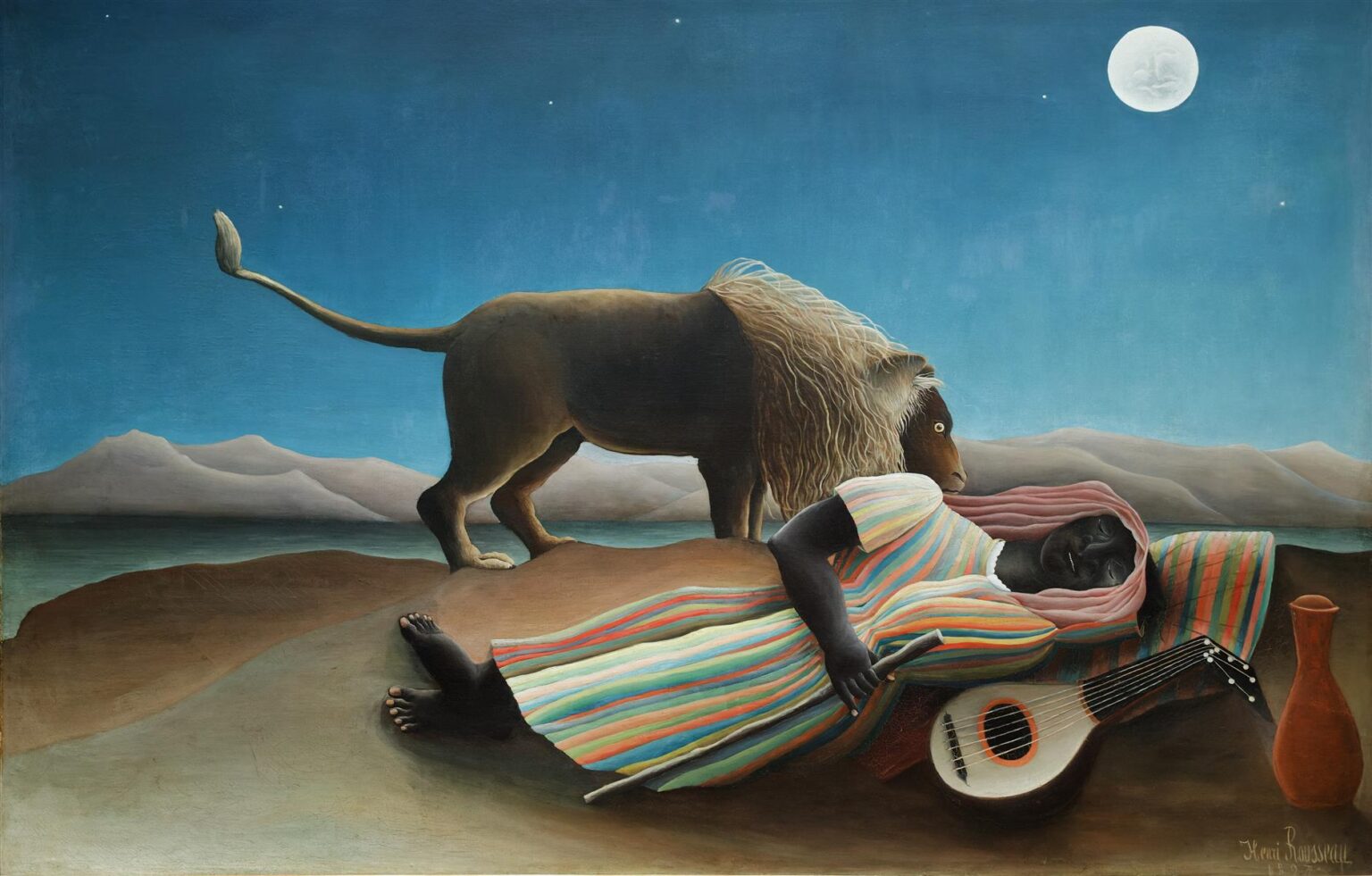
Image source: wikiart.org
Henri Rousseau’s The Sleeping Gypsy: A Complete Analysis
Henri Rousseau’s The Sleeping Gypsy from 1897 is one of the most haunting and memorable paintings of the late nineteenth century. At first glance, the scene appears simple. A sleeping woman lies in a barren landscape beneath a moonlit sky while a lion stands over her, alert and silent. Nearby rest a stringed instrument and a clay vessel. Mountains rise in the distance, and the water behind them seems almost still enough to suspend time itself. Yet the longer the viewer remains with the painting, the stranger and more compelling it becomes.
This is a work that resists easy explanation. It belongs neither fully to realism nor entirely to dream. It is descriptive, but it is also mysterious. Rousseau presents every object with clarity, but the overall atmosphere feels suspended between waking and sleeping, between danger and calm, between reality and invention. The painting achieves its power not through dramatic movement or complex narrative, but through stillness, precision, and ambiguity.
What makes The Sleeping Gypsy so enduring is this unusual balance. The image is immediately legible, yet never fully solved. The lion does not attack. The woman does not wake. The moon shines with a strange, almost symbolic intensity. The desert is empty, but the scene feels dense with meaning. Rousseau turns a simple encounter into a visual riddle, and in doing so, he creates one of the most unforgettable dream images in modern painting.
The Scene and Its Unusual Calm
The painting shows a dark-skinned woman asleep on the ground in what appears to be a desert or barren plain. She wears a long striped garment and a head covering. Her body lies diagonally across the foreground, giving the composition an immediate visual anchor. Beside her rest a mandolin and a jug, objects that suggest travel, music, and personal life. A lion stands above and behind her, head lowered as if sniffing or observing. In the background, pale mountains stretch across the horizon, with a body of water separating them from the foreground. Above all of this hangs a large glowing moon in a deep blue night sky.
The first surprise of the painting is its quietness. A lion standing over a sleeping human should produce suspense and terror. In most paintings, this setup would lead toward violence or dramatic confrontation. Rousseau does something very different. He removes movement. The lion seems curious rather than aggressive. The woman remains deeply asleep. Nothing in the painting suggests struggle, panic, or alarm. Instead, the entire scene feels unnaturally calm.
This calm is what gives the image its unsettling force. Rousseau replaces obvious drama with suspended possibility. The viewer expects danger, but receives silence. That silence becomes the real subject of the work. It transforms the image from a narrative event into a dream state. The painting is not about what happens next. It is about what it feels like to inhabit a world where opposites coexist without resolution.
Composition and the Power of Stillness
Rousseau’s composition is remarkably controlled. The sleeping figure stretches across the lower part of the canvas, occupying a broad horizontal space. Her body creates a stable base that grounds the scene. The lion, placed above and slightly behind her, introduces a vertical counterpoint. This contrast between the woman’s reclining pose and the lion’s upright alertness creates the central tension of the painting.
The composition guides the eye carefully. The viewer first notices the striped garment because of its bright, rhythmic pattern. From there the eye moves to the dark face of the sleeping woman, then to the lion’s head, then outward to the moon and distant hills. The instrument and jug on the right side help balance the scene and deepen its meaning. These objects prevent the painting from becoming a simple animal encounter. They suggest a life beyond the moment, perhaps a journey interrupted by sleep.
The space is shallow and clear. Rousseau does not create deep atmospheric recession in the academic sense. Instead, the foreground, middle ground, and background are separated with unusual crispness. This gives the painting a staged quality, almost like a vision arranged in layers. The result is not clumsy, as some early critics claimed of Rousseau’s art, but deliberate. By flattening and simplifying space, he heightens the dreamlike effect. Everything appears both close and distant, real and unreal.
Stillness is the key compositional principle. There is no wind in the garment, no visible motion in the water, no dramatic bend in the lion’s posture. Even the stars seem fixed with ceremonial precision. This stillness allows the painting to function almost like a held breath. Time is paused. The viewer is left in a suspended moment that feels eternal.
Color, Light, and the Dreamlike Night
Color plays an essential role in shaping the emotional atmosphere of The Sleeping Gypsy. The dominant blue of the sky creates an immediate sense of nocturnal calm, but it is not a heavy or oppressive darkness. Rousseau’s night is luminous. The blue is clear and open, allowing the moon and stars to glow without being swallowed by shadow. This gives the painting a sense of clarity rather than obscurity. It is a night seen not through fear, but through strange serenity.
The moon is especially important. Its pale circular form acts almost like a watchful presence in the sky. It illuminates without fully explaining. Moonlight in this painting does not reveal the world in naturalistic terms. Instead, it lends everything an enchanted quality. The lion’s mane, the woman’s robe, and the sandy ground all seem touched by a cool, even light that removes harsh contrast and deepens the sense of stillness.
The striped garment is the boldest color statement in the painting. Its alternating bands of soft reds, greens, blues, yellows, and creams inject rhythm into the otherwise quiet landscape. This robe becomes a visual bridge between the human figure and the dreamlike world around her. It is both decorative and symbolic. Against the subdued earth tones of the desert and the dark body of the sleeper, the stripes create a musical vibration. They echo the mandolin nearby, as if color itself were becoming a kind of silent song.
The lion is rendered in muted browns and golds, with the mane flowing in pale, almost silvery strands. These tones connect the animal to the earth, but the strange precision of its outline keeps it from blending naturally into the environment. Rousseau makes the lion solid and spectral at once. It belongs to the scene, yet it also feels like an apparition.
The painting’s palette is limited, but every color has a distinct role. Blue establishes the emotional field. Earth tones create calm stability. The striped robe introduces visual energy. White and pale gray in the moon, mountains, and instrument provide moments of purity and stillness. Together, these colors create a world that is coherent but uncanny, serene but never ordinary.
The Sleeping Figure and the Mystery of Vulnerability
The woman at the center of the painting is both specific and enigmatic. Rousseau calls her a gypsy, a term that reflects nineteenth century language and fantasy more than any documentary reality. In the painting, she appears as a wandering musician or traveler, marked by her garment, headscarf, mandolin, and vessel. Yet Rousseau does not turn her into a theatrical performer or a dramatic heroine. She is asleep, passive, self-contained, and almost monumental in her stillness.
Her vulnerability is obvious. She lies exposed in an open landscape, apparently alone except for her possessions. Most dramatically, she remains asleep in the presence of a lion. But Rousseau does not paint vulnerability as panic or weakness. The sleeping figure seems strangely protected by the very depth of her sleep. Her face is calm. Her body is relaxed. She is not resisting the world around her. Instead, she appears completely surrendered to it.
This surrender gives the painting much of its emotional complexity. Sleep here is not merely physical rest. It becomes a state of trust, innocence, or perhaps spiritual withdrawal. The woman is vulnerable, but she is also inaccessible. Because she sleeps, she does not participate in the tension that surrounds her. The viewer worries on her behalf, but she herself remains beyond worry. This creates a fascinating emotional split between viewer and subject.
Her dark skin also matters visually and symbolically. Rousseau contrasts her figure strongly with the lighter sand, the pale instrument, and the moonlit landscape. This contrast helps make her the emotional center of the painting. At the same time, her stillness and closed eyes prevent the image from becoming a portrait in the traditional sense. She is both person and symbol, both individual and dream figure.
The Lion as Threat, Witness, and Symbol
The lion is the painting’s most arresting presence after the sleeper herself. It is the source of narrative tension, but Rousseau refuses to make it merely threatening. The animal does not pounce or roar. Instead, it leans in with quiet attention. Its posture suggests curiosity, recognition, or instinctive assessment. This ambiguity is central to the painting’s meaning.
On one level, the lion represents danger held in check. Nature stands over human fragility. The wild confronts the defenseless. But because no attack occurs, the lion also becomes something else. It is a witness to sleep. It is a guardian of the dream. It may even function as a projection of the inner world, a symbol of primal power that approaches but does not destroy.
Rousseau often painted animals with a combination of decorative clarity and psychological intensity. In The Sleeping Gypsy, the lion is not rendered with scientific realism. Its form is simplified, its outline distinct, and its mane stylized. Yet this stylization does not weaken the animal. Instead, it strengthens its symbolic force. The lion becomes less an observed creature and more an embodiment of a condition: danger without violence, instinct without chaos, power without noise.
Many viewers read the lion as an image of death held at bay, desire restrained, or the unconscious approaching the sleeping mind. These readings are possible because Rousseau leaves the relationship open. The lion is never reduced to a single meaning. Its silence is what makes it rich. It stands at the threshold between the external and the internal, between what is physically present and what may belong to dream or symbol.
Music, Travel, and the Narrative of the Wanderer
The mandolin and the jug are easy to overlook, but they are vital to the painting’s atmosphere. These objects suggest that the sleeping woman is a traveler, someone who has crossed a difficult landscape and paused to rest. The mandolin implies music, performance, or personal expression. The jug suggests sustenance, survival, and physical need. Together they transform the sleeper from an abstract symbol into a figure with a life and a history.
These objects also deepen the painting’s sense of silence. A mandolin is an instrument of sound, rhythm, and human presence. Yet here it lies mute beside a sleeping body. The contrast between the possibility of music and the actual stillness of the scene is poignant. It suggests a song interrupted or completed, a human voice replaced by moonlight and quiet.
Travel is an important part of the image’s imaginative structure. The open terrain, the sparse belongings, and the solitary figure all suggest movement through a vast and indifferent world. Yet this movement has paused completely. The wanderer sleeps in the wilderness, caught in a moment outside ordinary time. In this sense, the painting may be understood as a meditation on rest in the midst of uncertainty. The desert journey stops, but the world does not become hostile. Instead, it becomes mysteriously contemplative.
Rousseau does not supply a literal story, but he offers enough details to evoke one. The viewer imagines where the woman came from, where she was going, what songs she may have played, and why she sleeps alone beneath the moon. These unanswered questions enlarge the painting’s emotional field. The image becomes not just a scene, but the fragment of a larger imagined world.
Rousseau’s Style and the Poetics of Simplicity
Henri Rousseau was long described as a naive painter because he lacked formal academic training and developed a style outside established artistic conventions. Yet The Sleeping Gypsy shows just how misleading that label can be when used dismissively. Rousseau’s simplifications are not signs of incapacity. They are the means by which he creates poetic intensity.
The painting is built from clear contours, simplified forms, and carefully separated planes of space. There is little illusionistic bravura, no aggressive brushwork, and no attempt to mimic the fleeting optical effects prized by some of his contemporaries. Instead, Rousseau embraces directness. He paints things with still clarity, giving each object a strong presence. This method can seem simple at first, but it produces a rare kind of visual concentration.
His style is especially effective in dreamlike subjects. Because Rousseau avoids excessive naturalism, his images do not become trapped in everyday plausibility. They remain believable enough to engage the eye, but strange enough to suggest another order of experience. In The Sleeping Gypsy, this balance is perfect. The desert, lion, instrument, and figure are all legible, yet the total scene feels suspended in imagination.
Rousseau’s decorative instinct is also important. The flowing lion’s mane, the repeated stripes of the robe, the smooth curve of the moon, and the broad shapes of the hills all contribute to a sense of visual harmony. Even the strange encounter at the center of the painting is organized through pattern and repetition. This harmony softens the threat of the subject and turns the entire image into a kind of visual chant.
Symbolism, Dream, and Psychological Meaning
One reason The Sleeping Gypsy continues to fascinate viewers is that it feels symbolic without locking itself into a fixed allegory. The painting invites interpretation, but it refuses to become a puzzle with one correct answer. This openness is part of its greatness.
Sleep is the most obvious symbolic element. Sleep suggests vulnerability, but also peace, unconscious life, dreams, and escape from waking reality. The moon reinforces this association, as does the silent landscape. The lion complicates it by introducing instinct, danger, animal force, and watchfulness. Together, sleep and the lion create a charged relationship between innocence and power, passivity and alertness, the human and the wild.
The desert setting adds another layer. Deserts often symbolize isolation, testing, spiritual exposure, or visionary experience. In Rousseau’s painting, the barren plain strips away social context and everyday detail. Nothing distracts from the essential encounter. The scene becomes archetypal. It feels less like a specific place than a psychological landscape.
The instrument suggests art, song, and human culture. Left silent beside the sleeping body, it may symbolize the pause of consciousness or the transformation of music into visual rhythm. The striped robe can be read similarly. Its ordered bands of color introduce a human system of pattern into the natural world, but that order remains gentle, not dominating.
Some viewers experience the painting as a dream image of coexistence between human vulnerability and natural power. Others see it as a meditation on death, with the lion embodying fate or mortality approaching the sleeping traveler. Still others read it as an image of artistic imagination itself, where impossible combinations become serene and convincing. Rousseau’s achievement is that all of these meanings can coexist without canceling one another.
Historical Context and Lasting Influence
Painted in 1897, The Sleeping Gypsy emerged at a time when European art was undergoing major transformation. Academic traditions still held institutional power, but artists were increasingly exploring symbolism, fantasy, subjective experience, and alternative ways of constructing pictorial space. Rousseau occupied an unusual place in this moment. He was not part of the academic establishment, but neither was he aligned neatly with any single avant garde movement. His work stood apart.
That distinctiveness later became one of his greatest strengths. Artists and writers in the twentieth century were drawn to Rousseau precisely because his paintings seemed to come from a different mental territory. The dreamlike logic, the clear yet uncanny imagery, and the emotional force of his simplified forms made him deeply important for later modernists and surrealists. The Sleeping Gypsy in particular anticipates the fascination with dreams, symbolic encounters, and psychological landscapes that would become central in modern art.
Yet the painting does not need historical explanation in order to work. Its power is immediate. Viewers who know nothing about late nineteenth century French painting can still feel the strange magnetism of the image. That universality helps explain its lasting popularity. Rousseau created a painting that is sophisticated in structure and meaning, but instantly accessible in visual terms.
Why The Sleeping Gypsy Still Captivates Viewers
The enduring appeal of The Sleeping Gypsy lies in its ability to combine opposites without forcing them into resolution. It is quiet and tense, simple and mysterious, decorative and profound. The image is easy to remember because its forms are clear, but it stays in the mind because its meaning remains open.
Many paintings achieve drama through action. Rousseau achieves it through suspension. Nothing happens, and that is precisely why the painting feels so charged. The lion’s restraint is more powerful than an attack would be. The woman’s sleep is more haunting than wakefulness. The moonlit silence is more intense than noise. Rousseau understands that mystery often grows in the absence of explanation.
The painting also speaks to a deep human fascination with states of exposure and protection. The sleeper is defenseless, yet untouched. The wild animal is present, yet gentle. The night is vast, yet calm. This improbable harmony creates a feeling close to myth. It suggests a world in which danger does not always destroy, and vulnerability does not always end in fear.
In the end, The Sleeping Gypsy remains one of Henri Rousseau’s most compelling achievements because it transforms a simple image into an unforgettable inner landscape. It is not merely a painting of a woman, a lion, and a desert night. It is a painting about silence, imagination, and the strange peace that can exist at the edge of danger.