Image source: wikiart.org
Introduction
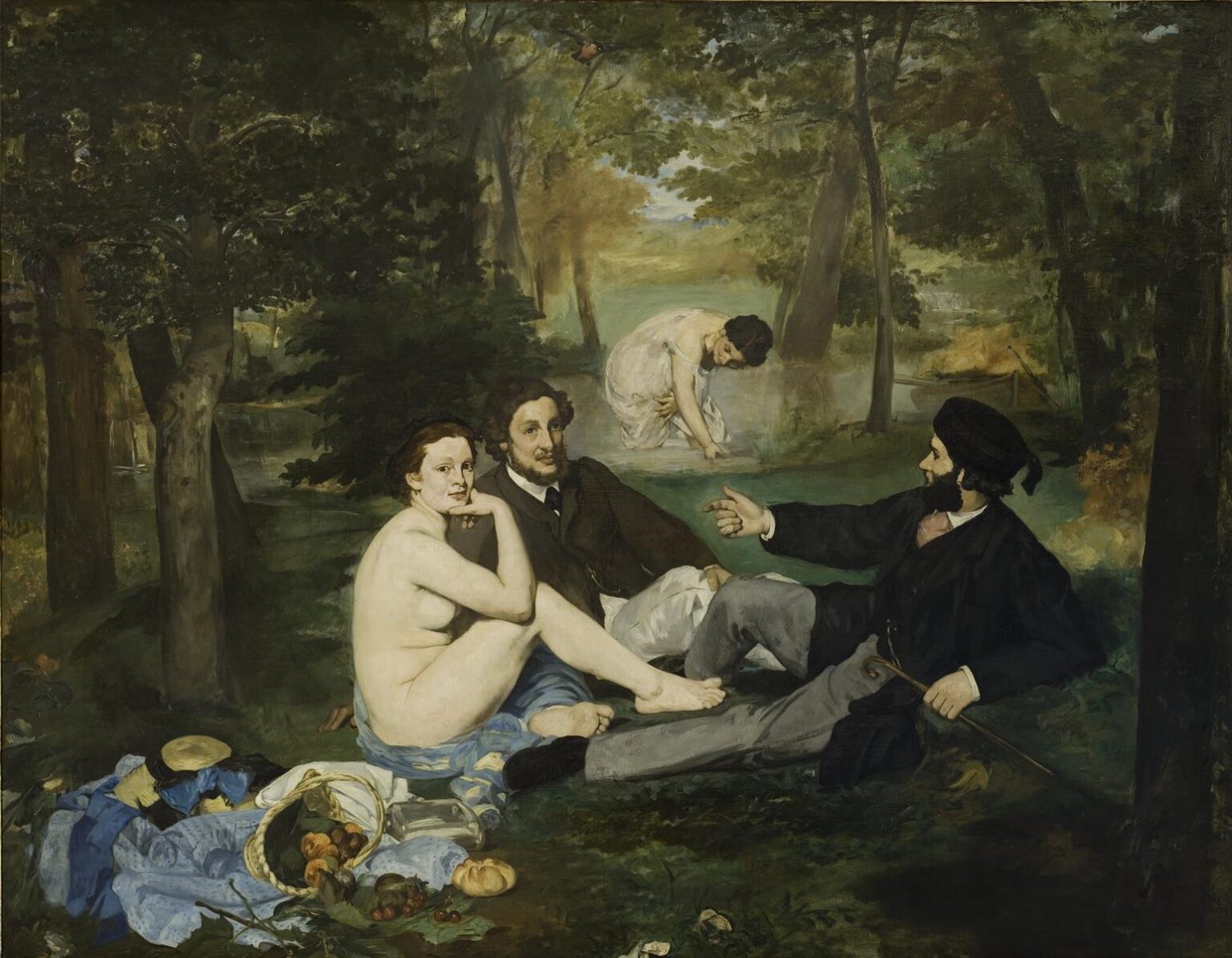
Edouard Manet’s The Luncheon on the Grass from 1863 is one of the most discussed paintings in modern art. Few works have changed the direction of painting so forcefully while also causing such immediate shock. At first glance, the scene seems almost simple. A nude woman sits on the grass beside two fully dressed men, while another lightly dressed female figure bends in the background near the water. Food, clothing, and a basket are scattered in the foreground, suggesting a picnic in a wooded landscape. Yet nothing in the picture feels entirely natural or comfortable. The figures seem close together but psychologically distant. The setting appears recognizable, but the space is strangely uncertain. The image looks both casual and staged, both modern and strangely borrowed from older art.
That tension is exactly what gives the painting its lasting power. Manet was not merely painting a picnic scene. He was testing the rules of art, confronting ideas about beauty, realism, propriety, and the purpose of painting itself. The result was a work that offended many viewers in its own time and later came to be seen as one of the central breakthroughs of modern art. The Luncheon on the Grass remains important because it refuses to behave like a conventional academic painting. It does not smooth over contradictions. Instead, it presents them openly.
Historical Context and the Paris of 1863
To understand why this painting caused such an uproar, it helps to place it in the context of Paris in the 1860s. This was a city undergoing enormous transformation. Urban life was changing, class boundaries were becoming more visible, and modern leisure had become a subject worthy of representation. At the same time, the official art world in France was still dominated by the Salon and by academic standards that valued polished surfaces, idealized forms, historical subjects, and clear moral hierarchies.
Manet entered this world as a highly educated artist who knew the traditions of European painting very well. He admired the Old Masters and studied them closely, especially painters such as Titian, Velazquez, and Goya. But he was not content simply to imitate them. He wanted to bring painting into the present and challenge the expectations that governed what a serious painting should look like.
When The Luncheon on the Grass was rejected from the official Salon, it appeared in the Salon des Refuses of 1863, an exhibition created for works the jury had turned away. There, it drew intense attention. Viewers were not merely surprised by the nude figure. After all, nude figures had long been accepted in art. What disturbed them was the way Manet placed that nude in a recognizably modern setting, beside contemporary men in ordinary clothes, without the protective disguise of mythological or allegorical subject matter. The painting did not pretend to be about ancient goddesses or timeless ideals. It seemed to say that this was modern life, and that was precisely the problem for many nineteenth century viewers.
A Scene That Looks Simple but Feels Unstable
One reason this painting continues to fascinate is that its basic subject is easy to identify, but its visual logic is difficult to settle. A group of figures occupies a forest clearing. The nude woman sits at the left foreground and looks directly at the viewer. Two men sit beside her. One points outward as though speaking, while the other faces forward more quietly. In the distance, a woman bends toward the water. Nearby sits a small boat. In the lower foreground are clothes, bread, fruit, and a basket.
Everything in the painting seems arranged to evoke everyday leisure, yet the image does not feel like a spontaneous moment. The figures do not interact in a naturalistic way. The nude woman’s gaze is calm, direct, and self possessed, but the men appear absorbed in their own conversation. The background figure seems oddly large in relation to the setting around her, as though she occupies a different scale. The space between foreground and background is compressed and difficult to read. These choices create a sense of theatricality. The painting presents itself as a constructed image rather than an illusionistic window onto the world.
That refusal of seamless realism was one of the reasons the work seemed so provocative. Manet does not try to hide the fact that a painting is a painting. He allows disjunctions to remain visible. Instead of using technique to lull the viewer into passive acceptance, he uses it to keep the viewer alert.
The Central Figure and the Power of the Gaze
The most striking figure in the painting is the nude woman seated in the foreground. She is not presented with the softened idealism that academic nudes often received. Her body is brightly lit and sharply visible against the darker setting, and her expression is neither embarrassed nor seductively theatrical. Most important of all, she looks directly out of the painting at the viewer.
That gaze changes the entire meaning of the work. In traditional painting, nude figures were often presented for visual pleasure under the cover of mythology, history, or allegory. The viewer could look without feeling directly challenged because the figure belonged to a fictionalized realm. In Manet’s painting, that distance collapses. The woman does not avert her eyes. She acknowledges the viewer’s presence with remarkable composure. She is not simply an object of observation. She becomes a participant in the act of looking.
This exchange unsettles the viewer because it removes the comfortable assumptions that usually structure the scene. The woman seems aware of being seen, yet she does not appear ashamed. Her calm expression resists easy interpretation. She is neither obviously inviting nor rejecting. Instead, she presents herself with a matter of fact confidence that was deeply unsettling to audiences trained to expect moral cues.
Her nudity, then, is not shocking merely because she is unclothed. It is shocking because Manet strips away the conventional excuses that art had long used to make the nude acceptable. He makes the figure immediate, modern, and psychologically present.
The Men and the Problem of Modernity
The two men beside the nude woman are just as important as she is to the painting’s impact. Their modern black clothing anchors the scene in contemporary life. They are not shepherds from an idealized pastoral world. They are not classical heroes. They are recognizably men of Manet’s own time.
This contrast between the nude woman and the clothed men intensifies the painting’s strangeness. Their dress makes the scene feel current and socially specific. The tension is not simply visual but cultural. Why is this woman unclothed while the men remain dressed? What is the relationship among them? Are they companions, spectators, or something less easily named? Manet refuses to clarify. He offers no clear narrative to organize the scene morally or emotionally.
The man on the right stretches out his arm in a gesture that suggests speech or explanation. Yet the meaning of the gesture remains uncertain. Is he pointing toward the nude woman, toward the landscape, or beyond the painting itself? The man in the center faces the viewer more directly, though with less confrontation than the nude figure. Together, the two men contribute to an atmosphere of conversation and detachment, as though they are in the painting without fully inhabiting the same emotional space.
This ambiguity is central to the work’s modernity. Rather than telling a coherent story, Manet offers fragments of social presence. The painting records a situation that feels both ordinary and impossible, as though modern life itself has become visually enigmatic.
The Forest Setting and the Still Life Foreground
The landscape in The Luncheon on the Grass is not a mere backdrop. It plays an active role in the painting’s mood. The wooded setting creates a cool, shadowed atmosphere that frames the figures and heightens the contrast between light and dark. Trees rise around the group, enclosing them within a space that feels intimate but also slightly unreal. The water behind them opens the composition somewhat, but not enough to create a convincing deep recession. Instead, the setting holds the figures in a shallow, suspended world.
The foreground still life is particularly important. The discarded blue dress, the basket tipped on its side, the fruit, and the bread suggest a picnic interrupted or only partially enjoyed. These objects ground the painting in tangible reality. They are painted with a concentration that recalls the tradition of still life, and they act as a visual entry point into the scene. Their textures and shapes offer a concrete contrast to the psychological ambiguity of the figures.
At the same time, the arrangement of these objects reinforces the sense that the scene has been staged. The fruit and bread are not simply casual details. They carry symbolic echoes of abundance, appetite, and sensuality. Yet Manet never pushes symbolism so far that it becomes fixed or didactic. He lets the objects retain their physical presence while also participating in the painting’s wider atmosphere of suggestion.
The combination of landscape, figures, and still life shows Manet’s ambition. This is not a small genre scene. It is a large, serious painting that pulls together several artistic traditions while refusing to submit fully to any one of them.
Borrowing from the Old Masters While Breaking with Them
One of the most interesting aspects of The Luncheon on the Grass is that it is both radical and deeply rooted in art history. Manet did not invent the grouped figure composition from nothing. He drew on older sources, especially Renaissance and Venetian models. Scholars have long noted the relationship between this painting and earlier works associated with Titian and with classical pastoral scenes. Manet was clearly engaging with the tradition of the reclining or seated nude in a landscape accompanied by clothed male figures.
But he transforms those sources in a decisive way. In earlier art, such compositions usually belonged to an ideal or poetic world. Even when the exact narrative was unclear, the style and setting elevated the image beyond ordinary life. Manet strips away that protective layer. He takes a structure associated with classical art and relocates it into the present.
This strategy helps explain why the painting seemed both familiar and offensive. Viewers sensed echoes of the museum tradition, but they also recognized that something essential had changed. Manet was not reverently continuing the past. He was using the past to challenge the present. He was asking whether the authority of old painting could survive if it were brought into direct contact with modern life.
That question is one of the foundations of modern art. Many later painters would similarly engage with tradition not as a set of rules to obey, but as material to question, revise, or disrupt. In this sense, The Luncheon on the Grass is modern not because it abandons history, but because it treats history as something active and unstable.
Color, Light, and Painterly Technique
Manet’s handling of paint is one of the key reasons the picture feels so immediate. He does not aim for the polished finish that academic painting prized. Instead, his brushwork remains visible, and he often relies on bold tonal contrasts rather than carefully blended transitions. The black clothing of the men, the pale body of the nude figure, the blue fabric in the foreground, and the green shadows of the landscape are organized in strong visual masses.
The light in the painting is equally striking. The nude woman’s body catches the eye because of its brightness against the darker environment. Her skin is painted with a frankness that emphasizes surface rather than idealized softness. The effect is almost abrupt. Instead of dissolving the figure into the atmosphere, Manet places her firmly on the picture plane.
The background light is more diffuse, especially around the woman near the water. Yet even here, the transitions are not fully naturalistic. The scene seems built from patches of value and color rather than from a smoothly unified visual space. This contributes to the painting’s flatness, which later modern artists would see as a strength rather than a weakness.
Manet’s technique also makes the painting feel contemporary because it values directness over finish. He paints what matters most for visual impact rather than what would satisfy academic ideals of completion. This choice gives the work its energy. The painting feels made, not merely polished.
Space, Scale, and Deliberate Visual Disruption
Much of the painting’s unsettling effect comes from its treatment of space. In a traditional academic picture, the relationship between foreground and background would usually be coherent and persuasive. In The Luncheon on the Grass, that coherence is deliberately weakened. The background woman seems too large for her position in space. The transition from the foreground group to the water and trees behind them feels abrupt. The spatial depth is suggested, but never fully resolved.
This has often been described as awkwardness, but it is better understood as a deliberate pictorial decision. Manet was not incapable of constructing space. Rather, he was willing to disrupt the conventions of illusion in order to foreground the painting’s structure. The result is a composition that keeps returning the viewer’s attention to the surface.
That flattening of space is one of the qualities that later artists found so liberating. Instead of pretending that the canvas disappears, Manet allows it to remain present. Figures are arranged not only according to narrative logic but according to pictorial necessity. The scene exists as an image before it exists as a believable slice of life.
This does not mean the painting lacks depth of meaning. On the contrary, its spatial instability becomes part of its psychological and cultural charge. The world it presents is one in which appearances cannot be taken for granted. Vision itself has become uncertain.
Scandal, Criticism, and Public Reaction
When viewers first encountered The Luncheon on the Grass, many responded with ridicule or outrage. The scandal was not only moral but artistic. Some criticized the painting as ugly, unfinished, or incompetent. Others saw it as a deliberate affront to taste. Because the nude figure was placed in a contemporary setting, audiences often interpreted the scene in explicitly social and sexual terms. The absence of an elevating mythological framework made the image seem indecent.
Yet the criticism reveals just how effectively Manet had exposed the assumptions of his time. The painting showed that the accepted nude in academic art depended on a set of cultural fictions. Once those fictions were removed, the same basic subject became intolerable. Manet had not invented immorality. He had revealed the fragility of the conventions that disguised desire, class, and the politics of looking.
What seemed offensive in 1863 later came to seem groundbreaking. The painting’s directness, its refusal of idealization, and its challenge to academic illusion all became central to the history of modern art. The scandal was real, but so was the achievement. In fact, the two were inseparable.
Meaning and Interpretation
Part of what makes The Luncheon on the Grass so durable is that it resists a single fixed interpretation. It can be read as a confrontation with academic tradition, as a modern reworking of pastoral imagery, as a study in visual ambiguity, or as a meditation on spectatorship and the politics of the nude. It can also be seen as a painting about modern alienation. The figures occupy the same space, yet they do not seem emotionally unified. Their relationship is visible but not explained.
The nude woman’s gaze remains central to these interpretations because it turns the viewer into part of the painting’s drama. We are not just looking at a scene. We are implicated in it. The work asks what it means to look, what it means to judge, and what it means for painting to present modern life without disguise.
At the same time, the painting is not merely theoretical. It is sensually rich, visually complex, and deeply aware of its own material beauty. The shadows are lush, the textures vivid, and the contrasts memorable. Manet’s achievement lies partly in holding intellectual challenge and painterly pleasure together.
Legacy and Influence
The influence of The Luncheon on the Grass has been immense. It helped open the door to Impressionism and to wider forms of modern experimentation. Although Manet was never a conventional Impressionist, many younger artists saw in him a model for how painting could break with academic formula while remaining fully engaged with the visual world.
Later artists returned to this painting again and again because it marked a turning point. It demonstrated that a major painting could be built from contradiction, ambiguity, and confrontation rather than from harmony and idealization. It made modern life a legitimate subject for ambitious art. It also showed that dialogue with the past could be active and critical rather than submissive.
Even today, the picture feels fresh because its tensions have not disappeared. Questions about the gaze, the body, gender, performance, and the act of representation still animate discussions of art. Manet’s painting continues to matter because it does not offer closure. It remains open, provocative, and difficult in the best sense.
Conclusion
The Luncheon on the Grass is one of the defining works of nineteenth century painting because it transforms a seemingly ordinary outdoor gathering into a radical statement about art and modernity. Manet draws on the authority of old painting while overturning the conventions that made that authority stable. He presents a nude without mythological disguise, a landscape without fully convincing illusion, and a social scene without clear narrative explanation.
The painting’s greatness lies in this deliberate instability. Its figures are near each other but not fully connected. Its space is legible but unresolved. Its mood is calm on the surface yet deeply unsettling underneath. The work confronts the viewer with the fact that painting is not a transparent copy of reality, but a constructed image shaped by choices, assumptions, and cultural codes.
That is why the painting still commands attention. It remains bold, enigmatic, and modern. More than a controversial picnic scene, it is a declaration that art could move into a new era by questioning every rule it inherited. In that sense, Manet did not simply paint a scandal. He painted a beginning.