Image source: wikiart.org
Introduction
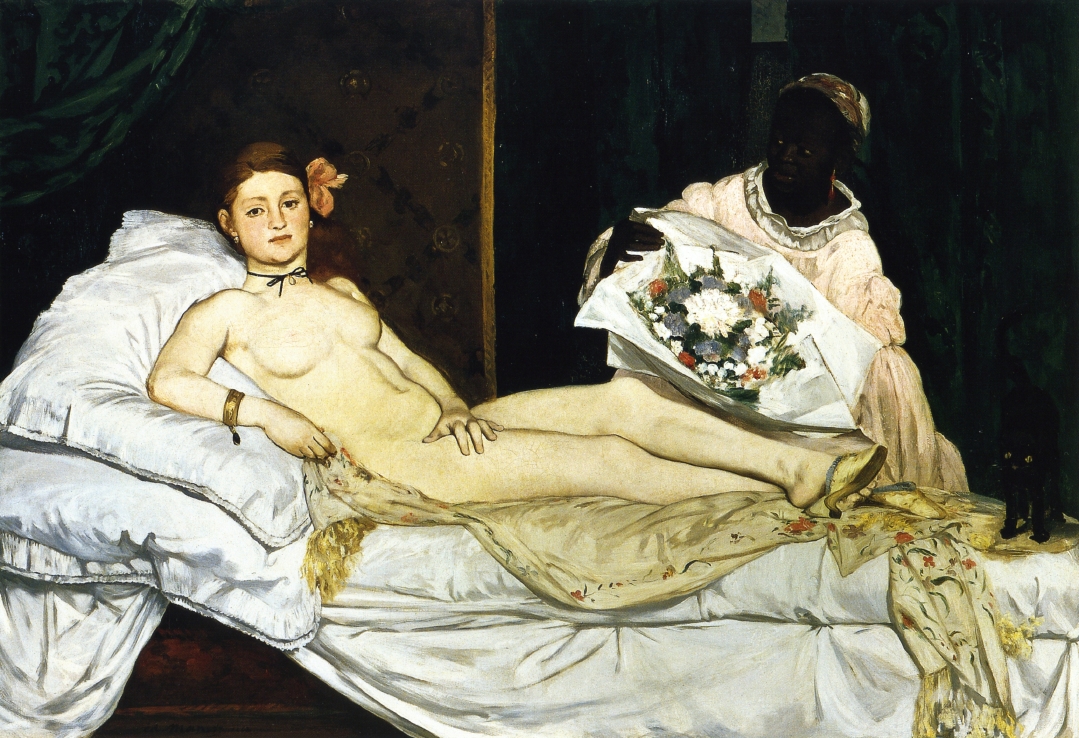
Edouard Manet’s Olympia, painted in 1863, remains one of the defining works of modern art because it does not simply present a reclining nude. It challenges the viewer, unsettles inherited traditions, and exposes the social tensions of nineteenth century Paris with unusual directness. At first glance, the composition seems simple. A nude woman lies across a bed, looking outward at the viewer. A Black maid stands behind her holding a bouquet of flowers. A black cat rises at the foot of the bed. The setting appears sparse, even abrupt, and the scene feels less mythological than startlingly present. Yet this apparent simplicity is exactly what gives the painting its power. Manet strips away the layers of idealization that had long protected the tradition of the female nude, replacing them with modernity, confrontation, and ambiguity.
When Olympia was first shown publicly, it provoked outrage because it seemed to violate the expectations that governed high art. It presented a woman who was not disguised as Venus, a nymph, or some other classical figure. She appeared contemporary, self aware, and socially legible. Her body was not softened into fantasy, and her gaze did not invite passive admiration. Instead, she seemed to know exactly who was looking at her and why. That self possession changed the entire meaning of the nude. The scandal surrounding the painting did not arise simply from nudity itself, since European painting had long included nude bodies. What shocked viewers was the way Manet refused to hide the economics, performance, and power relations beneath the subject.
Olympia matters not only because it caused controversy, but because it exposed the fragility of artistic conventions. Manet used the established format of the reclining nude and then emptied it of comforting illusion. He made viewers confront modern life and their own assumptions. The painting stands at a crossroads between realism, modernism, and the long academic tradition it challenged. It is a picture about looking, status, gender, race, and artistic truth. That is why it still feels provocative today.
The Scene and Its Immediate Impact
The central figure in Olympia lies on a white bed, her body angled horizontally across the canvas. Her head is slightly raised, supported by pillows, and her face turns outward with a calm but unmistakably alert expression. One arm rests near her side while the other hand covers her lower body with a gesture that is both protective and deliberate. Behind her, a maid enters with a bouquet wrapped in paper, perhaps delivered by a visitor. At the lower right, a black cat with raised tail stands on the bed, replacing the more traditional symbol of domestic fidelity often found in earlier paintings.
The immediate impact of the image comes from its unusual emotional temperature. Many earlier reclining nudes were designed to create softness, sensual harmony, and visual ease. Manet instead produces tension. The woman’s body is illuminated against the white sheets, yet the surrounding interior is dark and compressed. The transitions between light and shadow are often abrupt. The figure is close to the viewer, but the atmosphere is not dreamy or intimate. It is crisp, theatrical, and somewhat cold. Rather than dissolving into an idealized setting, the body appears placed before us with startling clarity.
This tension is reinforced by the figure’s expression. Olympia does not appear embarrassed, seductive in a conventional sense, or lost in reverie. She seems aware, guarded, and in control. Her gaze is central to the meaning of the painting. It interrupts the viewer’s position as a passive observer and turns looking into a visible act. We are made conscious of ourselves as viewers. That awareness is a major reason the work was so disruptive. Instead of offering beauty as a tranquil spectacle, Manet stages an encounter.
The bouquet deepens the ambiguity of the scene. It suggests a client, admirer, or transaction outside the picture, someone whose presence is implied but not shown. The maid presents the flowers as though carrying a message from the unseen world into Olympia’s chamber. This creates a narrative tension without resolving it. The viewer is left to wonder whether they occupy the position of that unseen visitor, whether they have intruded, or whether they are being coolly assessed.
Manet and the Reinvention of the Nude
One of the most important aspects of Olympia is the way Manet reworks a long tradition of reclining female nudes. He clearly draws on older models, especially the Venetian Renaissance tradition, yet he transforms their meaning. In paintings such as Titian’s Venus of Urbino, the reclining nude was framed as a classical or poetic subject. Such works often combined sensuality with elegance, mythology, and harmonious composition. They presented the nude body as timeless, elevated, and culturally sanctioned.
Manet borrows this structure but removes its protective veil. Olympia is not presented as a goddess. She is a modern woman in a recognizably contemporary setting. Her accessories, including the ribbon around her neck, the bracelet, the slippers, and the orchid in her hair, make her look adorned rather than idealized. These details emphasize artifice and fashion rather than mythic timelessness. Her name itself matters. “Olympia” was associated in nineteenth century Paris with courtesans and women of the demi monde. The title directs the viewer away from classical allegory and toward urban modern life.
This shift from myth to modernity transforms the entire function of the nude. In academic art, nudity could be made respectable through historical, biblical, or mythological framing. Manet refuses that convention. He shows the body not as an abstract ideal but as a socially situated presence. The result is not merely realism in the sense of visual accuracy. It is realism in a deeper cultural sense. The painting acknowledges class, commerce, and contemporary identity.
This refusal of disguise was deeply unsettling because it made visible what traditional art often concealed. The reclining nude had always involved looking, desire, and power, but earlier forms wrapped those elements in poetic distance. Manet strips away that distance. The painting asks what happens when a nude is no longer safely relocated into myth. The answer is scandal, because viewers are forced to recognize the structure of their own gaze.
The Power of Olympia’s Gaze
Olympia’s gaze is the emotional and intellectual center of the painting. It is direct, level, and self aware. She looks outward as though she recognizes the social situation perfectly and has no intention of pretending otherwise. This changes the usual balance between subject and viewer. Instead of being an object completely available to sight, Olympia resists that position through consciousness. She cannot be absorbed into pure aesthetic enjoyment because she is too visibly present as a person who sees back.
This gaze has often been described as confrontational, but it is also controlled. She does not seem frightened or vulnerable. Her composure suggests experience, calculation, and autonomy within the limits of her world. The hand placed across her body is part of this control. It is not a gesture of modesty in the traditional sense. It is a gesture of possession. Her body is not simply available. Access is regulated. Even in repose, she sets terms.
The expression on her face is also notable for its lack of theatrical emotion. She does not smile. She does not blush. She does not appear transported by romance or daydreaming. This emotional restraint makes the image more modern. It rejects sentimental narrative and places weight on social reality. Olympia’s face is not there to soften the scene. It hardens it.
The viewer, in turn, becomes implicated. Looking at the painting is no longer innocent. We are not just admiring a beautiful composition. We are placed into a field of exchange and observation. The bouquet, the chamber, the pose, and the stare all suggest that a transaction is either about to happen or has already taken place. The painting never states this openly, but it does not need to. Its power lies in implication. Manet forces viewers to feel the instability of their own position.
Composition, Space, and Visual Tension
The composition of Olympia is carefully organized to heighten flatness and tension. The figure stretches across the lower half of the canvas, dominating the picture plane. The bed takes up much of the foreground, pressing forward instead of receding gently into depth. The surrounding space feels compressed. The dark background does not open into an expansive room. Instead, it functions almost like a backdrop, making the figures stand out with greater force.
This compression is crucial to the painting’s modernity. Traditional academic painting often emphasized smooth depth, gradual modeling, and spatial harmony. Manet resists those effects. He prefers sharper contrasts and a more immediate arrangement of forms on the surface. The result is a picture that reminds us of itself as a painted object. We become aware not just of what is represented, but of how it is placed on the canvas.
The white sheets play an especially important role. Their broad, luminous forms create a stark field around Olympia’s body. The bed linens are handled with visible brushwork and strong tonal contrasts, giving them volume but also an almost abstract presence. Their brilliance pushes the figure into prominence while also making the shadows and darker areas feel more abrupt. This contributes to the painting’s visual severity.
The figure of the maid behind Olympia is partly absorbed into the darker background, creating a contrast between foreground and background, visibility and obscurity. The bouquet, with its bursts of color, acts as a visual bridge between them. Meanwhile, the cat at the foot of the bed functions as a sharp, lively accent. Its silhouette and raised tail add both movement and symbolic bite to the otherwise horizontal arrangement.
What is most striking is how stable and unstable the composition feels at the same time. Olympia’s body forms a calm horizontal structure, yet the emotional effect is restless. The picture is balanced, but not soothing. Its harmony is edged with discomfort.
Color, Light, and Brushwork
Manet’s handling of color and paint in Olympia was one of the reasons some viewers found the work jarring. He does not use color to produce soft illusion in the academic manner. Instead, he relies on striking contrasts and simplified tonal relationships. Olympia’s pale body is set against the white sheets and dark background, creating a high contrast image in which forms emerge through opposition rather than subtle fusion.
The palette is restrained but strategic. Creams, whites, blacks, muted browns, pinks, and greenish shadows dominate the painting. These tones give the scene an austere elegance. The bouquet introduces small notes of brighter color, but overall the effect is disciplined rather than lush. Manet avoids excessive warmth and sentimental glow. The body is not bathed in golden light. It is coolly illuminated, which makes the flesh appear more present and less idealized.
His brushwork also resists polished finish. Edges can appear abrupt. Surface texture remains visible. Rather than concealing the act of painting, Manet allows it to remain legible. This was important for later modern art because it shifted attention from illusionistic perfection to pictorial truth. Paint is not merely a transparent vehicle here. It has its own presence.
The lighting contributes strongly to the painting’s mood. The bright exposure of Olympia’s body creates a kind of stage effect, as though she has been placed under scrutiny. Yet this is not dramatic light in the romantic sense. It does not ennoble or spiritualize. Instead, it clarifies and exposes. The dark room behind her does not soften the scene. It intensifies it.
Even the flesh tones are treated with a frankness that resists classical idealization. The body is not endlessly rounded through delicate transitions. Manet uses relatively broad tonal planes, which gives the figure a certain firmness and immediacy. Critics at the time often saw this as crude, but it was part of the painting’s refusal of false refinement.
The Role of the Maid and the Question of Race
The figure of the Black maid is essential to the meaning of Olympia, even though she occupies less space than the reclining woman. She enters from the darker part of the room carrying a bouquet, and her presence establishes an important visual and social contrast. The bright whiteness of the sheets and Olympia’s pale skin are set against the darker tones of the maid and the background. This contrast heightens the painting’s visual drama, but it also brings race and hierarchy into the structure of the image.
The maid is not merely an accessory. Her presence indicates service, class difference, and colonial context within nineteenth century France. She marks Olympia’s social environment and complicates the intimacy of the scene. Through her, the painting includes more than a private moment. It points outward toward broader systems of labor, representation, and racialized visibility.
Yet the maid is also positioned in a way that has prompted enduring criticism and discussion. She is partly obscured by darkness and relegated to the background, while Olympia dominates the foreground in light. This arrangement reflects the inequalities of the society from which the painting emerged. Modern viewers often read the work not only as a challenge to the nude tradition, but also as a document shaped by the racial structures of empire and modern urban life.
The bouquet itself deepens this relationship. The maid bears the token of male attention, acting as an intermediary in the scene. Her role is functional, but her presence is not neutral. She helps define the world Olympia inhabits, a world organized by service, display, and power. At the same time, the contrast between the two women raises questions about who is seen, how they are seen, and under what conditions.
This dimension of Olympia has become increasingly important in recent scholarship because it reminds us that modernity in art is never only formal. It is social and political as well. The painting’s modernism lies not just in brushwork or composition, but in the uncomfortable realities it reveals.
Symbolism and Social Meaning
Although Olympia is often described as bluntly modern, it still contains symbolic details that help shape its meaning. The orchid in Olympia’s hair, the black ribbon around her neck, the bracelet, the slippers, the shawl, the bouquet, and the black cat all contribute to the impression of cultivated self presentation. These are not mythological attributes. They are markers of fashion, performance, and coded social identity.
The cat is especially significant because it replaces the dog that appears in earlier reclining nudes such as Titian’s Venus of Urbino. In traditional iconography, the dog often symbolized loyalty and domestic stability. Manet’s black cat suggests something different: independence, alertness, sensual unpredictability, and perhaps even a hint of danger. It sharpens the painting’s rejection of marital or domestic ideals.
The bouquet is another loaded detail. Its arrival implies a suitor, client, or admirer, but the sender remains outside the frame. This omission matters. It creates a social drama based on absence. The unseen man is not pictured, yet his influence structures the scene. The painting therefore becomes a meditation on power that does not need to show power directly. It is present through gesture, implication, and exchange.
Olympia’s accessories likewise emphasize that her body is staged, framed, and socially encoded. Her nudity is not natural in the sense of innocence. It is surrounded by signs of urban identity. This combination of nakedness and ornament is one reason the painting felt so provocative. It made it harder to pretend that the subject belonged to a distant world of artful fantasy.
Manet’s symbolism is subtle because it works through social signs rather than elaborate allegory. The painting remains grounded in observable reality, yet every detail intensifies its meaning. It shows how modern life can produce symbols no less powerful than those of mythology.
The Scandal of 1865
Although Olympia was painted in 1863, its public scandal erupted when it was exhibited at the Paris Salon in 1865. The reaction was fierce. Viewers and critics mocked the work, condemned its subject, and attacked its technique. Some were offended by what they saw as ugliness, others by its apparent indecency, and many by both at once. The controversy reveals a great deal about the values of the period.
It is important to understand that the scandal did not result from nudity alone. The Salon contained many nude figures. What made Olympia intolerable to many viewers was its refusal to idealize or disguise. Manet seemed to place contemporary sexuality, class tension, and urban commerce into the central format of high painting. He brought what society preferred to keep implicit into a public cultural institution.
The criticism of technique was closely tied to the criticism of subject. Viewers described the body as flat, harsh, or unfinished because they expected the female nude to be rendered with polished softness. Manet’s painting denied that expectation. The perceived roughness of the paint became part of the insult. It was as though both the subject and the style had violated decorum together.
The outrage also shows how strongly art functioned as a moral and social battleground. Olympia exposed not just an individual woman, but the hypocrisy of a culture that accepted eroticized nudity in classical form while recoiling from modern candor. The painting became a mirror in which bourgeois society saw too much of itself.
In hindsight, the scandal was a sign that Manet had touched something fundamental. He revealed that the conventions of beauty were inseparable from conventions of denial. Once those denials were removed, modern painting could no longer proceed in quite the same way.
Olympia’s Legacy in Modern Art
The lasting importance of Olympia lies in the way it opened the door to modern art. Manet showed that painting could engage directly with contemporary life while also challenging the inherited language of representation. He did not abandon the great traditions of European art. Instead, he confronted them, borrowed from them, and transformed them from within.
Later artists learned from this example. The flattening of space, the visible brushwork, the bold tonal contrasts, and the refusal of academic idealization all anticipated directions that would be developed by the Impressionists and by later modern movements. Even more important was the idea that a painting could make viewers aware of the act of looking itself. That self consciousness became central to modern art.
Olympia also continues to matter because its social questions remain unresolved. Discussions of gender, racial representation, power, class, and spectatorship still gather around the painting. It is not a work that can be reduced to one meaning. Its complexity is part of its endurance. It is both a formal breakthrough and a cultural provocation.
For modern audiences, the painting no longer shocks in exactly the same way it did in 1865, but it still unsettles. The gaze remains firm. The space remains tense. The contrast between exposure and control remains striking. We still feel that the painting is aware of us, testing the way we look and what we assume.
That is the mark of a truly transformative work. Olympia did not merely scandalize its own time. It permanently altered the possibilities of painting.
Conclusion
Edouard Manet’s Olympia is one of the great turning points in Western art because it dismantles the comforting illusions of the traditional nude and replaces them with a scene of modern confrontation. Through its direct gaze, compressed space, stark contrasts, coded symbolism, and social frankness, the painting forces the viewer to confront questions that earlier art often concealed. It is a picture about a body, but also about power, exchange, race, class, and the instability of seeing itself.
What makes Olympia so enduring is that it never settles into one easy meaning. It is beautiful, but in a severe and unsettling way. It is rooted in art history, yet it breaks with tradition. It is socially specific, yet formally innovative. It is intimate, yet emotionally distant. Every element of the painting contributes to this tension.
Manet understood that modernity required a new pictorial language. In Olympia, he found one by taking an old format and stripping away its protective fictions. The result was not just a new image of the nude, but a new understanding of what painting could do. It could reveal, provoke, and expose. It could force the viewer into self awareness. It could bring the contradictions of modern life to the surface of the canvas.
That is why Olympia remains one of the most discussed and significant paintings of the nineteenth century. It does not ask to be admired from a safe distance. It asks to be faced.