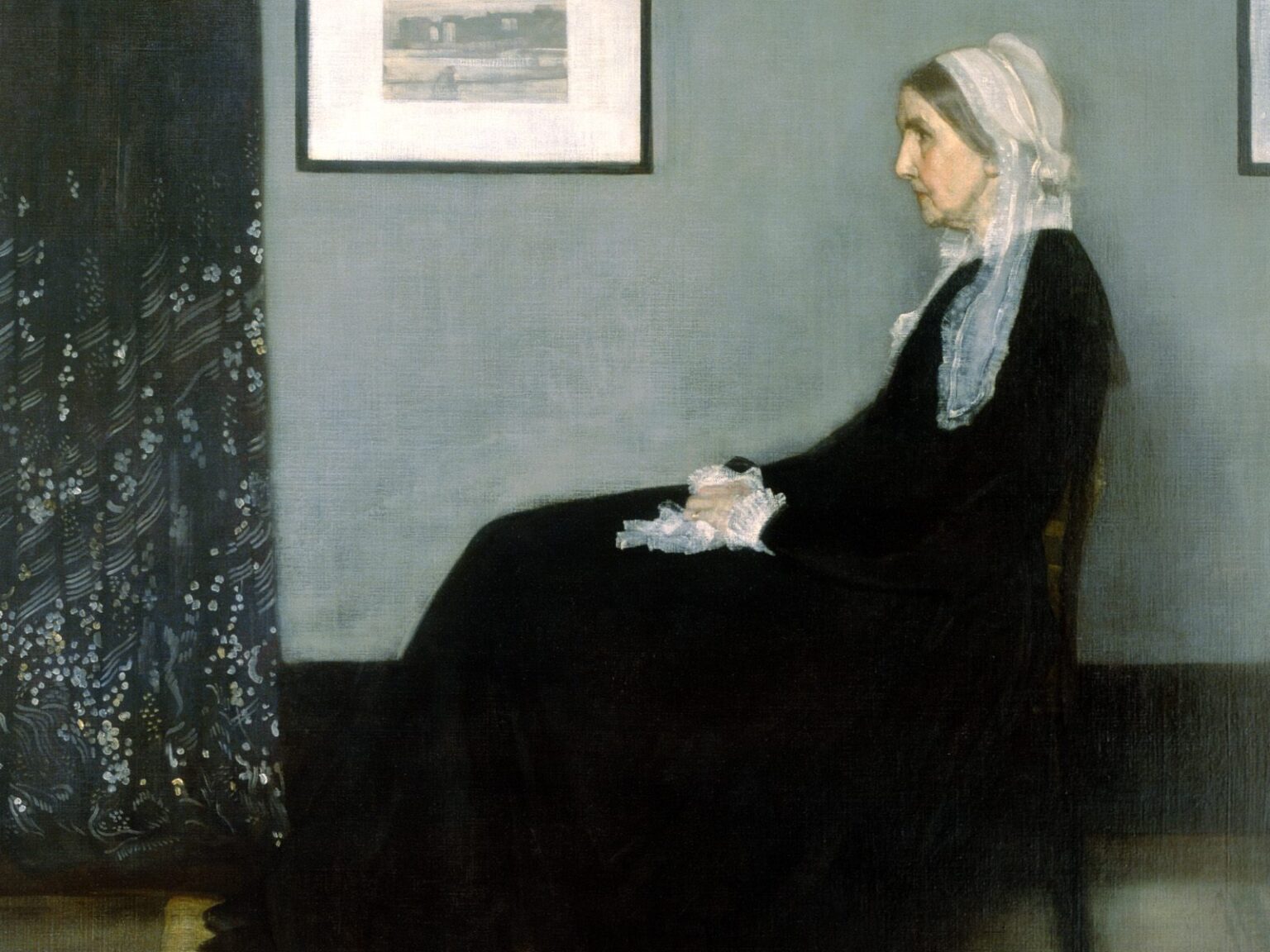
Image source: wikiart.org
Introduction to Whistler’s Mother
Whistler’s Mother, painted in 1871 by James McNeill Whistler, is one of the most recognized portraits in Western art. Its formal title, Arrangement in Grey and Black No. 1: Portrait of the Artist’s Mother, reveals much about the artist’s intentions. While many viewers approach the painting as a tender and dignified image of motherhood, Whistler also wanted it to be understood as an arrangement of tones, shapes, and harmonies. That dual identity is part of what makes the work so compelling. It is at once a portrait of a specific individual, Anna McNeill Whistler, and a highly controlled aesthetic statement about balance, restraint, and visual order.
At first glance, the painting seems quiet almost to the point of severity. A woman dressed in black sits in profile against a pale wall. A curtain occupies the left side of the composition, framed pictures hang above, and the setting feels modest and restrained. Yet the longer one looks, the more powerful the painting becomes. Its stillness is not emptiness. Its simplicity is not lack. Instead, Whistler creates emotional depth through silence, discipline, and precision. The image does not overwhelm the viewer with dramatic gesture or decorative abundance. It speaks in a low voice, and that low voice is exactly what gives it authority.
Part of the painting’s lasting fame comes from how easily it enters cultural memory. Even people who know little about art history often recognize the seated elderly woman in profile. But familiarity can make a painting seem simpler than it really is. In truth, Whistler’s Mother is a carefully constructed and intellectually ambitious work that reflects Whistler’s ideas about beauty, modern painting, and the relationship between portraiture and design. It invites viewers to think not only about maternal dignity and age, but also about the very nature of art itself.
James McNeill Whistler and the Artistic Context
James McNeill Whistler was one of the most distinctive artists of the nineteenth century. Although born in the United States, he built his career largely in Europe and became especially associated with artistic circles in London and Paris. He moved within a world shaped by Realism, Aestheticism, and debates about what painting should do. Some artists sought moral instruction, some pursued narrative drama, and others tried to represent modern life with directness. Whistler carved out a different position. He believed that painting should be valued for its formal beauty and arrangement, not only for its story or moral lesson.
This principle is essential to understanding Whistler’s Mother. The painting emerged during a period when Whistler was refining his personal philosophy of art. He often used musical titles such as “arrangement,” “symphony,” or “nocturne” to suggest that painting, like music, could be appreciated for harmony and mood rather than explicit narrative. In choosing the title Arrangement in Grey and Black No. 1, he deliberately pushed the work beyond ordinary portraiture. He signaled that the image should not be read merely as a sentimental likeness of his mother, but as an organized composition in which tonal relationships matter as much as the sitter’s identity.
At the same time, Whistler was working in a Victorian context where portraits often carried strong social meanings. Portraits could communicate wealth, family values, respectability, and personal accomplishment. Whistler’s Mother is unusual because it avoids many of those conventional signals. There is no elaborate setting, no luxurious display, and no theatrical expression. Instead, the work presents reserve, sobriety, and inwardness. It reflects the nineteenth century, but it also resists many of its habits. This tension between convention and innovation helps explain why the painting has remained so influential.
Composition and the Power of Stillness
One of the most remarkable achievements of Whistler’s Mother is its compositional discipline. The structure appears simple, but it is extremely deliberate. The seated figure occupies the right side of the painting, creating a strong horizontal shape that stretches across the lower portion of the canvas. Her body forms a dark mass against the lighter wall, while her face and white cap provide a focal point of brightness. The curtain on the left balances the figure on the right, and the framed pictures above help stabilize the upper register of the composition.
Whistler relies heavily on geometric relationships. Vertical lines from the curtain, the picture frame, and the wall meet the long horizontal baseboard and the extended shape of the dress. The chair introduces another vertical anchor, though it remains partially subdued within the dark clothing. These lines and blocks create a sense of order that feels nearly architectural. Nothing appears accidental. The placement of each object contributes to a measured equilibrium.
This order produces a profound stillness. The sitter does not look at the viewer. She is shown in profile, her hands folded, her posture upright yet calm. There is no obvious action and no narrative interruption. The composition does not invite us into a story unfolding in time. Instead, it holds us in a sustained moment of quiet contemplation. That suspension of movement is one of the painting’s greatest strengths. It transforms an ordinary domestic interior into a space of meditation.
The stillness also intensifies the viewer’s awareness of form. Because the painting avoids dramatic distraction, the eye begins to notice subtle things: the edge of the veil, the weight of the black dress, the texture of the curtain, the careful spacing between objects. The composition teaches the viewer how to look slowly. In that sense, Whistler’s Mother is not merely an image of stillness. It is a painting that creates stillness in the act of viewing.
Color, Tone, and the Meaning of Restraint
Despite the widespread familiarity of the image, one of the painting’s most refined qualities is its restricted palette. Whistler builds the work from greys, blacks, off whites, and muted browns. This economy of color is central to the painting’s identity. Rather than using bright hues to command attention, he creates atmosphere through tonal subtlety. The greys of the wall, the black of the dress, the delicate white of the bonnet and lace, and the dark curtain all interact in a restrained harmony.
This tonal discipline reinforces the title’s emphasis on arrangement. The painting is not simply about a mother seated in a room. It is about the orchestration of neutral tones in space. The large black dress becomes almost abstract in its visual effect, forming a shape of great weight and depth. Against it, the pale wall seems softer and quieter, while the white details around the head and hands acquire special importance. Whistler shows how limited color can produce richness when handled with intelligence and sensitivity.
Restraint is the key emotional effect of this palette. The painting does not seek pleasure through opulence or sensory excess. It derives beauty from control. That control can feel austere, but it is never cold. Instead, the subdued palette creates a solemn dignity that suits the sitter and the mood of the work. The colors suggest maturity, gravity, and calm acceptance.
There is also a modern quality in this reduction of color. By narrowing his palette, Whistler moves away from anecdotal detail and toward a more distilled visual language. The work begins to feel less like a traditional Victorian portrait and more like a study in relationships between masses and tones. That reduction is part of what makes the painting seem timeless. It is rooted in a specific era, yet its formal clarity allows it to transcend it.
The Portrait of Anna McNeill Whistler
Although Whistler wanted the work to be understood formally, it remains a portrait, and its emotional force depends on the presence of Anna McNeill Whistler. She is presented with remarkable dignity. Her age is visible, but it is not exaggerated. Her profile is calm, thoughtful, and composed. She does not perform for the viewer. There is no smile meant to charm, no grand gesture meant to impress. Instead, she appears self contained, disciplined, and inward.
This presentation has often encouraged viewers to read the work as an image of maternal devotion or moral virtue. Those associations are understandable. The sitter’s black clothing, modest posture, and serious expression suggest self control and respectability. Yet the painting gains power precisely because it avoids sentimental overstatement. Whistler does not turn his mother into a theatrical symbol of maternal sacrifice. He allows her presence to remain quiet and real.
The profile view contributes greatly to this effect. Profile portraiture can feel detached because it denies direct eye contact, but here it creates concentration. Anna McNeill Whistler appears absorbed in thought, almost as if she exists within her own interior world. The viewer observes her but does not fully enter her consciousness. That slight distance preserves her dignity. She is available to sight, but not completely open to interpretation.
There is tenderness in the work, but it is expressed through restraint rather than display. The care with which Whistler paints the veil, the lace at the cuffs, and the firmness of her posture suggests attentiveness and respect. The portrait does not dramatize affection, yet affection is present in the seriousness of the artist’s looking. That seriousness is what makes the image so moving. It honors the sitter not by romanticizing her, but by giving her weight, permanence, and form.
Space, Interior, and the Domestic World
The setting of Whistler’s Mother appears simple, but it plays a crucial role in the painting’s meaning. This is not a grand palace interior or a richly furnished salon. The room is plain, almost sparse. A wall, a curtain, framed prints, a chair, and a floor line are enough to define the space. Such restraint keeps the viewer’s focus on the relationship between figure and environment rather than on decorative detail.
The domestic setting matters because it situates the sitter within an ordinary lived world. Yet Whistler does not treat that world in a casual or anecdotal way. Instead, he transforms the room into a carefully ordered field of visual relationships. The curtain on the left is not just a household object. It functions as a dark vertical counterweight to the sitter. The framed picture above becomes a rectangle within the larger rectangle of the canvas. Even the empty wall space contributes to the composition by giving the figure room to breathe.
This handling of interior space creates a paradox. The room feels recognizable and intimate, but it also feels abstracted and formalized. We are in a domestic environment, yet we are also in a world of measured proportions and tonal balance. Whistler thus turns the ordinary interior into a stage for aesthetic contemplation.
The emptiness of the wall is especially significant. Many painters might have filled such a space with additional objects or decorative detail. Whistler leaves it open, allowing silence to enter the image. That silence is visual as well as emotional. It gives the painting a sense of pause and gravity. The room does not distract from the sitter. It frames her existence with quiet dignity and makes the entire composition feel deliberate, spare, and enduring.
Aestheticism and the Idea of Art for Art’s Sake
Whistler’s Mother is often discussed in relation to the Aesthetic Movement, and for good reason. Aestheticism emphasized beauty, harmony, and artistic autonomy. It pushed back against the expectation that art must always tell a clear story or deliver a moral lesson. Whistler was one of the movement’s most articulate and provocative figures, and this painting demonstrates his commitment to those ideas.
The title alone places the work within an aesthetic framework. By calling the painting an “arrangement,” Whistler shifts attention toward visual structure. He asks viewers to notice tonal organization and compositional harmony. This does not erase the sitter’s identity, but it changes the way the portrait operates. The painting is not only about who is represented. It is also about how representation itself can become an exercise in formal beauty.
This approach was radical in a culture that often expected portraits to flatter, commemorate, or narrate. Whistler instead proposes that a portrait can be appreciated much like a piece of music. One does not demand that music tell a story in order to value it. Its effect lies in pattern, balance, rhythm, and mood. In a similar way, Whistler wants painting to be understood through relationships of line, mass, and tone.
Yet one of the painting’s great ironies is that it remains emotionally resonant despite this formal agenda. The work proves that aesthetic control does not cancel feeling. On the contrary, form can intensify feeling by purifying it. Because Whistler avoids sentimentality, the emotional impact becomes more durable. The painting does not manipulate the viewer. It creates a space in which dignity, memory, affection, and stillness can emerge naturally.
Why the Painting Became an Icon
Whistler’s Mother became far more than a respected nineteenth century portrait. Over time, it entered public consciousness as an icon. Part of that transformation came from the image’s extraordinary clarity. The silhouette of the seated woman in profile is immediately recognizable. The composition is simple enough to be remembered easily, yet distinctive enough to remain unforgettable.
Another reason for its fame is the way it has been interpreted symbolically. Many viewers came to see it as an image of motherhood itself, even though the painting is much more complex than that. Its quiet solemnity, mature sitter, and domestic setting encouraged broad cultural readings. Reproductions, textbooks, popular culture references, and parodies further expanded its reach. As a result, the image became familiar even to people who had never encountered Whistler’s broader body of work.
Its iconic status also reflects a deeper truth about the painting. It speaks across different kinds of viewers because it combines formal intelligence with human presence. Scholars can analyze its geometry, tonal structure, and aesthetic philosophy. General audiences can respond to its calm dignity and emotional stillness. That double accessibility is rare. Some paintings are formally admired but emotionally distant. Others are emotionally immediate but formally less ambitious. Whistler’s Mother manages to be both profound and approachable.
The painting also endures because it captures something universal without becoming vague. It is about one person in one room at one moment, yet it evokes age, memory, quiet endurance, and the passage of time. Its stillness allows viewers to project their own experiences of family, loss, respect, and contemplation into the image. That openness is part of its lasting power.
The Lasting Importance of Whistler’s Mother
Today, Whistler’s Mother remains one of the defining works of nineteenth century art because it continues to reward sustained attention. It is a painting that grows richer the more one studies it. What first appears simple gradually reveals itself as exquisitely controlled. What first appears reserved gradually becomes emotionally deep. What first appears to be a conventional portrait turns out to be a sophisticated statement about painting, perception, and beauty.
Its importance lies partly in how it bridges different traditions. It belongs to portraiture, yet it pushes portraiture toward abstraction through tonal organization and design. It belongs to Victorian culture, yet it resists Victorian excess. It belongs to the Aesthetic Movement, yet it remains humanly immediate rather than purely theoretical. Few paintings hold together so many dimensions with such apparent ease.
Whistler’s achievement was to show that quiet art can be monumental. He did not rely on historical spectacle, bright color, or dramatic movement. He trusted proportion, tone, and stillness. In doing so, he created a work that feels both intimate and monumental, private and public, personal and universal.
That is why the painting continues to matter. It is not famous merely because it is recognizable. It is recognizable because it is deeply well made. Every element serves the whole. Every restraint becomes expressive. Every silence becomes meaningful. Whistler’s Mother stands as a reminder that a painting does not need to shout in order to endure. Sometimes the works that remain with us longest are the ones that seem, at first, to speak most quietly.