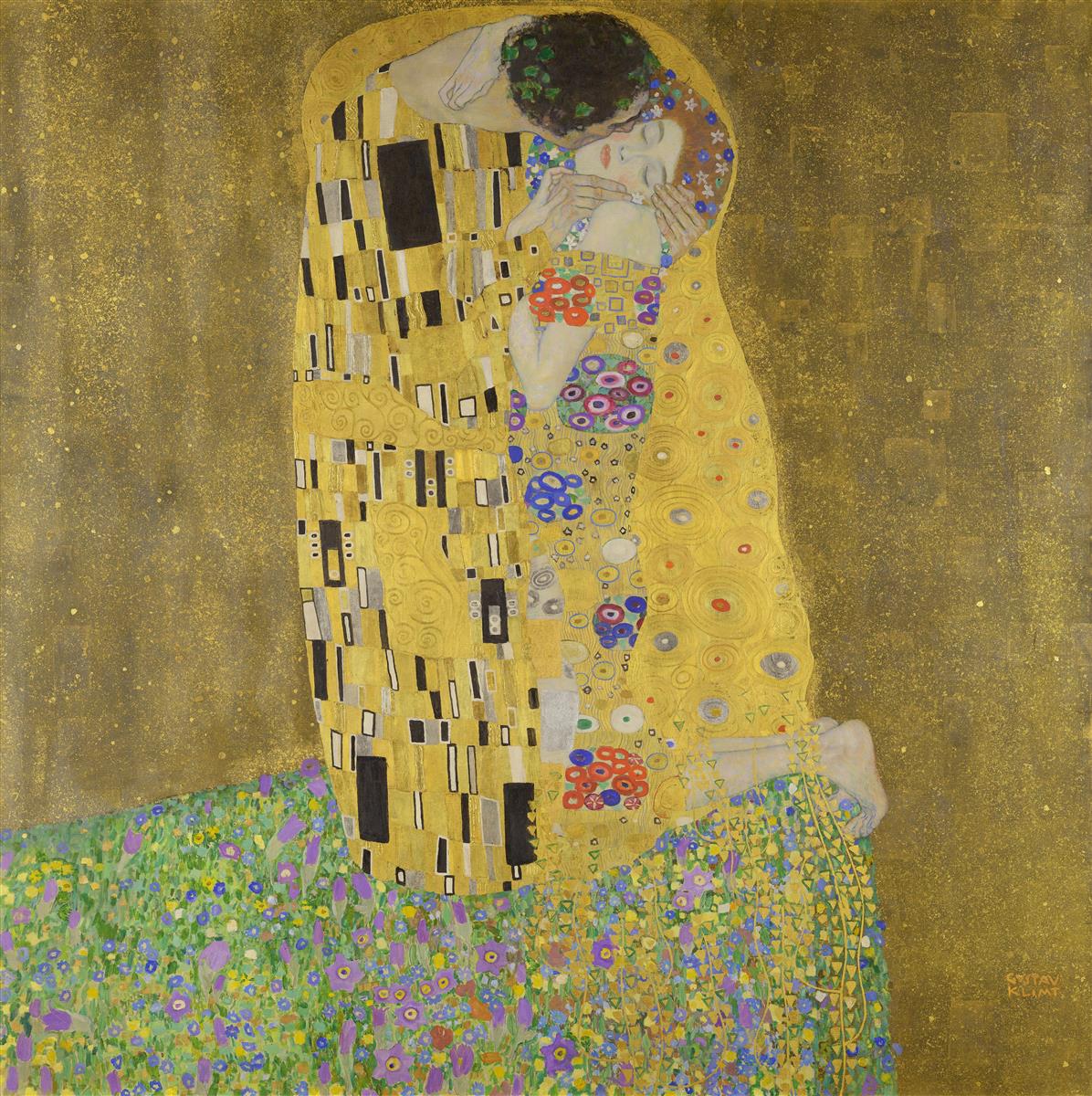
Image source: wikiart.org
Introduction
Gustav Klimt’s The Kiss from 1908 is one of the most recognizable paintings in modern European art, yet its familiarity should not obscure how unusual it really is. At first glance, the work seems simple. A man and woman embrace at the edge of a flowering meadow, wrapped in a brilliant gold mantle that dissolves the boundary between clothing, ornament, and sacred aura. The couple appears absorbed in a private moment, cut off from the ordinary world. But the longer one looks, the more complex the painting becomes. It is not simply an image of romance. It is a carefully structured meditation on intimacy, beauty, decoration, sensuality, spirituality, and the relationship between the human body and the world of artifice.
Painted during Klimt’s celebrated Golden Phase, The Kiss condenses many of the qualities that define his mature style. It combines natural forms with geometric abstraction. It turns surface ornament into emotional language. It treats the human figure both as a physical presence and as an icon. The painting is deeply sensual, but it is also formal and controlled. It feels tender, yet it is built from highly sophisticated visual oppositions between masculine and feminine, movement and stillness, nature and pattern, flesh and gold.
Part of the painting’s enduring appeal lies in this balance. It offers immediate beauty, but it also rewards close attention. Viewers are drawn to the shimmering gold, the elaborate motifs, and the recognizable emotional scene, but the image remains mysterious. The couple is at once real and symbolic. Their embrace is both personal and universal. Klimt transforms a fleeting human gesture into something timeless, almost ceremonial. The result is a painting that feels intimate and monumental at the same time.
The Scene and Its Emotional Core
At the center of The Kiss is a kneeling couple locked in an embrace. The man bends over the woman, pressing his face toward hers, while she tilts her head back and closes her eyes. His hands cradle her head and face. Her body leans into him, but not with complete abandon. One arm circles his neck, while the other rests gently on his wrist. This is an important detail because it gives the scene emotional nuance. The painting is not only about surrender. It is also about response, hesitation, and mutual feeling.
The emotional force of the work comes from the fact that Klimt captures an instant poised between movement and stillness. The kiss itself is not shown in a theatrical or dramatic way. Instead, the image holds the moment just before, or perhaps during, the softest point of contact. The woman’s closed eyes and parted lips suggest inward absorption. She seems less engaged with the outer world than with the sensation of the moment itself. This inwardness gives the painting much of its dreamlike atmosphere.
What makes this scene so compelling is that Klimt avoids narrative distraction. There is no detailed setting, no architectural backdrop, and no anecdotal explanation of who these figures are. We are not given a story in the conventional sense. Instead, the painting isolates emotion and elevates it. The embrace becomes the event. Everything else in the composition serves to intensify that central act of union.
Yet the picture is not merely sentimental. There is a certain tension in the way the two bodies interact. The man appears active, leaning forward, enclosing, and pressing downward. The woman appears receptive, curved, and luminous, but she is not erased. Her face is the emotional center of the composition, and her expression contains both pleasure and introspection. Klimt thus turns the kiss into something larger than a simple romantic image. It becomes a meditation on closeness, difference, and the fragile beauty of human connection.
Composition and the Power of Containment
One of the reasons The Kiss feels so iconic is the clarity of its composition. Klimt builds the entire painting around a strongly unified vertical form. The two figures are almost fused into a single mass, wrapped within a shared golden envelope that rises like a pillar from the flowered ground. This shape dominates the composition and creates a sense of containment. The lovers do not merely stand together. They seem enclosed in a self-contained world, separate from time and space.
The painting’s format contributes to this effect. The square canvas gives the scene a sense of equilibrium and monumentality. Unlike a wide horizontal composition that might suggest narrative development or spatial expansion, the square creates a more concentrated visual field. It encourages focus and containment. Within that space, the couple becomes an almost architectural presence, like a shrine or icon placed before the viewer.
Klimt also positions the figures near the top and center of the canvas, but not exactly in a rigid symmetrical scheme. The slight asymmetries keep the painting alive. The man’s bent posture, the woman’s tilted head, and the irregular edge of the meadow introduce enough variation to prevent the composition from feeling static. The figures seem suspended between stability and motion, as though they have momentarily crystallized out of a flowing decorative world.
Another striking compositional choice is the edge of the meadow. The figures kneel near what appears to be a precipice or drop, though the space is intentionally ambiguous. This detail introduces a subtle note of danger or instability beneath the calm surface of the scene. The couple stands at the threshold between safety and uncertainty, grounded on a patch of flowers that seems almost too delicate to support them. This tension enriches the image. Love is shown as ecstatic and beautiful, but also precarious.
The composition therefore does more than organize the figures. It gives visual form to the emotional state of the painting. The lovers are enclosed, elevated, isolated, and poised at an edge. This combination of security and vulnerability is central to the work’s meaning.
Gold and the Transformation of Surface
Perhaps the most immediately striking feature of The Kiss is its radiant gold surface. Klimt uses gold not as a background detail but as the dominant visual atmosphere of the painting. It transforms the image from a scene of ordinary life into something ceremonial and transcendent. Gold does not behave like natural light. It does not describe a time of day or a believable environment. Instead, it suspends the figures in a timeless, glowing realm.
This use of gold is closely associated with Klimt’s Golden Phase, during which he explored the expressive and decorative potential of metallic surfaces. In The Kiss, gold functions in several ways at once. It creates luxury and splendor. It flattens space and draws attention to the painting as an object. It evokes sacred art, especially mosaics and icons, where gold often symbolizes divine or eternal presence. At the same time, it intensifies sensuality by making the lovers seem precious, luminous, and almost untouchable.
What is remarkable is how Klimt balances gold’s decorative richness with emotional intimacy. The painting never feels cold or merely ornamental. Instead, the shimmering surface heightens the value of the human moment at its center. The kiss becomes something worthy of reverence. Ornament is not opposed to feeling here. It becomes the medium through which feeling is elevated.
The gold also changes the way the viewer sees form. It compresses space, softens depth, and makes contour more important than modeling. Rather than constructing the bodies through traditional illusionistic shading, Klimt often lets pattern and surface carry visual meaning. This gives the painting its characteristic tension between flatness and volume. We recognize the figures as bodily presences, yet they are also inseparable from the abstract field that surrounds them.
By using gold so extensively, Klimt turns surface into substance. The painting invites the eye to linger not only on faces and hands but on texture, gleam, and pattern. Looking becomes a tactile experience. The viewer feels the richness of the work before fully understanding it. This is one reason The Kiss has such immediate impact. It seduces the eye even as it deepens into symbolism.
Pattern, Ornament, and the Language of Difference
One of the most sophisticated aspects of The Kiss is Klimt’s use of ornament to distinguish between masculine and feminine energies. The garments of the two figures are covered with different motifs. The man’s robe is marked by rectangles, black bars, and angular forms. The woman’s dress is filled with circles, spirals, flowers, and softer, more fluid patterns. These decorative systems are not random embellishments. They act like a visual language.
The contrast between angular and rounded motifs suggests difference without breaking the unity of the couple. The man’s forms seem firm, structural, and assertive. The woman’s forms appear organic, blooming, and receptive. Klimt does not express gender primarily through anatomy or facial expression. He expresses it through pattern. This is one of the painting’s most modern features. Decoration is not secondary to meaning. It is meaning.
At the same time, these patterns do not remain neatly separate. They coexist within a shared golden field. The lovers are different, yet joined. Their union does not erase contrast, but it gathers contrast into harmony. This is why the painting feels so complete. It presents intimacy not as sameness but as the meeting of distinct forms of being.
The floral motifs on and around the woman reinforce her connection to organic life and growth. She seems to emerge from the meadow itself, as though her body participates in the rhythm of blossoming. The man, by contrast, appears more absorbed into the mantle’s structured geometry. He feels slightly more concealed, less individually revealed. This difference affects the emotional reading of the work. The woman’s face, neck, arm, and feet remain visible, making her more vulnerable and more humanly accessible. The man is more hidden behind pattern and posture.
Klimt’s achievement lies in how he transforms ornament into psychology. The viewer senses emotional and symbolic distinctions through visual texture alone. The painting becomes a kind of decorative poetry in which shape and pattern convey the terms of love, union, and identity.
The Female Figure as Sensual and Sacred Presence
Although the painting depicts two lovers, the emotional and visual center of The Kiss is the woman. Her face is the brightest human focal point in the composition. Her closed eyes, relaxed mouth, and tilted head communicate inward feeling with extraordinary delicacy. She is the figure through whom the viewer most directly experiences the painting’s emotional temperature.
Klimt presents her as both sensual and sacred. Her bare skin glows against the gold and patterned fabric, emphasizing her physical presence. Her feet, visible at the lower right, are especially important because they anchor the otherwise ethereal scene in bodily reality. At the same time, her serenity and the halo-like effect of the surrounding gold make her seem almost like a devotional image. She is not simply a woman in a meadow. She becomes an emblem of beauty, intimacy, and receptivity.
This duality is essential to Klimt’s art more broadly. He often portrays women as powerful bearers of emotional, erotic, and symbolic meaning. In The Kiss, that tendency is softened into tenderness. The female figure is not depicted as threatening or distant. Instead, she becomes the locus of calm, absorption, and luminous vulnerability.
Her kneeling posture also matters. It introduces a gentle curve into the composition, contrasting with the block-like vertical mass of the mantle. The body bends, while the ornament stabilizes. This interplay between softness and structure gives the painting much of its formal beauty. Her exposed arm and shoulder break through the decorative field, reminding us that beneath the gold there is living flesh.
There is also something deeply inward about the way Klimt paints her face. She does not engage the viewer. She is turned away from the external world and enclosed within sensation. This creates a sense of privacy that makes the scene more moving. We are allowed to witness the moment, but not to interrupt it. The woman remains psychologically self-contained even in embrace. That balance between intimacy and distance is one of the painting’s greatest strengths.
Nature, Meadow, and the Edge of the World
The lower portion of The Kiss introduces a vivid meadow filled with flowers in purple, blue, green, yellow, and red. This area provides a striking contrast to the dominant gold above. Where the upper field feels timeless and abstract, the meadow feels alive, seasonal, and earthly. It supplies the painting with coloristic freshness and visual relief.
The flowers are more than decorative additions. They create a symbolic ground for the lovers’ union. Blossoming nature has long been associated with fertility, renewal, and erotic life, and Klimt draws on those associations without becoming literal. The meadow acts as a living counterpart to the gold. It suggests that love belongs both to the ideal realm and to the natural world.
At the same time, the ground beneath the figures is strangely unstable. The meadow appears to end abruptly, as if the couple stands at the edge of a cliff or ledge. This detail introduces ambiguity into an otherwise harmonious scene. The lovers are surrounded by beauty, but they are also close to a void. The painting does not dramatize this danger overtly, yet its presence gives the image a deeper emotional resonance. Intimacy is shown as something precious partly because it exists near uncertainty.
Klimt also uses the meadow to counterbalance the austerity of gold with a denser, more varied form of ornament. The flowers below echo the circular motifs on the woman’s garment, linking her to the natural ground. This connection enhances the sense that she belongs to a world of growth and flowering, while the man enters that world through embrace.
The meeting of meadow and gold is therefore not merely a color contrast. It is a meeting of realms. Earth touches eternity. Organic life touches decorative transcendence. The lovers kneel where these worlds intersect. This is one reason the painting feels so complete as an image. It does not confine love to either pure spirit or pure flesh. It places love where body, nature, desire, and ideal beauty converge.
Klimt’s Style and the Spirit of Vienna Around 1900
The Kiss is inseparable from the artistic climate in which it was created. Klimt was a central figure in Viennese modernism, and his work reflects the era’s fascination with symbolism, psychology, design, and the breakdown of traditional academic categories. In this painting, those concerns come together with exceptional clarity.
Rather than choosing between fine art and decoration, Klimt unites them. Rather than treating painting as a window onto realistic space, he embraces flatness, pattern, and surface richness. Rather than presenting the figure in purely classical terms, he surrounds it with a symbolic environment that blurs the line between body and ornament. These choices place The Kiss firmly within the experimental spirit of its time, but they also help explain why the painting still feels modern.
The influence of mosaic-like surface treatment is especially important. Klimt creates a composition that seems assembled from precious fragments, as if painting were approaching the condition of jewelry, textile, and sacred object all at once. This hybrid quality gives the work a distinctive aura. It does not feel like a conventional easel painting. It feels like a treasure.
At the same time, Klimt never abandons the emotional accessibility of the human image. The painting is formally adventurous, but it does not become obscure. Viewers respond immediately to the embrace, the tenderness, and the visual luxury of the work. This combination of innovation and direct appeal helps explain its lasting popularity. It belongs to a specific cultural moment, yet it transcends that moment through its emotional clarity.
In many ways, The Kiss represents Klimt at the height of his ability to synthesize different artistic ambitions. He creates beauty without shallowness, symbolism without obscurity, and decoration without emptiness. The painting stands as a distilled expression of a world in which art sought to transform everyday experience into something total, immersive, and spiritually charged.
Why The Kiss Still Resonates
The continuing power of The Kiss lies partly in its openness. It is easy to recognize and easy to feel, but it does not close itself off with a single fixed interpretation. Some viewers see it primarily as a celebration of romantic love. Others see a symbolic union of masculine and feminine principles. Others are drawn to its spiritual atmosphere, its ornamental brilliance, or its tension between intimacy and idealization. The painting supports all of these readings because it is built from layers rather than from one simple message.
Its visual beauty also plays a major role in its endurance. Klimt understood how to make a painting unforgettable at first sight. The gold, the floral ground, the fused silhouette of the couple, and the soft radiance of the woman’s face combine into an image of exceptional memorability. It is decorative in the best sense of the word. It gives pleasure. Yet that pleasure leads into deeper reflection.
Another reason the painting still resonates is that it captures a universal human desire for closeness while preserving mystery. The lovers are joined, but they are not fully knowable. The moment is shared, but inward. The image promises connection, but it also acknowledges the distance that always remains between one person and another. That complexity makes the painting feel emotionally truthful even within its dreamlike beauty.
Finally, The Kiss continues to matter because it demonstrates how art can elevate a simple gesture into something timeless. Klimt takes an embrace and transforms it into a visual emblem of desire, tenderness, and transcendence. He makes love appear both fragile and monumental, earthly and sacred, personal and universal. Few paintings achieve that kind of balance so completely.
Conclusion
The Kiss endures because Gustav Klimt created far more than a beautiful image of two lovers. He created a painting in which composition, color, ornament, surface, and emotion all work together with extraordinary precision. The gold field removes the scene from ordinary time. The patterns encode difference and harmony. The meadow anchors the figures in nature while placing them at a threshold. The woman’s luminous face gives the image emotional depth, and the unified silhouette of the couple turns an intimate act into a near-monumental form.
What makes the work so remarkable is its ability to hold opposites together. It is sensual and sacred. It is decorative and profound. It is immediate and mysterious. It offers the pleasure of surface while inviting slow contemplation. In this sense, The Kiss is not simply famous because it is attractive. It is unforgettable because it reveals how beauty itself can become a serious artistic language.
Klimt transforms ornament into feeling and feeling into icon. The lovers seem enclosed in their own radiant world, yet that world remains open to every viewer who has ever recognized the wonder and vulnerability of human closeness. More than a century after it was painted, The Kiss still feels alive because it speaks to a desire that is never outdated: the hope that love might briefly turn the fragile world into something luminous and complete.