Image source: wikiart.org
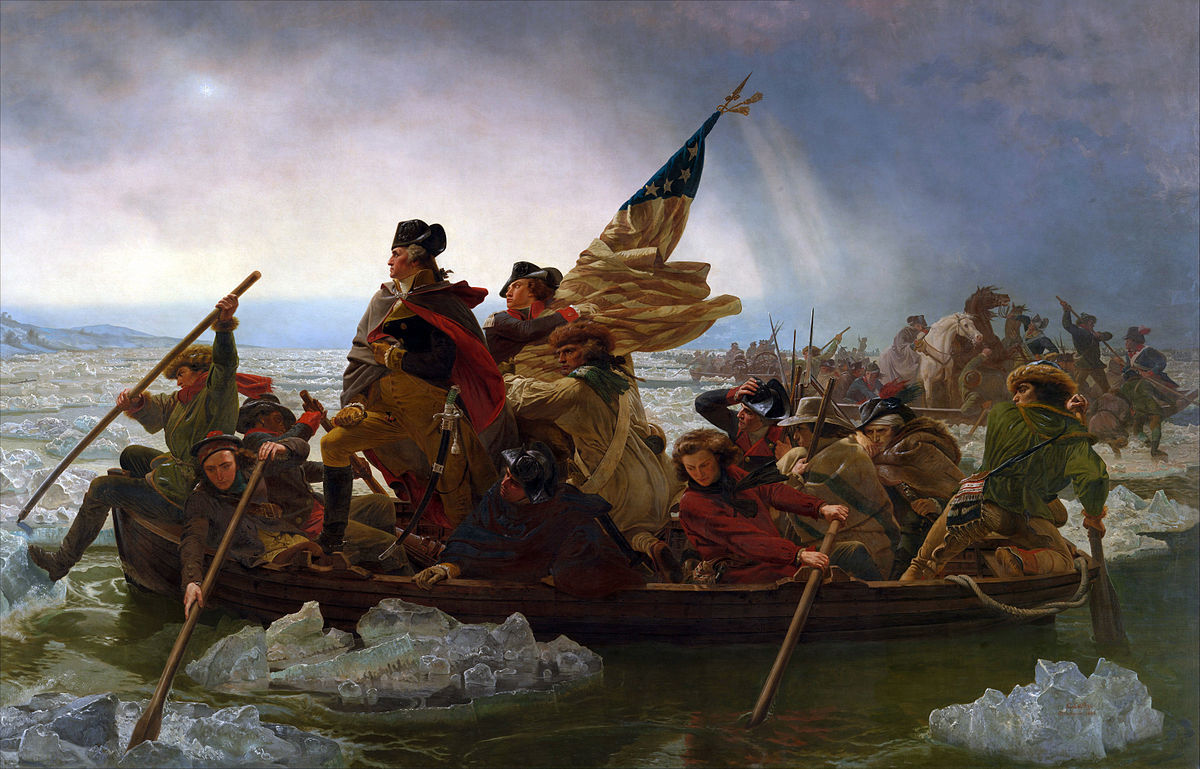
Washington Crossing the Delaware by Emanuel Leutze
Emanuel Leutze’s Washington Crossing the Delaware, completed in 1851, is one of the most recognizable history paintings of the nineteenth century. Few images have done more to shape the visual memory of the American Revolution. Even people who know little about the details of George Washington’s winter campaign often know this scene: the commander standing upright in a crowded boat, wrapped in a dramatic cloak, pushing through floating ice beneath a cold and troubled sky. The painting transforms a dangerous military maneuver into a grand statement about leadership, resolve, sacrifice, and national destiny.
At first glance, the work feels immediate and heroic. It gives the impression of a moment seized in the middle of action, as if the viewer has arrived at the river just as history is being made. Yet the painting is far more than a literal record of a crossing. It is a carefully staged vision of courage under pressure. Leutze was not simply illustrating an event. He was constructing a national myth in paint, using the visual language of Romanticism and history painting to turn an episode from 1776 into a timeless symbol.
The result is a work that operates on several levels at once. It is a dramatic narrative image, a patriotic allegory, a political statement, and a theatrical arrangement of bodies, light, and movement. It is also a painting created decades after the event it depicts, which means that it reflects not only the Revolutionary era but also the concerns of the mid nineteenth century. That layered quality is one reason the work remains so compelling. It tells us as much about how a nation wanted to imagine its origins as it does about the past itself.
The Historical Moment Behind the Scene
The painting depicts George Washington’s crossing of the Delaware River on the night of December 25 to 26, 1776, during the American Revolutionary War. At that stage in the conflict, the Continental Army was in a desperate condition. Morale was low, previous defeats had weakened confidence, and the revolutionary cause seemed fragile. Washington’s decision to cross the river in brutal winter conditions and launch a surprise attack on Hessian forces at Trenton became one of the most famous acts of daring in American military history.
Leutze understood the drama built into this moment. The crossing was not a triumphant parade. It was risky, exhausting, and uncertain. Men, equipment, and weapons had to move through darkness, freezing temperatures, and broken ice. The operation carried the possibility of disaster. By choosing this episode, Leutze selected a point in history when success was not guaranteed. That uncertainty is central to the painting’s emotional power. The heroism here does not come from celebrating an easy victory. It comes from facing overwhelming difficulty.
The scene also carried broad symbolic meaning. The crossing led to the victory at Trenton, which helped revive the revolutionary cause. In retrospect, the event came to represent perseverance at a moment of near collapse. That idea made it ideal subject matter for a grand historical image. Rather than showing the battle itself, Leutze focused on the tense approach, when resolve matters more than results. This choice gives the work a deeper emotional charge. It is about faith in action before the outcome is known.
Emanuel Leutze and the Painting’s Cultural Background
Emanuel Leutze was a German American painter, and that background is essential to understanding the work. Although the painting deals with an American subject, Leutze completed it in Düsseldorf, where he was associated with a European artistic environment shaped by history painting, theatrical composition, and political idealism. He was interested not only in American history but also in the broader idea of freedom. In the revolutionary movements and political unrest of nineteenth century Europe, the story of Washington could function as an inspiring symbol of resistance to oppression.
Because of this, Washington Crossing the Delaware is not merely backward looking. It speaks to the present of the artist as much as to the past of the nation. Leutze turned the American Revolution into an image with international resonance. Washington becomes more than an American general. He becomes an embodiment of principled leadership and collective struggle. The painting therefore joins memory and aspiration. It celebrates a historic event while also suggesting that liberty must be defended in every age.
Leutze’s training also shaped the painting’s style. He worked within the grand tradition of European history painting, a genre that aimed to elevate significant events through large scale, idealization, and carefully organized drama. This is why the work feels monumental. It is not interested in modest anecdote. Everything in it is intensified so that the event appears larger than life. Even the river, sky, and ice participate in the sense of epic struggle.
The Monumental Composition
One of the most striking features of the painting is its composition. The boat cuts across the foreground on a diagonal, creating a powerful sense of motion and instability. The diagonal is one of the oldest tools for generating drama in painting, and Leutze uses it masterfully. The vessel seems to surge through the icy water while also appearing dangerously vulnerable. The men are crowded together, each engaged in a different action, and their bodies form an intricate arrangement of leaning, bracing, pulling, and turning.
At the center stands Washington, elevated above the others and clearly marked as the focus of the entire image. His upright pose contrasts sharply with the hunched and laboring bodies around him. Everyone else is occupied with the physical difficulty of the crossing. Washington appears composed, forward looking, and unwavering. This contrast is essential. It visually separates the leader from the group while still keeping him within it. He is part of the scene, yet also above it in a symbolic sense.
Leutze organizes the painting so that the eye keeps returning to Washington. The flag rises behind him, helping frame his figure. The lines of the oars, the arrangement of bodies, and even the light all guide attention toward the central hero. But the surrounding figures remain crucial. They give the scene density, variety, and humanity. Without them, Washington would become a mere statue. With them, he becomes the still point in a world of effort and danger.
The composition also balances chaos and control. The icy river suggests unpredictability, while the structure of the boat and the disciplined actions of the men suggest purpose. This tension mirrors the historical moment itself. The revolution was threatened by confusion and defeat, yet it was sustained by courage and direction. Leutze translates that political reality into visual form.
George Washington as Heroic Icon
Washington’s pose has often been discussed because it is so unmistakably heroic. He stands tall in the boat, even though such a posture would have been risky in real life. That impracticality is beside the point. Leutze was not aiming for documentary realism in every detail. He wanted to represent Washington as the embodiment of command. The standing figure makes the leader visible not only to the men around him but also to history itself.
There is a sculptural quality to Washington’s body. He appears firm, balanced, and resolute, with his gaze directed toward the unseen shore and the future beyond it. He does not look at the viewer, nor does he seem distracted by the immediate chaos around him. His attention is fixed on the destination. This is leadership expressed through posture. The body itself becomes a statement of purpose.
His red cloak adds to the effect. It catches the eye and introduces a note of warmth into the cold palette of the scene. The cloak also gives him an almost classical or imperial presence, linking him to older traditions of heroic representation. Yet because the subject is revolutionary rather than royal, the effect is transformed. Washington is not depicted as a tyrant or conqueror. He is presented as a leader whose greatness is tied to the cause of liberty.
This idealization helps explain why the painting endured in popular culture. It offers a clear and compelling image of what leadership is supposed to look like. Washington does not appear anxious, doubtful, or physically overwhelmed. He appears morally centered. Whether or not the real crossing looked anything like this, the image succeeded because it gave viewers a powerful emblem of national character.
The Role of the Other Figures
Although Washington dominates the composition, the other men in the boat are far more than background. Leutze gives them distinct poses, costumes, and expressions, creating a diverse group that appears to represent the wider American cause. Their individuality suggests that the revolution was not made by one man alone. It required collective labor, shared danger, and the participation of people from different regions and backgrounds.
Each figure contributes to the rhythm of the painting. Some row with force, some crouch low, some turn their heads, and some strain against the cold. These varied gestures animate the scene and prevent it from becoming rigid. The men do not form a static arrangement. They create a chain of energy that runs through the boat from front to back.
Several art historians and viewers have noted that the group seems almost symbolic in its diversity. Leutze appears to include different types of Americans, presenting the revolution as a united effort. Whether read literally or allegorically, the effect is important. The crossing becomes a collective undertaking, and the image suggests that national identity is forged through shared hardship.
The physical vulnerability of these figures also heightens Washington’s authority. Their bent postures, protective gestures, and heavy winter garments emphasize the severity of the environment. They look cold, burdened, and human. Washington, by contrast, looks elevated and unbroken. This difference is not meant to diminish the others. Instead, it sharpens the painting’s central idea: the leader must remain steady when everyone else is struggling.
Light, Atmosphere, and the Winter Setting
The atmosphere of the painting is one of its greatest achievements. Leutze creates a world of freezing air, dim light, and shifting weather. The sky is filled with clouds, yet a break in the gloom allows pale light to spread across the scene. This light does not merely illuminate forms. It carries symbolic weight. It suggests hope emerging through darkness, purpose piercing uncertainty, and dawn approaching after a long and difficult night.
The river itself is a character in the drama. The chunks of ice in the foreground are rendered with remarkable care, and they make the crossing feel perilous. The boat appears exposed and fragile among them. Water and ice reflect the muted light in cold grays, whites, and greens, creating a surface that feels both beautiful and hostile. This is not a passive landscape. Nature here resists human intention.
Leutze uses atmosphere to intensify emotional meaning. The cold is almost visible. The viewer senses the wind, the wetness, and the danger of slipping or capsizing. The men are not only fighting an enemy army. They are fighting the elements. That struggle against nature broadens the significance of the image. It becomes a test not just of military strategy but of endurance itself.
The suggestion of dawn is especially important. The sky seems to hold the first promise of daylight, and that temporal shift works as metaphor. The crossing occurs in darkness, but the painting points toward morning. The revolution may have passed through a period of shadow, yet a new day is coming. Such symbolism is characteristic of history painting, and Leutze employs it with great effectiveness.
Color and Emotional Temperature
The color palette is dominated by cool tones, which reinforces the winter setting and the severity of the scene. Blues, silvery grays, muted browns, and icy whites establish a restrained atmosphere. These colors make the river and sky feel bitterly cold, and they also give the painting a solemn mood. This is not a cheerful patriotic celebration. It is a grave and determined passage through hardship.
Against this cold environment, warmer accents become especially powerful. Washington’s red cloak is the most obvious example, but there are also touches of warm flesh tones, reddish garments, and earth colors throughout the boat. These areas create visual contrast and keep the composition from becoming monotonous. More importantly, they suggest human warmth and vitality struggling against the frozen world around them.
The flag introduces another crucial color element. Its blues, reds, and lighter tones rise above the boat and connect the human drama below to the larger meaning of national identity. The flag is partially unfurled and caught by the wind, which gives it a restless energy. It does not simply hang as a sign. It participates in the movement of the scene. The nation itself appears to be in motion, unstable yet advancing.
Leutze’s handling of color is therefore both descriptive and symbolic. It conveys weather, texture, and depth while also supporting the painting’s emotional narrative. Cold tones represent danger and adversity. Warm accents represent courage, life, and purpose. This contrast is one reason the image remains so visually memorable.
Romantic Drama and Historical Imagination
The painting belongs firmly to the tradition of Romantic history painting. Romanticism valued emotion, heroism, dramatic nature, and the heightened representation of decisive moments. Washington Crossing the Delaware embodies all of these qualities. It does not treat history as a set of dry facts. It treats history as a source of moral drama.
This approach helps explain some of the painting’s departures from strict realism. The size and type of the boat, the arrangement of the figures, the position of Washington, and the lighting of the scene have all been questioned by viewers seeking factual accuracy. But Leutze’s purpose was not journalistic reconstruction. He was aiming for historical truth in a broader, more symbolic sense. He wanted to convey what the moment meant, not merely how it may have looked in every practical detail.
Romantic art often seeks to make visible the inner significance of events. In this painting, that inner significance is courage in the face of uncertainty. The image feels theatrical because theater was one of the ways nineteenth century artists made emotion legible. Gesture, pose, and contrast are intensified so that the viewer experiences the event as morally charged. The crossing becomes not just a military operation but a test of national will.
That is why the painting has endured despite repeated observations about its historical inaccuracies. Viewers continue to respond to its emotional clarity. It offers a compelling vision of history shaped into legend, and legend has its own kind of power.
Patriotism, Myth, and National Identity
One of the most important aspects of the painting is the way it contributes to American national mythology. It takes a specific event and elevates it into an origin story. Washington is not shown as a flawed or ordinary person. He is shown as the leader a nation wants to remember at the moment of its trial. The painting therefore tells us how Americans in the nineteenth century wished to see the Revolution: unified, purposeful, and guided by moral greatness.
This mythmaking is not accidental. Nations often rely on iconic images to summarize their values. Leutze’s painting became one such image because it condensed complex historical ideas into a single, unforgettable scene. Sacrifice, bravery, leadership, hardship, and victory are all implied at once. The work gives visual form to the belief that freedom requires endurance and resolve.
At the same time, the painting reveals how national memory simplifies the past. Real revolutions are messy, divided, and uncertain. Leutze organizes that complexity into a coherent drama led by a central hero. In doing so, he creates an image that is emotionally satisfying and politically useful. The painting does not merely remember history. It shapes it.
This is part of its lasting fascination. Modern viewers can admire the work both for its stirring power and for what it reveals about collective memory. It is a masterpiece of patriotic imagination, but it also invites reflection on how nations build legends from historical events.
Why the Painting Still Matters
More than a century and a half after its completion, Washington Crossing the Delaware remains deeply embedded in visual culture. It is reproduced in textbooks, parodied in popular media, and referenced whenever American perseverance or leadership is discussed. That level of recognition is rare for any painting. It shows how successfully Leutze created an image that could move beyond the museum and enter public consciousness.
Part of the painting’s endurance comes from its clarity. The scene is easy to understand even for viewers unfamiliar with the details of the Revolution. A group of men struggles through danger, and one leader stands firm at the center. The story is immediate. But the work also rewards closer looking. Its arrangement of forms, use of light, symbolic contrasts, and emotional pacing reveal considerable sophistication.
The painting also remains relevant because it speaks to recurring human themes. It is about crossing into uncertainty, acting under pressure, and continuing forward when success is not assured. Those ideas extend beyond the American context. They help explain why the work has appealed to audiences in different eras and places.
In the end, Washington Crossing the Delaware is not simply a picture of a river crossing. It is a grand visual statement about how history becomes memory and how memory becomes identity. Emanuel Leutze took a moment of military risk and turned it into an enduring image of purpose. Whether viewed as patriotic icon, Romantic spectacle, or meditation on mythmaking, the painting remains one of the most powerful historical images of the nineteenth century.