Image source: wikiart.org
Overview of “Tristan and Isolde” by John William Waterhouse
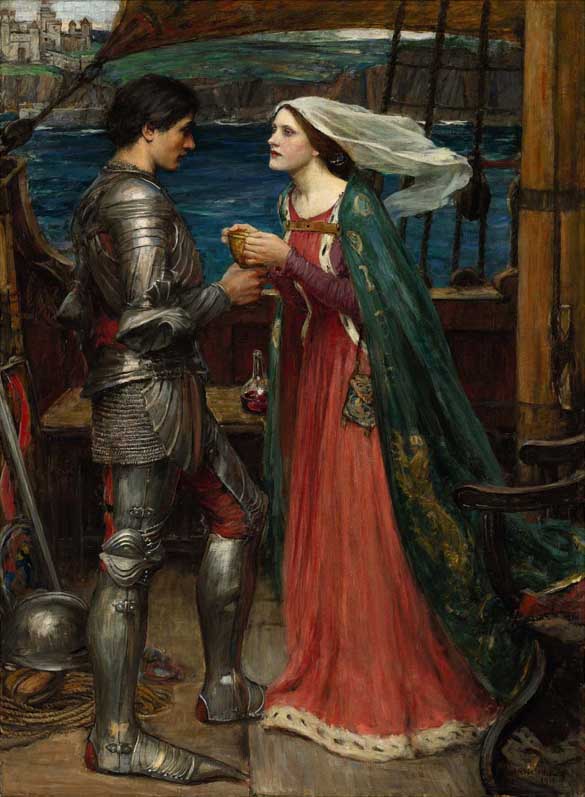
John William Waterhouse’s “Tristan and Isolde” (1916) stages a private turning point inside a public journey. The scene is set on a ship, but the real voyage is emotional: two figures face each other at close range, separated by almost nothing except breath, hesitation, and the knowledge that whatever happens next cannot be taken back. Waterhouse chooses the moment when love becomes fate. The couple’s hands meet around a cup, small enough to seem harmless, charged enough to feel inevitable. Everything in the painting, from the taut ropes to the restless water, echoes that tension between control and surrender.
The subject comes from medieval romance, where Tristan and Isolde are bound by a love potion and by the disastrous consequences of devotion that collides with duty. Waterhouse does not need to narrate the full legend. He compresses it into a single exchange of looks. The knight’s armor suggests obligation and worldly order, while Isolde’s flowing dress and wind-lifted veil suggest emotion, vulnerability, and the forces that cannot be locked into rules. The result is both intimate and theatrical, like a whispered confession delivered on a stage made of timber, sailcloth, and sea.
The Story Moment Waterhouse Chose and Why It Matters
Rather than paint a climactic rescue or a tragic ending, Waterhouse focuses on the hinge of the story: the instant when a choice passes from possibility into reality. The cup in Isolde’s hands is the painting’s quiet engine. In the legend, the potion is often accidental, sometimes mistaken for a drink intended for another. That ambiguity, part innocence and part doom, is perfectly suited to Waterhouse’s temperament. He loved narratives where desire arrives like weather, beautiful and unstoppable.
This is a moment of transfer. Tristan’s hand reaches toward the vessel, his body angled forward, while Isolde holds it close, as if weighing what it means. Their proximity turns the cup into a threshold object, something that must be crossed. If it is a love potion, it becomes the physical form of destiny. If it is simply wine, it becomes the symbol of a decision already made in the heart. Waterhouse paints it so that it can be both, because the legend itself lives in that overlap: love as choice, love as compulsion, love as disaster, love as truth.
Composition and Staging on the Ship’s Deck
The composition is built like a chamber drama framed by the ship. Two vertical bodies occupy the center, their faces almost level, their hands joined around the cup. Waterhouse uses the ship’s architecture to create a contained arena: the mast rises at the right edge like a pillar, ropes make a web of diagonal lines behind Isolde, and the low wooden rail cuts across the scene, keeping the viewer inside the deck space. Even the distant coastline and buildings are kept high and small, a reminder of the world beyond that is quickly becoming irrelevant.
The couple is positioned so that the space between them becomes the painting’s most charged area. Their faces are close but not touching. Their hands are the point of contact, a more revealing intimacy than a kiss because it implies consent, exchange, and consequence. The knight’s armor provides a hard, reflective surface that contrasts with Isolde’s textiles. That contrast is not merely visual. It reads as a conflict between a life structured by vows and a life moved by feeling.
Waterhouse includes telling objects near the bottom left: a helmet on the deck and coiled rope. These details ground the scene in physical reality and also work symbolically. The helmet suggests a protective persona set aside, a warrior unarmed in the face of love. The rope implies binding and entanglement, a literal sailor’s tool that becomes a metaphor for a bond that tightens.
The Language of Gesture and Eye Contact
Waterhouse’s figures communicate through restraint. Tristan’s posture is attentive and slightly forward, as if he is listening with his whole body. Isolde’s posture is upright, her chin lifted, her gaze steady. She does not look down at the cup. She looks at him. That choice makes the exchange feel less like an accident and more like recognition. Even if the story insists on enchantment, Waterhouse paints their connection as something already present, something the drink will only confirm.
The most psychologically rich detail is the way the hands meet. Isolde holds the cup with both hands, careful and protective, while Tristan’s hand comes in to take or share it. Their fingers do not tangle dramatically. They touch with the delicacy of people who understand how much a small action can change everything. This kind of controlled emotion is typical of Waterhouse’s late romantic scenes. He builds intensity not through melodrama, but through the sensation that the characters are thinking as fast as they are feeling.
Isolde’s veil, pulled by wind, adds a second language of movement. It streams behind her head like a banner, turning her into a figure of both purity and prophecy. The wind does what the characters cannot: it declares that forces outside them are already in motion.
Color, Light, and the Emotional Weather of the Sea
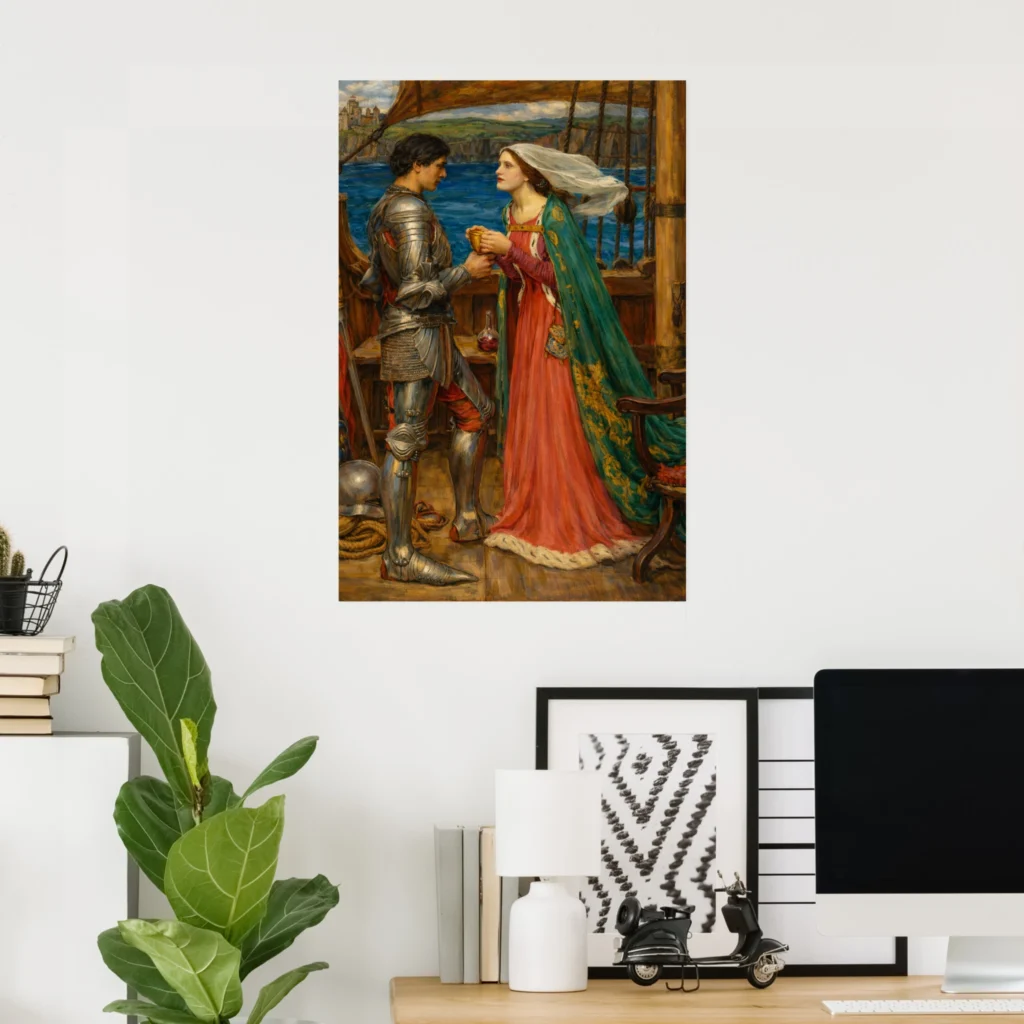
The palette is arranged around a strong dialogue of reds, greens, and blues. Isolde’s dress is a deep, warm red that immediately marks her as the emotional center. Over it falls a green cloak with ornate patterning, a color often associated with nature, enchantment, and the complicated allure of the unknown. Behind them, the sea is a saturated blue, and the sky is subdued, keeping the focus on the figures while still suggesting a living, shifting world.
Waterhouse uses these colors not just for beauty but for meaning. The red gown reads as passion and vitality, but also as risk. The green cloak reads as magic and fate, but also as shelter and concealment. Together, they make Isolde a figure of layered significance: not only beloved, but dangerous to love, not only vulnerable, but powerful in the way a story can be powerful.
Light in the painting is soft and even, with no harsh spotlight. That matters because it suggests inevitability rather than shock. This is not an event that erupts. It is an event that arrives, like tidewater. The armor catches highlights, giving Tristan a flicker of brightness that contrasts with the matte richness of fabric. The effect is to make him look both real and fragile: metal that can be dented, duty that can be bent.
Costume, Armor, and the Theme of Duty Versus Desire
Tristan’s armor is rendered with attention to plates, rivets, and layered protection. It is the visual shorthand for social order: knighthood, loyalty, service, reputation. Yet on the ship’s deck, surrounded by ropes and timber, the armor also feels heavy, almost out of place. Love stories thrive on that imbalance. Waterhouse paints Tristan as someone who has trained his body for war and his mind for obedience, but now stands disarmed by closeness.
Isolde’s clothing emphasizes the opposite. Her gown falls in a continuous column of fabric, soft and human, while her cloak drapes and trails, suggesting motion even when she is still. The patterned textile implies courtly status, but its very softness makes it feel nearer to skin and breath than Tristan’s metal. Her veil is a fragile boundary, a line between public identity and private self, lifted by the wind as if that boundary is being stripped away.
The costume contrast becomes the moral contrast of the legend. Duty is structured, articulated, and hard. Desire is continuous, flowing, and difficult to contain. Waterhouse makes that philosophical argument without a single overt symbol, simply by letting materials speak.
Space, Distance, and the Feeling of a Narrow Threshold
Although the figures stand in the open air, the space feels tight. The ship’s rail, mast, and rigging create a kind of enclosure. This spatial compression increases the emotional pressure. The couple cannot easily step away from the moment because the composition refuses them escape routes. Even the sea behind them, often a symbol of freedom, looks dense and weighty, pushing the scene forward rather than opening it up.
The background coastline is faint but legible. It suggests civilization, law, and the world of arranged marriages and political obligation waiting on shore. Yet it is distant enough to feel like another life. The ship becomes a liminal setting, neither fully in society nor fully outside it. That is exactly where stories of forbidden love happen, in corridors, gardens, boats, thresholds. Waterhouse knows this and uses the ship not only as a narrative location but as a metaphor for a passage that cannot reverse direction.
The placement of the cup near the center intensifies the threshold theme. It sits between them like a small gate. Their hands make an arch around it. The viewer’s eye returns to it again and again, because it is the object that turns feeling into destiny.
Waterhouse’s Late Style and His Medieval Imagination
By 1916, Waterhouse was working late in life, and his approach to romantic medieval subjects had become both distilled and psychologically intent. He keeps the storytelling clear, the surfaces richly painted, and the emotional temperature high without resorting to spectacle. In this painting, the drama is internal. That internal focus aligns him with a broader Pre-Raphaelite and post Pre-Raphaelite fascination with literature, especially stories where women are not merely decorative but central to the moral and emotional force of the narrative.
The handling of fabric and hair, the luminous pale skin against saturated color, and the careful balance between decorative detail and strong structure all feel characteristic of Waterhouse’s mature work. The scene is neither purely historical nor purely fantasy. It is a dream of the Middle Ages filtered through late Victorian and Edwardian sensibilities: medieval enough to feel mythic, modern enough to feel like a study of human psychology.
The painting’s restraint is also part of its late style. Waterhouse does not crowd the deck with extra characters. He does not show a court watching, or an attendant interrupting. He isolates the couple so that the legend becomes a study of two faces and one decision.
Symbolism of Sea, Wind, and the Objects on Deck
The sea in “Tristan and Isolde” functions like an emotional atmosphere. It is deep, restless, and unavoidable, the element that carries the ship as fate carries the lovers. The wind that pulls Isolde’s veil gives the painting motion and suggests that the world itself is participating in their story. It is as if nature approves, or simply refuses to remain neutral.
Objects on the deck enrich the symbolism without turning it into a puzzle. The helmet suggests identity put aside. The ropes suggest binding, navigation, and the possibility of being pulled off course. The mast and rigging form a lattice behind Isolde, visually echoing entrapment, as if the ship’s functional lines have become a net of consequence.
Even the wine bottle near the center lower area, with its dark red contents, reinforces the theme. It is a mundane container, but in the context of the story it becomes ominous. Waterhouse places it close enough to the figures to be relevant, but not so prominent that it overwhelms the human exchange. The point is not the potion as a gimmick. The point is the way a small drink can stand in for the largest possible change.
Why the Painting Still Feels Modern
“Tristan and Isolde” endures because it treats myth as a mirror. The painting does not ask the viewer to believe in magic in order to feel its power. It asks the viewer to remember what it feels like when a relationship crosses a line, when one moment makes future moments impossible to imagine without it. Waterhouse captures the sensation of knowing you are stepping into something transformative while still being unable to name exactly what it will cost.
The lovers’ expressions are key to that modern feeling. Tristan looks intent, vulnerable, and captivated. Isolde looks steady, serious, and awake to consequence. This is not romantic comedy enchantment. It is romantic tragedy enchantment, the kind that begins with clarity rather than confusion. Their faces suggest that even if a potion exists, it only accelerates what they already are.
The ship setting amplifies the theme in a way that resonates today. People still meet at thresholds: leaving home, traveling, changing jobs, crossing into adulthood, stepping away from familiar structures. Waterhouse turns travel into metaphor and makes a medieval story feel like a timeless psychological moment.
