Image source: wikiart.org
First Impressions and the Painting’s Quiet Shock
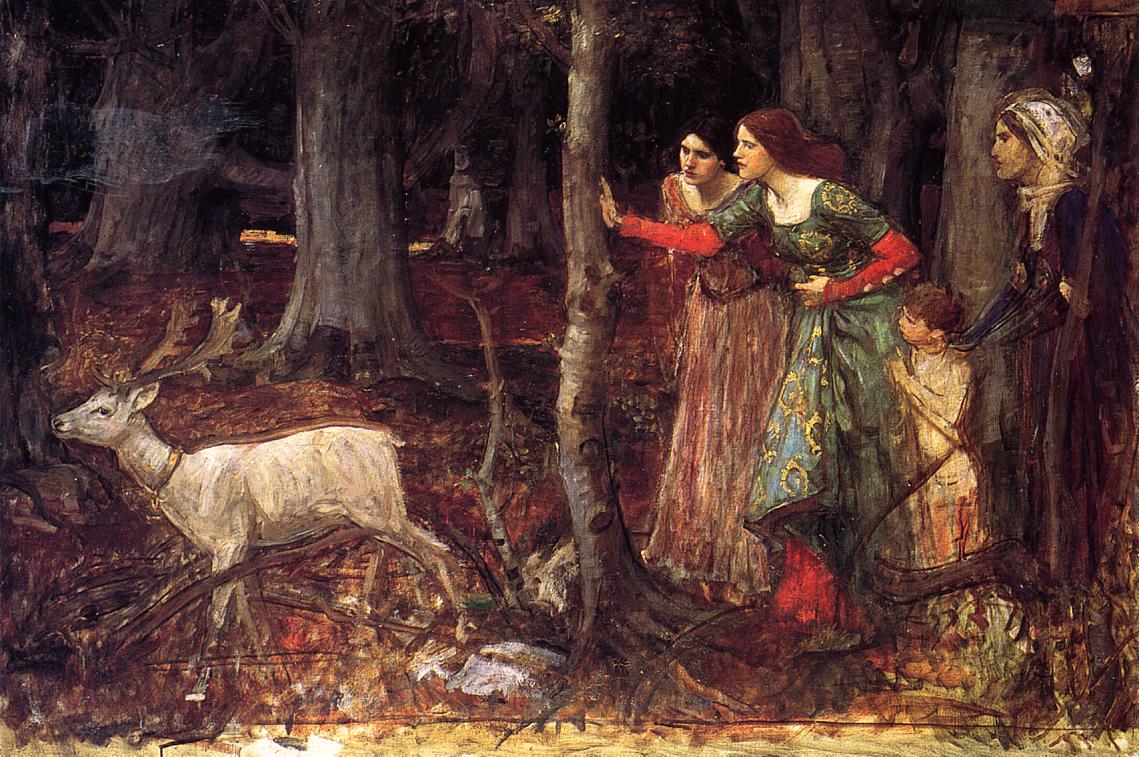
John William Waterhouse’s The Mystic Wood (1917) meets you in half light, as if your eyes need a moment to adjust before the story can begin. The scene is a forest interior, dense with trunks, roots, and brown leaf litter, painted in a palette that feels autumnal and inward. Out of that dimness, a pale stag moves leftward, almost gliding, its body catching what little light the wood allows. On the right, a small group huddles near the shelter of trees: two young women in richly patterned dress, a child clinging close, and an older, hooded figure behind them. The whole image seems to pause at the instant when ordinary sight turns strange, when a familiar landscape becomes a threshold.
The shock is not loud. There is no dramatic chase, no obvious violence, no theatrical sky. Instead, Waterhouse builds suspense through restraint. The forest is quiet, but not empty. The figures are still, but not calm. The stag is present, but not fully explained. This is the kind of mystery that lives in silence and suggestion, the kind that asks the viewer to lean in and finish the tale in their own imagination. Even the title proposes an experience rather than an event: a wood that is not merely dark or ancient, but “mystic,” charged with meaning that cannot be spoken directly.
Composition and the Feeling of a Threshold
The painting is structured like a discovery. Waterhouse divides the space so that the stag occupies the left side, open enough to read clearly, while the people gather on the right, partly obscured by trunks and shadow. Between them, the forest becomes both corridor and barrier. Vertical tree forms act like columns in a natural cathedral, separating the groups as if a rule of distance must be respected. The gap between the stag and the observers is the painting’s main tension. It is not only physical distance, but a moral or spiritual interval, a sense that crossing it might change everything.
Waterhouse’s choice to place the stag so far left is significant. In narrative terms, it suggests movement away from the group, as if the vision is already retreating. That creates urgency without action. The figures do not run after it; they hesitate. The viewer, positioned slightly outside the group, shares their uncertainty. Are they meant to follow, or to stay hidden? Is the animal guiding them, warning them, or simply passing through?
The strongest compositional gesture is the forward reach of the central woman, her arm extending toward the stag as if to signal, to protect, or to touch the air where it moves. Her body leans into the moment while her feet remain anchored. Waterhouse captures the posture of someone confronting the unknown: drawn forward by curiosity, held back by caution. The forest amplifies this psychological drama. The trunks are not just background; they are the physical shape of hesitation, the wood itself saying not yet.
The White Stag as Symbol and Invitation
The white stag is the painting’s brightest presence, and Waterhouse treats it like an apparition. Its pale body reads against the dark ground with near supernatural clarity. In folklore and medieval romance, a white stag often signals a quest, a test, or a crossing into enchanted territory. Even for viewers who do not know specific legends, the color alone suggests rarity, purity, and otherness. This is not an animal of everyday hunting. It feels like a messenger from the forest’s deeper laws.
Waterhouse avoids over explaining the stag. It is not haloed or surrounded by obvious magic. Instead, its strangeness comes from how it sits in the painted world: luminous but solid, calm but alert. The antlers, branching like the forest itself, connect the creature to the woodland architecture. The stag becomes a moving tree, a living emblem of the place. If the wood is “mystic,” the stag is its visible sentence, the one clear phrase the forest speaks to those who enter.
The direction of its movement matters. It moves left, toward deeper shadow, not toward the figures. That reversal of expectation makes the encounter feel like a missed opportunity or a fleeting grace. The group is witnessing something that does not belong to them, something that will not wait. The stag’s departure turns the moment into memory even as it occurs, which is part of why the scene feels haunted and tender at the same time.
The Human Group and a Spectrum of Responses
On the right, Waterhouse stages a small drama of reactions. The foremost woman, dressed in green with ornate patterning and a vivid red underlayer, appears to lead. Her expression and gesture suggest urgency, perhaps warning the others not to step forward too quickly. She is the one most engaged with the stag’s presence, the interpreter of the moment. Beside her, the second young woman watches with a different intensity, more inward, her hands closer to herself. Their proximity suggests shared experience, but their body language implies differing interpretations.
The child clings to the group, a reminder of vulnerability and the stakes of decision. The child’s presence also shifts the scene away from romantic adventure into something more familial and consequential. A quest that involves adults alone can be framed as choice or desire; a quest with a child feels like fate pressing in, responsibility narrowing the range of safe options. The child’s smallness against the forest emphasizes how immense and indifferent the wood can be.
Behind them stands an older figure, hooded, partially hidden, the face turned toward the unfolding vision. This figure functions like a chorus in a tragedy or a wise witness in folklore. Whether she is guardian, nurse, seer, or simply elder, she introduces a sense of generational memory, as if the forest’s mysteries are known, feared, or remembered. Waterhouse lets ambiguity do the work. The hood and partial concealment make the figure feel both protective and uncanny, like someone who belongs to the edge between village life and wild myth.
Together, these figures form a spectrum: initiative, contemplation, dependence, and experience. The painting becomes not only about a mystical animal, but about how different kinds of people meet the unknown.
Color, Light, and the Emotional Weather of the Scene
Waterhouse’s palette here is dominated by browns, deep reds, and muted blacks, with selective bursts of color in the garments. The forest floor is warm and restless, painted with layered strokes that suggest fallen leaves, damp earth, and tangled undergrowth. This warmth is not comforting. It feels like a smoldering undertone, as if the ground itself holds old stories.
Against that darkness, the white stag becomes a visual and emotional release, a brief clearing of the eye. The garments on the right echo that contrast. The green dress, ornamented and luminous, carries human artistry into the wild. The red underlayer acts like a pulse, a sign of life and danger. The more subdued clothing of the other figures keeps the focus on the central woman as the emotional axis of the scene.
Light is handled as filtered and scarce, as it would be in a dense wood. There is no broad illumination, only patches that touch bark, cloth, and animal hide. This kind of light creates intimacy. It turns the scene into a private encounter rather than a public spectacle. It also heightens the feeling that something could be hidden just beyond the visible. Waterhouse paints the forest as a place with corners, not only spatial corners but narrative ones, places where a story can turn.
Brushwork, Texture, and the Forest as a Living Surface
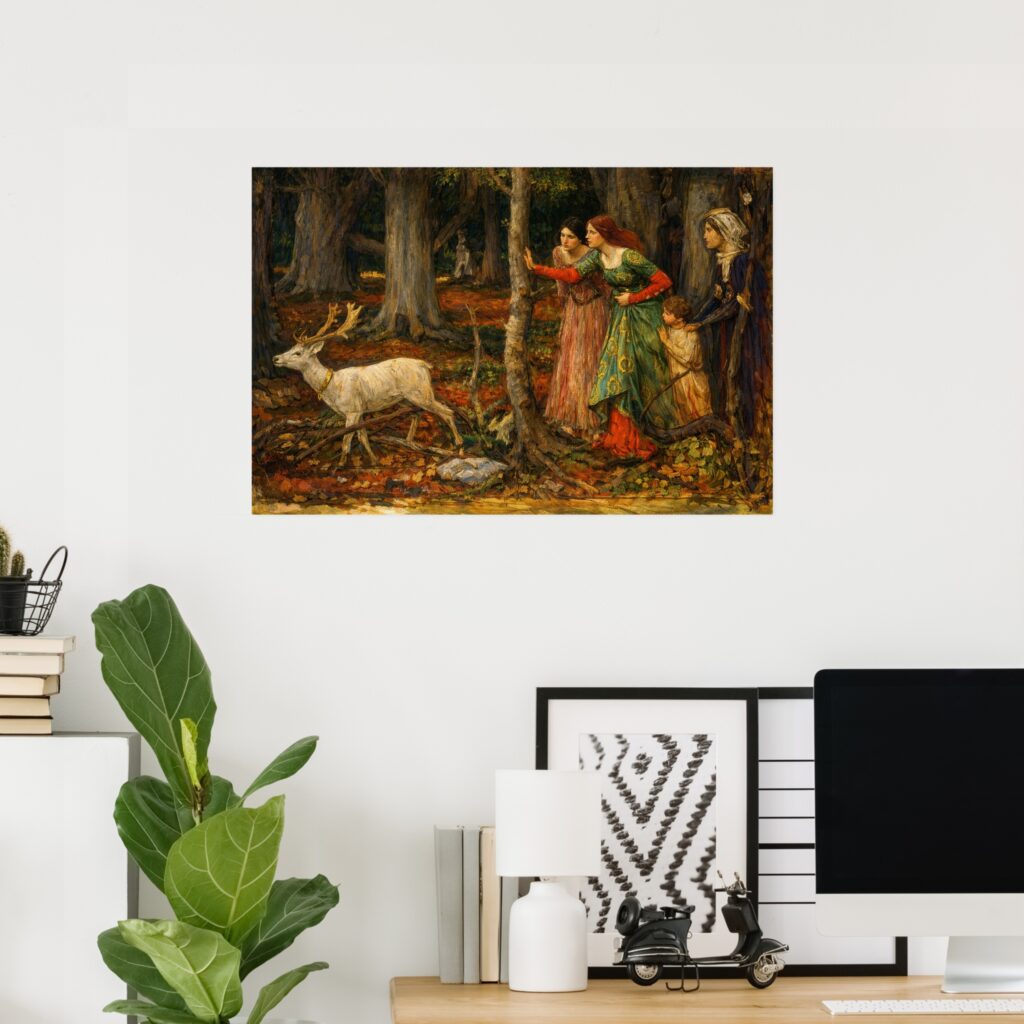
One of the painting’s strengths is its texture. The bark of the trees is built with layered strokes and tonal shifts that give each trunk weight and age. The forest floor is less defined, more turbulent, a weave of lines and patches that suggests movement even in stillness. This contrast between the stable verticals of the trunks and the restless horizontals of the ground produces unease. The forest feels solid above and unsettled below, like a place where footing is never entirely secure.
Waterhouse does not render every leaf or twig with botanical precision. Instead, he uses suggestion to create density. That choice supports the theme. A “mystic” wood should resist full clarity. If everything were crisp, the spell would break. The haziness, especially in darker passages, reads as atmospheric and psychological: the forest is not only seen, it is felt.
The stag itself is painted with smoother transitions, making it stand out from the more rugged surroundings. Its body reads as a single, coherent form moving through chaos. That formal clarity adds to its symbolic authority. In a world of tangled textures, the stag is a clean sign.
Storytelling Without a Fixed Myth
Waterhouse often worked with literary and mythic subjects, yet The Mystic Wood feels less like an illustration of a single known tale and more like a distillation of many. The figures could belong to medieval romance, to a fairy story, or to an invented legend that never existed outside the painting. This openness is part of its power. The viewer is not locked into one plot. Instead, the scene functions like the opening of a story, the chapter where a strange sign appears and life divides into before and after.
The stag is a classic catalyst. It does not need to do anything more than appear. The real drama lies in what the humans will do next. Follow it and you may enter a world of tests, transformation, or loss. Ignore it and you may remain safe but unchanged, haunted by what you refused. Waterhouse captures that fork in the road, the moment where destiny is not yet destiny, only a possibility shimmering at the edge of sight.
The painting also suggests secrecy. The figures are partly hidden, peering rather than confronting. That posture introduces themes of taboo and forbidden knowledge. In many traditions, the forest is a place where social rules loosen and older rules emerge. The viewer senses that the group knows the encounter is significant and possibly dangerous, even if we do not know why.
The Forest as Psychological Space
Beyond narrative, the wood operates as a psychological landscape. It is the mind’s interior, full of shadowed compartments and half remembered fears. The white stag becomes an image of desire or revelation, something pure moving through the subconscious. The figures could be aspects of a single psyche: the reaching self, the cautious self, the vulnerable inner child, the older voice of memory. Read this way, the painting becomes an allegory of confronting the unknown within.
Waterhouse strengthens this interpretation through enclosure. The trees press in, creating a sense of being surrounded. There is no visible horizon, no clear exit. The world is narrowed to the immediate encounter. This is how intense internal moments feel: the outer world fades, and all attention gathers on one symbol, one choice, one glimpse.
Even the act of watching becomes charged. The figures are not acting; they are perceiving. In psychological terms, perception is already transformation. To truly see the white stag is to admit it exists, and admitting it exists means life cannot remain the same. The painting’s stillness is therefore not passive. It is a held breath.
Waterhouse’s Late Style and the Mood of 1917
Made in 1917, The Mystic Wood belongs to Waterhouse’s later period, when his work often turned toward atmosphere, mood, and a slightly rougher handling of paint compared to his earlier, highly finished canvases. The world of 1917 was marked by war, uncertainty, and a sense of civilization’s fragility. Without forcing the painting into direct allegory, it is hard not to feel that fragility in the scene’s apprehension. The figures huddle, the world is dim, and the sign that appears is both beautiful and unsettling.
In such a context, the white stag can be read as longing for purity, for a guiding meaning that rises above chaos. The forest could represent a world that has become hard to navigate, where old certainties no longer apply. The humans do not stride confidently; they hesitate. Waterhouse gives us a vision that is not triumphant, but searching.
At the same time, the painting is not bleak. The presence of the stag is a kind of grace, and the rich clothing suggests that beauty persists even in shadow. The mystic wood is dangerous only because it is real, because it contains truths that ordinary daylight life prefers to ignore.
Clothing, Pattern, and the Human Attempt to Bring Order
The patterned green dress is one of the painting’s most striking details. In a natural world of bark and leaf litter, pattern reads as human order, the desire to shape and decorate experience. It also evokes medieval or fairy tale settings, placing the figures in a timeless past that is always available to imagination. The dress becomes a bridge between civilization and wilderness, between the domestic and the enchanted.
The contrast between textile richness and woodland roughness suggests a thematic tension: humans bring culture into the wild, but the wild remains the older power. The stag, though “uncivilized,” appears purer and more composed than the people. That reversal undermines the idea that humans dominate nature. In this wood, nature is the author, and humans are readers trying to interpret a single luminous sentence.
Even the act of hiding behind trees suggests that culture, for all its beauty, is not protection against the unknown. The garment can signal status, identity, and artistry, but none of that guarantees safety or understanding in a mystic place.
Silence, Suspense, and the Painting’s Lasting Spell
The most remarkable quality of The Mystic Wood is how much it accomplishes without resolution. Waterhouse gives us suspense without climax, meaning without explanation. The painting remains in the threshold moment, which is why it lingers. The viewer keeps asking: what happens next? Does the group follow? Does the stag vanish? Is this a blessing or a warning? The image refuses to settle into one answer, and that refusal is its magic.
The stillness also creates intimacy. We feel like witnesses to something private and delicate, like overhearing a whispered omen. The stag’s lightness against darkness feels like a brief opening in reality, an invitation that can be accepted only once. The figures’ cautious posture mirrors the viewer’s own caution in interpreting the scene. We do not want to pin it down too quickly and lose its mystery.
In the end, Waterhouse makes the forest into a moral space, not in the sense of preaching, but in the sense that choices matter. The mystic wood is where you meet signs you cannot ignore, where the world speaks in symbols rather than instructions. The white stag is not simply an animal. It is the feeling that something beyond the visible is moving near you, and that your life might change if you dare to follow.
