Image source: wikiart.org
A late Waterhouse vision of the Lady of Shalott
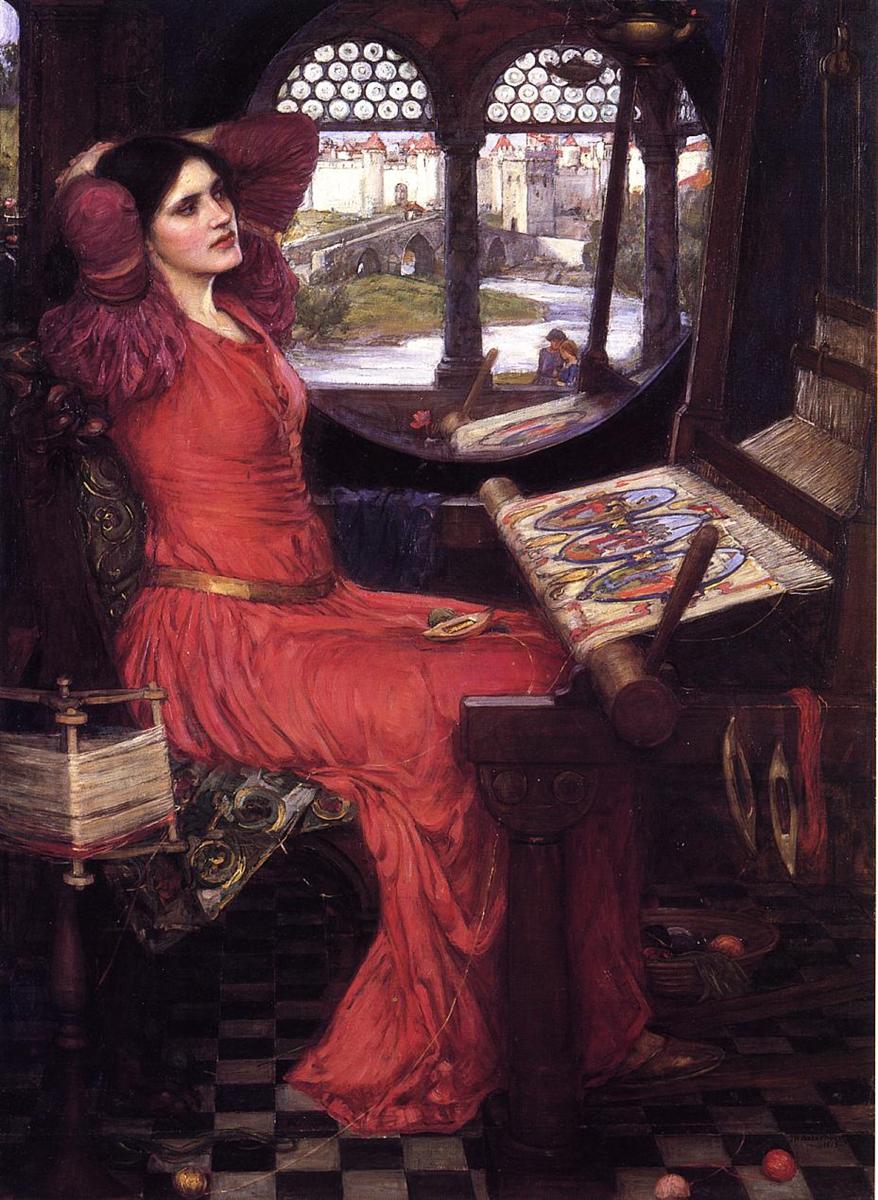
John William Waterhouse returned to the Lady of Shalott again and again, but “I am Half Sick of Shadows, said the Lady of Shalott” (1915) has a different temperature from his earlier treatments. Instead of dramatic motion or a narrative climax, the painting lingers in a suspended interior moment where thought and longing do the work that action has not yet begun. The Lady sits at her loom in a dim, enclosed chamber, dressed in a saturated red gown that seems to carry the whole painting’s emotional heat. Her body is still, but her mind is not. She turns her face toward the light, as if listening for the world beyond the walls, and the phrase in the title becomes less a spoken line than a private confession.
Waterhouse’s subject comes from Alfred, Lord Tennyson’s poem “The Lady of Shalott,” in which a woman is bound by a mysterious curse to remain in her tower, weaving images of the outside world as reflections and “shadows” rather than direct experience. In this 1915 interpretation, Waterhouse makes that division between life and representation feel physical. The tower is not just a setting, it is a psychological architecture. The window is wide, yet the Lady’s position remains turned inward, tethered to labor and ritual. The painting becomes a meditation on spectatorship, on what it means to know the world through images, and on the aching gap between looking and living.
The composition as a map of confinement and desire
The painting is carefully built around contrasts: interior versus exterior, shadow versus light, weaving versus wandering, stillness versus distant motion. Waterhouse places the Lady on the left, occupying a carved chair with a high back and curling decorative forms, as if the furniture itself participates in the tower’s ornate imprisonment. Her figure is large, solid, and near the viewer, while the outside landscape appears framed and far away. This spatial arrangement makes the Lady feel present and touchable, while the world she wants is reduced to a view, a picture within a picture.
The arched window functions like a stage set. The upper panes are dotted with small circular lights, and the main opening reveals a river, a bridge, and pale buildings that suggest Camelot’s presence without needing to declare it. Even the people outside are tiny, absorbed in their own movement, almost indifferent to the tower that dominates the foreground. Waterhouse’s choice to show human figures beyond the window is crucial. They serve as living proof that ordinary life continues, close enough to be seen clearly, yet distant enough to remain unreachable.
At the center-right, the loom pushes forward into the space like a barrier. Its horizontal beam and rolled tapestry project toward the viewer, interrupting any imaginary path between the Lady and the outside world. The tools of weaving are not neutral props. They are the physical embodiment of the curse’s routine. The loom is both her craft and her cage, positioned so that it feels like the room’s true axis of power.
The Lady’s posture and the drama of an inward turning point
Waterhouse chooses a moment of pause that feels dangerously close to decision. The Lady leans back slightly, her arms lifted behind her head, as if stretching after long hours of work. But the gesture reads as more than fatigue. It is a bodily expression of refusal, a brief rebellion against the posture that weaving demands. In that stretch, her chest opens, her neck lengthens, and her face turns toward the window. She is not working at this instant. She is thinking, listening, wanting.
Her expression is a study in quiet intensity. The eyes are directed outward and upward, not fixed on a specific object but pulled by the idea of what lies beyond. The lips are slightly parted, and the face has that Waterhouse blend of classical beauty and modern psychological immediacy. This is not merely a medieval heroine in costume. She feels like a person caught in a modern dilemma: whether to remain safe inside a life of images or to risk everything for direct experience.
The title line, “I am half sick of shadows,” is perfectly matched to this pose. She is still inside the system of shadows, still surrounded by the apparatus of representation, yet her body signals impatience with the role. Waterhouse paints the instant when longing becomes unbearable, when the mind begins to translate desire into potential action.
Color as emotion: the red gown against the tower’s darkness
The painting’s most striking decision is the dominance of red. The Lady’s gown is not a gentle accent but the visual engine of the composition. It blooms against the tower’s deep browns, blacks, and smoky purples, making her seem like a flame in a room of embers. Red here carries multiple meanings at once. It is vitality, desire, anger, and a kind of romantic doom. It is also defiance. In a world of shadows, she is the strongest color.
Waterhouse paints the dress with a sense of weight and movement. The fabric gathers in folds that cascade down her legs and pool along the checkered floor. The gown’s richness suggests courtly elegance, but its looseness also suggests private life, a body at rest rather than a public presentation. This tension mirrors her situation: she is a figure of legend, yet she is trapped in a private space where no one sees her except the viewer and perhaps the distant world she watches.
The surrounding palette is deliberately subdued. The tower interior is built from dark wood, muted stone, and dim textiles, which absorb light rather than reflect it. This makes the window’s brightness feel like a promise. It also means the red gown becomes the painting’s emotional center. Waterhouse is effectively painting desire as color, and confinement as tone.
The loom and tapestry: making images instead of living them
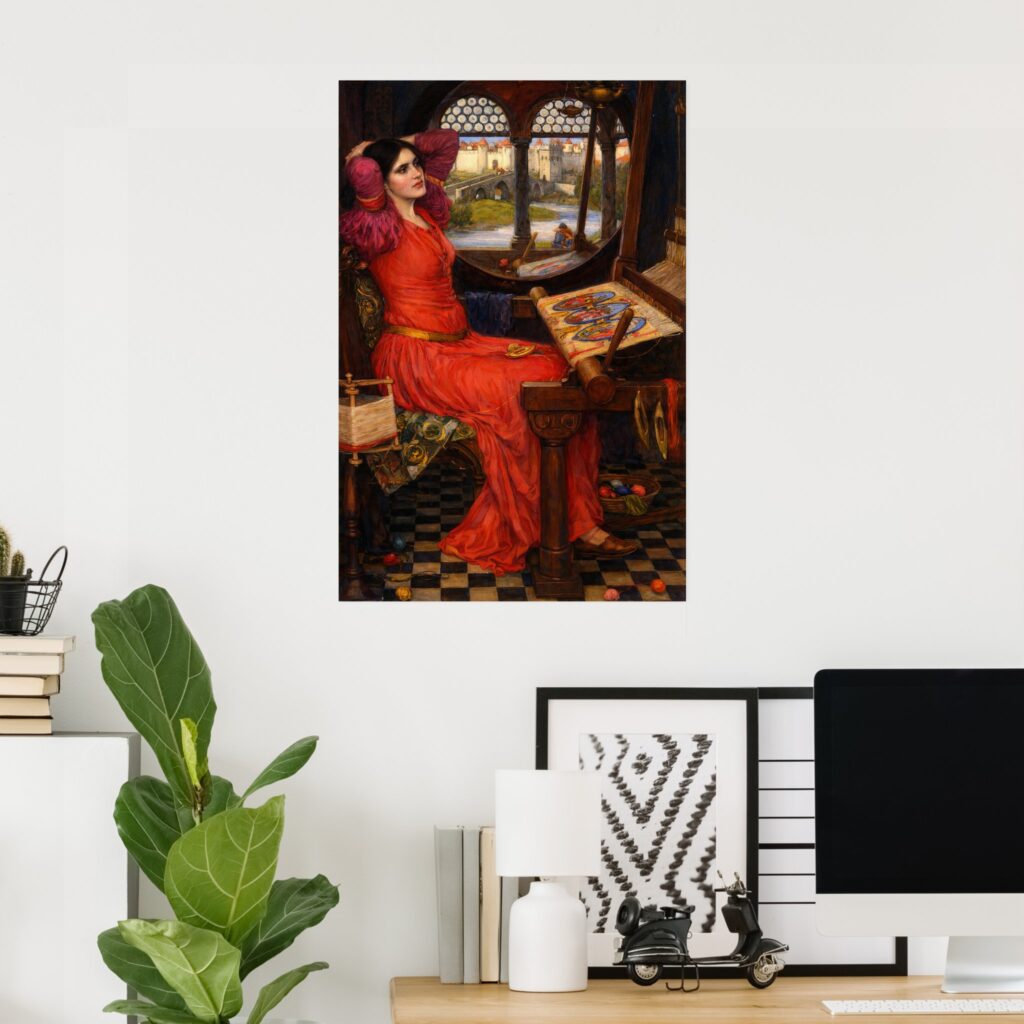
The loom is the painting’s symbolic heart. Waterhouse gives it prominence, detail, and tactile presence. The rolled tapestry shows bold decorative forms, looping patterns and vivid colors, like a captured fragment of the world translated into ornament. It looks alive, but it is not life. It is representation. The Lady’s task is to turn experience into pattern, movement into design, longing into labor.
This idea is echoed by the room’s objects. The weaving tools, the spindles, and the structured mechanisms suggest repetition and discipline. Waterhouse invites the viewer to feel how time passes in this room: hour after hour of the same motion, the same framing, the same mediated relationship to the outside. Even the act of looking becomes part of the routine. She is allowed to see, but only in ways that keep her separate.
There is also a subtle irony in how beautiful the tapestry is. Waterhouse does not mock the Lady’s craft. He treats it with respect and fascination. The curse is tragic partly because it is productive. It gives her skill, purpose, and aesthetic creation, yet it steals the very thing art is supposed to connect us to: lived reality. The painting becomes a reflection on the cost of turning the world into images, a theme that feels especially modern in a work made in the twentieth century by an artist associated with Pre-Raphaelite ideals.
The window view: Camelot as an invitation and a threat
Through the window, Waterhouse paints a calm, luminous scene: a river, a bridge, pale stone buildings, and small figures moving together. The world outside does not look violent or chaotic. It looks ordinary and beautiful. That is what makes it so tempting. The Lady’s longing is not for an abstract romance alone, but for the simple privilege of participation: walking, meeting, speaking, being among others.
The architecture outside contrasts with the tower interior. The exterior appears open, sunlit, and connected. The bridge is an especially important motif. Bridges are symbols of passage, of crossing from one state to another. Yet here the bridge is not hers. It belongs to the world. She can see it, but she cannot step onto it. Waterhouse uses this visual metaphor to sharpen the poem’s emotional logic. The curse is not just isolation, it is enforced distance from transition itself.
The tiny figures outside reinforce this. They are not individualized portraits, but they are unmistakably human. Their scale makes them feel unreachable, like memories or dreams. They are also the opposite of the Lady’s stillness. They move together, while she remains alone. The scene becomes a quiet cruelty: community is visible, but unavailable.
Light, shadow, and the psychology of the tower
Waterhouse’s handling of light is central to the painting’s mood. The interior is dim and heavy, with shadows pooling in corners and deepening the carved textures of wood and stone. The window is the main source of illumination, but it does not fully rescue the room from darkness. Instead, it creates a gradient: the brightest area is outside, the midtones gather around the window frame and loom, and the darkest shadows remain in the tower’s recesses. This arrangement turns the room into a psychological landscape. The closer she is to the window, the closer she is to desire. The deeper she is in shadow, the closer she is to resignation.
The title’s “shadows” takes on multiple meanings in this context. Shadows are not merely the absence of light. They are the mediated images the Lady weaves, the reflections that replace direct sight. They are also the emotional shadows inside her: boredom, loneliness, and that creeping sense that life is passing elsewhere. Waterhouse’s visual shadows make these invisible states feel tangible.
The checkered floor adds another quiet psychological note. Its pattern suggests order and structure, but also a kind of chessboard logic, as if her life is a game with fixed rules and limited moves. The room is beautiful, but it is also strategic, designed to keep her in place.
Waterhouse’s style in 1915: Pre-Raphaelite echoes and later softness
Although Waterhouse is often grouped with the Pre-Raphaelite tradition, his work has its own signature blend of realism, lyricism, and theatrical clarity. In this late painting, there is a noticeable softness in the handling of edges and atmosphere. The forms remain detailed, but the overall effect is more introspective than jewel-like. Waterhouse seems less interested in dazzling the viewer with minute botanical precision and more interested in building a single emotional chord.
The figure remains idealized, but not distant. The Lady’s face and hands are painted with tenderness, her skin illuminated against the darkness without becoming porcelain. The fabrics and woodwork are richly described, yet they do not overpower the mood. Waterhouse keeps returning the eye to the Lady’s head and upper body, then outward to the window, then back to the loom. It is a visual loop that mirrors her own mental loop: think of the world, return to the task, feel the ache again.
Because the painting was made in 1915, it also carries an unspoken sense of lateness. Waterhouse is painting medieval longing in a modern era, and the result feels like a deliberate retreat into myth that is also a confrontation with modern isolation. The Lady becomes a symbol not just of romantic tragedy, but of a broader human condition: living through images, separated from the directness of experience.
Themes that keep the Lady of Shalott compelling
This painting endures because it captures a moment that many viewers recognize, even without knowing Tennyson’s poem. It is the moment of feeling trapped in a life that looks stable and productive, yet internally incomplete. The Lady is surrounded by beauty, skill, and structure, but she senses that something essential is missing. Waterhouse’s genius is to make that missing thing visible through composition and color.
“I am Half Sick of Shadows” is also about the tension between art and life. The Lady creates art from shadows, from reflections, from indirect knowledge. Her art is real, but it is built from distance. Waterhouse invites the viewer to ask whether art can satisfy longing, or whether it sometimes intensifies it by making the world more vivid while still out of reach. The loom becomes a symbol of every way we translate life into representation: stories, images, patterns, screens, memories. The painting’s emotional power lies in how gently, yet firmly, it suggests that representation is not the same as participation.
Finally, the work is compelling because Waterhouse refuses to resolve the story. He gives us the pause before the break, the inhale before the leap. The Lady is still in the tower. The curse is still intact. Yet her posture and gaze imply that the balance is shifting. That is why the painting feels charged. It is not the tragedy itself, but the awakening that makes tragedy possible.
