Image source: wikiart.org
Entering Waterhouse’s Storytelling Garden
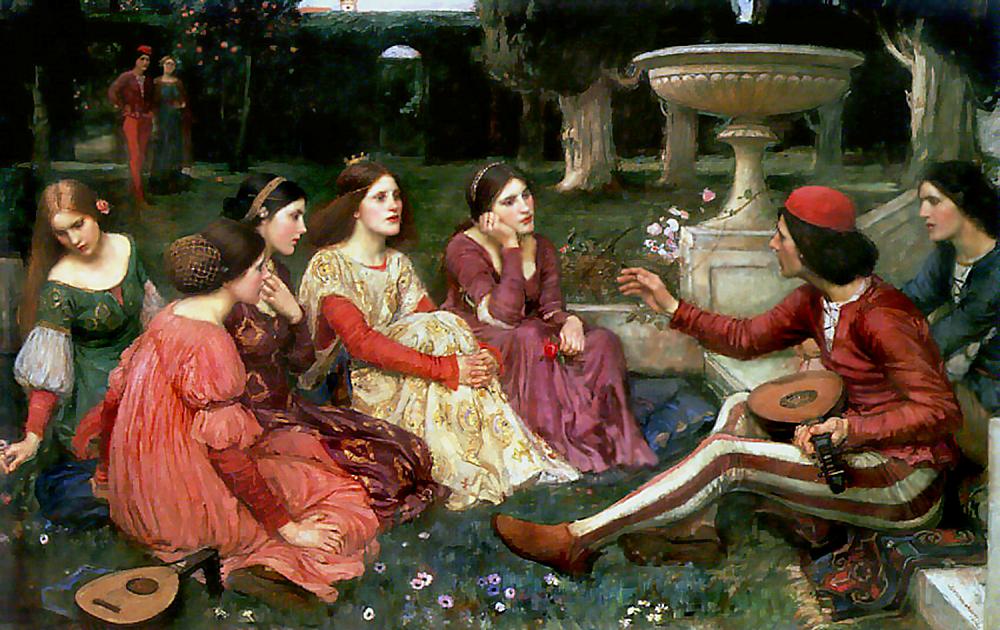
John William Waterhouse’s A Tale from the Decameron (1916) invites you into a quiet, staged moment where narrative feels as tangible as fabric and as fleeting as perfume in the air. The scene is set outdoors, in a manicured garden that reads like a theatrical space built for listening. A youthful storyteller sits to the right, angled toward a semicircle of women who have arranged themselves on the grass like an audience at court. Behind them rises a stone fountain, solid and pale, a kind of visual anchor that makes the figures feel gathered around a shared center of gravity. Waterhouse does not depict the tale itself in action. Instead, he paints the charged pause where imagination is about to be sparked, when attention becomes a kind of intimacy.
The painting’s power comes from its restraint. Nothing “happens” in the loud sense. No chase, no duel, no grand gesture. Yet everything is happening in the faces and hands, in the varying degrees of leaning in, holding back, listening, judging, daydreaming. The garden is quiet enough that we can almost hear the storyteller’s voice carrying across the lawn, and quiet enough that we notice the smallest details: scattered flowers, the sheen of velvet and satin, the small musical instruments placed like props that hint at performance. Waterhouse builds a world where a story is not only told, it is collectively received, shaped, and emotionally tested.
The Decameron as a Frame for Desire and Wit
Boccaccio’s Decameron is fundamentally a book about storytelling as survival and pleasure, a collection of tales shared by a group who withdraw from crisis into a self made refuge. Even if Waterhouse does not show the larger frame directly, the title carries the implication of a circle gathered for narrative exchange. The Decameron is famous for its variety: romance and trickery, moral lessons and shameless comedy, tenderness and satire. That range matters here, because Waterhouse paints a listening group that does not respond in one unified way. The women are not a single emotion with multiple faces. They are separate inner worlds, each negotiating the tale differently.
By choosing “a tale” rather than a specific named episode, Waterhouse preserves a deliberate openness. The viewer becomes a silent addition to the circle, trying to infer the story from the listeners’ expressions. Is it humorous, with sly turns that make one listener suppress a smile while another looks doubtful? Is it romantic, with a promise of devotion that draws one woman into dreamy absorption? Is it daring, testing the boundaries of what can be said in polite company? The title acts like a doorway rather than a label, encouraging the painting to function the way oral storytelling does, as a living event shaped by whoever hears it.
Composition as Conversation
The structure is elegantly clear. The storyteller sits on the right, extending a hand as if shaping a sentence in the air. His posture is relaxed but engaged, legs stretched out, body turned toward his audience. In his other hand he holds a lute or mandolin like instrument, which suggests that speech and music are intertwined here. He may be accompanying the tale with melody, or using music as a prelude that gathers attention before words take over.
Opposite him, the women form a gentle arc that draws the eye from left to center. Waterhouse arranges them so that each face becomes a different note in a chord: one woman tilts her head downward, another turns sharply to focus, another sits upright with an open, luminous attention. The grouping creates a rhythm of profiles and three quarter views, a pattern that feels like conversation even though only one figure appears to be speaking. The fountain behind them rises like a stage set, lifting the background into a simple architectural form that keeps the figures visually prominent.
Depth is present but softened. In the far background, two figures stand beneath dark greenery, slightly removed from the main circle. Their distance suggests another layer of narrative possibility: onlookers, lovers, or late arrivals who watch from the edge. This background vignette is small, but it expands the painting’s social world, implying that stories do not exist only inside the circle. They ripple outward, overheard, interpreted, perhaps even reenacted.
Faces, Gestures, and the Psychology of Listening
What makes this painting feel alive is the careful differentiation of attention. Listening is not passive in Waterhouse’s hands. It is a spectrum of states, from hunger for entertainment to skeptical appraisal. One woman rests her chin on her hand, a posture that can signal boredom, deep contemplation, or guardedness. Another leans forward, her gaze fixed, as if pulled into the tale by curiosity or identification. The woman in pale, patterned gold and cream sits near the center like a visual focal point, her face lifted, lips slightly parted, as if she is either most moved by the story or most ready to respond.
Waterhouse is particularly attentive to hands. The storyteller’s raised hand becomes an instrument of persuasion, punctuating the tale. The women’s hands, by contrast, reveal private reactions. Some hands are folded, self contained. Others rest loosely, receptive. These differences communicate emotional boundaries. The painting becomes a study of how people manage what they feel in public, especially when a story touches on love, reputation, or desire.
Even the figure at the far left, slightly turned away, contributes to the psychological richness. Her downward gaze suggests distraction or discomfort, as if the story has brushed against something personal. Waterhouse often excels at portraying women at the edge of speech, caught between inner intensity and outward composure. Here, that signature sensitivity is redirected toward a group, letting us witness social dynamics rather than a single solitary reverie.
Color, Fabric, and the Sensuality of Surface
The palette is lush without being gaudy. Deep greens and shadowed foliage create a cool atmospheric base, while the clothing brings warmth and variety: reds, pinks, purples, cream, and gold. Waterhouse uses these colors not only for beauty but for meaning. The storyteller’s red cap and rich garments make him immediately legible as a performer, a figure of vitality and charisma. The women’s dresses, each distinct, become visual equivalents of personality.
Fabric is central to the painting’s pleasure. The gowns appear heavy and textured, with embroidered patterns and folds that catch the light. Waterhouse’s handling of cloth creates an almost tactile experience. The patterned cream dress near the center feels ceremonial, suggesting refinement and perhaps a heightened sensitivity to romance or idealism. The purple dress, more muted and cool, reads as introspective. The pink dress in the foreground adds softness and immediacy, bringing the viewer closer to the group and grounding the scene in the physical act of sitting on grass.
The floral accents scattered near the figures add a delicate counterpoint. They are small, but they reinforce the garden as a place where beauty is cultivated, where leisure and art thrive. These details also echo the logic of storytelling itself. A tale is made of many small choices, like flowers arranged into an overall effect.

The Fountain and the Garden as Symbols
The stone fountain is more than background decoration. As an object, it suggests continuity, tradition, and a controlled version of nature. Water flows in cycles, and stories do too. Tales are retold, reshaped, and returned to again and again, especially in a collection like the Decameron. The fountain’s pale solidity contrasts with the softness of bodies and fabric, implying the enduring structure of culture within which human desire plays out.
The garden setting also matters because it implies a space of sanctioned freedom. Gardens in European art often operate as semi private arenas where social rules loosen slightly. People can flirt, listen, linger, and imagine. Yet the garden is still curated, bounded, and watched. That tension fits the Decameron perfectly, since many of its stories involve love pursued within constraints, cleverness exercised under pressure, and reputations managed through wit.
Waterhouse places the group on grass, close to the earth, but surrounds them with signs of refinement: dressed hair, ornate clothing, architectural stone. The result is a setting where nature and culture cooperate. Storytelling becomes the bridge between the two, a human art practiced outdoors, as if the garden itself is listening.
Music, Voice, and Performance
The presence of instruments is quietly revealing. One instrument lies near the foreground, while the storyteller holds another. This repetition suggests that music is part of the gathering’s identity, not a random prop. In the context of medieval and Renaissance themed imagery, a lute evokes courtly performance, troubadour traditions, and the idea that love and narrative are often delivered through song.
Music also functions as a metaphor for persuasion. Like melody, a story can charm, disarm, and guide emotion without force. The storyteller’s pose suggests he is mid performance, not merely recounting events but shaping them for maximum effect. The women’s attention then becomes the real drama. Waterhouse paints the moment when art acts upon people, when voice and rhythm reconfigure the room, or in this case the lawn.
There is also a subtle implication of competition. If another instrument rests nearby, perhaps someone else will perform next. The Decameron is a sequence of voices, one tale after another, told by different personalities. Waterhouse’s scene can be read as a single episode inside a larger cycle, a day of stories where every listener might become a speaker.
Late Waterhouse and the Afterlife of the Pre-Raphaelite Spirit
By 1916, Waterhouse was working long after the early Pre-Raphaelite Brotherhood had made its initial impact. Yet his art continued to carry forward a Pre-Raphaelite love of literary subjects, luminous color, and emotionally charged figures. In this painting, the medieval or Renaissance costume, the garden, and the emphasis on narrative all feel aligned with that tradition. At the same time, the handling is softer than early Pre-Raphaelite sharpness. Edges dissolve gently, and the atmosphere feels more dreamlike than documentary.
This softness suits the subject. Storytelling is not an event you can pin down with hard contours. It is a shared mental space. Waterhouse’s late style allows the scene to hover between reality and imagination, as if the tale is already beginning to tint the air. The figures are solid enough to feel present, yet the garden’s shadows and the distant architecture suggest a world that is partly remembered, partly invented.
Waterhouse’s enduring appeal often lies in his ability to make literature feel sensuous and immediate. Here he accomplishes that without showing any dramatic plot point. He trusts that the real seduction is in the act of telling and hearing, in the way a story can create a private theater inside each listener.
1916 and the Meaning of Escape
Painted in 1916, this image of cultivated leisure takes on an added resonance. Regardless of the viewer’s historical knowledge, the date places the work in an era marked by upheaval. The Decameron itself is framed by retreat from crisis into storytelling. That parallel gives the painting a quiet poignancy. It becomes not only a nostalgic vision of the past, but also a meditation on why people turn to stories at all.
The gathering suggests a chosen community, a circle formed not by obligation but by shared appetite for art. In such a circle, people practice empathy, judgment, laughter, and longing, all through narrative. Waterhouse paints this as something precious, almost protective. The dark foliage around the garden reads like a boundary, a sheltering wall of green. Within it, language and music hold the group together.
Seen this way, the painting is not simply decorative medievalism. It is an image of cultural continuity. Even when the world is unstable, people still gather, still listen, still trade tales as if they were bread and water for the spirit.
Ambiguity and the Viewer’s Role
A compelling feature of A Tale from the Decameron is that it makes the viewer work, but pleasantly. We are not told what the story is. We infer it from reactions. That inference becomes a mirror. If you read the central woman’s lifted face as romantic absorption, you might imagine a love story. If you focus on the skeptical or withdrawn expressions, you might imagine satire, scandal, or moral complication. The painting allows multiple narratives to coexist, like the Decameron itself.
This ambiguity also highlights how stories function socially. A tale is never received identically by everyone. Each listener filters it through personal history, desires, fears, and hopes. Waterhouse paints that truth into a single tableau. The garden circle becomes a laboratory of interpretation, and the storyteller becomes a catalyst rather than a dictator of meaning.
The distant couple in the background deepens this effect. They seem to inhabit another storyline at the edge of the main one, suggesting that real life keeps unfolding while art is performed. Or perhaps they are part of the tale, a visual echo, quietly acting out what is being described. Waterhouse leaves it open, and in doing so he makes the painting feel like a living narrative machine.
Technique and Atmosphere
Waterhouse’s brushwork here favors softness and unity over crisp delineation. The greens are layered, creating depth without harsh separation. The faces are modeled with care, especially around eyes and mouths, where expression lives. The clothing is rendered with enough detail to feel luxurious, but not so much that it becomes stiff. This balance supports the painting’s central theme: the meeting of the tangible and the imagined.
Light is handled as a gentle presence rather than a dramatic spotlight. It catches the pale stone of the fountain and the bright passages of fabric, then fades into the shaded garden. That movement of light guides the eye across the group, reinforcing the circular flow of attention from storyteller to listeners and back again.
The overall atmosphere is one of hushed intensity. The painting feels like a pause held in common, the moment when a story has gathered everyone into the same rhythm. Waterhouse captures that rhythm visually through repeated curves: the semicircle of figures, the rounded fountain basin, the arc of the storyteller’s gesture.
Why the Painting Still Works
A Tale from the Decameron endures because it is about something universally familiar: being absorbed in a story with other people. Even in a modern context, we recognize the feeling. The circle could be a group around a campfire, friends listening to someone recount an event, an audience watching a performer. Waterhouse makes the setting historical, but the psychology is timeless.
The painting also offers a gentle ideal. It imagines a community where attention is valued, where art is not background noise but a shared event. The women are not depicted as interchangeable beauties. They are individuals, and their individuality is expressed through the subtle drama of listening. The storyteller is not portrayed as a conqueror of hearts, but as an artist at work, shaping emotion through words and music.
In the end, the painting is less about any single tale and more about the human need for tales. It shows narrative as a social bond, a safe arena for exploring love, risk, humor, and moral complexity. Waterhouse gives us the moment before the punchline, before the confession, before the twist, and makes that anticipation feel like its own form of beauty.
